A great researcher can be wrong. Science advances because its claims can be tested—and corrected.
A museum asks a harder question than who was a hero
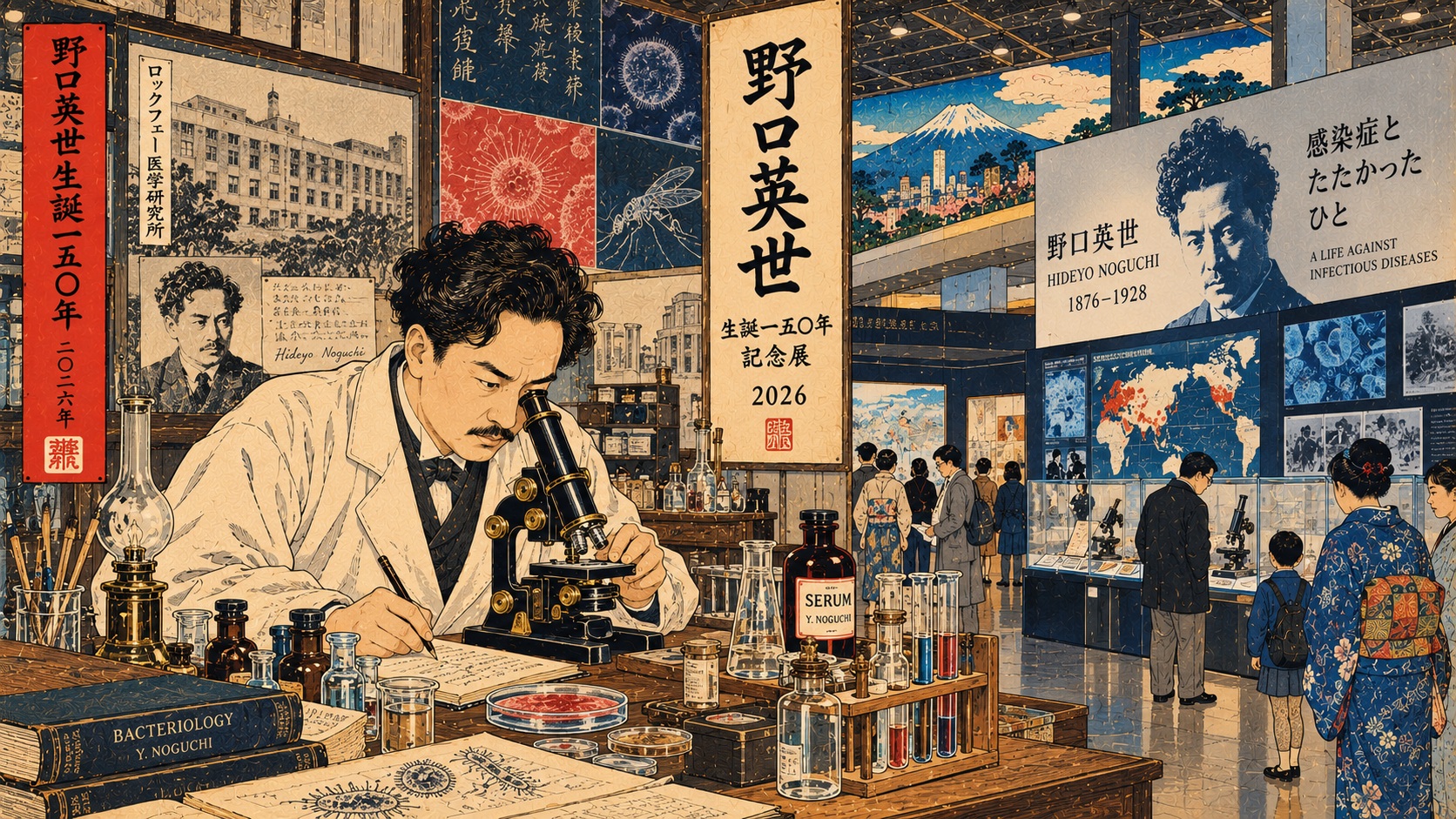
On October 27, 2026, Tokyo’s National Museum of Nature and Science opened an exhibition marking 150 years since the birth of Hideyo Noguchi. Its subject is larger than a celebrated Japanese bacteriologist: The Battle Against Infectious Diseases: Past, Present, and Future traces how researchers have learned to identify pathogens, how ideas are corrected and why old epidemics still matter after COVID-19. It runs through February 28, 2027. This is a report on the documented exhibition and its historical setting, not an eyewitness gallery review.
From rural Fukushima to Rockefeller
Born on November 9, 1876, in what is now Inawashiro, Fukushima Prefecture, Noguchi was originally named Seisaku. A serious childhood burn injured his left hand; treatment and support from teachers and others helped shape his ambition to practice medicine. He qualified in Japan in 1897, moved to the United States in 1900, and joined the Rockefeller Institute for Medical Research in 1904. His rise across national and linguistic boundaries was extraordinary, but an inspirational biography is not a substitute for judging scientific claims on their evidence.
Why the story opens in 2020
The exhibition begins with the experience of COVID-19 in Japan in 2020–21, then travels backward through the history of infectious disease. That ordering makes a pointed argument: outbreaks are not just distant disasters or challenges overcome by earlier generations. The lives, institutions and choices of people today are shaped by how reliably scientific knowledge is produced and communicated. The museum’s announced structure does not by itself establish any particular judgment about Japan’s pandemic policies.
The instruments that changed what humans could know
An early chapter follows the emergence of microbiology through objects including a replica of Antonie van Leeuwenhoek’s microscope, historical drawings of bacteria and swan-neck flasks associated with experiments in contamination and spontaneous generation. Such objects are more than charming antiques. Seeing an organism, growing it under controlled conditions and proving that it causes a disease are separate scientific tasks. That distinction becomes essential to understanding both Noguchi’s successes and his failures.
What Noguchi contributed to syphilis research
Noguchi’s best-known contributions centered on spirochetes, including Treponema pallidum, the bacterium that causes syphilis. Japan’s Cabinet Office identifies his 1911 cultivation work and his 1913 demonstration of the organism in the brain of a patient with progressive paralysis as important developments. They belong to the history of recognizing the neurological consequences of syphilis. Historical accounts also caution that some early laboratory claims and methods have been reappraised; they should not be presented as equivalent to modern diagnostic evidence.
The yellow-fever theory that failed
Noguchi traveled to Ecuador in 1918 to investigate yellow fever and argued that a bacterium he called Leptospira icteroides was responsible. That conclusion was wrong. Yellow fever is caused by a mosquito-borne virus, not a leptospiral bacterium. A historical review published in 1989 examines why his experimental interpretation failed, and later accounts describe confusion with illnesses that can resemble yellow fever. Recognizing the error is not an attack on his character: it is the necessary distinction between a courageous attempt and a correct discovery.
An ending in Accra
In 1927 Noguchi went to West Africa to pursue yellow-fever investigations. He contracted the disease and died in Accra, in present-day Ghana, on May 21, 1928, aged 51. His death made him an international symbol of scientific devotion. There is another lesson, too: ambitious field research requires safeguards, disciplined methods, transparent records and independent checks. The danger of an infection does not validate a researcher’s hypothesis about its cause.
What visitors are scheduled to see
According to the museum’s published plan, the five-chapter presentation includes a replica of words inscribed on a pillar at Noguchi’s childhood home, medical equipment taken to Africa, pathological specimens from his research, and a section where visitors can observe microorganisms through microscopes. Its final chapter looks toward contemporary and future infectious-disease research. Japan.co.jp has not visited the installation or independently inspected the objects, and makes no claims about their impact on visitors.
The error that remains relevant
It is tempting to treat Noguchi’s mistaken yellow-fever diagnosis as an antique problem from an age before electron microscopy. But the more durable lesson concerns the way certainty can outrun evidence. Independent reproduction, comparison groups, alternative explanations and the willingness to revise a conclusion are safeguards, not bureaucratic inconveniences. Public health today depends upon separating promising preliminary findings from established causes and proven interventions.
The public life of a scientific reputation
Noguchi’s face appeared on Japan’s ¥1,000 banknote introduced in 2004, giving him a place in everyday civic memory. The Japanese government also established the Hideyo Noguchi Africa Prize to recognize work in medical research and health services in Africa. Such honors carry history forward, but they need not demand an uncritical account. A richer commemoration distinguishes the personal journey, research contributions, mistaken hypotheses and the modern institutions working on infectious disease.
How to visit the Tokyo exhibition
The National Museum of Nature and Science is in Ueno Park, Tokyo. The exhibition runs October 27, 2026–February 28, 2027 in the Japan Gallery, first-floor planned-exhibition room. Hours are generally 9 a.m.–5 p.m., with final admission 30 minutes before closing. Standard admission is ¥630 for adults and university students, and free for high-school students and younger and visitors aged 65 or above. Mondays and additional specified dates are closed, with holiday exceptions; check the official calendar before traveling.
An anniversary worth taking seriously
The strongest way to honor Noguchi is neither to repeat every legend nor to define his life by one refuted claim. He helped build modern Japanese participation in international biomedical science, produced influential work, committed serious errors and died of the disease he had tried to understand. The exhibition provides a timely invitation to distinguish persistence from certainty, scientific reputation from evidence and collective progress from the myth of a solitary genius.
Sources and verification
Based on the museum’s published exhibition details, the Memorial Foundation, Japanese government and National Diet Library records, and historical scholarship. No onsite exhibition visit or original curator interviews were conducted.
- National Museum: official Japanese exhibition details
- National Museum: official English exhibition details
- Hideyo Noguchi Memorial Foundation: biography
- Cabinet Office: Noguchi chronology
- National Diet Library: biographical record
- Historical research on the erroneous yellow-fever theory
- Historical assessment of Noguchi’s scientific work
- Memorial Infectious Disease Museum: institutional perspective