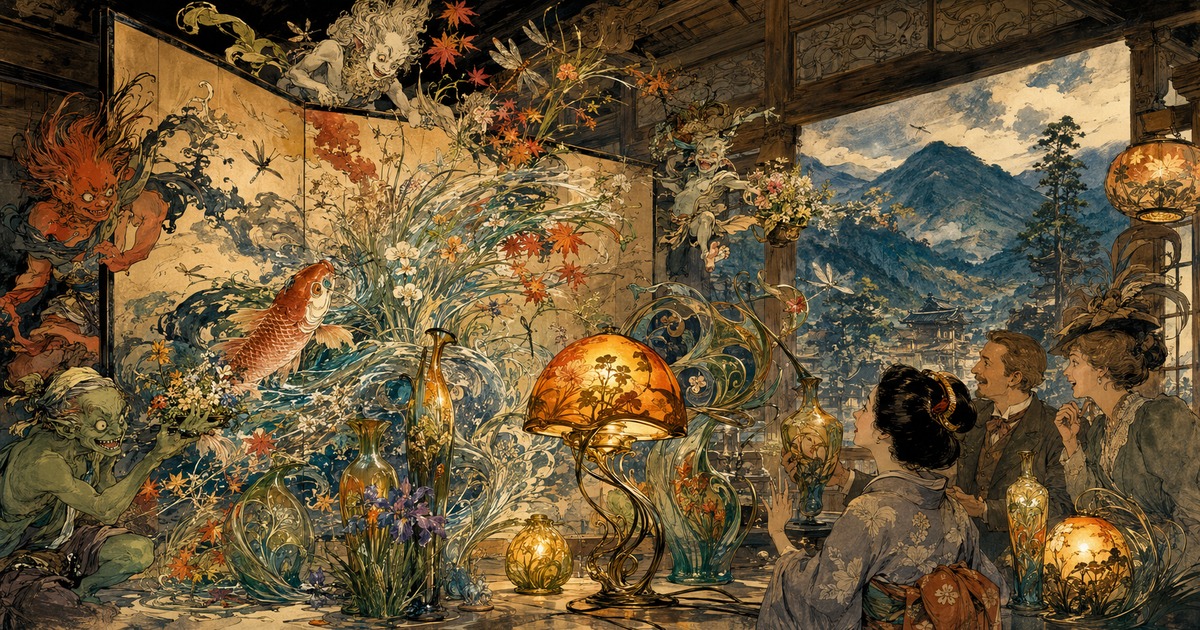
Inside the first gallery, glass appears to hover in mountain mist. Light enters a vessel from the front and from behind; color that looked brown becomes amber, then green, then the bruised violet of a petal after rain. On one long-necked vase by Émile Gallé, chrysanthemums travel around the curved body. They do not sit obediently in a centered bouquet. The flower, the empty ground and the shape of the vessel are made to depend on one another.
That is the most useful place to begin “Masters of Japonisme and Art Nouveau—Nature in East and West,” which opened Monday at the Hida Takayama Museum of Art. The exhibition, running through February 15, 2027, draws from the museum’s holdings and the collection of KIBUN Corporation. Its announced center is Gallé’s Long-necked Vase with Chrysanthemum-crest Design, while event listings place René Lalique, Maurice Marinot and Gabriel Argy-Rousseau in the wider account of French glass.
The title promises a meeting of East and West. That phrase can easily dissolve history into a pleasant story of mutual admiration. The real encounter was stranger and more consequential. Japanese objects arrived in Europe through coerced treaty ports, merchants, international exhibitions and a Meiji state determined to turn craftsmanship into cultural prestige and export income. European artists studied those objects avidly, but often separated motifs from the religious, literary, seasonal and social meanings they carried in Japan.
Still, the change was profound. A dragonfly or iris could be borrowed as decoration. More radically, Japanese art demonstrated that a composition did not need a central subject, that empty space could act, that a branch could be cut by an edge and continue in the viewer’s mind, and that an ordinary insect could command the same attention as a heroic figure. Art Nouveau turned those lessons into posters, jewels, rooms, furniture, ironwork and glass.
Europe Did Not Discover Japanese Nature; It Discovered a Different Frame
The compressed version of Japonisme begins when Japan “opened” and ukiyo-e prints suddenly flooded Paris. The verbs hide as much as they explain. Commodore Matthew Perry’s warships entered Japanese waters in 1853; treaties in the following years ended the Tokugawa government’s severe controls on most Western trade under unequal pressure. Japanese art had reached Europe earlier through Dutch trade and collecting, but the scale, circulation and audience changed dramatically after the 1850s.
World’s fairs turned encounter into spectacle. Japan participated officially in the Paris Exposition of 1867 under the shogunate and several domains. Later Meiji exhibitions presented lacquer, ceramics, cloisonné, textiles, bronzes and carved objects not simply as remnants of an isolated country, but as evidence that a modern nation could possess both technical mastery and a distinctive visual culture. Dealers and department stores helped transform admiration into a market.
In 1872, critic and collector Philippe Burty used japonisme to name the widening European engagement with Japanese art and culture. The category mixed scholarship, collecting, fashion and fantasy. A serious print by Hokusai, an export fan, a kimono worn as costume and a cheaply made “Japanese” interior could all enter the same appetite for novelty.
The most influential artists went beyond props. Ukiyo-e and Japanese illustrated books offered flat color, forceful contour, high or oblique viewpoints, abrupt cropping and a willingness to make pattern compete with depth. Japanese paintings and craft designs made asymmetry feel stable rather than incomplete. A blank area was not an unused remainder; it established weather, distance, rhythm or suspense.
Birds, Flowers, Weeds and Insects Were Systems of Time
European enthusiasm often converted “Japanese nature” into a single national temperament, as if an entire archipelago had always looked at plants in one way. Japan’s visual traditions were far more varied. Court painting, Buddhist art, literati ink painting, Rinpa, natural-history illustration, commercially printed ukiyo-e and everyday design each organized the natural world according to different patrons, materials and purposes.
Yet recurring practices mattered. Flower-and-bird imagery—kachō-ga—placed plants, animals, weather and season in concentrated relationships. A plum branch could imply the endurance of late winter; irises could summon early summer and literary memory; chrysanthemums carried autumn associations and, in some contexts, imperial authority. Birds, grasses and insects were not generic “nature.” They operated inside calendars, poems, festivals, names and cultivated knowledge.
Hokusai and Hiroshige’s flower-and-bird prints could isolate a small encounter with astonishing economy: a bird leaning into wind, an insect approaching a bloom, reeds cut by rain. Rinpa artists expanded or repeated plants across folding screens, lacquer and textiles until surface became rhythm. Craftspeople placed bats, fish, gourds, crickets, shells and wild grasses on objects held in the hand. Scale did not determine dignity.
European designers found both motifs and methods there. The cropped branch allowed the vessel or page to suggest continuation beyond its edge. Repetition could vary like growth rather than march like a classical border. Negative space made a single stalk more intense. Most important, close observation did not have to end in scientific illustration. Anatomical truth could be stylized into line, color and texture without losing the sensation of life.
This did not mean Europe lacked an art of nature. Botanical illustration, herbals, landscape painting, Rococo ornament and the Arts and Crafts movement had their own deep histories. By the 1890s, microscopy and publications such as biologist Ernst Haeckel’s studies of radiolarians and marine organisms were supplying another repertoire of spirals, cells and branching forms. Japanese art was a catalyst inside that crowded field, not a solitary cause.
Siegfried Bing Built the Commercial Bridge—and Named the Room
No figure embodies the connection more clearly than Siegfried Bing. Born in Hamburg and active in Paris, Bing traded in Japanese art, published the lavish journal Le Japon artistique from 1888 to 1891 and wrote about Japanese artists’ reverence for nature. His pages did more than reproduce objects. They taught European designers how to see a system: the relation of motif to material, decoration to use and close observation to abstraction.
In December 1895 he opened a Paris gallery called L’Art Nouveau. The name helped popularize the French term for the new style, even though related movements developed across Europe under other names: Jugendstil in German-speaking regions, the Vienna Secession in Austria, Modern Style in Britain and Stile Liberty in Italy. Bing’s rooms joined painting, sculpture, glass, textiles and furniture into a total environment.
The bridge was commercial as well as intellectual. Bing selected, framed and interpreted Japan for European customers. What he promoted was not a neutral cross-section of Japanese life. It was a highly mediated Japan shaped by supply, taste and the needs of designers searching for escape from historicist revival styles.
That mediation is part of Japonisme, not an unfortunate footnote to it. Cultural influence never travels without editors. Dealers, translators, fair organizers, collectors and manufacturers decide which objects move, which names become famous and which meanings disappear.
Gallé Made a Laboratory of the Forest
Émile Gallé, born in Nancy in 1846, is often described as a poet of glass. He was also a manufacturer, technical experimenter, furniture designer, ceramicist, social campaigner and serious student of botany. Those identities met in the workshop. The studio collected botanical treatises, plant photographs and drawings from life. In Nancy, artists worked alongside a vigorous horticultural culture of growers and hybridizers. Nature was not only metaphor; it was a body of local knowledge.
Gallé inherited a family enterprise and gradually turned the vase from a support for applied decoration into a material environment. Layers of colored glass could be cut back with acid, engraved, wheel-carved, polished, enamelled or joined through glass marquetry. A leaf might exist as silhouette in one layer, vein in another and shadow inside the vessel. Light completed the work differently each time.
Japanese art entered Gallé’s practice early, especially in ceramics and decorative vocabulary, but it did not remain a costume. Fans, fish, insects, chrysanthemums and asymmetrical arrangements helped loosen the inherited grammar of European ornament. The vessel no longer had to behave like architecture with a front, center and repeated border. Its surface could be continuous and episodic, something the eye circled as if moving through undergrowth.
The École de Nancy, formally founded in 1901 with Gallé as its first president, made the renewal of decorative and industrial arts a regional project. Its glassmakers, cabinetmakers, metalworkers and architects sought unity among mediums. Plant structure could determine not only the image on a desk but the desk’s roots, uprights, handles and joints. Decoration was strongest when it appeared to grow from construction.
Gallé’s famous motto—“My root is deep in the woods”—captures both sincerity and strategy. The woods were Lorraine, a source of botanical study and regional identity after the Franco-Prussian War. They were also literary and political terrain. Gallé used objects to address Dreyfus, justice, national memory and loss. The natural motif was never automatically innocent.
A Chrysanthemum in Glass Is Not a Japanese Print in Disguise
The Hida Takayama exhibition’s Long-necked Vase with Chrysanthemum-crest Design invites a tempting before-and-after story: Japanese chrysanthemum enters, French vase emerges. The object is more interesting if the line remains complicated.
A chrysanthemum in Japan could signal season, longevity, poetry, family identity or imperial symbolism depending on form and setting. In a European interior, many of those associations would be unavailable or selectively understood. The flower could become a sign of exotic Japan. But Gallé’s transformation was not limited to meaning. He translated the behavior of Japanese surface design into the optics and chemistry of glass.
On paper, a pale ground is still opaque. In layered glass, ground can be light itself. A branch seen from one side may overlap differently when the vessel turns. A motif can appear submerged, as if growing inside atmosphere rather than resting on an exterior wall. Acid etching removes material to create image; transmitted light returns depth. The Japanese lesson and the European furnace produce something neither tradition contained alone.
That is why “influence” should not be imagined as a visible arrow between two matching flowers. It can be structural. It changes how an artist distributes attention, connects form and ornament, or asks a viewer to move around an object.
From Gallé to Lalique, Nature Became Material
Art Nouveau was never one look. In Brussels, Victor Horta made iron seem to unfurl through architecture. Alphonse Mucha turned hair, flowers and lettering into interlocking currents on Paris posters. In jewelry, René Lalique gave orchids, dragonflies, snakes and peacocks bodies made from horn, enamel, opal and glass, deliberately placing expressive effect above conventional gem value. Daum’s Nancy workshops developed their own layered and acid-etched landscapes and botanical forms, adapting artistic research to organized production.
Later glassmakers complicate the exhibition’s chronology. Maurice Marinot treated thick glass as a mass to be blown, cut and scarred rather than as a carrier of delicate Art Nouveau line. Gabriel Argy-Rousseau cast powdered glass in molds through pâte de verre, giving plants, animals and figures a granular, jewel-like body that bridges Art Nouveau and Art Deco. Their presence shows that Japonisme did not end when the whiplash curve went out of fashion. Lessons about surface, asymmetry and the dignity of craft continued under new geometries.
The movement also had American participants—Louis Comfort Tiffany is indispensable to the history of art glass—but the European story had distinct regional economies. Nancy drew on Lorraine’s furnaces and horticulture. Bohemia and Vienna developed different relations between geometry and ornament. Britain’s Arts and Crafts reform connected design to labor and morality. There was no single European receiver waiting for Japan to transform it.
Art Nouveau Had Many Parents
Giving Japanese art proper weight does not require making it the only origin. The Metropolitan Museum of Art traces Art Nouveau to design reform, the Arts and Crafts and Aesthetic movements, Gothic and Rococo precedents, Symbolism, botanical illustration, marine biology and the search for a total work of art. Industrial technology was equally central. New printing methods spread color posters; iron and glass altered buildings; chemical research expanded the possibilities of ceramics and glass.
Japanese art mattered because it arrived when European designers wanted both rupture and authority. It offered evidence that sophisticated design could ignore academic perspective, elevate applied arts and bind ornament tightly to an object’s material and use. For artists trapped between machine-made pastiche and nostalgic handicraft, that evidence was liberating.
But liberation had contradictions. Art Nouveau objects were celebrated as modern while often remaining expensive luxuries. Workshops preached unity of art and life while relying on divisions of labor that hid many makers behind a famous master’s signature. European artists praised Japan as timeless nature at the very moment Japan was industrializing, building an empire and strategically redesigning crafts for foreign markets.
Admiration, Extraction and Meiji Agency
The language of “inspiration” can make every transfer sound generous. Some artists studied Japanese works with discipline; others lifted signs of exotic difference. Women in kimono became decorative fantasies. Sacred or heraldic forms lost context. “Japanese” rooms combined unrelated periods and objects. The world’s fairs that expanded cultural knowledge also ranked nations, peoples and colonies inside structures of imperial power.
Japan, however, was not a passive mine of motifs. The Meiji government and private producers used international exhibitions to compete for prestige and contracts. Craftspeople adjusted scale, palette and subject for export. Dealers such as Tadamasa Hayashi became essential interpreters and suppliers in Paris. What Europeans understood as traditional Japanese taste was partly a modern product shaped by negotiation across the market.
The most accurate model is therefore neither pure exchange nor simple theft. Power was unequal, knowledge was partial and money directed attention. Yet Japanese makers exercised strategy; European makers transformed rather than merely reproduced; and objects acquired lives not controlled by either side.
The Hida exhibition can make that complexity visible if visitors resist treating every iris as proof of spiritual harmony. Ask instead: Who made this? For which market? Through whose collection did it travel? Which Japanese meaning remained legible, and which new European problem did the motif solve?
The Style Crossed Back to Japan
The route did not stop in Paris or Nancy. Around 1900, Japanese artists and designers encountered Art Nouveau in magazines, posters, department stores and overseas travel. They recognized a fashionable European modernity that had already absorbed Japanese art. The National Crafts Museum has described this as a cycle: Japan influenced the formation of Art Nouveau, then Japanese makers received the new style as both foreign innovation and a transformed reflection of themselves.
Designer Hisui Sugiura adopted Art Nouveau’s flowing lines and integrated typography for Mitsukoshi advertising, including the 1914 poster announcing the department store’s new building. Asai Chū and Sekka Kamisaka engaged European design through their own practices. Potters and metalworkers moved between inherited motifs, export markets and the new vocabulary of international design.
This return matters because it destroys the picture of two fixed civilizations exchanging packages. “Japanese” and “European” design were already changing through contact. A chrysanthemum could move from Edo-period craft into French glass, return in a Japanese commercial poster and be read as modern each time.
Why Hida Takayama Is More Than a Picturesque Backdrop
Hida Takayama offers an unusually charged setting for this history. Its preserved merchant streets and spring and autumn float festivals are frequently presented as windows onto Edo Japan. The Takayama events form part of UNESCO’s representative listing of Japan’s Yama, Hoko and Yatai float festivals. Their carved, lacquered, metal and textile surfaces embody collaboration among crafts, motion and public ritual—the kind of material unity Art Nouveau reformers admired from afar.
That parallel should not be mistaken for direct genealogy. Takayama festival artisans did not cause Gallé’s glass, and “Hida craftsmanship” is not a timeless national essence. The value of the location is more immediate: visitors can leave a gallery of French objects and enter a city where wood, lacquer, textiles and metal still organize shared space and seasonal time.
The museum itself adds another layer. The original Hida Takayama Museum of Art opened in 1997 and gained repeated three-star recognition in the Michelin guide. Its collection was reborn in 2024 inside the Sanctuary Court Takayama Art Gallery Resort, but the museum remains open to the public. Galleries use controlled light, sound and scent: “Gallé Forest” evokes Northern Alps mist, while another room shifts with season and weather.
That scenography can sharpen perception. Transmitted light is essential to understanding layered glass. It can also over-romanticize the argument, turning historical exchange into perfume and mountain atmosphere. The most rewarding visit will move between enchantment and evidence—allowing the glass to glow, then asking what economic, technical and political forces made that glow possible.
How to Look at the Exhibition
Begin with composition before iconography. Do not ask only, “Is that a Japanese chrysanthemum?” Watch where the flower begins and ends. Does the branch accept the vessel’s symmetry or disturb it? Does blank glass act as air? Must you walk around the object to complete the scene?
Then look at depth. Determine which color lies inside, which was applied, which was cut away and which appears only when light passes through. In Gallé, nature often exists simultaneously as image, material and optical event. In Lalique, compare the value of conventional luxury materials with the emotional force of horn, enamel and molded glass. In later pâte de verre, notice how granular translucency makes a petal feel cast from light rather than painted on it.
Finally, look for what resists the headline. Which objects still obey European symmetry? Which natural forms come from Lorraine horticulture, Symbolist literature or modern science rather than Japan? Which Japanese-looking feature might be a generalized market convention? Influence becomes more persuasive, not less, when similarities are tested rather than assumed.
- Is the Japanese connection a motif, a compositional method, a technique or a later interpretation?
- How does the maker use the physical behavior of glass rather than merely decorate its surface?
- What seasonal or cultural meaning might have changed as the image traveled?
- What other sources—botany, industry, local craft or literature—are present in the same object?
The Flower Was Never Still
Art history likes the clarity of origins. An image leaves one country, enters another and produces a movement. The glass in Hida Takayama refuses that stillness. Its colors migrate through layers. Its flowers change when the viewer moves. Japanese objects were themselves products of long exchanges within Asia and, by the late Edo period, of selective encounters with European optics and print. Meiji export craft altered what foreigners thought was ancient. Art Nouveau returned to Japan as modern design.
What Japanese nature transformed was therefore not simply the look of European ornament. It changed relations: between center and edge, empty and full, fine art and useful object, close observation and abstraction. It helped European designers imagine that a vase could be a landscape without illustrating one, that structure could grow like a stem and that a beetle deserved the furnace, the jeweler and the architect.
Europe did not learn to love nature from Japan. It encountered ways of distributing attention that made its own habits newly visible. Gallé joined that encounter to Lorraine botany, poetry, industrial research and political conscience. Lalique joined it to the body and the jewel. Later glassmakers turned it toward mass, grain and geometry.
The chrysanthemum in Takayama has crossed too many borders to belong to a simple story of East giving and West receiving. It is Japanese and French, symbol and organism, surface and depth, quotation and invention. When the light changes, so does the balance of those identities. That instability is not a failure to explain the object. It is the history contained inside it.
Reporting Notes and Sources
This report reflects information available by 10:29 a.m. Japan time on July 28, 2026. The exhibition identifies an important relationship between Japonisme, Art Nouveau and close observation of living forms. The broader historical analysis here distinguishes documented influence from claims that any shared natural motif must have a single Japanese source.
- Hida Takayama Museum of Art: official exhibition page
- Hida Takayama Museum of Art / Resorttrust: exhibition announcement, dates, collections and visitor information
- Tokyo Art Beat: English listing and participating artists
- Tanseisha: gallery design and lighting concept
- The Metropolitan Museum of Art: Japonisme
- The Metropolitan Museum of Art: Art Nouveau
- The Metropolitan Museum of Art: Design, 1900–1925
- The Metropolitan Museum of Art: France, 1800–1900 chronology
- National Gallery of Art: Japanese prints and French composition
- National Gallery of Art: Edo-period art, Rinpa and asymmetrical design
- Musée de l’École de Nancy: Art Nouveau, nature and the Nancy school
- Musée de l’École de Nancy: Gallé and Daum glass collections
- Musée de l’École de Nancy: Gallé ceramics, Japonisme and naturalism
- National Crafts Museum: the cyclical nature of Art Nouveau and Japanese design
- Musée Lalique: René Lalique, nature, materials and Art Nouveau
- UNESCO: Yama, Hoko and Yatai float festivals in Japan