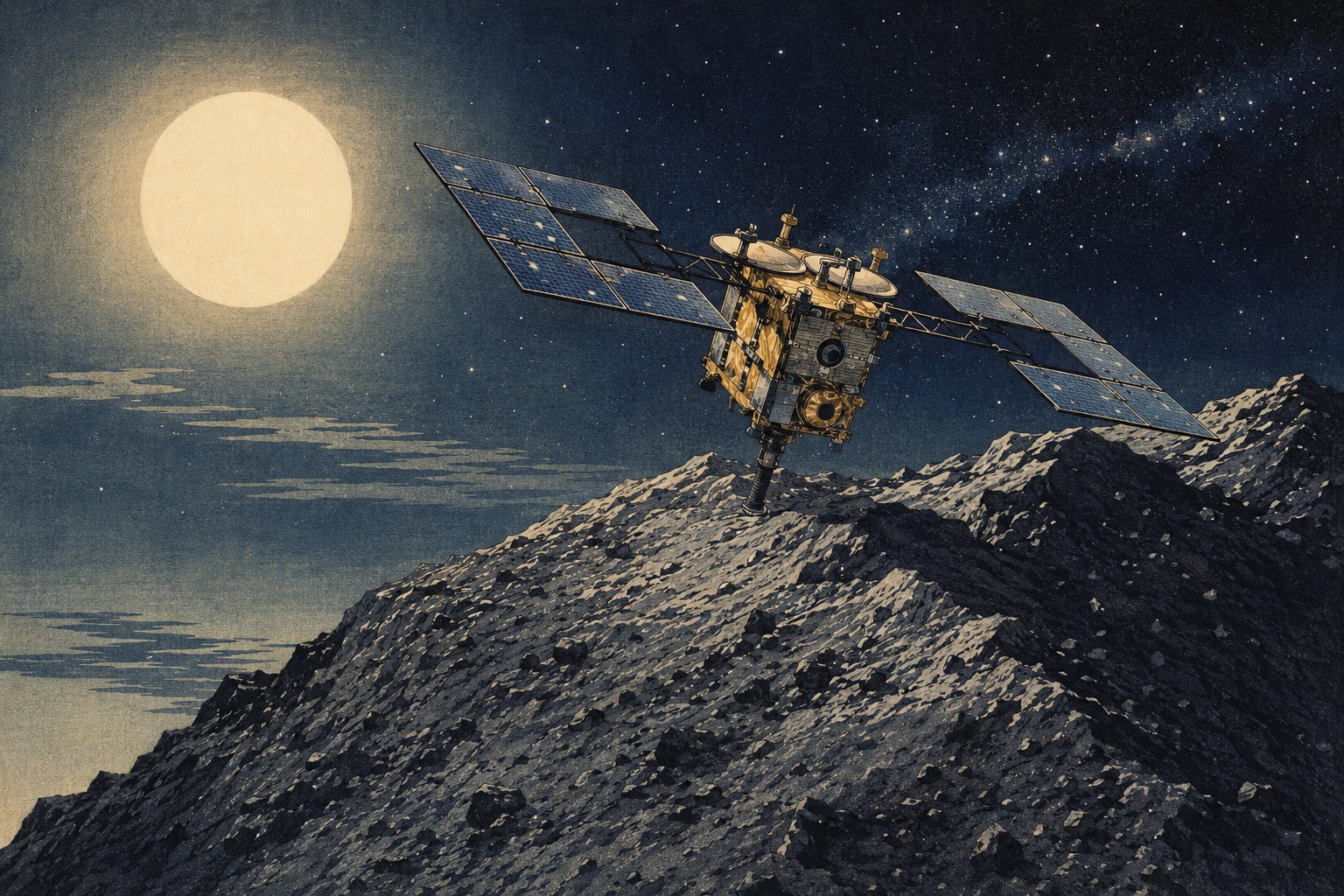
The minimum distance was approximately 744 meters from Torifune’s center and about 400 meters from its surface at 18:30:00.31 Japan time on July 5, with a timing uncertainty of ±0.03 second. The closest-approach point was 120 meters from the target. JAXA cautions that distances and dimensions may be refined as the asteroid’s shape model improves.
Eight-hundredths of a second
There was no orbit insertion, no slow descent and no second attempt. Hayabusa2 and Torifune met at a relative speed of about five kilometers every second. At that velocity, the spacecraft traveled a distance equal to its entire 400-meter surface clearance in 0.08 second. A late error was not something a controller could correct after seeing it. By then, the moment would already be history.
The closest approach came at 18:30:00.31 JST on July 5. It took weeks of data reduction for JAXA and its industrial and academic partners to reconstruct the geometry precisely. The early public estimate had put the spacecraft roughly one kilometer from the asteroid’s center. The July 30 result moved it inward: 744 meters from the center and approximately 400 meters from the irregular surface.
That distinction matters. Torifune is not a smooth sphere with a clean altitude line. JAXA now estimates a long axis of about 840 meters, a short axis of about 340 meters and a mean diameter near 540 meters. Its two-lobed body turns the word “distance” into a problem of shape, orientation, trajectory and time. The record is measured to a surface that scientists are still modeling.
A spacecraft built to wait was asked to sprint
Hayabusa2 was designed for rendezvous. At Ryugu, it matched the asteroid’s motion, spent roughly a year and a half nearby, mapped the surface, deployed small robots, rehearsed descents and conducted two touchdowns. Torifune demanded the opposite temperament. The spacecraft would see its target clearly only late in the approach and then lose it almost instantly.
That made the mission an exercise in improvisation with hardware launched in 2014. The fixed telescopic navigation camera was not designed as the high-speed tracking eye of a dedicated flyby probe. The team had to combine radio tracking from Earth with optical measurements of the asteroid and newly developed onboard guidance software. Three trajectory correction maneuvers came on July 1, July 4 and just over three hours before closest approach on July 5. Autonomous control handled the final refinement.
The result was a 120-meter offset from the planned closest-approach point. In ordinary life, 120 meters is a city block. In a blind, high-speed meeting with an irregular object about 100 million kilometers from Earth, it is evidence that navigation had become more accurate than the asteroid was understood.
The probe was confirmed healthy through ground communication at 18:35, five minutes after the encounter. That simple status report carried an additional meaning: the team had obtained its record without sacrificing the spacecraft’s journey to 2031.
The one-shot instrument sequence
Hayabusa2 began direct imaging of Torifune on June 20. The telescopic Optical Navigation Camera, ONC-T, served two roles at once: it provided pictures for navigation and scientific images of the body itself. During the final hour, three other instruments joined the sequence.
| Instrument | What it sought | Why the pass was difficult |
|---|---|---|
| ONC-T telescopic camera | Shape, surface features, rotation and optical position for navigation. | A fixed camera had to keep a rapidly expanding target in view during a high-speed crossing. |
| TIR thermal-infrared imager | Surface temperature, thermal inertia and clues to roughness or loose material. | Useful data had to be captured before the geometry changed; a released image was taken at about 10 km. |
| NIRS3 near-infrared spectrometer | Composition and evidence of water or hydroxyl groups. | The instrument had only a narrow field and a brief opportunity to collect enough reflected light. |
| LIDAR laser altimeter | Direct ranging between spacecraft and asteroid. | The return pulse had to be acquired from a small, fast-moving and uneven target. |
Observations continued until immediately before closest approach but could not continue after the spacecraft passed because of the encounter geometry and spacecraft attitude. Only part of the science data had reached Earth when JAXA issued its first results. The July 30 navigation finding is therefore a milestone, not the final scientific word.
Torifune’s double revelation
Before the encounter, telescopes had shown that Torifune’s brightness changed dramatically as it rotated every 5.02 hours. That implied an elongated body. Flyby images revealed the stronger answer: two rounded masses joined at a neck, a contact-binary form.
Such a shape is a fossil of low-speed construction. Two objects can orbit a common center, lose energy and settle together gently enough to remain distinct lobes rather than shatter. Comet 67P/Churyumov–Gerasimenko and the Kuiper Belt object Arrokoth have made the form familiar, but every contact binary records a different combination of collisions, spin and weak gravity.
Torifune is a stony, S-complex near-Earth asteroid, compositionally closer to the kind of object explored by the first Hayabusa at Itokawa than to carbon-rich Ryugu. Yet its architecture tells the same broad story: small worlds are not scaled-down planets. They can be loose aggregates, joined fragments and spinning structures whose gravity is barely strong enough to hold them together.
JAXA’s revised dimensions—about 840 by 340 meters, with a mean diameter of 540 meters—also show why spacecraft reconnaissance matters. Ground telescopes can infer rotation, reflectivity, spectrum and a rough silhouette. A passing spacecraft can turn a changing point of light into geology.
A name chosen for exactly this journey
Torifune was discovered by the U.S. LINEAR survey on February 3, 2001 and carried the provisional designation 2001 CC21. After JAXA selected it for Hayabusa2’s extended mission, a public naming campaign drew suggestions that were considered with the help of a committee of elementary and junior-high-school students.
The winning name, approved in 2024, abbreviates Ame-no-torifune. In Japanese mythology it is both a deity and a divine ship, described in the naming citation as traveling safely at high speed like a bird while remaining steady as a rock. The hope embedded in the name was unusually literal. The spacecraft had to be fast, steady and safe—all within the same second.
From Itokawa dust to a record flyby
The Torifune pass belongs to a distinct Japanese tradition: using small spacecraft and electric propulsion to do things that initially look unreasonable.
The first Hayabusa launched in May 2003 as an engineering demonstrator. It reached asteroid Itokawa in 2005 after traveling about two billion kilometers, made two landings and endured failures that repeatedly threatened the return. On June 13, 2010, its capsule reached the Australian desert. Roughly 1,500 grains were later identified, most judged to be extraterrestrial and from Itokawa. Japan had returned material from an asteroid for the first time.
Hayabusa2 was not merely a repeat. Launched on December 3, 2014, it incorporated more reliable ion engines, navigation, communications and attitude control. It reached the carbon-rich asteroid Ryugu in June 2018, deployed rovers and the German-French MASCOT lander, created an artificial crater with a small carry-on impactor and touched down twice. The second collection targeted material exposed from beneath the weathered surface.
On December 6, 2020, Hayabusa2 released its sample capsule over Australia and continued past Earth. The capsule held 5.4 grams of black, primitive material from two sites—far above the mission’s 100-milligram minimum success threshold. Analysis has shown water-altered minerals, abundant organic chemistry and, in a 2026 study, all five canonical nucleobases used by DNA and RNA. That does not mean life existed on Ryugu. It means some of life’s molecular alphabet can form without life and travel inside ancient asteroids.
The primary mission had succeeded. The spacecraft itself, however, still worked, and about half of its xenon propellant remained when the extension was planned. Rather than discard a functioning interplanetary laboratory, JAXA gave it a second decade.
The Hayabusa line: twenty-eight years of one mission becoming another
| Date | Milestone | What changed |
|---|---|---|
| May 2003 | Hayabusa launches toward Itokawa. | Japan begins testing ion propulsion, autonomous navigation, asteroid landing and sample return as one system. |
| 2005 | Hayabusa reaches and lands on Itokawa. | A tiny rubble-pile asteroid becomes a place that can be surveyed and physically sampled. |
| June 2010 | Itokawa capsule returns to Earth. | The first asteroid material recovered by a sample-return mission reaches laboratories. |
| December 2014 | Hayabusa2 launches. | The experimental architecture is rebuilt as a more capable scientific mission. |
| 2018–2019 | Ryugu exploration, crater experiment and two touchdowns. | Hayabusa2 studies a carbon-rich body and collects surface and subsurface-related material. |
| December 2020 | Ryugu capsule lands; spacecraft continues. | The 5.4-gram sample goes to Earth while the mothercraft begins Hayabusa2#. |
| July 2026 | Torifune flyby at about 400 meters above the surface. | A rendezvous spacecraft demonstrates record-close rapid reconnaissance and precision targeting. |
| 2027–2028 | Two planned Earth swingbys. | Earth’s gravity reshapes the trajectory for the final target. |
| July 2031 | Planned rendezvous with 1998 KY26. | The mission aims to explore an object only about 11 meters wide, rotating once in roughly five minutes. |
Why 400 meters matters to planetary defense
Planetary defense begins with discovery, but discovery is not enough. If astronomers find an object on a dangerous path, decision-makers need its orbit, size, mass, composition, shape, spin and internal structure. A solid monolith, a fractured body and a loose rubble pile can respond differently to the same impact. A mission sent to push an asteroid may first need a scout.
Torifune offered a simulation of that emergency reconnaissance. It was a small near-Earth object, not fully characterized, approached at high speed by a spacecraft built for another purpose. JAXA’s June description framed the flyby as a test of how much information an already-flying probe could obtain in a rapid encounter. The goal was not only a picture; it was the ability to turn uncertainty into targeting data.
The orbit result is the clearest measure. Before the flyby, JAXA put Torifune’s positional uncertainty at the encounter at 49.5 kilometers, using a three-sigma measure. After the flyby it was 0.78 kilometer. That is an improvement by a factor of more than 60. The asteroid did not become easier to see from Earth. A spacecraft met it and converted proximity into knowledge.
The 120-meter targeting offset demonstrated the other half of the chain. JAXA says the result shows control technology capable of guiding a probe into a collision with a small asteroid. Hayabusa2 did not test deflection—it deliberately avoided Torifune—but the navigation problem for a near miss and an impact is closely related.
Hayabusa2 and DART: reconnaissance before the collision
NASA’s DART mission intentionally struck the 160-meter asteroid moonlet Dimorphos in September 2022 at about 6.6 kilometers per second. The collision shortened Dimorphos’s orbit around Didymos by roughly 32 minutes in the initial measurement, humanity’s first full-scale demonstration that a kinetic impactor could change a celestial body’s motion.
Torifune was a different kind of test. DART was purpose-built to die on impact, with autonomous navigation designed around that single end. Hayabusa2 was a veteran sample-return spacecraft that needed to survive and continue. Its contribution is the rapid-scout and precision-guidance side of planetary defense: approach an uncertain object, resolve its orbit and shape, take physical measurements and prove that the targeting chain works.
A real defense campaign could need both capabilities. Reconnaissance tells engineers what they are trying to move. An impactor supplies the push. Follow-up observations determine whether the change was enough. Torifune strengthens the first link while demonstrating part of the second.
The destination beyond the record
Hayabusa2’s extended mission is nicknamed Hayabusa2#—“Hayabusa2 Sharp,” also expanded by the mission team as Small Hazardous Asteroid Reconnaissance Probe. Torifune was the first asteroid encounter of that extension, not its final destination.
The probe is scheduled to return to Earth’s neighborhood for gravity-assist flybys in December 2027 and June 2028. Those encounters will redirect it toward 1998 KY26 for a July 2031 rendezvous. Current JAXA information puts that target at only about 11 meters in diameter, spinning once in roughly five minutes. At that rate, centrifugal force near the surface can exceed the asteroid’s feeble gravity.
It will be a new class of world. Torifune tested whether Hayabusa2 could cross a target’s vicinity in seconds. KY26 will test whether an aging spacecraft can remain near an ultra-small, rapidly rotating object for sustained exploration. The engineering lessons could matter because objects of that scale are numerous, hard to detect and capable of surviving atmospheric entry under some conditions.
What the record does not yet tell us
- The definitive shape: JAXA warns that the 840-by-340-meter dimensions and the center-to-surface distances may change as the shape model is refined.
- The internal structure: Images reveal a two-lobed exterior but cannot by themselves determine porosity, density or how deeply the lobes are joined.
- The surface physics: Thermal-infrared data should constrain roughness and thermal inertia, while spectral data may refine composition and hydration.
- The complete instrument return: Only part of the encounter data was initially downlinked; detailed scientific interpretation will take time.
- The spacecraft’s long-term condition: Surviving Torifune is one milestone in a mission expected to operate until at least 2031.
A narrow passage through Japan’s space history
Four hundred meters is not the distance from Earth to a frontier. It is shorter than a brisk five-minute walk. Yet in the geometry of deep space, it represented twelve years of spacecraft endurance, decades of ion-engine development, a chain of ground observatories, industrial software, optical navigation and a team willing to use an old machine in a way it had never been designed to operate.
Hayabusa2’s deepest achievement may be its refusal to remain one mission. It was built to answer questions about water and organic chemistry at Ryugu. It returned those answers in a capsule, then turned its surviving hardware toward planetary defense. A camera that once searched for a safe landing site became the eye of a high-speed scout. A laser altimeter designed for patient descent was fired at a rock rushing past. A sample-return spacecraft became an interceptor that chose not to collide.
At 18:30:00.31 on July 5, Hayabusa2 passed the narrowest point. Torifune’s stone filled its view, then was behind it. The record is 400 meters. The larger measure is the distance Japan’s asteroid program has traveled—from microscopic grains at Itokawa, to ancient chemistry at Ryugu, to the practical question of how humanity might one day meet a dangerous object on purpose.
Sources and methodology
Japan.co.jp used JAXA’s July 30 reconstructed navigation results as the controlling source for closest-approach distance, timing, targeting error, asteroid dimensions and orbit uncertainty. Earlier provisional distance estimates are not presented as final. JAXA notes that shape-model refinement may revise some values. The displayed exchange rate—1 U.S. dollar to 160.57 Japanese yen—was supplied with a timestamp of July 31 at 12:54 a.m. UTC, equivalent to 9:54 a.m. JST.
- JAXA: Hayabusa2 sets minimum-distance record in a solar-system-body flyby, July 30
- JAXA: Hayabusa2 captures images and science data from Torifune
- JAXA: Flyby timing, speed and planetary-defense objectives
- ISAS: Engineering challenge of flying a rendezvous spacecraft past Torifune
- Hayabusa2 project: The naming of asteroid Torifune
- ISAS: Hayabusa2 mission, Ryugu history and 1998 KY26 extension
- ISAS: The original Hayabusa mission to Itokawa
- ISAS: Ryugu’s 5.4-gram returned sample and early analysis
- Nature Astronomy: All five canonical nucleobases in Ryugu samples
- NASA: DART asteroid-deflection mission and results
- Hirabayashi et al.: Overview of the Hayabusa2# Torifune flyby
