- The monk who made a picture ask a question
- From a post town to a renewed Rinzai tradition
- 1. The red-robed Daruma: intensity at human scale
- 2. Hotei on a boat: how little a picture needs
- 3. Hotei blowing out Otafuku: a joke across two scrolls
- 4. Kannon in a lotus pond: the other face of Zen
- 5. Otafuku administers moxibustion: compassion without ceremony
- 6. A second Daruma: a lesson in looking closely
- Why Hakuin still speaks to a world of images
The monk who made a picture ask a question
A face fills a scroll almost from edge to edge. The pupils are startlingly small inside enormous eyes. It is not a flattering portrait, and it is not meant to be. Hakuin Ekaku used the image of Bodhidharma to turn the act of looking into an encounter with a religious question. In other works he could be mischievous, tender or absurd. The same painter who made a patriarch stare could make a folk deity puff a woman out of a pipe.
This autumn, Tokyo offers a particularly useful opportunity to encounter that range. Eisei Bunko Museum’s Hakuin World exhibition runs through November 29, 2026, and its companion exhibition at Waseda University’s Aizu Museum continues through December 8. Our six-image selection draws on works associated with several collections; it is not a checklist of either exhibition.
From a post town to a renewed Rinzai tradition
Hakuin was born in Hara, a post town on the Tōkaidō in what is now Numazu, Shizuoka. The dates 1686–1769 used by many international museums reflect Gregorian conversion of dates in Japanese lunar-calendar years 1685 and 1768. Japanese institutions often retain the latter convention.
He entered Shōinji (松蔭寺) as a young monk and spent years travelling in search of instruction. In 1708 he studied at Shōjuan in Iiyama with Dōkyō Etan, remembered as Shōju Rōjin. By 1717 he was established at Shōinji, where he cultivated a community of students. His influence extended through disciples such as Tōrei Enji and through writings and lectures intended for people outside monasteries.
The long journey matters because the exuberance of his paintings should not be confused with an absence of discipline. Hakuin was a religious teacher first. His late-life production of paintings belonged to a broader effort to make demanding Zen practice intelligible beyond a narrow circle of specialists.
1. The red-robed Daruma: intensity at human scale
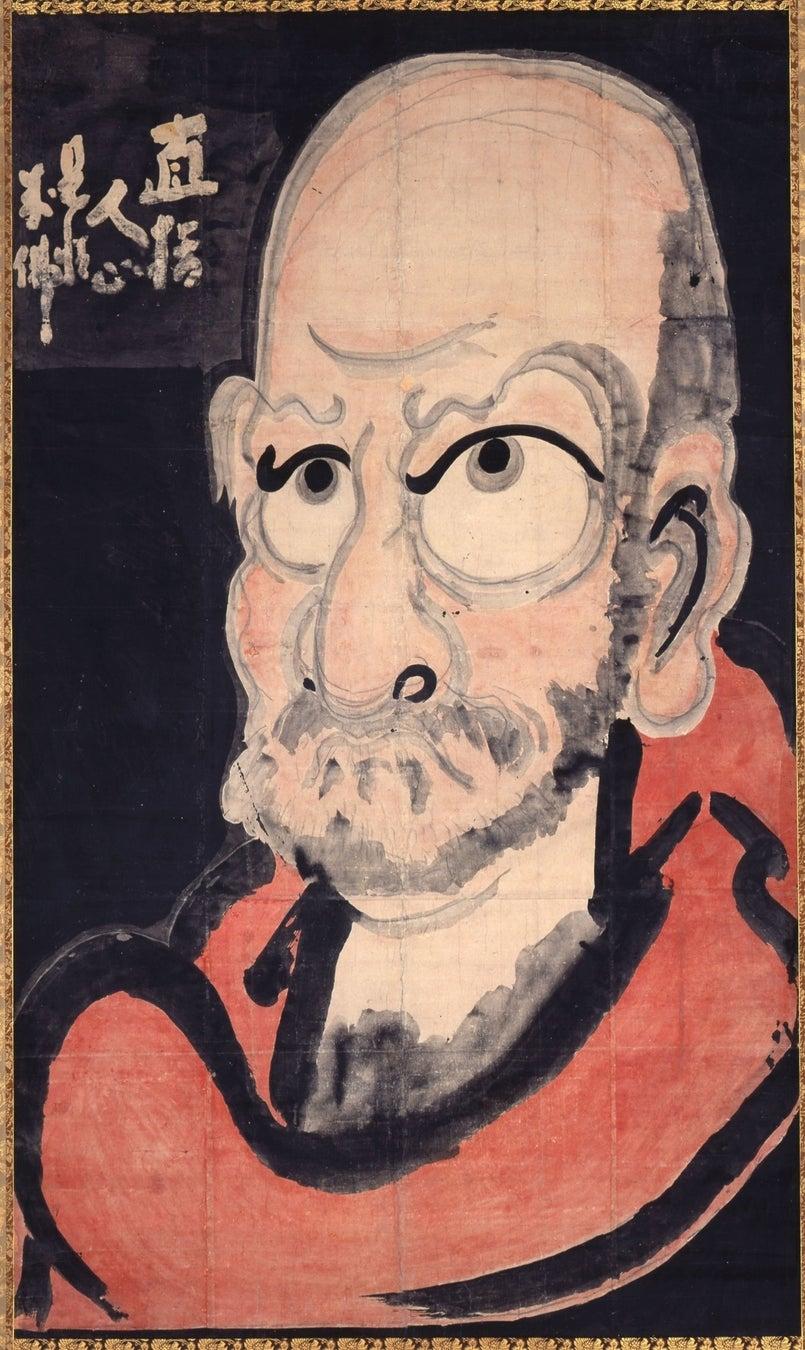
At Manjuji (萬壽寺) in Oita is a monumental half-length Daruma, often called the Red Daruma. Measuring 192 by 112 centimetres, the painting makes its subject physically imposing. The red robe and pale head stand against a dark field; the uncompromising contours of the eyes have a force very different from a naturalistic likeness.
Bodhidharma is traditionally associated with the transmission of Chan Buddhism to China. Hakuin’s inscription invokes the Zen principle 直指人心、見性成仏: look directly into the human mind and awaken to one’s own nature. The Bunkamura exhibition account describes the reserved lettering made using wax. Here the text participates in the visual drama rather than serving as a label.
2. Hotei on a boat: how little a picture needs
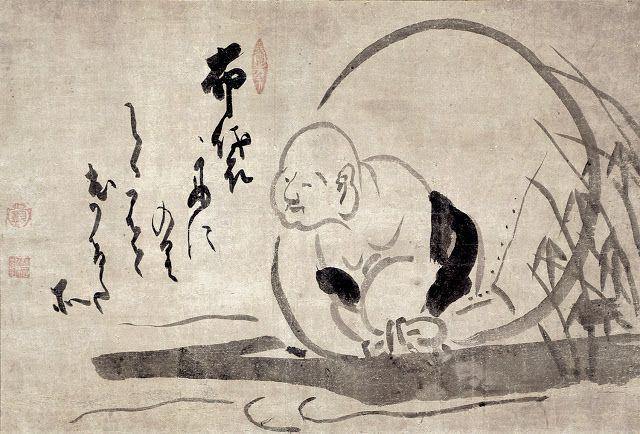
Hotei, the jovial monk familiar in Japan as one of the Seven Gods of Good Fortune, gave Hakuin a very different vocabulary. The Museum of Fine Arts, Houston catalogues an eighteenth-century ink-on-paper hanging scroll titled Hotei on a Boat.
The supplied image invites a close look at the economical construction of space: the low horizontal form of the craft, the rounded body and a large arch behind it. A few marks suggest water. The empty paper leaves room for motion and atmosphere, while the inscription is a visual counterweight. Rather than filling every corner with information, the artist lets the viewer complete the scene.
3. Hotei blowing out Otafuku: a joke across two scrolls
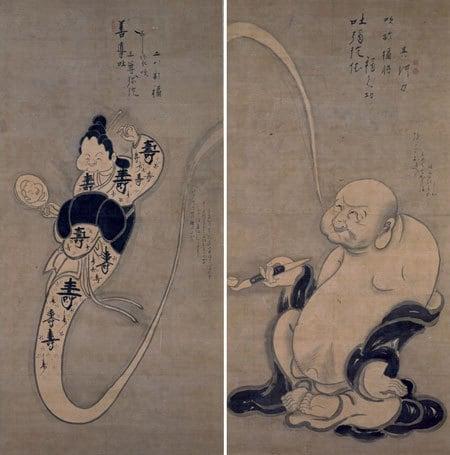
The two panels are not unrelated auspicious figures. Bunkamura identifies the paired work as 布袋吹於福, held by Hokkeji in Ehime and deposited with Ozu City Museum. Hotei sits in the right panel holding a pipe; Otafuku materializes in the left, apparently borne on the smoke. Characters for longevity decorate her clothing.
A related composition discussed by the Houston museum plays on a tradition about the Chinese Pure Land teacher Shandao, in which recitations manifest as buddhas. Replacing a sacred manifestation with a familiar figure of good fortune produces a visual surprise. This is not simply an amusing trick: the contrast invites reflection on how easily spiritual significance becomes attached to familiar forms.
4. Kannon in a lotus pond: the other face of Zen
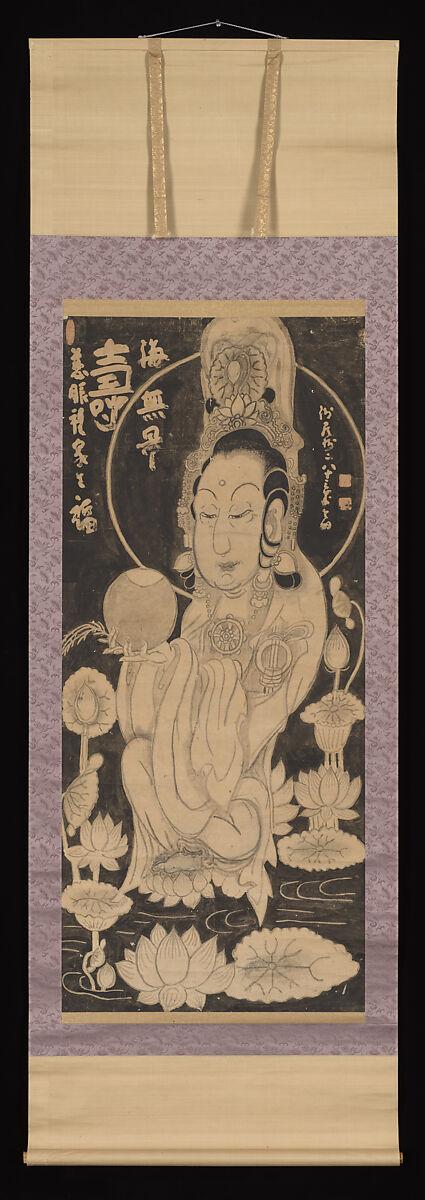
The Metropolitan Museum of Art catalogues this 1767 hanging scroll under accession number 2025.92 and marks its image public domain. Its painted area is 132.7 by 57.8 centimetres. The bodhisattva of compassion is surrounded by lotus forms, with luminous unpainted areas emerging from a dense ink background.
Hakuin’s connection to the Lotus Sutra began in childhood, and the Met relates his repeated Kannon imagery to his mother’s devotion. In this scroll the inscription adapts a passage associated with the Kannon chapter, using a homophone to evoke both good fortune and longevity. An enlarged character makes the written message part of the composition. The work challenges the assumption that Zen imagery must always be austere or confrontational.
5. Otafuku administers moxibustion: compassion without ceremony
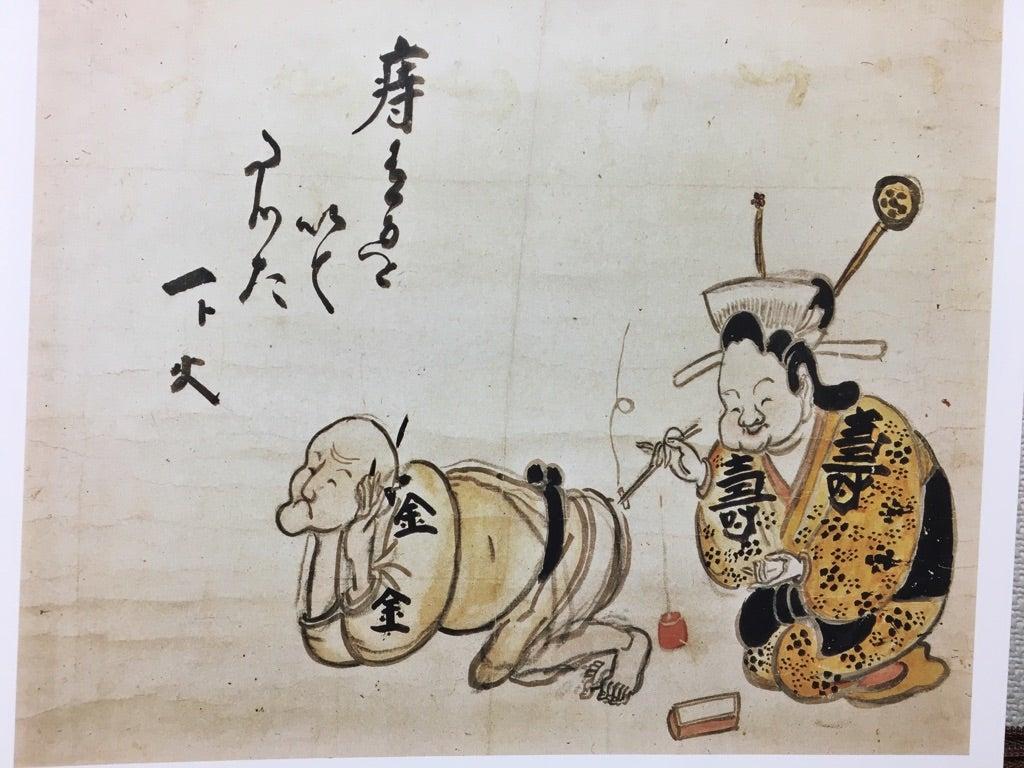
Eisei Bunko identifies a work titled お灸お福図 in its 2026 exhibition publicity. The supplied scene shows a richly dressed Otafuku attending to a crouching man with moxa. The intimate, undignified situation is far removed from conventional devotional grandeur. The Dayton Art Institute discusses this motif in connection with service and compassion.
One reading of the painting is that care for another person is worth more than the prestige conveyed by clothing or wealth. It is an interpretation, not a literal translation of the inscription. Moxibustion is part of the historical setting; the picture is not evidence of medical efficacy. Hakuin also wrote about the difficulties of intensive religious training in Yasen Kanna, a text that would later inspire a major collector of his art.
6. A second Daruma: a lesson in looking closely
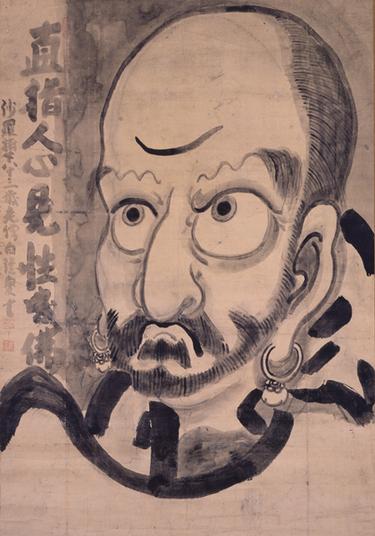
The final historical image, our principal historical selection, uses a lighter ground and fine lines in the hair and beard. Strong dark marks around the eyes, mouth and robe give the portrait a peculiar energy. The inscription at the left places language beside an expression that is almost impossible to ignore.
There are many surviving Daruma compositions by Hakuin. Shizuoka Prefecture documents a 1767 example at Seikenji; the Tohoku History Museum and Cultural Heritage Online document other works with the same central teaching. A close resemblance does not establish that two photographs represent the same scroll. The value of this selection is the comparison of visual strategies, without assigning an unsupported date or collection to the supplied reproduction.
Why Hakuin still speaks to a world of images
A kōan is a problem or encounter used in Zen practice, not merely a clever riddle. Hakuin’s well-known challenge concerning the sound of one hand exemplifies an attempt to move beyond ordinary conceptual answers. His pictures can work in a related way: the unexpected juxtaposition of two things interrupts habitual recognition and makes a viewer reconsider what is being seen.
That makes his work especially interesting to an editorial publication working with modern imagery. A lunar rover with outsized optical sensors, or a surgeon whose arm stretches across a landscape, can convey an idea through exaggeration. These are our contemporary interpretations, not historical pictures and not claims that Hakuin anticipated technology. The November 27 JAPAN.co.jp edition uses AI-generated illustrations inspired by this visual language, clearly separated from the six historical reproductions.
The collectors who carried his art into modern museums also deserve attention. Hosokawa Moritatsu encountered Yasen Kanna during illness in his youth and began collecting Hakuin’s works; Eisei Bunko now holds more than 300. The joint exhibition with Waseda explores the relationship between this collection and that of Tomioka Shigenori. It reminds us that the survival of art depends on a chain of preservation, scholarship and public access.
Explore the JAPAN.co.jp Art Gallery
Sources and further reading
- Numazu City: Hakuin biography and chronology
- Shizuoka City Museum of Art: Hakuin of Suruga
- Kyushu National Museum: Hakuin and Sengai
- Bunkamura: Hakuin exhibition, selected works
- Museum of Fine Arts, Houston: Hotei on a Boat
- Metropolitan Museum of Art: Kannon in a Lotus Pond, 2025.92
- Eisei Bunko: 2026 autumn exhibition press information
- Eisei Bunko Museum: official exhibition information
- Waseda University Aizu Museum: Hakuin World
- Shizuoka Prefecture: Seikenji Daruma cultural property
- Tohoku History Museum: half-length Daruma and inscription
- Cultural Heritage Online: Daruma, MIHO Museum
- Daizoin temple: Hakuin dates and Zazen Wasan
- Museum of Fine Arts, Houston: related Hotei and Otafuku motif
- Eisei Bunko: Chinese-language exhibition images
- Shizuoka City Museum of Art: exhibition highlights
- Dayton Art Institute: Hakuin biography and imagery