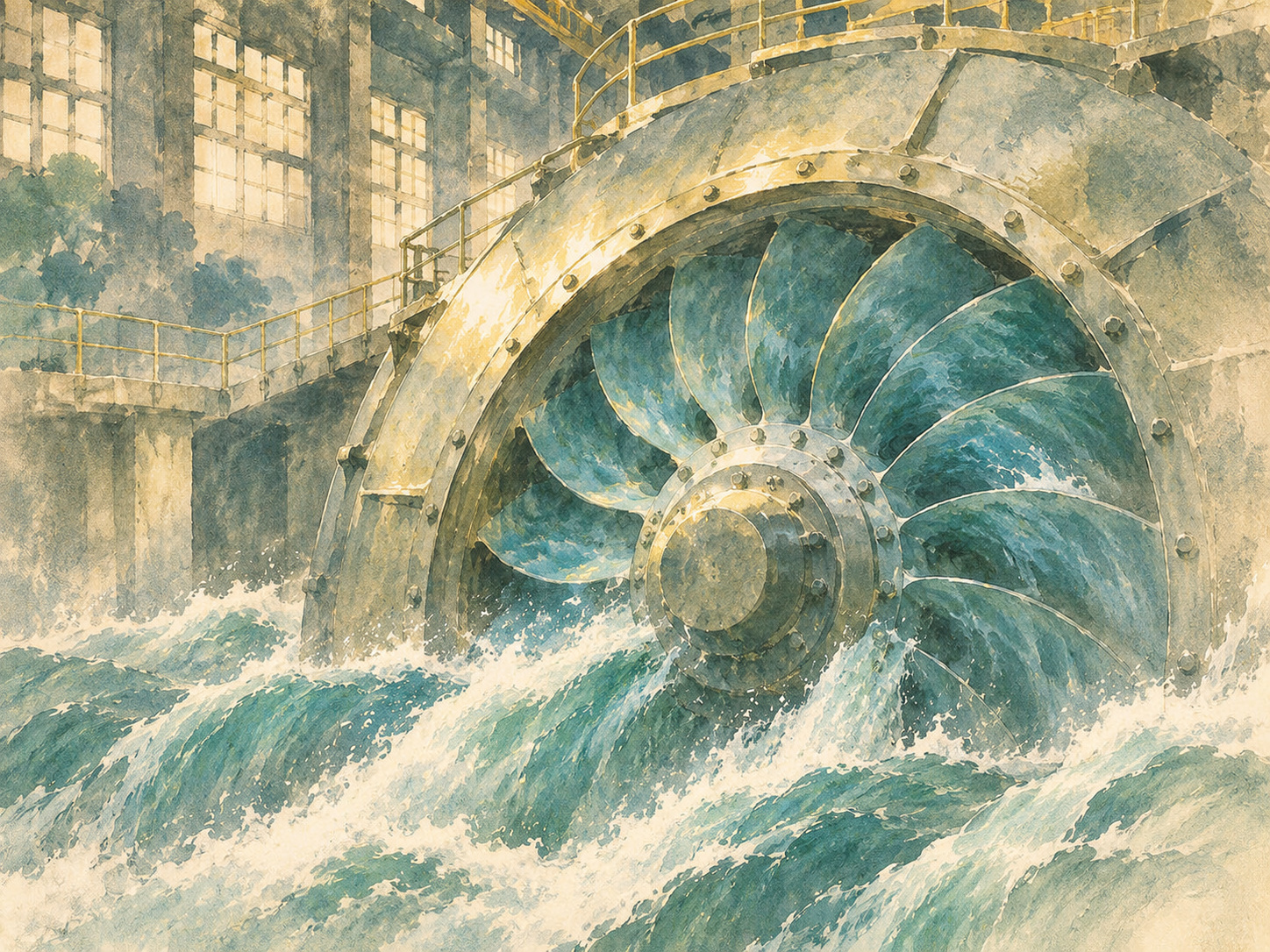
- A generator becomes the exhibit
- The scale of an 11.7 MW installation
- Where the electricity really comes from
- Why project light onto real machinery?
- The dam that took generations
- Who controls the dam, and who runs the power station?
- A new commercial role for local electricity in 2026
- The role of hydropower in Japan’s energy transition
- How to visit, according to the November 12 guide
- The questions the light cannot answer
A generator becomes the exhibit
At the foot of Yamba Dam in Gunma Prefecture, the object at the center of a visitor presentation is not a replica of a power station. It is an actual generator. Animated light projected onto the equipment helps visitors picture a process that usually happens out of sight: water descending through an engineered passage, turning machinery and producing electricity.
Gunma updated its official guide to the projection-mapping tours on November 12, 2026. The update does not mean the plant or the show opened this week; both already existed. The news provides a reason to revisit a revealing piece of infrastructure—a power station whose engineering, ownership and political history are as important as its visual spectacle.
Understanding it requires following the water well beyond the turbine. Yamba is a chapter in Japan’s arguments about dams, regional livelihoods and energy security, and a contemporary example of how electricity can acquire local commercial value.
The scale of an 11.7 MW installation
The operator, Gunma Prefecture’s enterprise bureau, lists installed maximum output at 11,700 kilowatts, or 11.7 megawatts. The plant’s maximum water intake is 13.60 cubic meters per second, and its effective head—the usable vertical energy difference—is 105.80 meters. The prefecture gives annual generation of approximately 42 million kilowatt-hours as a planning figure, comparable by its estimate to the consumption of roughly 12,000 households.
A maximum output rating is not an annual generation total. If 11.7 MW were delivered uninterrupted for a year, it would produce about 102.5 million kWh. The prefecture’s 42 million kWh annual figure corresponds to an illustrative capacity factor of about 41%, calculated from those two published figures—not a measured 2026 performance statistic.
The prefecture reports a project cost of roughly ¥8 billion. Commercial operation began April 1, 2021, after construction undertaken between April 2015 and March 2021. Water is diverted from the dam’s water-supply release conduit into a dedicated power passage and reaches a powerhouse immediately downstream on the left bank.
Where the electricity really comes from
Hydropower starts with gravity. Water stored higher up possesses potential energy, and controlled flow through a conduit transfers that energy to a turbine. The turbine turns a generator, whose electrical output must then be controlled, protected and delivered through the grid. The process looks simple in a diagram but depends on elaborate civil and electrical engineering.
Using the published maximum flow and effective head, the standard theoretical water-power relationship—density times gravitational acceleration times flow times head—gives roughly 14.1 MW of hydraulic power before losses. The published electrical maximum is 11.7 MW. The figures illustrate that useful output is below the ideal energy in the water; they do not establish a precise measured efficiency for each component of the installed machinery.
Visitors cannot normally see what happens inside a sealed generator or a pressure conduit. Projection mapping helps turn an invisible energy chain into a memorable spatial explanation, without being a live measurement of the internal current, water pressure or flow.
Why project light onto real machinery?
Gunma’s tourism information is specific: projection-mapping imagery is cast onto the actual generator to explain the mechanism of hydroelectric generation. That distinguishes the tour from a conventional interpretive wall display. The machinery’s dimensions and the way visitors move through the powerhouse become part of the lesson.
But the animated display is an illustration, not a transparent window into the generator. A glowing stream need not represent an instantaneous sensor reading. It would be misleading to infer operating output or hydraulic conditions from the color or speed of the projected image alone.
The public tour page does not provide a controlled study showing improved learning outcomes, a verified visitor satisfaction percentage, or a definitive first-show date. Those may be subjects for future reporting, but none should be inserted as established facts.
The dam that took generations
Yamba Dam sits on the Agatsuma River in the Tone River basin. National officials trace the investigation of the project to 1952. After decades of planning, legal and political debate, and construction, the concrete gravity dam was completed in March 2020 and began operating the following month.
It has several purposes: flood control downstream, supply of municipal and industrial water, maintenance of river functions and hydropower provided by the prefecture. Such objectives cannot be reduced to the needs of the turbine. Nor was the project politically uncontroversial: in 2009 a national minister announced a policy of cancellation; after reassessment, the government decided to continue the project in 2011.
Kawarayu Onsen, a historic hot-spring community, was relocated and rebuilt beside the reservoir. That history matters when describing a scenic modern visitor attraction. The landscape surrounding the dam reflects the costs and choices of a major public-works project, not simply the construction of an energy asset.
Who controls the dam, and who runs the power station?
The national Ministry of Land, Infrastructure, Transport and Tourism manages Yamba Dam; Gunma’s prefectural enterprise bureau operates Yamba Power Station. Their responsibilities intersect but are not identical. Dam operators must account for flood safety, water supply and river conditions, alongside the release used for electricity generation.
The distinction explains why an 11.7 MW maximum rating does not imply that electricity can always be produced whenever market prices are attractive. Head, flow, water-management rules and maintenance all shape actual output. Multi-purpose water infrastructure requires coordination among stakeholders with sometimes competing needs.
For a visitor who sees one impressive machine, this may be the most important invisible lesson: a generator is part of an integrated water system, not an independent engine that controls its own fuel supply.
A new commercial role for local electricity in 2026
In a March 18, 2026 announcement, Gunma said it had signed a memorandum with Kansai Electric Power concerning the sale of Yamba electricity and associated environmental attributes to businesses in Gunma. The intended sales period runs from July 2026 to March 2041, subject to detailed arrangements. Eligible buyers are high-voltage and extra-high-voltage users with facilities in the prefecture or plans to establish them.
Under the described arrangement, Kansai Electric would work to offer the electricity plus environmental attributes, or environmental attributes alone, to eligible businesses. Gunma would publicize the opportunity. The prefecture says the wholesale arrangement uses Japan’s Feed-in Premium (FIP) system, which differs from a straightforward assertion that every local customer is physically served exclusively by Yamba.
The memorandum does not establish the identities of completed buyers, contracted volumes, prices or actual 2026 delivery. Those details require contractual or operational evidence. Still, the policy provides a tangible reason for local manufacturers to care about a dam that might otherwise seem chiefly a tourist attraction.
The role of hydropower in Japan’s energy transition
Japan’s Seventh Strategic Energy Plan, adopted in 2025, outlines a 2040 electricity mix in which renewables supply roughly 40%–50% of generation. Agency for Natural Resources and Energy information puts hydropower at about 7.4% of the national mix in fiscal 2024. That is a national figure, not a percentage attributable to Yamba.
Unlike solar or wind generation, some hydropower systems can vary output by controlling water releases, although the freedom to do so depends on reservoir rules, river conditions and the project’s design. It would be wrong to assume that Yamba can always dispatch electricity without regard to its other water-management obligations.
Renewable does not mean impact-free. Dams alter landscapes, ecosystems and community geography; large projects can also displace residents. A credible educational presentation should leave room for the advantages of low-fossil-fuel electricity and the difficult social choices that made the facility possible.
How to visit, according to the November 12 guide
Gunma lists tours on Fridays, Saturdays, Sundays, Mondays and public holidays, except December 29 to January 3. Each lasts approximately 30 minutes, with 10 sessions scheduled per day. Admission is free and no advance reservation is required, but visitors must register at the plant on the day. Each tour admits up to 16 people in order of application.
Visitors must be elementary-school age or older. They descend via the dam’s public elevator to basement level B3 to reach the registration point at the downstream-side plant entrance. Helmets are provided and practical shoes are required. There is no restroom inside, and preschool children and pets are not admitted. Gunma says a modified projection-only experience applies to visitors requiring wheelchair or walking assistance.
Weather alerts and operational conditions can interrupt the schedule. The prefecture’s current tour page, rather than an undated travel guide, should be consulted before leaving home. The visit is a public-education opportunity, but it takes place at an active industrial facility.
| Visitor detail | Official November 12 guide |
|---|---|
| Days | Friday–Monday and holidays, except Dec. 29–Jan. 3 |
| Duration | About 30 minutes; 10 sessions per day |
| Admission | Free; same-day registration only |
| Capacity | 16 people per session, first come first served |
| Age | Elementary school age and older |
The questions the light cannot answer
The presentation offers an unusually direct encounter with the physical machinery behind everyday electricity use. Its effectiveness as journalism, however, lies in connecting that moment to the wider system: where the water came from, who controls it, what it costs to operate, how the power is sold and which communities live with the resulting landscape.
Yamba’s celebrated 11.7 MW generator is not a stand-alone answer to Japan’s energy challenge. It is a working example of the opportunities and compromises involved in turning water infrastructure into electricity while serving flood control and municipal needs.
Projection mapping can make an unseen process visible. The more consequential task is making the accompanying decisions visible too—from decisions taken decades before the dam was complete to new commercial arrangements announced in 2026.
Primary sources and reporting limitations
Capacity and approximate annual generation are operator figures, not verified 2026 meter readings. The local-marketing memorandum does not establish completed customer sales or prices. Turbine model, measured efficiency, visitor learning outcomes and latest visitor totals have not been independently verified.
- Gunma Prefecture: November 12, 2026 updated tour guide
- Gunma Yamba tourism site: projection mapping on the actual generator
- Gunma Prefecture: plant technical specifications and commissioning
- Gunma Prefecture: March 18, 2026 announcement on local energy sales
- MLIT Kanto Regional Development Bureau: Yamba Dam history
- Gunma Prefecture: Agatsuma power stations and their functions
- Gunma Prefecture: electricity utility historical chronology
- Japan Agency for Natural Resources and Energy: Seventh Strategic Energy Plan
- Agency for Natural Resources and Energy: national policy principles