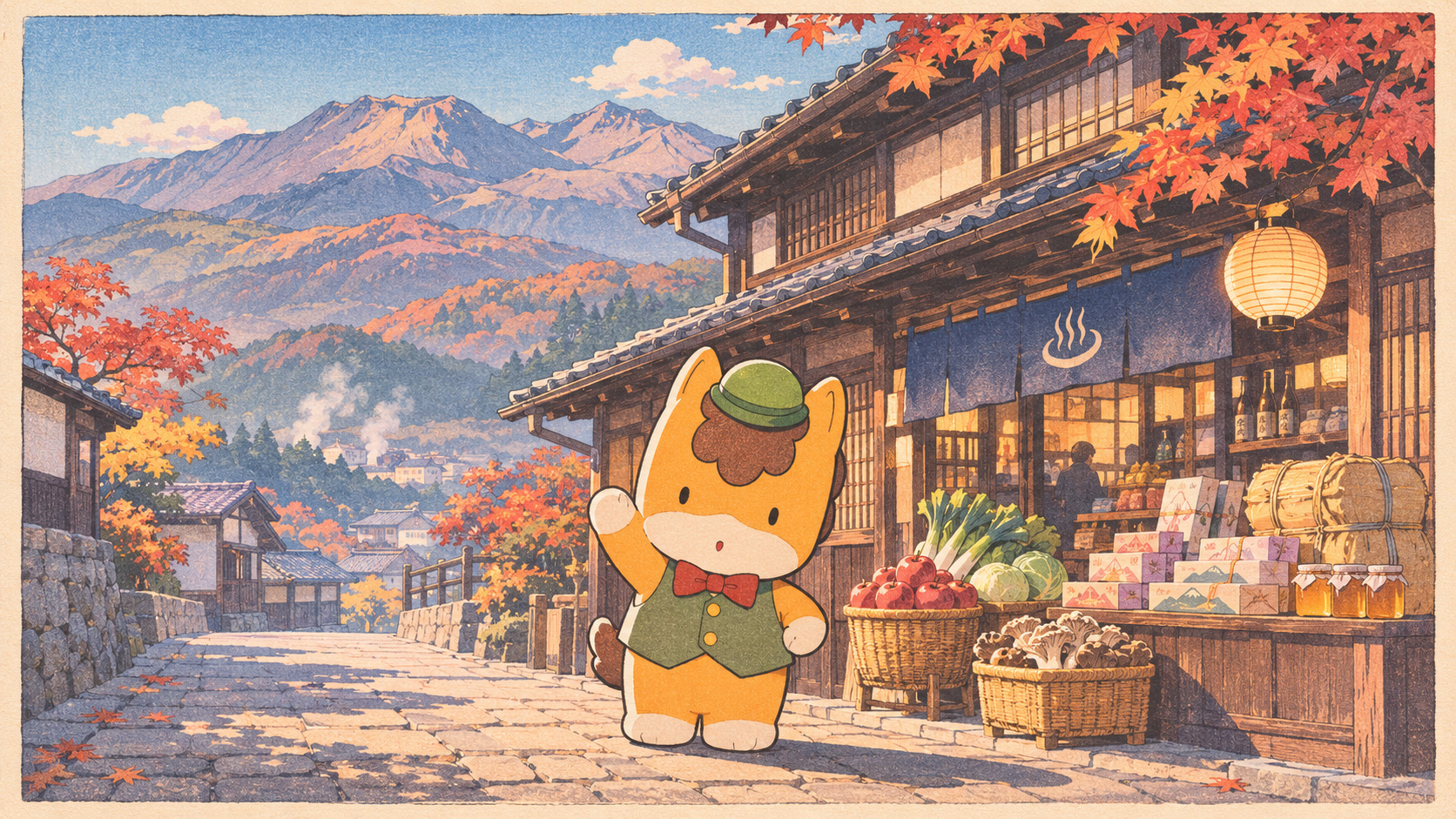
A horse on the grocery shelf
The surprising thing about Gunmachan’s commercial success is not the number of plush toys it has sold. It is the food. Reporting by the Yomiuri in September put food products at ¥64.4 billion of the ¥66 billion total for 2025. A character that began as a sporting-event mascot now participates in the routine business of selling everyday goods.
Gunma announced the record at a September 17, 2026 briefing. Jiji Press returned to the subject on November 21 as the mascot expanded its promotional activities. The annual figure is therefore a previously announced result, not a new November sales release. At the supplied exchange rate of ¥158.81 per dollar, it is equivalent to approximately US$416 million.
The prefecture’s figure measures sales of goods carrying the character’s design. It is neither the government’s licensing income nor an estimate of the additional economic output created by the mascot. That distinction is essential to understanding what this unusual regional brand has accomplished.
Two generations of a public mascot
Gunma’s first namesake mascot appeared at the 1983 National Sports Festival, designed by manga and picture-book artist Noboru Baba. The character familiar today has a separate origin: a design created by then-prefectural employee 中嶋史子 (the designer’s name in Japanese) for the 1994 Yuai Pick sports event in Gunma. Originally called Yuma-chan, it became the second Gunmachan in 2008.
The event’s inclusive sporting mission helps explain the character’s origins as a public symbol rather than a proprietary entertainment franchise. Its 2014 victory in the Yuru-chara Grand Prix subsequently brought national attention. The official profile gives it a February 22 birthday and the job of promoting Gunma.
For a regional government, the challenge is turning a temporary event symbol into an enduring public identity. Gunmachan has done so by appearing in different settings, from local events to packaging and children’s entertainment. Each creates a new opportunity for a consumer to associate a place with a familiar face.
Why giving away a license can make business sense
Gunma’s licensing system is not simply a free-for-all. The original character illustrations and logotype are available without a usage fee under the official rules, while related characters and animation artwork can incur charges. Applicants generally must submit designs for consultation and approval.
For a small manufacturer, removing the royalty on eligible artwork makes a packaging experiment less expensive. The prefecture in turn gains a potential distribution channel through products that private businesses already manufacture and market. The arrangement resembles a shared regional identity more than a conventional character franchise built primarily on royalties.
There are limits to this model. A shared symbol can lose distinctiveness if its quality is poorly managed, and a government must avoid implying official endorsement of particular commercial products. Licensing controls are therefore not an incidental administrative detail: they are part of the design of the brand.
What the ¥66 billion does and does not measure
Sales rose from ¥62.4 billion in 2024 to ¥66 billion in 2025, about 5.8 percent. The prefecture attributes the improvement partly to processed foods and broader adoption of the design by businesses. Gunma’s agricultural and food-processing economy provides a natural setting for this approach: products may carry the regional identity long after a visitor has returned home.
But a product with a mascot on its wrapper may already have been selling successfully. Its entire turnover cannot be attributed to the artwork. A rigorous estimate of incremental benefit would require evidence about sales before and after adoption, comparable products without the design, and changes in prices or distribution.
Nor does the aggregate reveal how much value remains in Gunma. Local ingredients, manufacturing wages and business profits matter, as do distribution costs and production outside the prefecture. The headline figure is a useful measure of commercial reach; it is not a regional GDP contribution.
The harder task: being liked rather than merely recognized
Gunma’s 2026 briefing reported national recognition of 49 percent, up two percentage points, with favorability unchanged at 9 percent. Recognition was higher among women in their twenties through forties and among families. The gap illustrates an important distinction in marketing: awareness is not the same as attachment or purchase intent.
Gunma also reported an initial fiscal 2025 budget of approximately ¥480 million for character-related activities, alongside an estimated ¥6.63 billion in advertising-equivalent promotional value. These are different measures. Advertising equivalence values exposure; it does not establish net profit or cash returned to taxpayers.
A more complete performance dashboard would track repeat buyers, newly participating businesses, retention of licensees, visitor conversion and the cost of acquiring an engaged audience. The challenge for public-sector marketing is to show that recognition creates durable benefits rather than fleeting publicity.
From Gunma to California
In September, the prefecture announced an English-language YouTube initiative, Gunmachan’s Playground, and scheduled English-language content for October 2. It also announced broadcasts on KRCB and KPJK in California’s San Francisco Bay Area. KRCB is PBS-affiliated; KPJK was identified as a non-PBS public broadcaster. This is regional US distribution, not a nationwide PBS rollout.
The strategy reaches families through songs, dance and animation before asking them to buy a product or visit Japan. In November, an official picture-book event in Fuchu offered another example of the character expanding beyond conventional merchandise.
International awareness is not the same as unrestricted international licensing. Gunma’s published FAQ generally excludes overseas applicants and goods intended solely for foreign markets; eligible domestic licensees may consult the prefecture about overseas sales. Whether media distribution translates into exports and inbound tourism remains an open economic question.
The Kumamon benchmark
Kumamon, created around the opening of the entire Kyushu Shinkansen route in 2011, offers a useful benchmark for readers unfamiliar with Japanese regional mascots. The black bear from Kumamoto became a recognizable representative of a place, not simply a fictional animal.
Kumamoto’s own 2025 survey put merchandise sales at about ¥150.3 billion, or roughly US$946 million at the supplied exchange rate. Cumulative sales since 2011 were ¥1.7725 trillion. Annual sales fell from the previous year, even as some overseas food sales increased. Gunmachan’s annual total is roughly 44 percent of Kumamon’s reported figure.
The comparison is indicative, not a formal market ranking: Kumamoto uses estimated final retail prices and specifies overseas and domestic categories, and identical survey coverage has not been established. Both cases illustrate how publicly managed characters can operate across many privately produced goods, rather than depending on a single flagship product.
The road to ¥83 billion
Gunma’s stated 2027 target is ¥83 billion, approximately US$523 million at the supplied exchange rate. Reaching it from the 2025 baseline requires growth of about 26 percent, equivalent to roughly 12 percent annually over two years if growth were uniform. That is a mathematical scenario, not a forecast.
The next stage will test whether the character can broaden its commercial footprint while retaining a coherent regional identity. A successful strategy would give local companies reasons to keep using the design, allow consumers to discover genuinely distinctive products and turn overseas curiosity into measurable economic activity.
Gunmachan’s most interesting achievement may ultimately be that a small public symbol can become an everyday invitation to discover a place. The value of that invitation cannot be captured entirely in a merchandise sales figure. It depends on whether the businesses and communities behind the character benefit over time.
Explore our Gunma prefecture coverage
Primary sources and references
- Gunma: governor’s September 17 briefing
- Jiji Press: November 21 report
- Official Gunmachan profile
- Japan Marketing Journal: regional branding study (2023)
- Official illustration licensing
- Licensing FAQ
- Gunma: English content and US broadcasting (September 25)
- Kumamoto: merchandise sales
- Kumamoto: detailed 2025 survey release
- Kumamon official profile
- Gunmachan official schedule
- Official picture-book event
- Gunma Television: September 17 coverage
- Yomiuri: food and nonfood breakdown