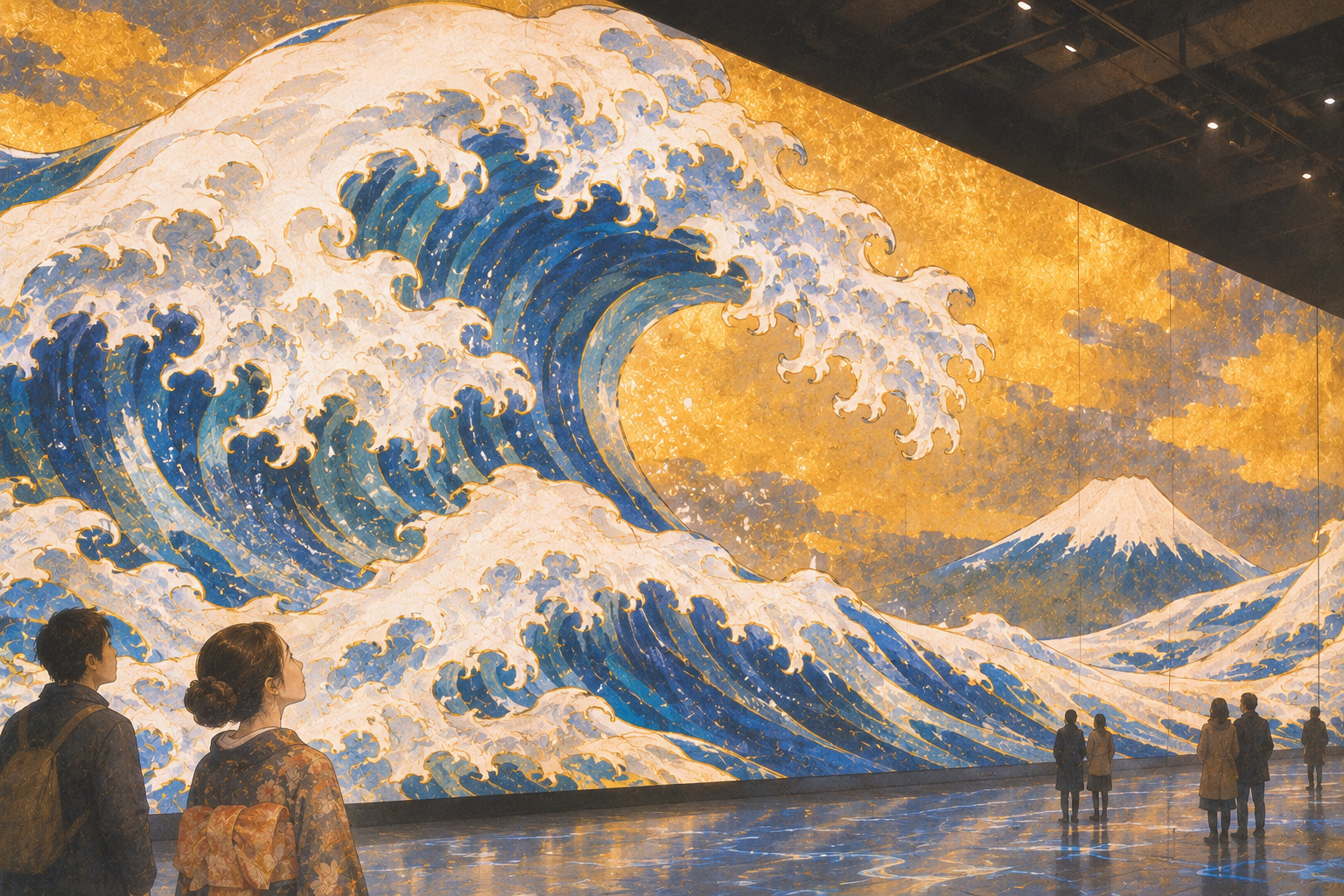
- A wave on the wall—and a museum with two opening dates
- What the figure of 300 actually means
- A distinctly Gifu contribution: more than 50 museum prints
- Before computers, ukiyo-e was already a collaborative technology
- Six masters, six different ways of seeing
- Forty years of history—and a reason to renovate
- The landscape that gives the show its identity
- Can moving an image teach us how it was printed?
- A civic institution meets a regional newspaper anniversary
- Planning a visit: what the official information says
- The real measure of an immersive exhibition
A wave on the wall—and a museum with two opening dates
The great temptation of immersive ukiyo-e is to describe what it feels like to stand in the middle of a moving woodblock print. In Gifu, that experience is being offered by Moving Ukiyo-e Exhibition GIFU, which opened on November 6 at the Gifu City Museum of History. Yet the institution has a second date essential to the story. Its renovated permanent galleries reopened on November 3 after approximately a year of closure. The immersive show is a temporary exhibition in the first-floor special gallery; the renovated second-floor historical display is a separate, permanent undertaking. That distinction matters because Gifu is trying to do two things at once: draw new audiences with spectacular moving images while rebuilding the way its public museum tells the city's history.
What the figure of 300 actually means
The organizers say the digital installations draw on more than 300 works by celebrated ukiyo-e artists. That is a count of source artworks for interpretation, not a statement that 300 original Edo-period woodblock prints are hanging in the exhibition rooms. The experience uses 3D computer graphics and projection mapping to turn print imagery into spatial presentations. Separately, original prints from the Edo period and reproduction prints are displayed with historical explanations. The distinction between an authentic historical object, a reproduction and a contemporary animation should not be lost in a headline. They do different jobs, and the exhibition's educational credibility depends on visitors being able to distinguish them. An immersive spectacle can be informed by history without itself becoming historical evidence.
A distinctly Gifu contribution: more than 50 museum prints
The most distinctive claim is not simply that masterpieces by Hokusai and Hiroshige can be made to move. It is that the Gifu City Museum of History has contributed imagery from more than 50 ukiyo-e works in its own collection to new locally developed content. Among the Gifu-connected themes are cormorant fishing on the Nagara River and Oda Nobunaga, the warlord whose association with the city is central to its identity. A projection of firelight on a river or a dramatic military figure may be arresting; it cannot on its own convey the labor of the cormorant masters or the historical evidence behind Nobunaga's image. The real opportunity is to connect a spectacular visual introduction with objects, documents and places that visitors can encounter beyond the screen.
Before computers, ukiyo-e was already a collaborative technology
Ukiyo-e is sometimes discussed as if it were simply a painter's finished image. Printed ukiyo-e, however, required a chain of specialists. An artist designed the image, a carver cut the woodblocks, a printer applied inks and aligned impressions, and a publisher financed and distributed the result. Japan's national performing-arts educational archive traces the emergence of sophisticated multicolor nishiki-e prints to Suzuki Harunobu's 1765 calendar prints. Color registration grew increasingly elaborate. Digital animation is not the same craft, and contemporary technicians cannot be treated as direct successors to Edo artisans. But this history challenges the idea that ukiyo-e was ever a purely solitary art. It has long depended on systems of reproduction, skilled hands and the possibilities of changing technology.
Six masters, six different ways of seeing
The advertised artists deserve to be approached as individuals rather than blended into one generic aesthetic. Katsushika Hokusai is celebrated for forceful forms and inventive landscape composition. Utagawa Hiroshige brings weather, travel and atmosphere into the print. Utagawa Kuniyoshi is known for muscular warrior imagery and playful invention; Kitagawa Utamaro for his sensitive treatment of figures; Toshusai Sharaku for incisive kabuki-actor portraits; and Utagawa Kunisada for the expansive world of actors and popular life. These works emerged within different artistic problems and markets. Animation may make details larger and easier to notice, but it can also flatten individual voices into a unified visual effect. A responsible exhibition helps visitors return from the spectacle to the decisions made by each artist.
Forty years of history—and a reason to renovate
Gifu City Museum of History opened on November 1, 1985. In a July 2026 briefing, the mayor described more than 3.3 million cumulative visits and said the equipment had aged while recent attendance growth had been disappointing. The institution closed on October 23, 2025, to update its permanent galleries. Reopening took place on November 3, 2026, with new interactive and digitized materials and a renewed focus on the Sengoku era. Such changes are not incidental to an exhibition about moving prints. The museum faces a familiar institutional challenge: how to welcome families and visitors accustomed to digital media without diluting the evidentiary work of a historical collection. That is why the permanent display deserves as much attention as the temporary projections.
The landscape that gives the show its identity
Visitors to Gifu encounter an unusually clear relationship between landscape and history. Gifu Castle stands above the city on Mount Kinka, while the Nagara River is associated with cormorant fishing documented over many centuries. Gifu City's heritage materials trace a reference to cormorant-keeping as far back as a 702 register, although such records must be interpreted carefully rather than treated as proof that every modern custom has persisted unchanged. The city also locates Oda Nobunaga within the story of its castle and the Sengoku period. These are precisely the local subjects the exhibition uses in its own digital content. They have a life beyond the museum, in archives, working traditions and the geography outside the walls.
Can moving an image teach us how it was printed?
Scale and movement have obvious benefits. A visitor who knows nothing about a woodblock print may find its dramatic forms immediately legible when projected across a room. Yet the source object has characteristics that do not survive an unlimited enlargement: fibrous paper, layered pigments, tiny imperfections of registration, and the deliberate compression of time into a still composition. A moving wave can be thrilling while still obscuring what the printmaker achieved without motion. This is not an argument against digital exhibitions. The museum's decision to show actual Edo prints and reproductions creates a useful second stage: move from projection to paper, and compare why the image was compelling before a computer animated it. That is a more interesting test of educational success than simply counting projected pixels.
A civic institution meets a regional newspaper anniversary
The formal Japanese title describes the exhibition as both a celebration of the museum's renewal and the Gifu Shimbun newspaper's 145th anniversary. The executive committee includes Gifu City, Gifu Shimbun, Gifu Broadcasting, Hitohata and TV Aichi; production is credited to Hitohata and TV Aichi. This mix of public history, local media and digital production helps explain the event's scale. It also raises an important editorial distinction: promotional claims about spectacle and accessibility are organizers' descriptions, while assessments of historical depth require independent viewing and expert evaluation. There is no basis in the reviewed official material for asserting visitor satisfaction levels or that the show has already improved museum attendance.
Planning a visit: what the official information says
The exhibition runs November 6, 2026, to January 11, 2027, in the museum's first-floor special gallery inside Gifu Park. Daily hours are 9 a.m. to 5 p.m., with final entry at 4:30 p.m. Mondays are generally closed, but November 23 and January 11 are open; November 24 and December 28 through January 4 are listed as closures. At-the-door admission is ¥1,500 for high-school students and adults, and ¥700 for elementary and junior-high students. The museum lists discounts for eligible groups and visitors in traditional Japanese clothing, and free admission for certain categories. The same exhibition ticket includes the renovated second-floor general gallery. Visitors using outside ticketing platforms should check the museum's instructions about exchanging tickets and timed access to the second floor.
The real measure of an immersive exhibition
There is a meaningful difference between giving an old artwork a dramatic new surface and helping a visitor understand why it mattered. Gifu's exhibition has a promising local advantage: paintings and prints from its own holdings form the basis of new content about the river, the castle and its people. The permanent galleries nearby can supply the historical grounding that a giant moving image alone cannot. The show offers a test of whether immersive art can be the start of an encounter with Japanese visual culture rather than its conclusion. This report is based on the museum's published records, city information and specialist historical sources. It does not claim that JAPAN.co.jp visited the exhibition or conducted interviews with its creators or visitors.
Sources and reporting method
The exhibition organizer’s claims are attributed, not presented as independent evaluations. Museum reopening, exhibition opening, reference artworks and displayed physical prints are explicitly distinguished.
- Gifu City Museum of History: official exhibition details
- Gifu City: museum reopening announcement
- Gifu City: mayoral briefing on museum history and renewal
- Official exhibition organizer and visitor guide
- Gifu City: exhibition ticket prices
- Gifu City Museum of History: English exhibition release
- Gifu City: museum location and contact
- Japan Arts Council: history of multicolor ukiyo-e prints
- Japan Search: nishiki-e and printing history
- Gifu City: Nagara River cormorant-fishing heritage
- Gifu Shimbun: November 3 museum reopening report