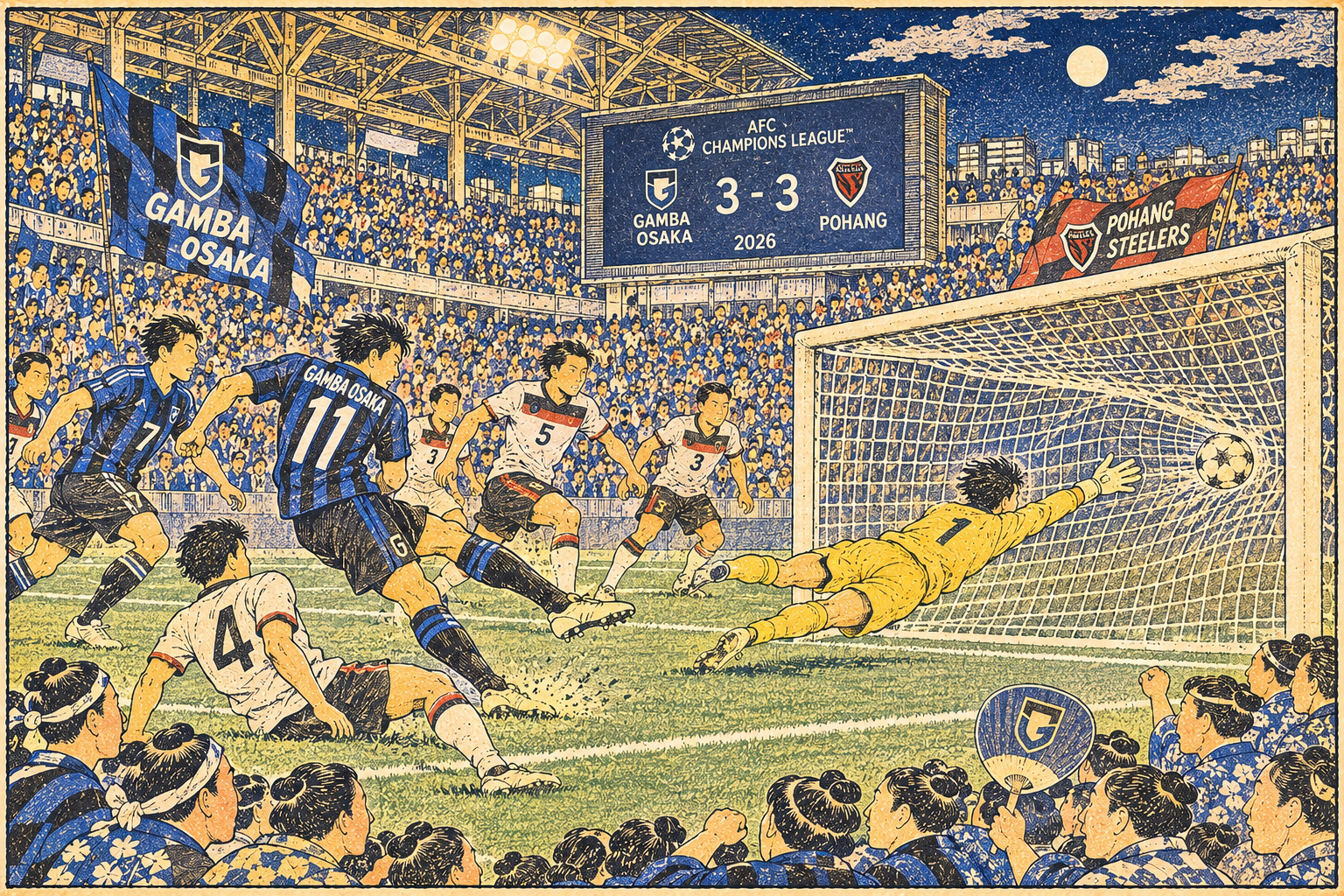
- A winning position, three times — and a point at the end
- Six goals, one recurring pattern
- What the numbers do — and do not — explain
- The warning was already in Gamba’s own preview
- Substitutions changed the contest
- From Osaka’s 2008 triumph to a new continental campaign
- Pohang was not an unknown opponent
- The format makes every late equalizer expensive
- Nine matches in a row, and an Osaka derby next
- Why this match matters beyond Gamba
A winning position, three times — and a point at the end
Three times Gamba Osaka went ahead at the Pohang Steel Yard on Wednesday night. Three times Pohang Steelers found a way back. In the last of those turns, Kim Gwang-won, introduced as a late substitute, scored in the 89th minute to make it 3–3. For the visitors, a game of six goals and genuine attacking promise ended with a result that will feel closer to a missed opportunity than a hard-earned recovery.
The November 4 encounter was matchday four of the East region in the 2026/27 AFC Champions League Elite. Gamba entered after two wins and one draw, while Pohang had lost their opening three. That disparity raised the stakes of a match in which the Japanese side could have strengthened its position among the eight eastern clubs that progress to the next phase. The draw instead left Gamba third with eight points; Pohang collected their first point.
The scoreline conceals the important story. Gamba created enough to score three times away from home, including two goals in ten second-half minutes. But the intervals between their goals revealed a side unable to turn an advantage into control. The issue is not whether one late defensive mistake cost a match. It is why the same problem returned after every lead.
Six goals, one recurring pattern
Ryotaro Meshino put Gamba ahead in the 34th minute, finishing a move credited with an assist by Soya Fujiwara. The lead lasted until the 55th minute when Wanderson, introduced at halftime, headed in from Kim Dong-jin’s delivery. Eli Adams restored the visitors’ advantage in the 69th minute, only for Jorge Teixeira to level at 2–2 in the 77th.
The match appeared to turn decisively in Osaka’s favor in the 79th minute, when substitute Koshiro Sumi scored after a pass from Ryoya Yamashita. This was the third time Gamba had taken the lead. Yet in the 89th minute another substitute, Kim Gwang-won, scored from a Cho Sang-hyeok assist, leaving the teams level at full time.
The scoring sequence is independently reflected in the post-match Reuters roundup and public event timelines. It supports a clear account of leads and equalizers; it does not by itself establish the exact tactical positioning or fault of any named defender at each moment. Those questions require video and a verified technical match report.
What the numbers do — and do not — explain
Available statistical feeds indicate Gamba held roughly 55 percent of possession and attempted 15 shots to Pohang’s 12. The home side, however, registered more attempts on target in the same feeds. Such numbers fit the broader impression of a team with meaningful territory and attacking volume but vulnerable when its opponents found chances.
The most meaningful number is three: Gamba’s three leads were each canceled out. That does not prove a universal weakness under pressure, still less show that every concession came from the same cause. It does, however, create an immediate coaching question about game management after taking the lead: the distance between midfield and defense, the protection of wide channels, the choice to press or retreat, and the quality of clearances from dangerous zones.
Published statistical services are not fully consistent about shots on target and related derived measures. For that reason, this analysis treats those feeds as indicative rather than presenting advanced statistics, including expected goals, as authoritative without access to the AFC’s verified post-match dataset.
The warning was already in Gamba’s own preview
Before the match, Gamba’s official Japanese preview described nine consecutive competitive fixtures and pointed to a side gradually adapting to a new shape under head coach Myojin. The club reported 16 shots against Buriram United and 14 against Machida, emphasizing chances created but not consistently converted into victories. Pohang was presented as an opportunity to turn promising performance into three points.
That pre-match assessment makes the three goals in Korea significant. The attacking players did convert. But the result exposed a complementary weakness: goals count less if an opponent can quickly erase the advantage. The answer is not simply to demand more clinical finishing, as the pre-match preview did. Protecting the result becomes equally urgent.
Club previews are valuable evidence of a team’s stated priorities, not independent proof of what happened on the field. The match can be analyzed against the ambitions outlined before kickoff without inventing post-match comments or attributing tactical judgments to players who have not been interviewed.
Substitutions changed the contest
Pohang turned to Wanderson at the interval; he equalized ten minutes into the second half. The hosts later introduced Jorge Teixeira, whose 77th-minute goal restored parity, and finally Kim Gwang-won, who scored at 89 minutes. These interventions gave Pohang goals from changing personnel and demonstrated the difficulty Gamba faced in adjusting to fresh attackers.
Gamba also found a decisive-looking contribution from its bench. Sumi entered in the 61st minute and scored 18 minutes later, while Yamashita, introduced in the 72nd, supplied the final pass. The match was therefore not a simple story of one side using substitutes effectively and the other failing to do so. Both benches changed the scoreboard.
What matters for the next fixture is whether Gamba can maintain communication and structural clarity when the attacking profiles opposite them change. The timing and scorers are verifiable; interpretations of individual substitution decisions remain editorial analysis.
From Osaka’s 2008 triumph to a new continental campaign
Gamba Osaka’s continental history gives this draw more resonance than an ordinary midseason result. Under Akira Nishino, the club won the 2008 AFC Champions League, defeating Adelaide United 5–0 on aggregate in the final. It was a defining achievement for a Japanese side whose domestic record also included league championships in 2005 and 2014.
The club returned to continental glory in May 2026. Deniz Hümmet scored the only goal of the AFC Champions League Two final against Saudi Arabia’s Al Nassr, giving Gamba a 1–0 victory and its first major Asian trophy since 2008. The Asian Football Confederation identified Gamba as the first club from the East region to win both the premier and secondary continental titles.
That distinction matters because the 2026/27 Elite tournament asks a different question from the previous season’s triumph. Can a team that succeeded in the second-tier competition sustain the level of control required against the strongest opposition across the continent? A 3–3 draw in Pohang does not settle that question, but it exposes the margins.
Pohang was not an unknown opponent
The clubs had already met in the round of 16 of the 2025/26 Champions League Two. At the Pohang Steel Yard in February 2026, they drew 1–1: Ryoya Yamashita scored for Gamba, with Jorge Teixeira equalizing. Gamba subsequently advanced after winning the home second leg 2–1.
That earlier tie provides useful perspective. The same venue and some familiar names recur, but the matches belonged to different competitions and team circumstances. The November game came with Pohang still looking for its first point of the new Elite league phase, and a Japanese opponent attempting to convert an encouraging start into a commanding position.
Pohang’s South Korean football pedigree makes the result meaningful without requiring grand claims about national superiority. Club football is shaped by squads, schedules, managerial decisions and injuries. One draw cannot establish whether the J.League or K League is stronger overall.
The format makes every late equalizer expensive
The 2026/27 AFC Champions League Elite East league stage uses a table in which the top eight of 16 teams advance. Gamba’s eight points after four matches preserved a top-three position at the halfway mark, according to Reuters, but a win would have been worth two additional points.
Two points can matter when the table tightens. So can goals conceded, depending on the ultimate tiebreakers. It would be premature to forecast final qualification odds from one game without examining the other clubs’ remaining schedules, home and away balance, and official ranking criteria.
The correct conclusion on November 7 is therefore narrow but important: Gamba remain strongly placed, yet failed to turn a favorable match position into the maximum reward. The result is a warning, not a collapse.
Nine matches in a row, and an Osaka derby next
Gamba’s official pre-match materials described a punishing sequence of nine straight competitive matches. The calendar then brings a particularly charged domestic test: Cerezo Osaka visit for the Osaka derby on November 8. The short interval leaves limited time to recover, work on collective defensive organization and assess player fitness.
Match fatigue may be relevant when evaluating late concessions, but it is not an established explanation for the 89th-minute equalizer. Without verified tracking data and player reports, fatigue should be treated as one possible contributing factor rather than a diagnosis.
The wider challenge is allocation of effort across domestic and Asian competitions. Continental ambition becomes sustainable only when a squad can rotate effectively without losing its capacity to manage the most consequential minutes.
Why this match matters beyond Gamba
Japanese clubs regularly face the twin demands of domestic fixtures and continental travel. The growth of Asia’s elite club competition places more emphasis on squad construction, tactical adaptability and recovery management. Gamba’s display offers a vivid case study: attacking substitutions can change a match in your favor, but opposing benches can quickly shift the balance back.
For supporters, the immediate emotional story is an away win that vanished late. For coaching staffs and analysts, the more useful question is repeatability: what defensive patterns appear after a team scores, and can those moments be managed without surrendering attacking initiative?
Neither the third-place standing nor the bitter taste of the 3–3 draw should overshadow the other. Gamba produced three goals in Korea and kept itself near the top of the table. The task now is to turn that capacity into results that endure through the final whistle.
Sources and reporting method
The report uses Gamba Osaka, JFA, AFC and J.League records and a Reuters match roundup. Public event timelines provide secondary checks for scoring minutes and substitutions.
- J.League official match record / Jリーグ公式試合記録
- AFC competition match preview / AFC公式プレビュー
- Gamba Osaka official November 4 preview / ガンバ大阪・11月4日公式プレビュー
- JFA match calendar / 日本サッカー協会・大会日程
- AFC: 2025/26 ACL Two final / AFC・2025/26 ACL Two決勝
- AFC: history of Gamba’s titles / AFC・ガンバ大阪の歴史
- Gamba Osaka club history / ガンバ大阪・クラブの歩み
- J.League: previous Pohang–Gamba tie, February 2026 / Jリーグ・2026年2月の対戦
- Reuters: November 4 match roundup / ロイター・11月4日のACL結果
- LiveScore event timeline / 試合経過・得点時刻の照合