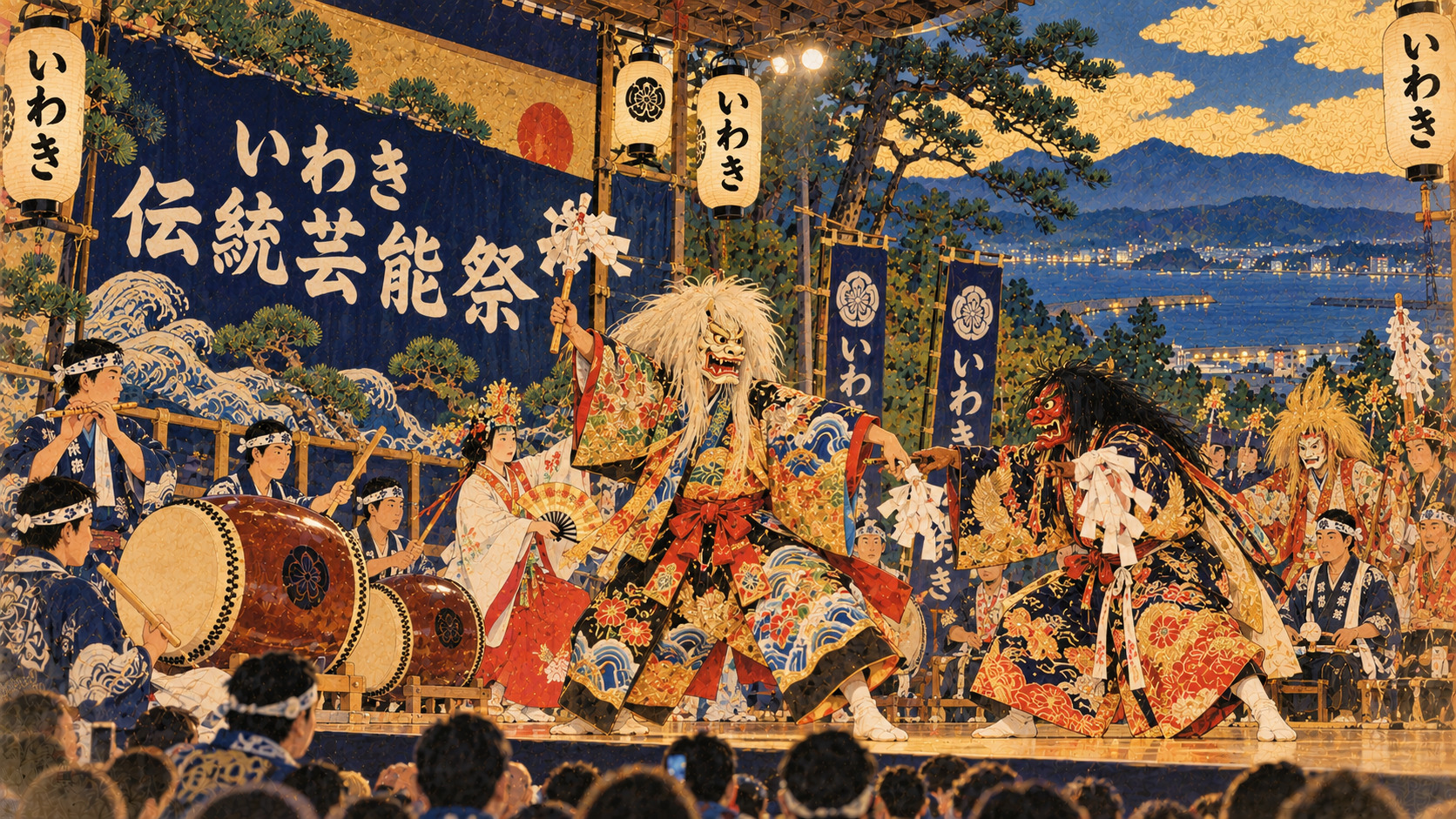
A stage for places that have endured
On November 7 and 8, a theater in Iwaki will become a meeting place for communities from across Fukushima Prefecture. The 2026 Furusato no Matsuri—roughly, Festival of the Hometowns—brings together 17 folk-performing-arts groups for a free program of kagura, lion dances, ritual movement and regional traditions. A high-school hula dance group will also appear in a separate presentation. What links the performances is more than spectacle: each survives through people who remember movements, maintain costumes, teach rhythms and create reasons for the next generation to participate.
Why the festival began in 2012
The prefecture established Furusato no Matsuri in 2012 with two explicit ambitions: protecting folk performing arts and rebuilding connections among people. That timing matters. The March 2011 earthquake, tsunami and Fukushima Daiichi nuclear disaster disrupted not only buildings and livelihoods but the social networks that make communal ceremonies possible. When practitioners are dispersed, a tradition cannot simply resume because a stage is available. Rehearsal, transport, instruments, costumes and younger recruits all require support. Prefectural recovery documents describe assistance for damaged equipment, travel to practice sessions and opportunities for groups to perform.
What kagura, shishimai and nenbutsu odori mean
Japan’s folk performing arts are not a single uniform tradition. Kagura refers broadly to forms of dance and music associated with Shinto ritual, but the choreography and stories vary. Shishimai, or lion dance, involves masks and movement traditions that differ from village to village. Nenbutsu odori connects dance with Buddhist invocation and remembrance, although its particular roles and local histories must be understood on their own terms. The Iwaki event creates a rare opportunity to compare these forms without treating one performance as a substitute for another.
Saturday: six groups, three regions
The November 7 bill, scheduled from 2 to 5 p.m., includes Suzuiishi Higashimachi Kyōrakukai of Nihonmatsu, Fukuda Jūni Kagura Hozonkai of Shinchi, Aizu Dainenbutsu Sesshukō Hozonkai from Kitakata and Yugawa, Namie Kawazoe Geinō Hozonkai, Shitamachi Kodomo Teodori Hozonkai of Minamisoma, and Shimohirakubo Seinenkai of Iwaki. The mix crosses the broad regional geography of Aizu, Nakadori and Hamadori. A participatory lion-mask blessing is listed at 1:20 p.m., before the principal performance window, and an experience with nenbutsu dance at 2 p.m. The prefecture cautions that timings are planned, not guaranteed.
Sunday: eleven preservation groups and a high-school performance
On November 8, the program is scheduled from 10 a.m. until 5 p.m. Participants include Kinuyā lion dancers of Iwaki, Minamiyunoki kagura performers from Minamisoma, the Maesawa Onna Hōzai dance group of Futaba, Takijiri bōsasara performers from Iwaki, Aizu Bandai miko dancers, Kaminōhara jangara performers, Ōkura daidai kagura from Tamura, Kumagawa chigo-shishimai from Ōkuma, Iitate’s Sōma Nagareyama dancers, Ono-Ōkura lion dancers and the Ōkunidama Shrine Yamato dance preservation group. The prefecture also lists Iwaki Yumoto High School’s Hula Dance Club, Velina Mahalo, as an attraction. English renderings of several group names are editorial transliterations; the official Japanese titles govern.
The disaster did not erase the older history
Fukushima’s folk traditions long predate 2011. Their relationship to seasonal rites, festivals, religious observance and local identity developed over generations. Yet the disaster exposed the vulnerability of this living heritage. A prefectural study of post-disaster performance traditions describes damaged communities, lost costumes and instruments and efforts to restart activities. One example, the rice-planting dance associated with Murakami in Minamisoma’s Odaka district, experienced devastating losses after the tsunami. That case provides historical context; it should not be confused with a claim that every group performing this November suffered the same experience.
Reconnection is a practice, not a slogan
Festival organizers can give a group an audience, but preservation depends on what happens afterward: regular practice, travel between scattered households, reliable leadership and young participants willing to inherit specialized skills. The prefecture’s own historical programs have recognized those practical needs. Such support also raises a policy question. How can a public celebration strengthen the ordinary community conditions that keep music and dance alive when a festival ends? A strong showing in Iwaki does not in itself establish that any tradition is permanently secure.
More than something to watch
Organizers have planned five participatory folk-arts sessions across the weekend, including lion-head blessings, nenbutsu dance and traditional instrument experiences. On both days, the first 50 people may join a Futaba daruma-painting activity connected with Fukushima prefectural government’s 150th-anniversary observance. These activities turn an audience into participants—an important distinction when cultural continuity depends on people doing, not only observing. The participation arrangements and time slots may change, so visitors should verify them on the official event page.
A traveling festival with a longer memory
The festival’s recent geography is telling. In 2025 it was staged at Michi-no-Eki Namie; in 2024 it took place in Koriyama, and in 2023 in Onahama. Rotating locations makes it possible for different communities to host performers and for audiences to encounter traditions outside their usual local circle. The choice of Iwaki Arts and Culture Exchange Hall Alios in 2026 offers a theater setting for art forms that often belong to shrines, streets and community spaces. The stage changes; the people and local contexts behind the dances remain essential.
A practical guide to November 7–8
The official venue is the Sekishō Middle Theater at Iwaki Arts and Culture Exchange Hall Alios, 1-6 Taira Misaki, Iwaki City. Admission to the performances is free. Saturday’s scheduled hours are 2–5 p.m., and Sunday’s are 10 a.m.–5 p.m. The Fukushima Prefecture page contains the full cast list, experience schedule and downloadable program. Anyone traveling to see one particular tradition should check the latest run of show directly rather than assume an exact performance time from this article.
The future contained in a dance
A ritual performance can be both an expression of the past and an act of planning for the future. Its steps are remembered by individuals, but its survival is collective. That is why the small practical details—who stores the masks, who arranges rehearsal transport, who teaches the children—belong at the center of the story. When the drums sound in Iwaki this November, they will carry more than the promise of two memorable afternoons. They will ask what it takes to keep a place’s cultural memory alive.
Sources and reporting notes
Based on Fukushima Prefecture’s October 28, 2026 program and historical cultural-preservation documents. No interviews with participating groups were conducted.