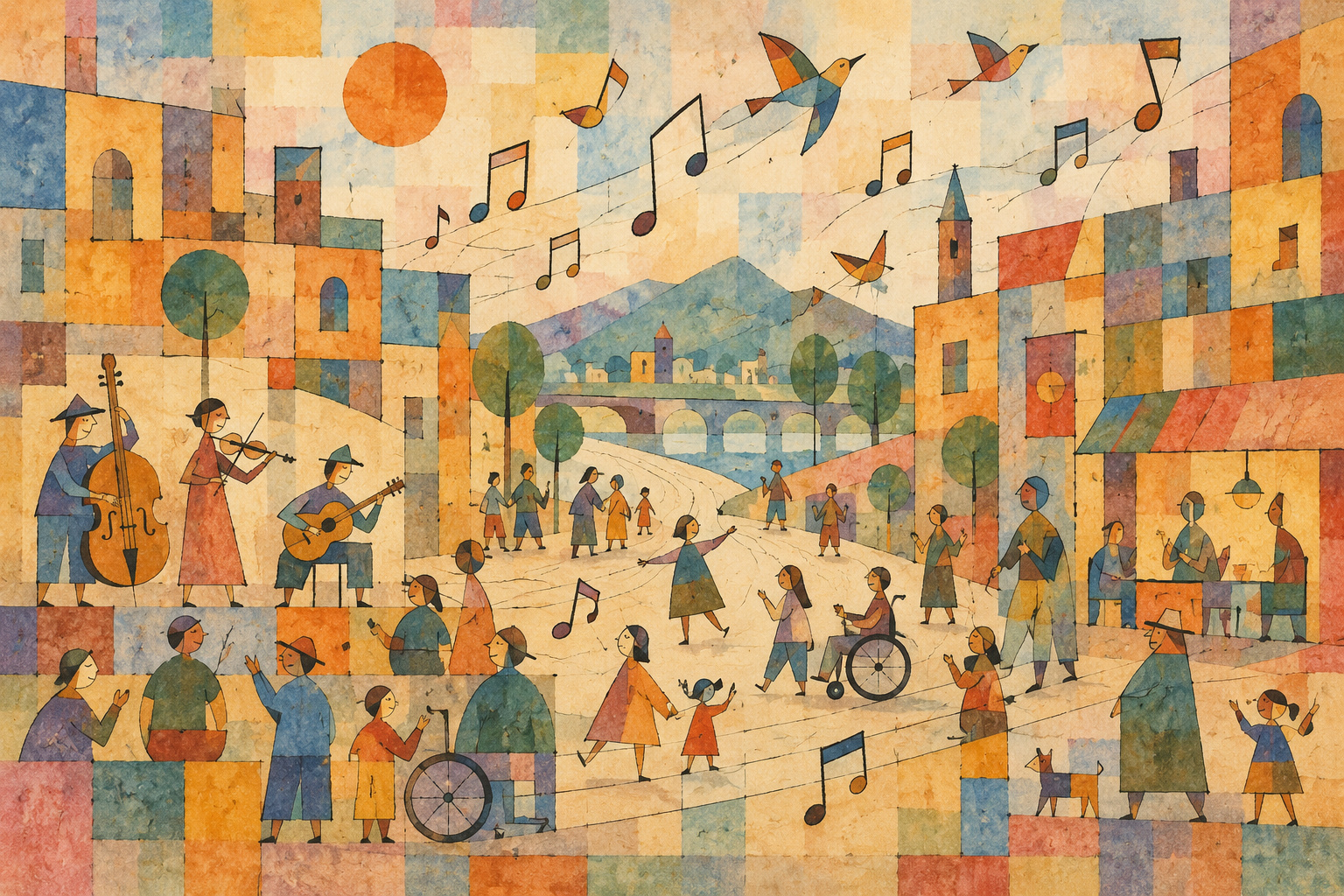
A city-center music festival can reach someone who never planned to attend a concert. A passerby hears a tune, pauses, and becomes part of an audience. Fukushima’s Totteoki festival is built around that possibility—and around the conviction that disabled and nondisabled people should share the opportunity to perform, listen and help make the event happen.
The 14th Totteoki Music Festival in Fukushima is scheduled for Saturday, September 19, 2026, with activity beginning at 10 a.m. across four sites near Fukushima Station. Its significance extends beyond the afternoon’s entertainment. The local festival began in the earthquake year of 2011, and its history connects a small act of civic determination with the continuing work of making cultural participation more open. [1][3]
Four stages, different starting times
The official performance sheets place stages at the station’s east-exit plaza and along Ekimae-dori, outside the Esta building, Seven-Eleven and the AXC building. They describe overlapping programs, not one continuous show that moves through all four sites. The times below are the first and last listed performance slots at each location, subject to changes. [2]
| Stage | Listed performance window (JST) |
|---|---|
| Station east-exit plaza | 11:10 a.m.–3:40 p.m. |
| Ekimae-dori: Esta building | 10 a.m.–4:15 p.m. |
| Ekimae-dori: Seven-Eleven | 10 a.m.–4:50 p.m. |
| Ekimae-dori: AXC building | 10 a.m.–3:40 p.m. |
For visitors, the distinction matters: the street stages start before the plaza’s first listed act. The schedule’s latest performance ends at 4:50 p.m.; that does not mean the surrounding traffic restrictions end then. Local publication CJ Monmo lists admission as free. [2][9]
There is no need to turn the visit into a race between stages. Choosing one performance and allowing time to linger can be a better way to encounter music outside an established taste. A short visit before shopping or meeting a friend still makes someone a listener. That modest threshold is part of what a street festival can offer.
The idea traveled from Sendai
Totteoki began in Sendai in 2001. The Fukushima organizers’ history connects the first event to that year’s national sports competition for people with disabilities: organizers sought a musical counterpart, with disabled and nondisabled performers sharing an outdoor stage. [3]
The Sendai committee explains the name as a rendering of “Very Special,” expressing the value of each individual and the joy of personal expression. Its aim of removing barriers “of the heart” addresses how people regard one another, alongside the choice to take music into open city spaces. [4]
In Japan.co.jp’s reading, the useful challenge is to listen without reducing a performer to a category. Disability may affect the support someone needs, but it does not supply a complete account of that person’s music. Treating the performance as an act of artistic choice and taking access requirements seriously are compatible responsibilities.
A first festival in the disaster year
Plans for a Fukushima event were underway when the Great East Japan Earthquake struck. According to the organizing committee, cancellation was considered, but music brought by visiting musicians helped encourage the decision to proceed. The first local festival took place on September 23, 2011, with eight acts and 37 performers. [3]
That history deserves care. It records a decision to make room for expression during a devastating period; it does not establish that music repaired every loss or that every resident experienced the event in the same way. The small scale of the beginning makes the organizational choice easier to see. People arranged a place and a time at which others could gather.
The 2026 announcement calls this the 14th edition. Years elapsed since the beginning and the number of editions are different measures. More importantly, the festival’s origin should not determine every story told about today’s participants. Their present interests, rehearsals and musical ambitions also belong in the account.
A program rooted in everyday musical life
The official sheets range across ukulele, rock, jazz, gospel and dance. The opening act outside the Esta building is the ukulele circle Mahaloha, whose published profile says it formed in 2008 and works mainly around Fukushima and Date. At the east-exit plaza, flores de colza describes a repertoire of Andean music. These are performers’ own introductions within the official program. [2]
Another listed act, Tossins, appears as a family band at the AXC site at 11:45 a.m. Elsewhere, school music activities and groups connected with disability services share the program with other ensembles. The range suggests a festival drawing on existing communities of practice: people who already meet, learn and rehearse, then bring that activity into public view. [2]
For an audience, the opportunity is not simply to applaud a worthy idea. It is to encounter a particular voice, rhythm or ensemble. A familiar tune might invite a first pause; an unfamiliar sound might persuade someone to stay. Connection begins with attention to what people have actually chosen to present.
What happens between the songs
The performer instructions allocate 25 minutes to a set and 10 minutes for clearing equipment and setting up the next group. They ask acts to keep to their finishing time even if a start is delayed, and tell those who need help setting up to raise it at reception. [5]
These are practical arrangements with a social purpose. One group’s extra minutes can become another group’s lost opportunity. A smooth changeover depends on people doing work the audience may barely notice. The event’s shared character is expressed through that cooperation as well as through the music itself.
The committee’s volunteer page invites involvement in planning, preparation and operation, and says disabled and nondisabled people work together within the committee too. Participation is therefore not confined to a place in front of a microphone. Anyone interested in helping should ask about an appropriate role and the current arrangements, rather than assume a last-minute place is available. [6]
Free to hear, supported by a community
The organizers say sponsorship advertising and donations fund the festival. Free admission and cost-free production are very different things. Keeping an event open to a casual listener requires somebody to organize the space, handle equipment and meet expenses. [7]
That structure gives local support a tangible purpose, but it does not by itself establish a financial benefit for the surrounding district. This report has not verified an economic-impact study or a measured change in participants’ attitudes. Those outcomes should not be inferred from a busy-looking street.
A more modest possibility is still meaningful: someone hears a group for the first time, learns that it rehearses nearby, and has a reason to take an interest again. A shop visit, a conversation or another rehearsal may follow. Those are potential connections, not achievements that can be announced before the festival takes place.
Access includes the journey
Fukushima Transportation has announced diversions from 6 a.m. to 9 p.m. on September 19, with the Ekimae-dori stop suspended for specified services. The notice covers designated Higashihamacho Line journeys and diversions for the weekend/holiday Melody Bus route; it says Melody Bus stops will not be suspended. Riders should consult the operator’s notice for their particular departure. [8]
The location near a station is convenient in principle, but it is not a complete accessibility assessment. Step-free routes, toilets, places to rest, sound levels and the way information is communicated can matter differently to different visitors. The festival’s inclusive purpose should not be presented as a guarantee that every requirement has already been met.
Ask organizers about specific needs in advance, leave room in pedestrian routes, and allow time to move between performances. Choosing fewer stages can make the experience more comfortable than attempting every possible change of scene. That is a visitor-planning suggestion, not a claim about verified facilities.
The organizers say the event will proceed in rain but be canceled in the event of a typhoon or disaster, with no postponement planned. Check the official site close to departure. Advance announcements cannot establish the day’s weather or confirm that every scheduled set has gone ahead. [5]
A public place to pay attention
Fukushima’s festival does not have to promise that one afternoon will dissolve social barriers. Its more immediate offer is a shared public occasion. People can meet first as musicians and listeners, then discover something of the lives and groups behind the performance.
The 2011 beginning explains why the occasion carries history. The 2026 program shows why it also belongs to the present: rehearsed songs, familiar friendships, new audiences and the work of making space for the next act. For someone crossing the station district, a few minutes spent listening may turn an ordinary route through town into a different kind of encounter.
- Organizing committee: 14th festival announcement, May 19, 2026
- Organizing committee: four official stage schedules, August 10
- Organizing committee: origins and the first Fukushima festival
- Sendai organizing committee: purpose and meaning of the name
- Organizing committee: performer instructions, August 28
- Organizing committee: volunteering and participation
- Organizing committee: sponsorship and donations
- Fukushima Transportation: September 19 bus diversions, notice dated September 9
- CJ Monmo: September 12 event listing, including free admission
- Organizing committee: 2026 venue announcement, July 30
Event information describes announced plans. Performer descriptions derive from their published program profiles. Interpretation and visitor-planning advice are Japan.co.jp analysis.