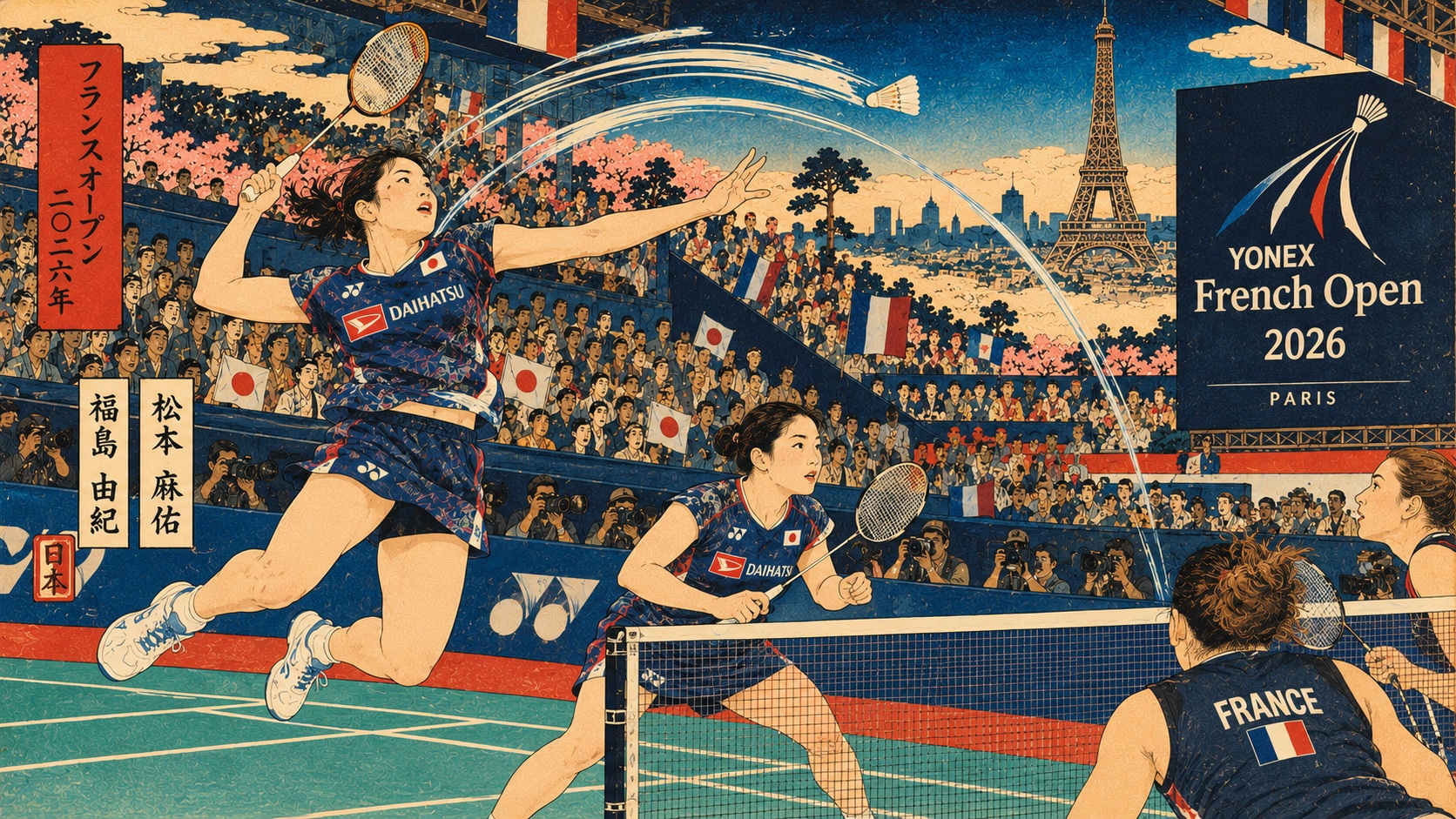
The rivals of yesterday became the doubles partners who found a way back.
A final that appeared to be slipping away
At the French Open badminton final on October 25, 2026, Japan’s Yuki Fukushima and Mayu Matsumoto found themselves outplayed in the opening game by Malaysia’s Pearly Tan and Thinaah Muralitharan. The score was 10–21. An hour-long final on the outskirts of Paris might have become another chapter in the Malaysian pair’s winning streak. Instead, the Japanese duo changed the direction of the match, winning 21–17 and 21–16 to take the women’s doubles title in 64 minutes. It was a comeback, but also a reminder that doubles is a sport of partnership rather than just the sum of two individual players.
The Malaysians dictated the opening
Specialist Japanese publication BADMINTON SPIRIT described Tan and Muralitharan racing ahead 8–1 in the first game. Fukushima and Matsumoto reduced the gap to 8–11 before the Malaysians asserted themselves again. That was not an innocuous lapse from Japan; the opposition had won the Denmark Open only a week earlier. Tan and Muralitharan were among the world’s leading doubles pairs and arrived with momentum. The challenge for the Japanese players was to create more useful attacking opportunities without gifting the Malaysians easy points.
How the formation began to work
In the second game, Fukushima increasingly constructed exchanges from the back of the court while Matsumoto was poised to capitalize at the net, according to the Japanese specialist match report. A run of six unanswered points helped them take the game 21–17. Doubles positions are not permanent occupations: players rotate constantly according to whether they are defending, attacking or trying to recover court space. But creating the right shot for a partner is fundamental. The match report suggests that this coordination changed the rhythm of the contest.
The pressure returned in the deciding game
Fukushima and Matsumoto raced to an 8–2 lead in the third game and were ahead 16–11 later on. The Malaysians accelerated their play, but the Japanese duo mixed pace and attacking sequences effectively enough to stay in control. At match point, according to BADMINTON SPIRIT, consecutive attacking strokes by Fukushima brought the contest to a close. The final score, 10–21, 21–17, 21–16, reveals both the extent of the early disadvantage and the disciplined recovery. No official shot-speed or rally-by-rally analysis was available for this report, and tactical descriptions are attributed to specialist coverage.
Two players who used to stand on opposite sides
The partnership has an unusual history. Fukushima was half of the renowned Fukuhio partnership with Sayaka Hirota; Matsumoto won back-to-back world doubles championships in 2018 and 2019 alongside Wakana Nagahara, the pair known as Nagamatsu. Those old teams met in successive world-championship finals, with Matsumoto and Nagahara winning both. The rivalry was not a footnote. It was one of the defining stories of Japanese women’s doubles in that era. In September 2024, following the dissolution of their previous partnerships, Fukushima and Matsumoto announced that they would team up. Two former opponents were now solving problems together.
An extraordinary start—and a less tidy middle
Their new arrangement began at the Kumamoto Masters Japan in November 2024. At the Malaysia Open in January 2025, Fukushima and Matsumoto won their first World Tour title together, beating a Chinese pair in three games. The following October they won the French Open, coming through a 95-minute final against Chinese opponents. That makes the 2026 championship a successful defense, not their first victory at the event. They also won the Indonesia Open in June 2026. But progress was not uninterrupted: they suffered a first-round defeat at the Japan Open in July 2025. The setbacks help explain why the latest comeback has weight.
The experience behind the comeback
Fukushima represented Japan at the Tokyo Olympics alongside Hirota and reached three successive world championship finals in their former partnership. Matsumoto and Nagahara were world champions in 2018 and 2019, and Matsumoto competed at both the Tokyo and Paris Olympics. Elite experience gives a team resources under pressure, but it cannot remove the challenge of developing shared instincts. Players learn where their partner will move, which incoming shot they will prefer and when a risky attack is justified. This article cannot claim knowledge of their private training discussions; it can place their public results in a longer competitive history.
A final between near equals
Japanese specialist outlet SMASH and NET. TV listed the Japanese pair as world No. 3 and the Malaysians as No. 4 using rankings as of October 20. It reported their pre-final head-to-head as five wins apiece. Both statistics are time-specific. The pairing therefore mattered beyond national pride: this was a close contest between leading international teams, not simply a favorite fulfilling expectations. What changed after the first game was the balance of tactical control, as described by the available match coverage.
Another Japanese pair came close
Japan had two women’s doubles pairs in the semifinals. Rin Iwanaga and Kie Nakanishi fell to Tan and Muralitharan 17–21, 20–22, while Fukushima and Matsumoto defeated Indonesia’s Febi Setianingrum and Rachel Allessya Rose 21–18, 21–15. Those results show the depth of the competition across Japan, Malaysia and Indonesia. Women’s doubles in Asia is not a single-country story; it is a continually changing contest among accomplished teams. The title provides a valuable measure of performance but no guarantee about the next event.
The sporting infrastructure behind two names
Japan’s badminton association listed Fukushima’s affiliation as Gifu Bluvic and Matsumoto’s as HoneGori Sagamihara for the tournament. Corporate and community-based teams remain important parts of Japan’s badminton ecosystem, supporting athletes’ careers and the national team pipeline. The two players compete internationally as one pairing despite different organizational homes. How their coaches share responsibilities and how their daily training is structured were not independently verified, so this report does not speculate about them.
A title earned, not a future promised
This was the duo’s second consecutive French Open title and their second World Tour victory of 2026, following the Indonesia Open. These are established sporting achievements, not predictions of an Olympic medal or a permanent shift in the world hierarchy. No first-hand interview with either athlete was conducted for this article, and no invented quotation is offered as their reaction. The lasting image is simple: a final beginning with a heavy first-game defeat, then two former rivals finding the right way to win together.
Sources and verification
Cross-checked association records, specialist final reporting and past official sponsor releases. No first-hand interviews were conducted.
- Badminton Association of Japan, delegation roster
- BADMINTON SPIRIT, Oct. 25 final report
- SMASH and NET. TV, final and ranking context
- BADMINTON SPIRIT, semifinal results
- Yonex, the pair’s 2025 French Open win
- Yonex, first Malaysia Open victory in 2025
- Nikkan Sports, 2024 partnership formation
- Badminton Association of Japan, 2026 result notice