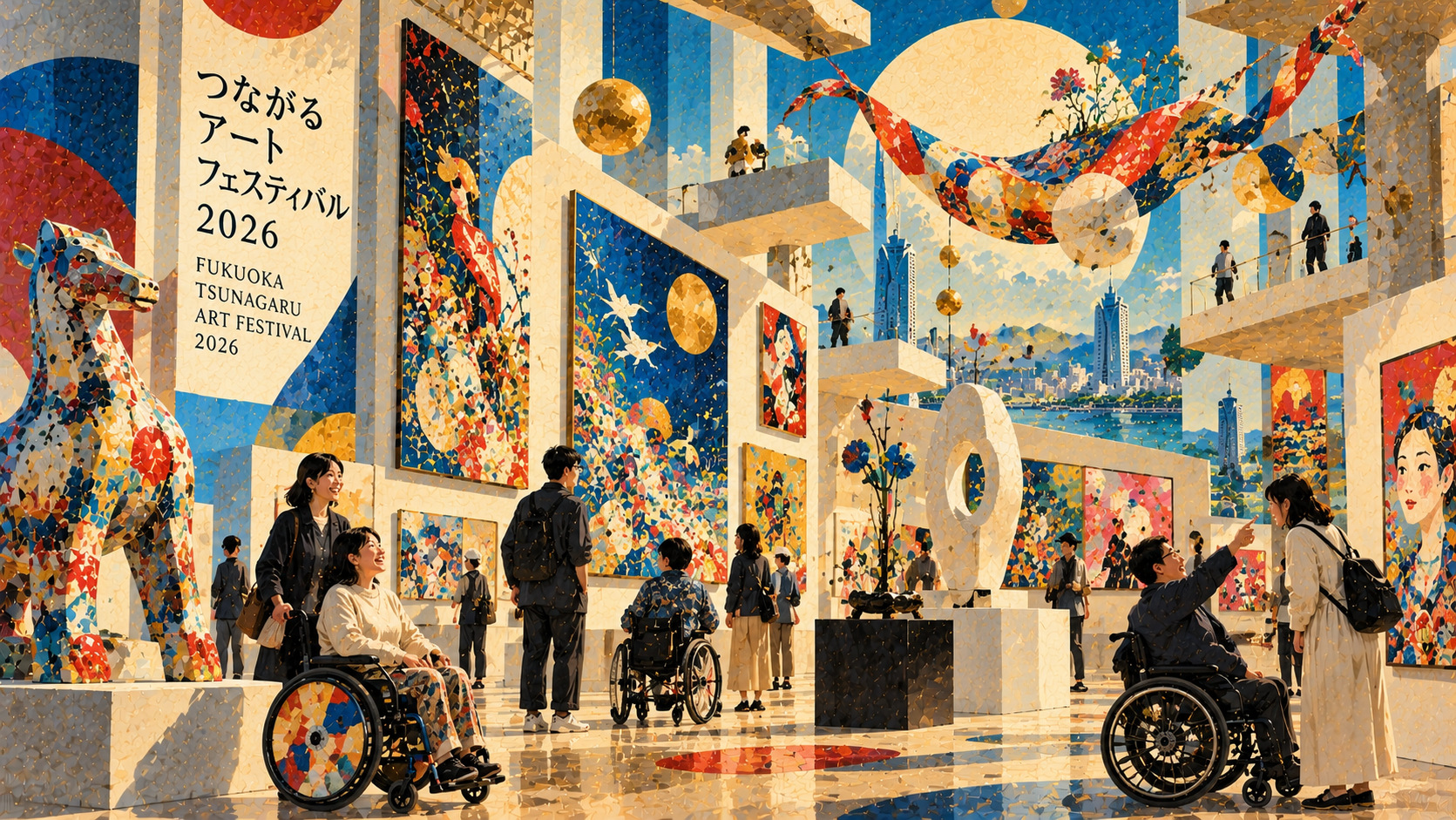
The question is not simply whether people with disabilities can exhibit. It is whether their work can be seen—and valued—as art.
An exhibition that asks who gets to be called an artist
In Chikugo, south of Fukuoka City, a gallery is opening its doors to a deceptively straightforward proposition: look at the art first. The prefecture announced on October 21 that Tsunagaru Art Festival FUKUOKA would run at Kyushu Geibunkan from October 24 through November 8, bringing together exhibitions and workshops by and for people with and without disabilities. Admission and listed activities are free.
The event arrives amid a broader argument in Japan about whether cultural inclusion means occasional celebration or lasting access to studios, galleries, income and audiences. The more demanding measure is not whether visitors leave feeling inspired. It is whether artists can make decisions about their own work and be recognized as creators, not symbols.
Chikugo, not downtown Fukuoka
The festival is held at Kyushu Geibunkan, 1131 Tsushima, Chikugo City, rather than in Fukuoka City. The official hours are 10 a.m. to 5 p.m., with closures on October 26 and November 2. Its regional setting is integral to the theme: an open-call exhibition asks artists working in Fukuoka Prefecture to respond to “Chikugo no ___,” loosely, “Something of Chikugo.”
That might mean its landscapes or produce, both specifically suggested by the prefecture. But the announcement does not identify the participating artists, individual works or exact number of submissions. It would be wrong to describe imaginary masterpieces, assert how the artists interpreted the brief, or turn one suggested theme into a claim about the whole collection.
The difference between showing art and sustaining artists
A second presentation, Magokoro Art FUKUOKA GALLERY, exhibits work made by people with disabilities. According to the prefecture, reproductions of works on display can be rented or purchased. This gives the festival a potentially important economic dimension. A framed print may end up in a home or business after the exhibition ends.
But art commerce is not automatically fair commerce. Who licenses the reproduction? What share of the payment reaches its creator? Is permission revocable, and how are image rights protected? The public announcement does not answer these questions. The real test is whether the resulting relationships treat the artist as a rights-holder and professional participant.
Hands-on events, with a limit to the promises
On October 24, a handicraft workshop was scheduled to use materials originating from welfare facilities. Gallery talks on October 31 and November 1 are intended to share episodes connected with exhibited works. A November 7 workshop invites visitors to color and make original pin badges. The handicraft and badge workshops require registration through the venue, according to the prefecture.
The opportunity is to move from making something oneself to asking how another person made something and why. An audience that notices material, color, rhythm and form is engaging with art. Warm feelings alone are not evidence of lasting educational or social effects. Organizers will have to evaluate those claims after the program, not before.
Accessibility means more than an open invitation
Free entry removes one barrier, but not every barrier. Travelers may need step-free transportation, accessible toilets, interpretation, captions, sensory accommodations, assistance with communication or clear information before a visit. Different people require different arrangements.
The October 21 release does not provide a full audited accessibility inventory for the venue or specific events. It is therefore not evidence that every form of accommodation is available. Prospective visitors should ask the organizing office about their particular needs. A serious account of inclusion distinguishes a welcoming intention from an independently verified service.
A 2018 law and the years that followed
Japan enacted the Act on Promotion of Cultural and Artistic Activities by Persons with Disabilities in June 2018. Its stated purposes include helping people exercise individuality and ability through culture and facilitating participation in society. National plans followed in 2019 and, for a second phase, in March 2023.
Legislation cannot by itself create affordable workspace, accessible exhibitions, equitable contracts or enduring careers. It provides an architecture for policy. Artists’ lived opportunities determine whether that architecture works. Fukuoka’s festival offers a local occasion to ask what has changed eight years after the law.
Fukuoka has its own five-year policy test
Fukuoka adopted its cultural-arts promotion ordinance in 2020. Its second prefectural cultural-arts development plan, covering fiscal 2026–2030, places the promotion of artistic activities by people with disabilities among four policy pillars. The plan also looks toward a new prefectural art museum planned for fiscal 2029.
The policy challenge is geographic as well as institutional. Exhibitions should not exist only at a single prominent museum or for a couple of weeks. Regional creators need repeated opportunities to show, sell and discuss work, with the freedom to decline participation on terms they do not accept. A festival may help build those pathways; it cannot substitute for them.
A separate exhibition with a similar mission
The prefecture has also announced the 2026 Fukuoka Prefectural Art Exhibition for Children and Adults with Disabilities, a different program soliciting painting, calligraphy and photography. Its schedule spans multiple venues from November 2026 into February 2027. This should not be confused with Tsunagaru, which has its own Chikugo exhibition theme and workshop program.
The distinction matters because eligibility, medium, prizes and curatorial approach can differ. Reporting on “disability art” as though it were one unified category flattens the experiences of artists and prevents the public from understanding how these programs actually operate.
The question of voice
Descriptions of disability arts can slip into a formula: difficulty overcome, audience moved, inspirational ending. That is not how critics usually review painting, sculpture or textile work. A fair account attends to compositional choices, materials and the maker’s intent—where that intent is available firsthand.
Fukuoka’s Disability Arts Support Center, known as FACT, describes aims that include expanding exhibition opportunities and developing artistic activity into work. Those aims suggest questions for interviews and later reporting, not outcomes that can be assumed to have occurred at this festival. The published notice does not identify artists willing to speak on the record.
How a public exhibition should be judged
After closing day, attendance will be only one available measurement. More revealing will be whether participants got repeat invitations, contracts were understandable, reproductions were properly licensed, audiences encountered unfamiliar local creators, and accessible ways of attending improved. Critics also have a role: writing about the art itself, not only the organizer’s social purpose.
There are no independently confirmed sales totals, visitor numbers or artist testimonials in the announcement. The festival’s October 24 opening likewise should not be narrated as an observed event without on-the-ground verification. At publication, the program is publicly scheduled; any claims about what happened during it require subsequent confirmation.
A visitor’s guide—and a more lasting invitation
Tsunagaru Art Festival FUKUOKA is scheduled for October 24–November 8 at Kyushu Geibunkan in Chikugo. Opening hours are 10 a.m.–5 p.m.; October 26 and November 2 are closing days. Admission and listed activities are free, although two workshops require advance registration. Contact details appear in Fukuoka Prefecture’s official announcement.
There is no requirement to love every work. It is enough to look closely and take the artist seriously. If someone encounters an unfamiliar color, strange structure or startling idea and wants to know who made it, the festival has already begun a conversation worth carrying into the next exhibition.
Sources and documentation
Verification: Based on the prefecture’s October 21 release and official policy documents. No original interviews or onsite reporting; individual artists, accommodations, visitor totals and sales results are not established.
- Fukuoka Prefecture, October 21 festival release
- Fukuoka Prefecture, second arts development plan 2026–2030
- Fukuoka Prefecture, 2020 cultural promotion ordinance
- Ministry of Health Labour and Welfare, disability arts law and plans
- Fukuoka Disability Arts Support Center FACT
- Fukuoka Prefecture 2026 disability visual arts exhibition
- Kyushu Geibunkan regional visitor information