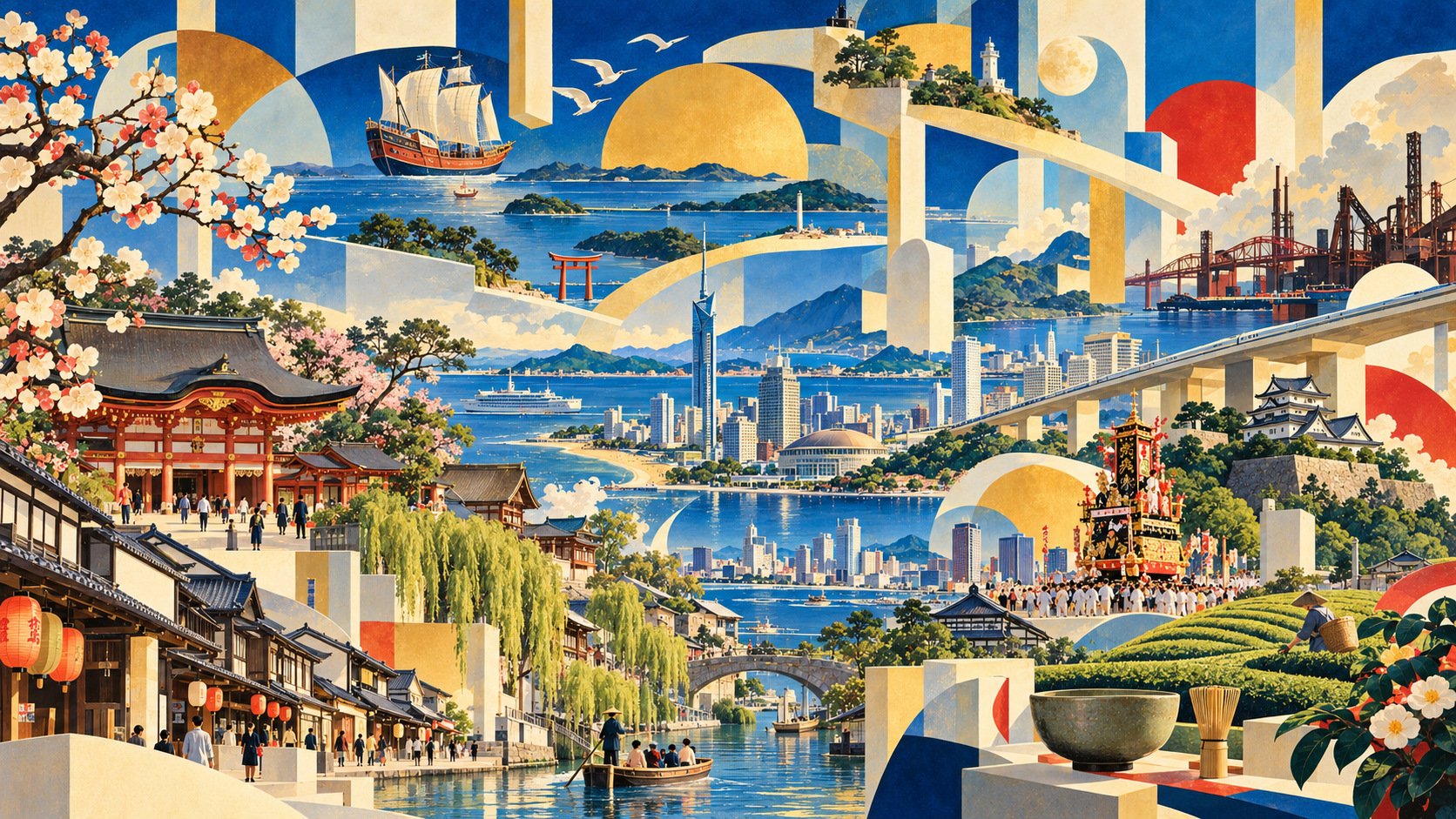
Fukuoka City grew. Kitakyushu shrank. One prefecture contains several futures.
A gateway with more than one door
A traveler landing at Fukuoka Airport can reach one of Japan’s liveliest city centers quickly. It is tempting to imagine that this is the whole story: ramen, nightlife, and effortless access to Kyushu. But northern Kyushu was connected to continental Asia long before modern aviation. Its ancient diplomatic institutions, merchant networks, coalfields, steelworks, and contemporary research economy make Fukuoka Prefecture a compressed history of Japan’s engagement with the world. Its latest census adds a harder question: what happens when the gateway city grows while much of the prefecture shrinks?
First, understand the map
Fukuoka City is not Fukuoka Prefecture. The city includes Hakata Station, Tenjin, major business districts, and waterfront neighborhoods. The prefecture also contains Kitakyushu’s industrial and port cities, Kurume’s medical and manufacturing institutions, the agricultural landscapes around Yame and Yanagawa, the old coal towns of Chikuho, and the coast of Itoshima. Hakata is both a present-day ward and the name of a centuries-old merchant port. These distinctions matter to history, investment decisions, and any itinerary that goes beyond the city center.
The census breaks a long pattern
The prefectural summary of Japan’s finalized 2025 census puts Fukuoka’s population at 5,077,785 on October 1, 2025, down 57,429, or 1.1%, from 2020. It was the first decline after successive increases in the census series from 1970 onward. Eleven municipalities gained population and 49 lost it. Fukuoka City registered the largest absolute gain, 50,401; Kitakyushu the largest fall, 35,437. Both are important cities. Their diverging trajectories are a reminder that a celebrated regional economy is not equally buoyant everywhere.
Aging changes the economics of place
People aged 65 and above numbered 1,447,798, or 28.5% of the prefectural population; those younger than 15 made up 12.1%, and working-age residents 59.4%. The prefecture had 2,412,177 households, with the average ordinary household size down to 2.05 people. Those figures translate into everyday decisions over buses, clinics, schools, empty properties, and the ability of towns to maintain local services. They also complicate simple claims about prosperity: more households can coexist with fewer people, and population gain alone does not measure security or quality of life.
A gold seal and Japan’s earliest diplomacy
The gold seal traditionally associated with the ruler of Na, granted by the Han court in AD 57 according to Chinese historical records, was discovered on Shikanoshima and is now held by Fukuoka City Museum. Its small dimensions belie its significance as evidence of an early diplomatic world. From the late seventh to the late eleventh century, the Kōrokan complex in the area of today’s Maizuru Park served diplomatic and trading functions. Dazaifu administered crucial imperial interests in Kyushu. The region’s openness to Asia was institutional, commercial, and sometimes defensive.
Hakata merchants and a castle town
Medieval Hakata developed as a commercial port linked to travelers, religions, goods, and ideas crossing the sea. In the early modern era, the Kuroda family’s castle town lent prominence to the name Fukuoka, while the older merchant identity of Hakata remained strong. A visit to Kushida Shrine and the Hakata Gion Yamakasa heritage evokes the world of townspeople and festivals; the ruins of Fukuoka Castle point toward the administrative and military counterpart. To see both is to understand why the two names still carry different resonances.
Coal and steel made another Fukuoka
Japan’s industrial rise transformed northern Kyushu. Chikuho coal powered factories and railways, while the government steelworks at Yawata began operating in 1901 and became central to modern heavy industry. Sites linked to the Yawata works and Miike coal complex form part of the World Heritage inscription for Sites of Japan’s Meiji Industrial Revolution. The story deserves neither uncritical nostalgia nor easy dismissal: industrial growth came with difficult labor histories, dangerous workplaces, pollution, and painful transitions after mines closed and industries were reorganized.
A diversified economy—and uneven rewards
Today, Fukuoka City concentrates commerce, universities, digital businesses and startup ambitions. Kitakyushu retains important manufacturing, transport, and environmental industries. Kurume has strengths in medicine and manufacturing; agricultural and food enterprises matter across Chikugo. Semiconductor investment elsewhere in Kyushu creates potential demand for Fukuoka’s talent, logistics, research and suppliers. But companies’ announcements cannot substitute for regional data on durable employment, wages, housing costs, and industrial productivity. The benefits of growth have to be measured, not presumed.
The essential cultural and scenic itinerary
Dazaifu Tenmangu and the nearby Kyushu National Museum make an excellent introduction to the region’s intellectual and diplomatic history. In Fukuoka City, seek out Kushida Shrine, the gold seal at Fukuoka City Museum, and the grounds of Fukuoka Castle and Ohori Park. In Kitakyushu, explore historic Mojiko and the industrial cityscape from Mount Sarakura. The Munakata shrine heritage, Yanagawa’s canals, Yame’s tea country, Itoshima’s coast, Akizuki’s historic streets and Iizuka’s Kaho Theater each tell a different story. Check access and restoration notices rather than assuming every site is always open.
Eat your way across several Fukuokas
Hakata-style tonkotsu ramen deserves its fame, but it is only an introduction. Udon, sesame-dressed mackerel, chicken mizutaki, beef-offal motsunabe, spicy cod roe and street-stall meals are all part of the local vocabulary. For named, identifiable stops, Hakata Issou is known for a foamy, robust pork broth; Yamanaka specializes in miso-based motsunabe; Ganso Hakata Mentaiju serves kombu-wrapped cod roe over rice. These are representative dining choices, not a scientifically ranked list of the “best.” Beyond the capital, try Yanagawa eel preparations and tea in Yame; the prefecture rewards eating regionally rather than chasing one viral bowl.
Where to stay, by purpose
The Ritz-Carlton, Fukuoka in Daimyo is a luxury base close to Tenjin; Grand Hyatt Fukuoka adjoins Canal City Hakata; Hotel Okura Fukuoka offers an established property by Hakata Riverain. ONE FUKUOKA HOTEL is another central option. Travelers focused on the baseball stadium and beachfront may prefer Momochihama, while Uminonakamichi appeals to those wanting a resort landscape rather than a dense shopping district. These are editorial suggestions based on setting and known amenities, not rankings derived from anonymous hotel stays. Room rates and availability fluctuate and should be checked directly.
Names that traveled far beyond Kyushu
Among widely known figures born in Fukuoka Prefecture are pop singer Seiko Matsuda, musician Fumiya Fujii and avant-garde painter Koga Harue, all associated with Kurume; television personality Tamori, singer Ayumi Hamasaki and actor Kanna Hashimoto, born in Fukuoka City; and manga creator Leiji Matsumoto, born in what is now Kitakyushu. “From Fukuoka” can sometimes mean born, raised, educated or professionally based there; those are not interchangeable. A careful cultural history distinguishes the ties rather than assigning every famous visitor a local birthplace.
How to build a visit that explains the place
For two days, combine old Hakata, contemporary Tenjin and Dazaifu. With three or four, choose either Yanagawa and Yame for waterways, agriculture and tea, or Mojiko and Kitakyushu for maritime and industrial history. Specialists in Japanese history can trace a route from the gold seal to Kōrokan, Dazaifu and modern steel. Food travelers can mix street stalls with regional dishes outside the city. The airport and shinkansen offer unusual convenience; they do not eliminate the travel time required to cover a large prefecture.
The next chapter is being written in two directions
The Fukuoka story has always been about exchange: foreign envoys, merchants, industrial machines, music, food and, now, international capital and research. But the 2025 census shows that the future will not be written by urban dynamism alone. A rapidly growing metropolitan core shares a prefecture with aging communities and cities losing residents. For visitors, that diversity is a reason to look beyond a single skyline. For residents and policymakers, it is the question beneath the glossy travel photographs: how can a globally connected region ensure that its smaller places remain places worth living in?
Sources and verification
Population figures are finalized 2025 census data. Hotel and restaurant selections are illustrative rather than independently tested rankings; recheck opening conditions and biographical birthplaces before publication.
- Fukuoka Prefecture: 2025 census final results (Sept. 30, 2026)
- Fukuoka City: Hakata Port history and the gold seal
- Fukuoka City: Kōrokan heritage and history
- Fukuoka Prefecture: Industrial Revolution World Heritage
- Japan National Tourism Organization: Fukuoka
- Fukuoka City official tourist guide: cuisine
- Dazaifu City: official tourism information
- Yamanaka motsunabe: official site
- Ganso Hakata Mentaiju: official information
- Fukuoka City: history of noodle culture