Culture is more than performance. It is also the question of who gets to experience it.
A song, a wrestling ring and a musical stage
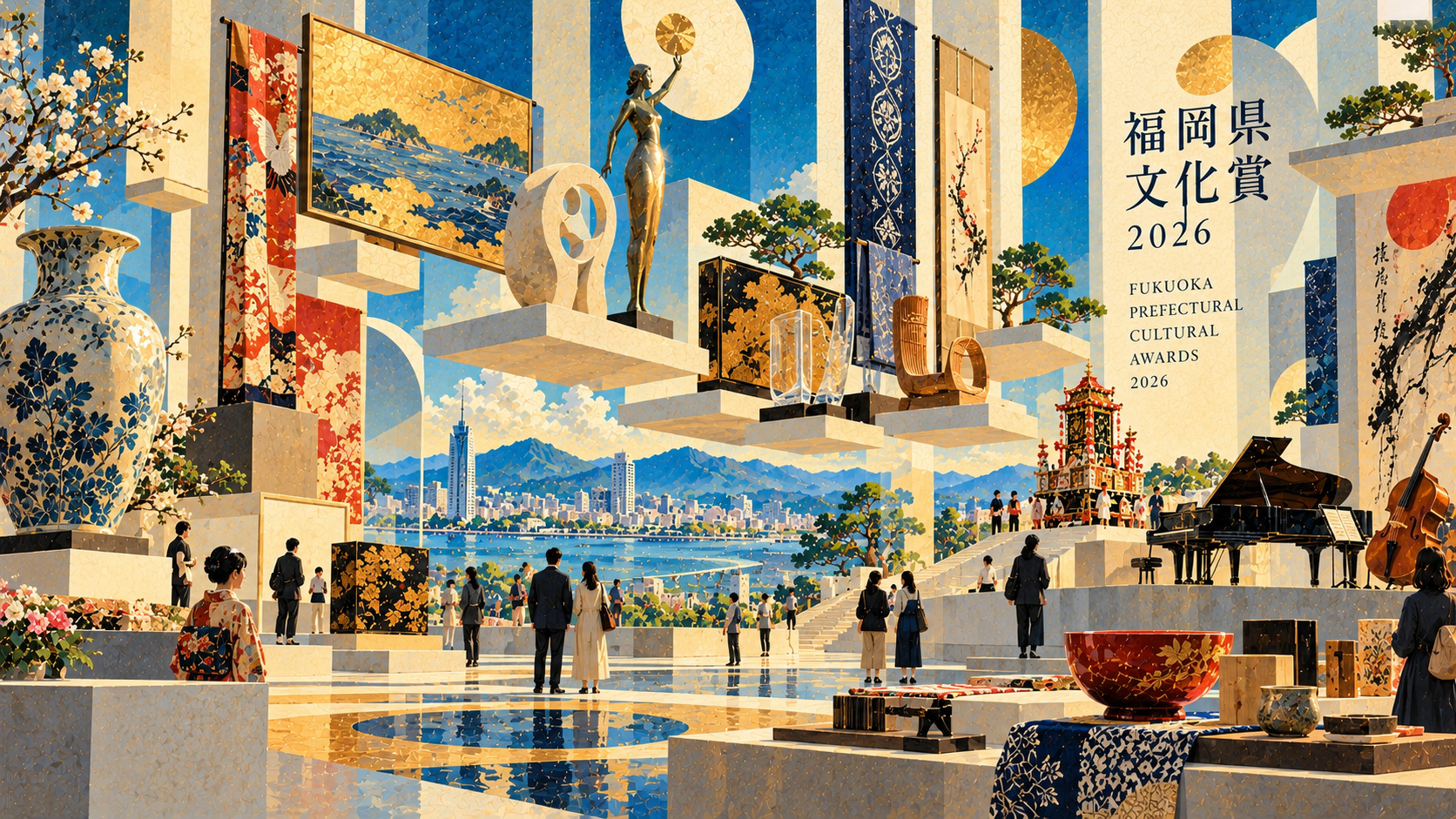
A prefectural cultural award might be expected to reward painting, literature or a centuries-old craft. Fukuoka has chosen a wider frame for 2026: songwriter Kazuo Zaitsu, nonprofit professional-wrestling group Kyushu Pro Wrestling and musical-theater performer Yoshio Inoue. The announcement on October 20 offers a revealing portrait of what the prefecture regards as culture—not simply the creation of art, but also its circulation through everyday life.
Three recipients, three different tests
Zaitsu receives the Creation Award for sustained artistic achievement. Kyushu Pro Wrestling receives the Social Contribution category for engagement with communities. Inoue receives the Encouragement Award, recognizing accomplishment and the prospect of further work. These categories are not rankings. They ask different questions about excellence, connection and cultural possibility. The prefecture selected the two individuals and one organization from 28 nominations, according to the governor’s news conference.
What happened on October 20—and what has not happened
The recipients were announced on Tuesday, October 20. Presentation of the awards, and an accompanying commemorative event, is planned for December 17 at 6 p.m. at ACROS Fukuoka Event Hall. The governor said the recipients’ attendance was still being arranged. Describing the October announcement as a completed ceremony would be incorrect. The distinction matters to visitors considering whether to attend a future event.
The prize is older than the current cultural boom
Established in fiscal 1993, the Fukuoka Prefectural Cultural Awards had recognized 129 recipients, individuals or groups, before the 2026 selection. Municipalities, cultural organizations and media outlets can recommend candidates; an external expert committee considers them. The structure was designed to recognize community contribution and cultural exchange as well as artistic creation. That broad purpose helps explain why a wrestling organization shares an awards announcement with celebrated performers.
Kazuo Zaitsu and the sound of a changing Japan
Born in Fukuoka Prefecture in 1948, Kazuo Zaitsu emerged from the local music scene as a leader of TULIP, founded in 1971. The band relocated to Tokyo and debuted in 1972 with “Mahō no Kiiroi Kutsu.” “Kokoro no Tabi” topped the Oricon chart in 1973; “Seishun no Kage” and “Saboten no Hana” followed among its enduring songs. Victor Entertainment’s group history traces that progression from regional popularity to national success.
Why a songwriter can matter beyond the charts
Commercial success alone is an incomplete measure of cultural significance. The governor also pointed to Zaitsu’s continuing lyric-writing classes in Fukuoka, connecting an artist known to several generations with aspiring local writers. His career offers a line from the Beatles-influenced sounds of Japan’s early-1970s pop scene to a mature musician handing on the craft of fitting words to melody. The precise number of workshop participants was not established in the reviewed sources.
A nonprofit that uses professional wrestling as a public service
Kyushu Pro Wrestling dates its inaugural show to July 6, 2008. Its official organizational profile names Ryota Chikuzen as chairman and lists shows, wrestler appearances, lectures and visits to facilities among its activities. It is a professional-wrestling promotion with a declared regional mission, not a conventional fine-arts institution. The unusual choice invites a worthwhile question: when physical performance is brought into schools and care facilities, where does entertainment end and community culture begin?
What the government says the wrestlers have done
At the October 20 briefing, the governor emphasized free family-oriented shows mounted in cooperation with municipalities, programming for students struggling to attend school and visits to facilities serving older people and people with disabilities. He cited more than 2,000 facility visits. That is an attributed official figure rather than an independently audited Japan.co.jp count. The activities, if sustained, place performance where commercial ticket sales alone might not take it.
Outreach deserves scrutiny as well as applause
Not every claimed benefit follows automatically from a public performance. The broader impact would be better assessed through participant feedback, follow-up activities, accessibility, stable funding and the experiences of receiving institutions. Nor should people with disabilities or older residents be treated as passive beneficiaries of someone else’s heroism. The cultural argument is stronger when audience members retain their own voices and agency.
Yoshio Inoue and the musical-theater generation
Yoshio Inoue, born in Fukuoka Prefecture in 1979, studied vocal music at Tokyo University of the Arts. He made his professional musical-theater debut in 2000 as Crown Prince Rudolf in “Elisabeth.” Subsequent accolades include the Yomiuri Theater Awards’ Sugimura Haruko Prize and a Kikuta Kazuo Theater Award. His work has expanded from major musical productions into concerts, television presenting and other performances, according to his record-label biographies.
An encouragement prize for an established star
The word “encouragement” might sound like an early-career prize in English. It is not evidence that Inoue is a newcomer. He has been on stage professionally for more than two decades. The prefecture highlighted his role as a supporter of the Kyushu National Museum, which began in 2025. That connection between national visibility and the cultural life of his home region is central to the award’s logic.
Fukuoka’s expanding definition of culture
The 2025 honorees were filmmaker Gakuryu Ishii, culinary researcher Sachiko Murakami and novelist Yui Suzuki. Their successors represent a different mix of artistic and social life. Across two years, the categories encompass film, food, literature, popular music, theater and wrestling. The point is not that these achievements are equivalent, but that regional culture may live in a kitchen, a reading room, a stage or a community hall. The December ceremony will celebrate the recipients; whether the award encourages the next generation will be visible over a much longer period.
Sources and reporting method
Based on the prefecture’s announcement and governor’s briefing and official biographies. No original recipient interviews were conducted; the December ceremony is scheduled.
- Fukuoka Prefecture: 34th Cultural Awards announcement
- Governor’s October 20 news conference
- Victor Entertainment: TULIP history
- Nippon Columbia: Kazuo Zaitsu profile
- Kyushu Pro Wrestling: organization profile
- Nippon Columbia: Yoshio Inoue biography
- Fukuoka Prefecture: 2025 recipients
- Fukuoka Prefecture: Inoue and Kyushu National Museum