- A different kind of Fukuoka showcase
- Bentwood: a wooden lunchbox made without nails
- Papier-mâché, festivals and the meanings of good fortune
- Multi Glass and the problem with calling every tradition ancient
- The faces of Imajuku and the raised surfaces of okiage
- Why the famous Hakata textiles and dolls are not among these five
- From heritage demonstration to sustainable livelihood
- What lasts after the booths are taken down
A different kind of Fukuoka showcase
A visitor crossing the busy streets of Tenjin might not expect to encounter five different forms of regional craftsmanship under one roof. Yet that was the idea behind the Fukuoka–Hakata Traditional Crafts Festival, scheduled for November 21–23, 2026, in the first-floor atrium of ACROS Fukuoka. The city advertised displays, sales and hands-on workshops each day from 10 a.m. until 6 p.m. Its organizer, the Hakata Traditional Craftspeople Association, represents a collection of makers whose goods once fitted naturally into everyday domestic and ceremonial life.
The five named disciplines are Hakata magemono, a bentwood craft; Hakata hariko, painted papier-mâché; Multi Glass, a layered glassmaking tradition; Imajuku dolls; and Hakata okiage, a kind of raised textile picture. They involve different tools, raw materials and markets. But bringing them together makes visible one shared problem: a technique cannot survive forever as a museum label. People must learn it, practice it and find customers prepared to pay for it.
This is a report grounded in the municipality’s festival notices and institutional descriptions, not an eyewitness reconstruction of the crowded exhibition hall. As of the reporting cutoff, independently verified attendance, sales totals and long-term recruitment outcomes were unavailable. Those missing metrics matter because the public value of a craft festival is not established simply by the fact that it was organized.
Bentwood: a wooden lunchbox made without nails
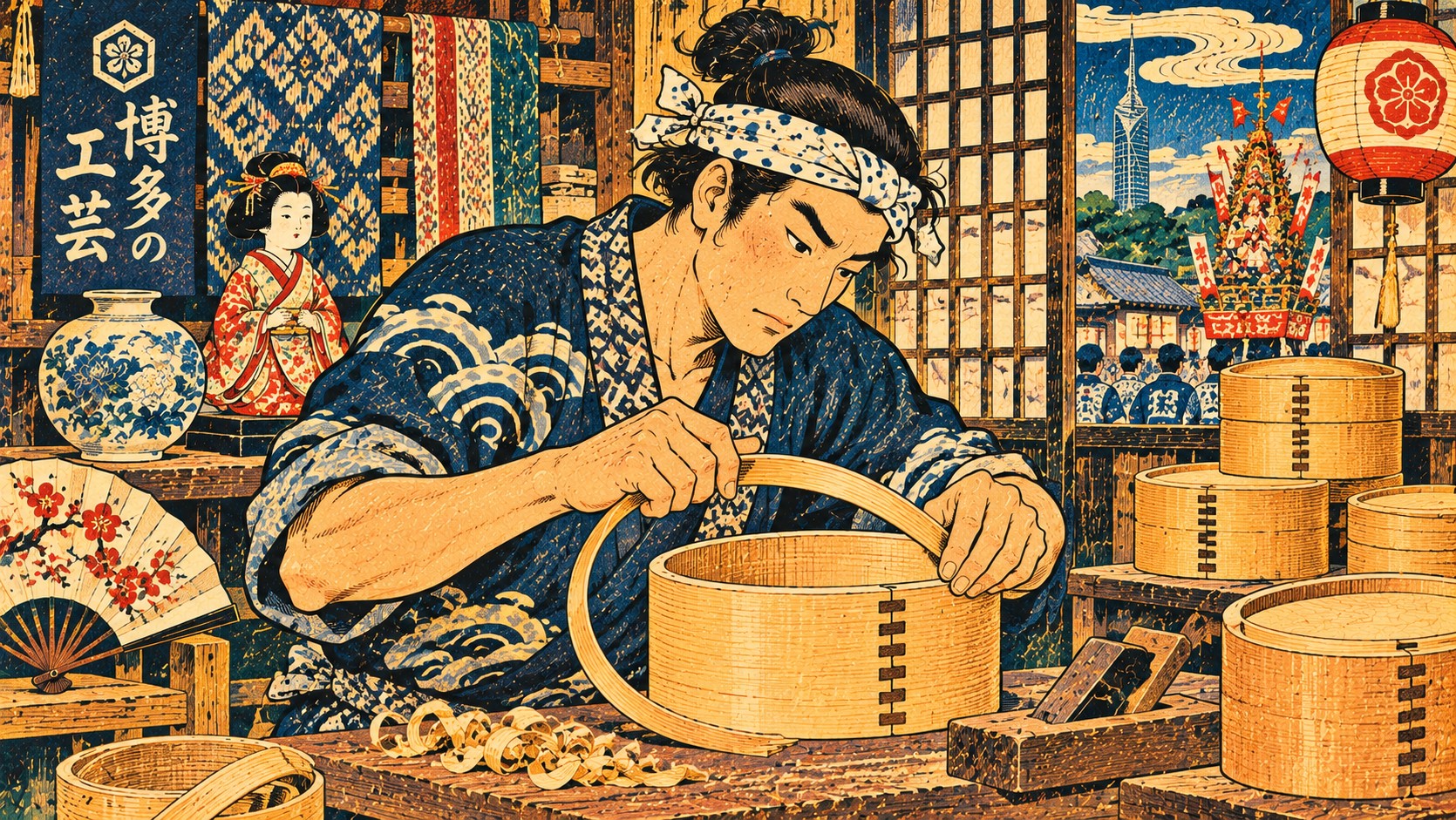
Hakata magemono begins with a thin sheet of cedar or cypress. Heat and moisture make it possible to bend that sheet into a vessel; strips of cherry-bark secure the joining edge. The result is light and remarkably direct in its construction. Lunchboxes and rice containers have been everyday uses, while decorated pieces for celebrations bear auspicious designs associated with the Hakata tradition. The city describes its history as extending back roughly four centuries.
It may appear simple: choose wood, bend it, join it, add a lid. But a working craftsperson must read the grain and judge how a given piece of material behaves, and those decisions are difficult to encode in a set of instructions. In a February 2026 civic feature, the city profiled Keigo Shibata, who was learning from his mother, eighteenth-generation maker Tamaki Shibata, alongside his brother. The report described the younger generation fitting training around other work.
This is where heritage becomes an economic story. A craft that depends on years of accumulated judgment cannot be replenished with occasional demonstration days alone. Yet the appeal of bentwood is not only historical. A lightweight, breathable container with a distinctive texture can still compete for a place in a modern kitchen—if buyers understand its care requirements and the labor reflected in its price.
Papier-mâché, festivals and the meanings of good fortune
Hakata hariko was shaped by techniques that Fukuoka City traces to the Edo-period transfer of papier-mâché making from the Kansai region. Sheets of Japanese paper or other paper are pasted in layers onto a mold, dried, removed and painted. The finished figures can become lucky animals, daruma dolls, decorations for the Toka Ebisu festival or masks worn for Hakata Dontaku festivities.
The work is bound to an annual cycle. An object used to welcome a new year or mark a local celebration carries significance beyond its raw materials, and its familiar shape tells a story that a mass-produced souvenir may not. The city profiled hariko maker Tomoko Miura in February 2026, describing her apprenticeship within a family line and experimentation with contemporary cat figures and other forms. That account offers a more interesting view of tradition than the idea of mechanically duplicating old designs.
For the festival’s final day, November 23, the published program offered a painting workshop for a sheep-themed decoration representing the 2027 zodiac year. The fee was ¥1,700 and each of two sessions was limited to ten participants. Such sessions do not turn a beginner into a master. They do, however, reveal that every cheerful painted surface is the endpoint of material preparation, drying, shaping and practiced brushwork.
Multi Glass and the problem with calling every tradition ancient
A third category complicates the usual image of Japanese heritage. Multi Glass is a regional layered-glass craft, described by the municipality as Fukuoka layered glass and included among its prefectural specialty-craft categories. Rather than relying on wood, paper or clay, it uses colored glass and the play of transmitted light to shape its objects. Its inclusion reminds visitors that local craft culture is not a single unchanging lineage from the feudal era.
The wider history of Japanese craft is one of adaptation as well as continuity. Materials change, markets open and close, and makers respond to the tastes and needs of successive generations. Layered glass gives Fukuoka’s makers a different vocabulary—transparent forms, concentrated color, polished surfaces—while participating in the same economic conversation as the older domestic crafts.
The official festival announcement confirms the category was represented. It does not independently establish the number of exhibits, the identities of individual glassmakers, the manufacturing process of specific pieces or their commercial success at this event. A responsibly reported feature must keep those details separate from background knowledge of glassmaking in general.
The faces of Imajuku and the raised surfaces of okiage
Imajuku dolls are rooted in the western Fukuoka area that gives them their name. Their simple forms and expressive painted surfaces give them the approachable character of local folk objects. The festival’s first-day workshop invited visitors to paint a monkey mask, with two sessions limited to ten people each and a ¥2,000 participation fee. What is valuable in such a workshop is not a claim of instant mastery but the experience of making small choices with brush and color.
Hakata okiage works with fabric to build a picture in relief. Shapes and layers give the image depth, making it different from both a flat painting and a clay figure. Its visual language has connections to decorative objects used for celebrations. On Sunday, November 22, participants could make a “lucky cat” battledore decoration; each of the two sessions had five places and cost ¥2,500.
The distinction between these crafts is worth keeping. Imajuku’s workshop was about surface painting on a folk form, while okiage required arranging a more tactile composition. Visitors might carry home both an object and an appreciation for the gulf between a short introductory class and the lifelong skills exercised by a working maker.
Why the famous Hakata textiles and dolls are not among these five
Readers familiar with Fukuoka might expect Hakata-ori textiles and Hakata ningyo dolls to feature in any festival bearing the name “Hakata traditional crafts.” Both are nationally designated traditional craft industries; Fukuoka City treats them separately from the locally designated specialty crafts in this three-day exhibition. That is not an omission to be silently corrected. It is central to understanding what the organizer represents.
The city’s traditional-industry account distinguishes the two nationally designated categories from seven prefectural specialty categories, including the five members of the Hakata Traditional Craftspeople Association. The city supports the association as part of its broader strategy, and it also maintains separate programs for textile training, doll-making instruction and exhibition spaces. The different institutional channels help explain why the public encounters one group of crafts at this particular event.
Designation is not a simple quality ranking. A bentwood vessel is not less culturally meaningful because it belongs to a different regulatory class than a silk textile. Instead, the categories tell readers which production traditions fall within which support systems, and why the livelihoods of small makers may depend on arrangements unlike those of more established industries.
From heritage demonstration to sustainable livelihood
Training is only one part of succession. Materials must remain obtainable; workshops need space and tools; work must command prices that cover skilled labor; and younger makers need both time to practice and a realistic route to customers. The survival of a craft is therefore inseparable from questions that are familiar to other small businesses: financing, marketing, product development and a reliable flow of orders.
Fukuoka City uses its Hakata Traditional Craft Center and other promotional initiatives to explain crafts to residents and visitors. Its documented programs for Hakata textiles and dolls include formal successor training, while its February 2026 feature describes magemono and hariko makers developing new uses and designs. The policy challenge is not to choose between tradition and innovation. It is to decide which aspects of a technique are essential, and how new products can support rather than erase them.
A serious assessment of the November festival would ask follow-up questions: Did visitors become repeat customers? Did participants enroll in longer courses? Were orders placed with workshops after the event? Can artisans obtain the tools, materials and prices they require? The organizers’ public materials do not answer these questions, and their absence should not be obscured by celebratory descriptions.
What lasts after the booths are taken down
The city’s program included capsule toys featuring craft-inspired acrylic charms and a photo area, alongside the more traditional demonstrations and reserved sessions. These are forms of public engagement suited to an urban shopping and cultural district. They can make a little-known craft recognizable to people who would never ordinarily visit a specialist workshop. Yet a souvenir charm and a handmade product do not play the same role in sustaining a maker’s livelihood.
The deeper opportunity lies in connections extending beyond the festival. Someone discovers a bentwood lunchbox and begins using it daily. Someone orders a hariko figure for a family celebration. A visitor learns why a layered-glass piece or raised textile picture takes time to produce. Their continued interest may be more consequential than a single weekend of crowds.
The November 21–23 schedule was established by Fukuoka City. Because this article does not claim on-site reporting or independently confirmed final-day attendance, it cannot declare that particular demonstrations attracted certain audiences or that the event solved succession problems. The genuine story is the coexistence of five local technologies—and the test of whether a moment of attention in Tenjin can become a longer relationship between maker and community.
Sources and reporting notes
This report draws on Fukuoka City’s event announcements, November 9 media release, municipal craft policy and civic reporting. JAPAN.co.jp did not conduct onsite interviews. Event arrangements are documented, but attendance and final sales figures remain unverified.