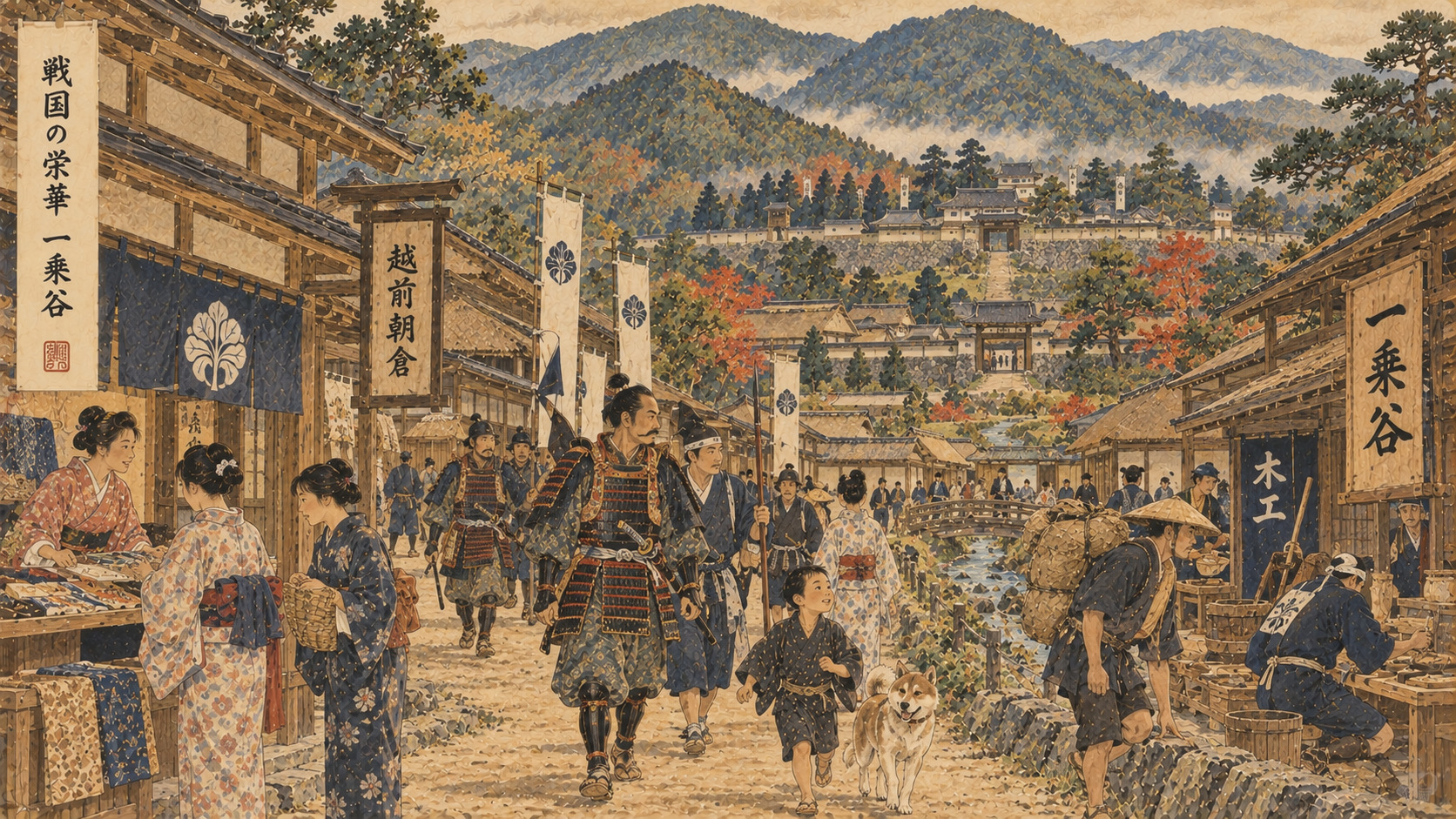
The extraordinary discovery at Ichijodani is not only what happened to its rulers, but how much of ordinary life survived them.
A city in the shape of a valley
A short journey from central Fukui brings travelers into a narrow mountain valley where house plots, gateways, garden stones and reconstructed streets trace the outline of an entire Sengoku-period town. Ichijodani is not simply the site of a vanished castle. It is one of Japan’s rare large-scale archaeological landscapes preserving the structure of a castle town, from residences of powerful retainers to workshops and religious places. Its value lies in what can be studied together: the ruler’s residence and the surrounding society.
The Asakura century
The Asakura traced their origins to Tajima and entered Echizen during the medieval struggles that preceded the Sengoku age. The Ōnin War helped establish their position in the province. Across five generations and more than a century they made Ichijodani a center of government and exchange. The founding lord, Asakura Takakage, is associated with household precepts emphasizing the concentration of retainers and the selection and cultivation of capable people. Their language is that of a sixteenth-century lordship, not modern management, but the texts reveal the importance of organizing a durable domain.
A planned and defended environment
The valley settlement was guarded by gateways at its upper and lower ends, while a fortified castle rose on a mountain about 473 meters above sea level. Archaeology has traced roads, residences, shop plots, wells, temples and waterways. Taken together, these features reveal how the settlement operated as a city rather than a collection of monuments. The present reconstructed townscape is a researched presentation based on excavations; it must not be confused with original timber structures surviving intact from the sixteenth century.
Culture beyond the battlefield
The Asakura cultivated formal gardens, learning, visual arts and relationships with people connected to Kyoto’s elite culture. In 1567 the last lord, Asakura Yoshikage, received Ashikaga Yoshiaki, a future shogun, and hosted him at the family residence the following year. Political calculations did not unfold as the Asakura had hoped. Yoshiaki later proceeded to Kyoto with Oda Nobunaga. Such choices have often been described as missed opportunities, but they emerged from a complex world of allies, military threats and uncertain loyalties.
Four gardens and a sophisticated city
Four gardens—the Asakura residence garden, Yudono garden, Suwakan garden and Nanyōji garden—received national designation as Special Places of Scenic Beauty in 1991. At the Asakura residence, excavators found distinctive stonework lining the pond. The monumental Suwakan garden and forceful standing stones at Yudono show that garden design could convey rank, reflection and aesthetic conviction. The site museum notes that some stones were transported from the coast around Mikuni, evidence of the effort invested in landscaping a mountain capital.
The destruction of 1573
Conflict with Nobunaga intensified after the invasion of Echizen in 1570. In August 1573 Yoshikage retreated and died at Ōno on August 20; the museum’s chronology records fires in Ichijodani over the preceding days. The Asakura political order collapsed and the town lost its former role. Destruction followed by changes in settlement patterns helped preserve traces of its streets and possessions. But archaeology does not assume that the entire valley was suddenly sealed beneath one uniform layer: the chronology of different deposits must be established from evidence.
A half-century of archaeological recovery
Major archaeological work began in the late 1960s. In 1971 Japan designated about 278 hectares as a Special Historic Site; in 2007, 2,343 excavated objects received Important Cultural Property designation. About 1.7 million objects have been recovered. Such numbers are impressive, but context matters more than volume. The place where an object was found, the associated surfaces and its relationship to other objects can reveal trade networks, dining habits, craft production or class distinctions in ways that a single spectacular treasure cannot.
Where archaeology meets the visitor
The restored buildings invite visitors to imagine workshops and households as occupied places. Yet the public presentation must preserve the distinction between archaeological remains and a modern reconstruction. Rain, vegetation, erosion and visitor access impose continual conservation challenges. Fukui’s preservation and redevelopment planning recognizes that even areas previously stabilized may need further interventions. A historic site is not finished when its excavation ends: interpretation and stewardship continue.
A current exhibition about death and remembrance
The Ichijodani Asakura Family Site Museum is holding an autumn exhibition, “Forms of Remembrance: Medieval Graves of Echizen and Wakasa,” from October 10 through November 29, 2026. Stone Buddhas, funerary objects and medieval graves shift attention from warfare to religious life and bereavement. On October 18 a lecture by researcher Norio Mitsui addresses the distribution of Shakudani stone, a distinctive regional material; the museum lists web reservations as required. Visitors should confirm availability and site access before traveling.
What a lost city can still teach
The buried city outlasted the political dynasty that once controlled it. Its stone gardens, market streets and religious sites allow people today to reconstruct relationships between culture, economy, class and power. A visit to Ichijodani suggests a more generous history of Sengoku Japan: alongside battles and powerful men were families, traders, craftspeople and generations who made a real town work. Their material traces are the heritage Fukui now protects.
The Conversation Continues
Japan.co.jp invites archaeologists, conservators, museum specialists and local residents to share documented discoveries, corrections, archival material and perspectives on the future of Ichijodani.