- A nursery inside a shell, beneath the dinosaur bonebed
- The evidence: 313 adults, 240 carrying embryos
- What “brooding” means—and what it does not
- How scientists looked through stone without destroying it
- The mothers were bigger—and reproduction shaped their shells
- A fossilized menu: algae, fine particles and detritus
- The wildfire paradox: destruction that may have preserved life
- Fukui’s excavation history: from dinosaur bones to ecosystems
- Why the oldest direct evidence is not the origin date
- The next questions hidden inside ancient river mud
A nursery inside a shell, beneath the dinosaur bonebed
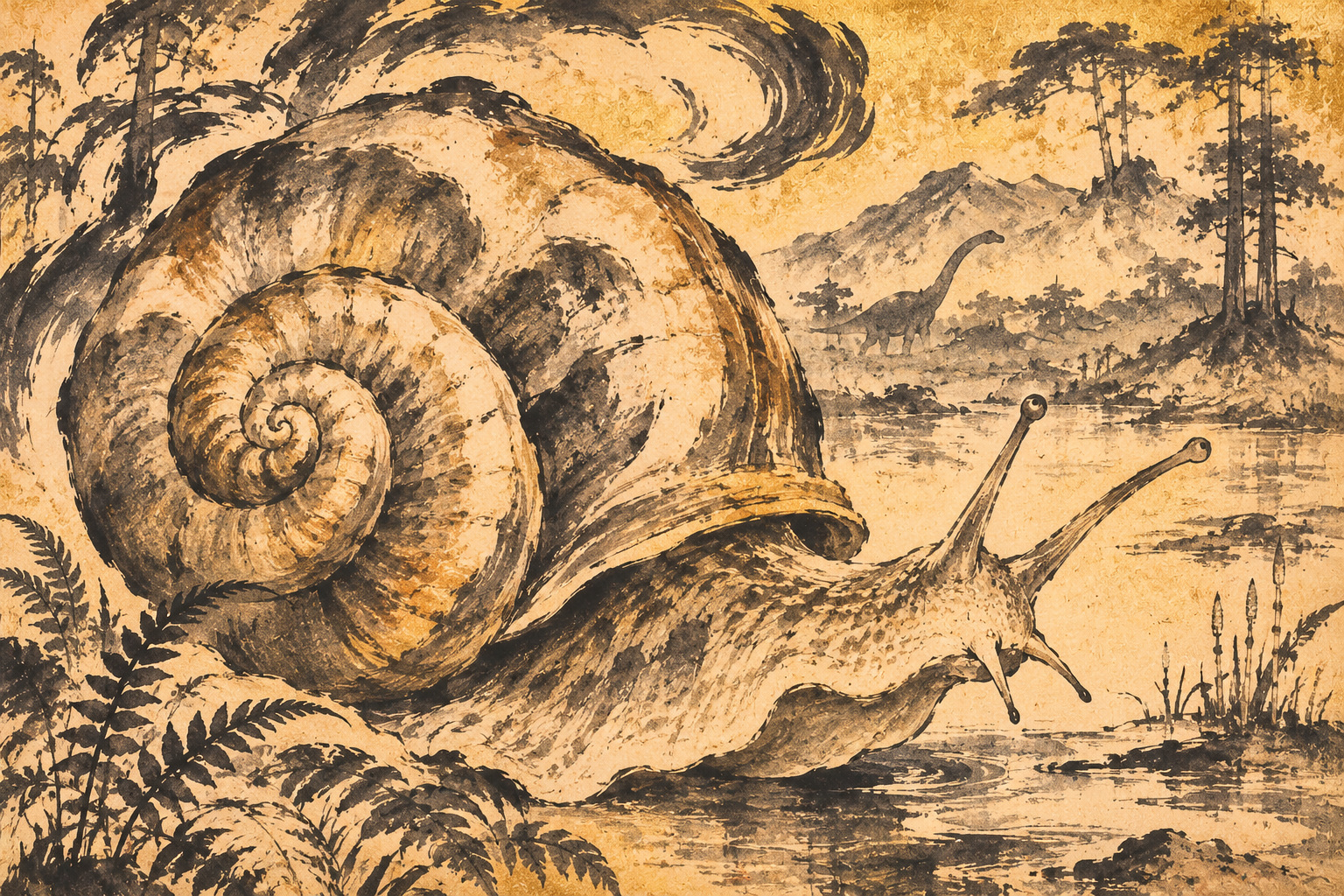
The discovery is intimate in a way dinosaur fossils rarely are. Inside an ancient freshwater snail shell, researchers found miniature shells belonging to its developing young. Up to sixteen were preserved together, their arrangement remarkably similar to the broods carried by living river snails. They came from deposits about 120 million years old in Katsuyama, Fukui Prefecture, an excavation site internationally known for dinosaur remains.
On November 10, 2026, a Japanese research collaboration published its findings in the peer-reviewed journal Communications Biology. Led by Taro Yoshimura of the University Museum, the University of Tokyo, the work provides what the researchers characterize as the oldest direct evidence of internal brooding in freshwater invertebrates. Unlike a shell that merely shows an animal lived, these specimens offer evidence of how it reproduced.
The evidence: 313 adults, 240 carrying embryos
The research examined 313 exceptionally preserved shells assigned to the freshwater viviparid “Viviparus” sp. from the Early Cretaceous Kitadani Formation, part of the Tetori Group. Of the 313, 240 contained embryonic shells—approximately 77 percent. The largest identified brood contained sixteen embryos.
The authors distinguished the miniature shells from accidental intrusions using their very early shell morphology and position within the adult. Embryos nearest the shell opening were generally larger, and those positioned farther inside were smaller. The orderly developmental gradient mirrors that found in living viviparid snails. It is more persuasive than a random scatter of tiny shells would be.
A closer look gives the scale of the claim. The study counted an average of 6.78 embryos among 195 brooding specimens after excluding 45 that held only one; sixteen is a maximum, not a typical brood size. The important discovery is the pattern across many individuals, not simply one spectacular specimen.
What “brooding” means—and what it does not
Today’s viviparid freshwater snails retain their offspring inside the maternal body until the juveniles are sufficiently developed to emerge. This is described in the study as obligate ovoviviparity: the young develop internally rather than being deposited outside as exposed eggs. A shell carrying miniature embryonic shells offers a physical window into that strategy.
There is a temptation to describe the find as the invention of parental love. That would miss the point. Fossils cannot establish affection, and the authors did not uncover the earliest parenting anywhere in the animal kingdom. Their historical priority concerns direct fossil evidence of internal brooding among freshwater invertebrates. The strategy itself may be older than the fossils that happen to preserve it.
Nor were the developing young visible like a photograph of a modern animal. Their identity comes from shell anatomy, orientation and comparative evidence, assessed together by the research team.
How scientists looked through stone without destroying it
High-resolution X-ray micro-computed tomography, or micro-CT, allowed the researchers to examine the interior of the preserved shells in three dimensions. The University of Tokyo describes a voxel resolution of 5.0 micrometres, enabling structures much smaller than a millimetre to be resolved without breaking open the maternal shells.
The team also used mechanical preparation, microscopic inspection and controlled chemical extraction of selected microfossils. The earliest shell whorls of the embryos measured roughly 200–300 micrometres across and matched the diagnostic early whorls in the adults. In some specimens, individual embryos overlapped or preservation was incomplete, limiting exhaustive statistical measurement of every developmental stage.
Micro-CT does not time-travel. It reveals structure preserved in rock, which researchers must interpret using observations, evolutionary comparison and geological context. This distinction is essential when translating a beautiful scan into a claim about ancient behavior.
The mothers were bigger—and reproduction shaped their shells
Gravid shells were on average about 1.22 times taller than shells without identified broods, according to the University of Tokyo. Their body whorls and apertures were also more inflated. That supports a female-associated size and shape difference, plausibly because carrying numerous young requires more internal space.
But the comparison carries a limitation: a non-brooding fossil might be a male or simply a female not carrying embryos at the moment it died. Researchers cannot assign every unoccupied shell to a sex. The paper explicitly discusses that uncertainty while documenting the strong morphological pattern.
The fossil shells also suggest continued growth after reproductive maturity. Larger individuals tended to carry more embryos. Together, those results offer evidence of reproductive investment across an animal’s lifetime—not just a snapshot of its final moments.
A fossilized menu: algae, fine particles and detritus
The surprises did not stop with reproduction. Material preserved within the shells offered clues about diet, an unusually elusive subject in the fossil record of freshwater invertebrates. The authors identified microfossils and organic remains consistent with grazing on attached algae, collecting suspended material from the water and feeding on decaying organic matter.
The study also describes juvenile snails inside articulated freshwater mussel shells from the same deposits. The empty chambers may have offered temporary shelter; the paper also considers scavenging opportunities. Neither explanation should be presented as a behavior observed directly 120 million years ago.
Ecologically, this matters because a flexible feeding strategy can help species exploit changing conditions. The evidence suggests these ancient snails had already developed a repertoire familiar from modern relatives, but cannot by itself establish how often any particular feeding method was used.
The wildfire paradox: destruction that may have preserved life
Why should delicate embryos and traces of food survive for 120 million years? Calcium-carbonate shells and organic residues commonly dissolve or degrade in freshwater settings. The Kitadani specimens were unusually well preserved, and the sediments contained fragments of ancient charcoal.
The researchers propose a geochemical explanation: ash from nearby prehistoric wildfires entered the water and helped buffer acidity, reducing the dissolution of the fragile carbonate shells after death. In other words, a fire that destroyed vegetation may inadvertently have improved the conditions for preserving minute records of aquatic life.
It is an evidence-based hypothesis, not a direct measurement of a Cretaceous river’s pH. How much ash entered the water, how long buffering lasted and the relative roles of burial and other chemical processes remain valuable subjects for further testing. This distinction between observed charcoal and inferred chemical effects is part of the story, not a weakness to conceal.
Fukui’s excavation history: from dinosaur bones to ecosystems
The Kitadani site sits within the Tetori Group in Katsuyama, Fukui, and preserves a Lower Cretaceous environment associated with dinosaurs including Fukuiraptor and Fukuisaurus, alongside plants, fish, turtles and other freshwater organisms. The area is famous for its dinosaurs, but a functioning landscape also required wetlands, food webs and small animals whose remains rarely attract the same attention.
Fukui Prefecture began organized dinosaur excavation work in the area in 1989. The Fukui Prefectural Dinosaur Museum records four major investigation phases: 1989–1993, 1995–1999, 2007–2010 and 2013–2023. The museum issued its report on the fourth phase in March 2026, documenting the importance of decades of sustained fieldwork.
This history matters because the discovery was not a spontaneous fossil miracle. Institutions had to excavate, catalogue and retain small specimens, and researchers had to return to them with tools able to answer new questions. The value of a fossil collection can grow as analytical methods improve.
Why the oldest direct evidence is not the origin date
Fossils of viviparid freshwater snails have been known from Mesozoic strata. What was missing was evidence that could reconstruct their internal breeding systems and feeding ecology. An empty adult shell demonstrates existence, not necessarily reproduction; embryos preserved in place narrow the gap between morphology and ancient life history.
The paper’s approximately 120-million-year-old fossils imply that internal brooding and flexible feeding strategies were already established by the Early Cretaceous. They do not tell us the exact evolutionary moment when these traits first appeared. “At least this old” is a defensible inference; “invented 120 million years ago” is not.
In October 2026, another University of Tokyo release described chitin preserved in freshwater bivalves from similarly ancient Fukui deposits. Together, these investigations illustrate how exceptional preservation and modern laboratory methods can expose biological information previously assumed lost.
The next questions hidden inside ancient river mud
The project brought together researchers affiliated with the University of Tokyo, Fukui Prefectural Dinosaur Museum, Shimadzu Corporation and Shizuoka University. The published paper identifies publicly catalogued specimens in museum collections and provides supplementary measurements, enabling further scholarly scrutiny.
Future work could test the proposed wildfire-buffering mechanism in other deposits, compare the pattern of ancient brooding with more viviparid lineages and search for equally informative fossils outside Japan. The current investigation does not establish the behavior of every ancient snail, and its depositional model remains open to refinement.
Most fossils tell us what an organism looked like. This one begins to tell us what living required: sheltering young, growing to accommodate them and finding different things to eat in a Cretaceous river. That a dinosaur excavation yielded such an ordinary, extraordinary biological story is the discovery’s lasting appeal.
Primary research and source notes
The directly observed evidence is fossil structure, preserved material and geological context. The buffering effect of prehistoric wildfire ash is the researchers’ explanatory interpretation, not a direct measurement of ancient water chemistry. The paper was published November 10, 2026.