- Twenty doors, one citywide emergency
- An imagined earthquake, with very real operational demands
- Japan's three-layer model at the neighborhood level
- Why twenty shelters are harder than one
- The portable toilet is not a minor detail
- Digital coordination meets the reality of power failure
- The supply chain begins before trucks arrive
- A commuter suburb shaped by more than a century of change
- Japan's longer lessons: shelter is not the same as safety
- The test is what the city changes next
Twenty doors, one citywide emergency
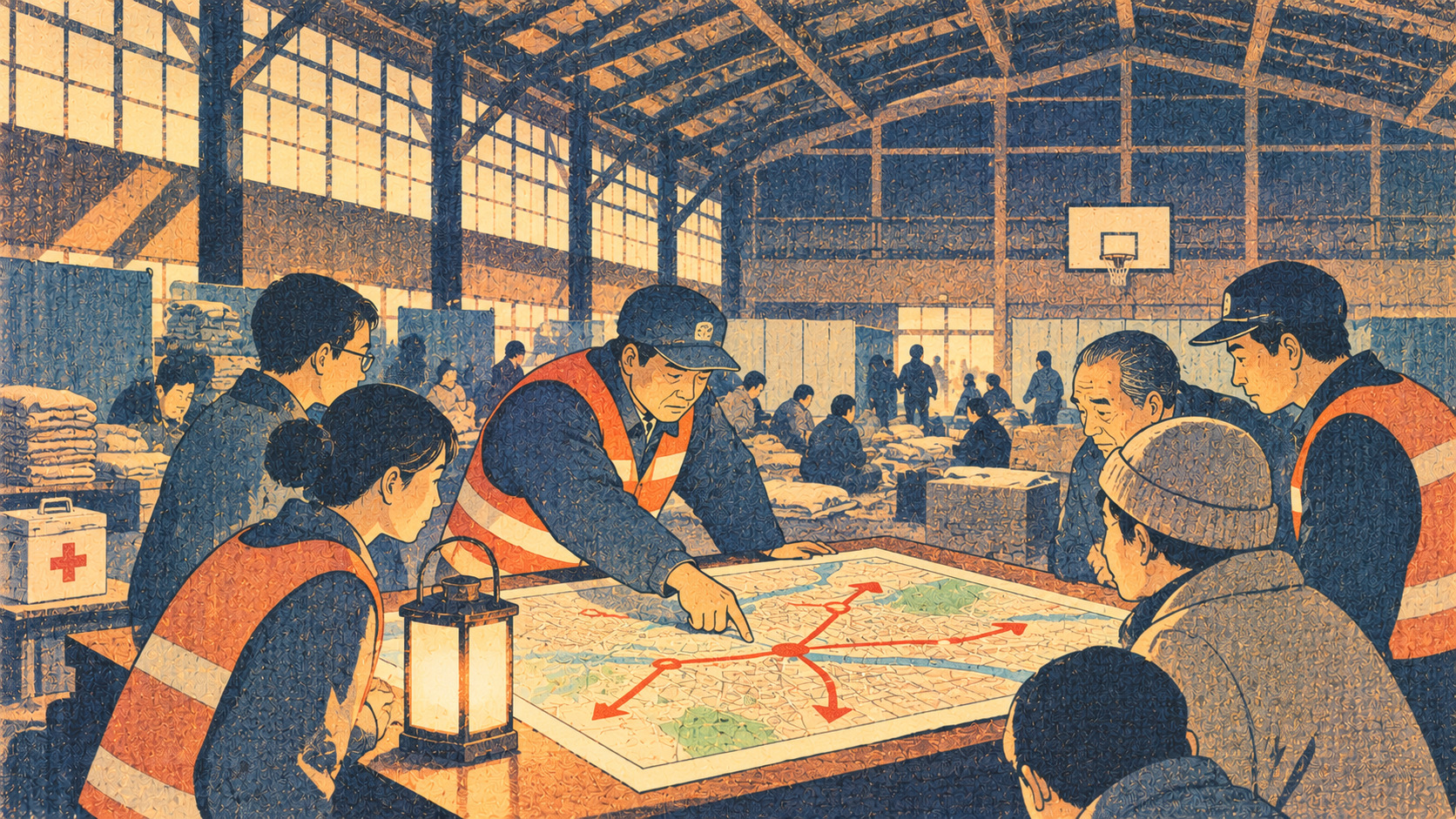
In the first hours after a major earthquake, a shelter needs more than a sign on a school gate. Someone must gain access to the building, confirm its safety, receive residents, register urgent needs and tell city headquarters what is happening. If twenty facilities must do that simultaneously, the problem becomes one of coordination, not merely preparedness at an individual school. That is the challenge Fujimino City in Saitama Prefecture set for its fifteenth comprehensive disaster drill on Sunday, November 8, 2026.
The municipality planned to involve residents in opening all twenty designated evacuation shelters between 8:30 a.m. and noon. Its November 4 announcement described the exercise, and a city-authored notice published on the morning of November 8 confirmed the public announcement of the drill. But the material available for this report does not include an independently verified after-action assessment showing that every shelter opened on time, how many people participated, or which systems failed. This is therefore a document-based assessment of the city's design and the questions that its results must answer, not an eyewitness account.
Documentation: Municipal source · Government source · Original documentation
An imagined earthquake, with very real operational demands
The official scenario places the hypothetical earthquake beneath northern Tokyo Bay at 8:30 a.m. It assumes shaking of upper 5 on Japan's seven-level seismic intensity scale, with lower 6 in some areas, and damage to homes, bridges and lifelines. These are exercise conditions, not a forecast of an actual earthquake. Their purpose is to force officials and residents to confront a period in which ordinary transport, communications and utilities may be impaired together.
The city scheduled an advance public-address message at 8:20 a.m. and an exercise siren at 8:30 a.m. Neighboring Kawagoe City warned that its residents might hear the signal from across the boundary. It is a small but revealing detail: emergency information does not respect municipal borders. A drill must warn the public clearly enough to avoid unnecessary alarm while still creating conditions that test readiness.
Documentation: Municipal source · Government source
Japan's three-layer model at the neighborhood level
Fujimino City's planned operation divides responsibilities among three connected layers. The municipal disaster headquarters gathers intelligence and coordinates overall action. Local disaster-response bases, built around designated shelters, bring together city and facility staff and community base coordinators. Resident-led district headquarters work through neighborhood associations to check safety, exchange information and assist neighbors.
The distinction matters because information flows in both directions. City hall needs to know whether a building is accessible and what supplies it requires. A neighborhood needs to know which roads are usable and whether help is coming. An elegant organizational chart is not proof that either conversation will take place under pressure. The meaningful tests include who makes decisions when the assigned person is absent, how conflicting reports are resolved, and whether a disconnected shelter has an alternative means of contacting headquarters.
Documentation: Municipal source · Government source
Why twenty shelters are harder than one
A demonstration at a single well-prepared school can hide the real challenge of a citywide emergency. School gyms, cultural facilities and other designated shelters are not identical: their entrances, sanitation systems, stores, accessibility and available staff differ. Opening twenty sites at once asks a different question: can the entire network operate when one building has damage, another lacks staff and a third receives more people than anticipated?
Twenty is the count of designated shelters involved in the exercise. It is not evidence that every resident could be housed or that all locations became fully functional. To judge the outcome, readers need opening times, capacity, staffing, communications records and whether vulnerable people could use each site. None of those operational results should be inferred from the announcement alone.
The portable toilet is not a minor detail
One of the most concrete features of the city's plan was a toilet trailer scheduled for Oi Elementary School between 10 a.m. and 11 a.m. Disaster news often emphasizes water deliveries and food stores, but a shelter can become unhealthy and degrading long before it runs out of blankets. Broken water and sewage infrastructure, sanitation supplies, cleaning arrangements, nighttime access and privacy can all determine whether a toilet is usable.
Japan's Cabinet Office revised national guidance in December 2024 on the living environment of evacuees, shelter management and emergency toilets. A trailer may improve resilience, but it still needs water, waste handling, cleaning, clear circulation and accessible arrangements. The published Fujimino plan establishes an intended demonstration; it does not establish the equipment's real throughput or the effectiveness of its deployment.
Documentation: Municipal source · Government source
Digital coordination meets the reality of power failure
The planned headquarters exercise included information collection and dissemination using the city's disaster information-sharing and comprehensive disaster information systems. Digital tools can make incoming reports more visible and help prioritize scarce resources, particularly when several shelters request assistance at once. Yet a shared dashboard can also create false confidence when the underlying reports are incomplete or delayed.
What happens if the mobile network fails, power is interrupted or a facility loses its connection? Which workers use radio, telephone, paper forms or physical messengers? Who verifies shelter populations before dispatching blankets or medical assistance? A useful published assessment would compare simulated conditions with actual message delivery times and show whether critical instructions reached all locations. Those measures were not established in the documents reviewed.
The supply chain begins before trucks arrive
The municipality's press notice lists cooperation drills involving Japan's Self-Defense Forces, police, fire services, local volunteer firefighters, medical associations and contracted businesses. Planned activities also include supply handling, road clearance, cooking demonstrations, equipment checks, earthquake simulation and educational sessions. That is a broad network of actors. Each may be effective individually while the overall response stalls if responsibilities overlap or messages arrive late.
The logistics problem is immediate. A truck cannot deliver supplies efficiently without knowing which entrance is usable and who will receive them. Medical personnel cannot prioritize care without timely information about people's needs. Clearing one roadway is of limited value if another essential link remains blocked. The significance of a citywide rehearsal lies in testing those handoffs rather than merely showing an impressive collection of emergency vehicles and uniforms.
A commuter suburb shaped by more than a century of change
Fujimino City was established on October 1, 2005, when Kamifukuoka City and Oi Town merged. About thirty kilometers from central Tokyo, the area grew from villages into a commuter suburb. The city traces a striking chapter of that transition to the large Kasumigaoka and Uenodai housing developments constructed from the late 1950s onward, which drew young families and commuters and reshaped local transportation. In 2025 the municipality marked its twentieth anniversary and commissioned a new city history.
This background has consequences for disaster planning. An older neighborhood, a postwar apartment complex and a more recent development may have different social networks, building access arrangements and populations requiring assistance. Emergency plans written for a uniform landscape risk overlooking that variation. Even in a relatively compact urban municipality, a response must work across multiple generations of housing and neighborhood institutions.
Documentation: Municipal source · Government source · Original documentation · Municipal history
Japan's longer lessons: shelter is not the same as safety
Japan's modern disaster policy framework rests in part on the Disaster Countermeasures Basic Act of 1961, developed in the aftermath of devastating mid-century disasters. Subsequent earthquakes, including the 1995 Hanshin-Awaji disaster and the 2011 Great East Japan Earthquake, exposed the human costs of displacement and the limits of improvisation. The country's emergency preparedness challenge has gradually broadened from getting people into buildings to sustaining health, dignity and access to services after they arrive.
The Cabinet Office's updated guidance addresses food, toilets, welfare needs and support for people staying in vehicles or at home. A gymnasium filled with cots is not automatically a safe environment for an older person who needs assistance, a family with an infant or someone with a disability. That wider perspective should determine how Fujimino and other cities interpret the results of practical shelter exercises.
Documentation: Municipal source
The test is what the city changes next
A convincing after-action report should say how many of the twenty facilities were opened, at what times and with what staffing. It should identify communications bottlenecks, discrepancies between expected and actual supply handling, the practical lessons from the toilet-trailer setup and the accessibility of the shelter process. It should also specify who is responsible for correcting shortcomings and when corrective exercises will happen. These are proposed measures of success—not results that have already been documented.
A shelter door may be unlocked by an employee, but it stays useful because neighbors, volunteers, municipal staff and emergency professionals coordinate their efforts. The compelling question raised by Fujimino's November 8 exercise is therefore not whether officials can organize a busy morning. It is whether the city can build a working chain of trust and action that survives the first confusing hours of a real disaster.
Sources and verification notes
The planned exercise has been distinguished from the unverified outcomes. No participant figures, completion times or exercise failures are invented.
- Fujimino City — 第15回ふじみ野市総合防災訓練
- Fujimino City — 2026年11月4日発表の訓練概要
- Fujimino City — 地域防災計画・2026年3月改定
- Fujimino City — 市の成立・2005年の合併
- Fujimino City — 都市の地理と成り立ち
- Cabinet Office — 避難所の生活環境対策・トイレと福祉
- Kawagoe City — 隣接地域にも届く訓練放送の案内
- Fujimino City — 自治体による当日の訓練告知
- Fujimino City — 市史の編さんと市制20周年
- Fujimino City — 団地開発・都市化の歴史