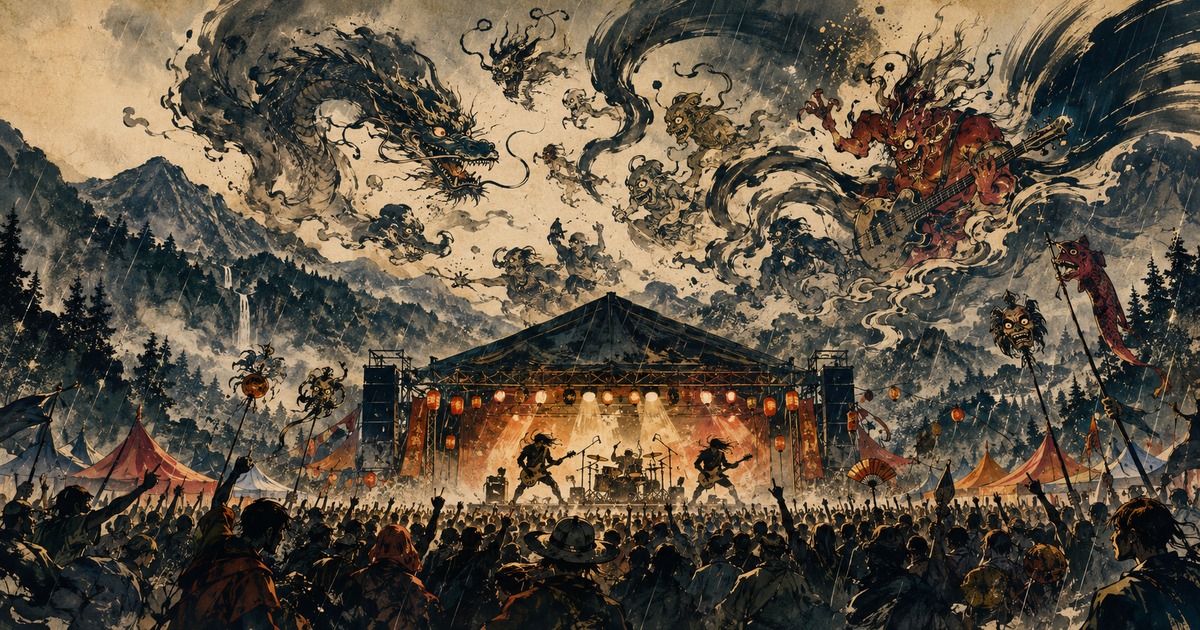
On Saturday evening, the vast Green Stage field at Naeba was already thick with people an hour before Fujii Kaze was due to begin. At 7:50 p.m., while he was still performing, XG started across the site on the White Stage. For 20 minutes, two of Japan’s most internationally visible acts occupied the festival at once. When Kaze finished, the crowd poured into the paths through the trees. Entry to XG’s performance was restricted for the remainder of the set, according to a post-festival report.
That was not merely an unfortunate timetable collision. It was a picture of how far Fuji Rock has moved. For years, the foundational promise of an “international music festival” in Japan was access: major overseas acts could be seen here, together, without flying to London, Los Angeles or Glastonbury. In 2026, two Japan-origin acts filled different major stages, played distinctive versions of global pop and went out simultaneously to an international stream. Naeba was not the end of an import route. It was a relay point sending sound in several directions.
Held from July 24 through 26 at Naeba Ski Resort in Yuzawa, Niigata Prefecture, Fuji Rock 2026 placed more than 180 acts across 12 stages, according to Electric Bloom’s post-event report. The Green Stage nights were closed by The xx, Khruangbin and Massive Attack. The same report put cumulative attendance, including the free Thursday-eve festivities, at 123,500 and said more than 70 performances were streamed free. Those are scale numbers. The more interesting question is what became visible because the festival was large enough to contain so many different centers at once.
Friday: Continuity, not nostalgia
Friday’s Green Stage ran from Turnstile, one of the defining heavy bands of the present decade, into Hi-STANDARD and then the spacious minimalism of The xx. Hi-STANDARD’s appearance was its first at Fuji Rock since 1999. With ZAX on drums following the 2023 death of Akira Tsuneoka, the band reconnected Japan’s live-house punk culture to the festival’s largest field after a 27-year absence.
The interest in that sequence was not a simple opposition between a heritage act and a new generation. Hi-STANDARD’s 1990s version of DIY internationalism and Turnstile’s expansion of hardcore into a mass audience belong to related histories: local scenes learning to speak beyond their borders without waiting for institutional permission. When The xx ended the night with negative space, restraint and intimacy enlarged for a field, Friday became a study in how underground languages reach large stages in different eras.
Elsewhere, Asian Kung-Fu Generation closed the White Stage. Toro y Moi, Arlo Parks, Snail Mail and South Korea’s HYUKOH ran alongside Altın Gün’s reinvention of Anatolian music and Antibalas’ New York Afrobeat. Seeing only a headliner has never meant seeing the whole of Fuji Rock. In the mountains, even the sets a visitor declines help define the night: every choice is accompanied by another line of bass audible through the trees.
Saturday: The subject of “global” changed
Saturday’s Green Stage moved through Argentine rapper Trueno, IO, Basement Jaxx, Fujii Kaze and Khruangbin. XG took the White Stage; Kokoroko and BADBADNOTGOOD occupied the Field of Heaven later in the evening. Musical coordinates associated with Buenos Aires, Tokyo, London, Houston and Seoul were not presented as national booths at a cultural fair. They were simply competing possibilities in the same afternoon.
The Fujii Kaze–XG overlap mattered because the two acts do not pursue the world in the same way. Kaze rearranges Japanese-language songwriting, piano, soul and pop around a highly individual presence. XG crosses borders through English lyrics, hip-hop, R&B and the precision of group performance. This is not a contest between preserving “Japaneseness” and discarding it. It is evidence that several routes out from Japan can succeed at the same time.
Electric Bloom reported that Kaze entered from the sound desk playing saxophone and substantially reworked familiar material for the festival. XG presented a festival-specific, 16-song set with a live band. The pressure created as the audience moved between the two was a practical lesson for future scheduling and crowd control. It was also proof that the old habit of treating domestic artists as supporting architecture for overseas stars no longer explains the reality on the ground.
Sunday: Experiment beside spectacle
The final Green Stage sequence ran through Kneecap, Mogwai, Susumu Hirasawa + Ejin and Massive Attack: politically charged Irish-language rap, Scottish post-rock, Japanese electronic theater and Bristol low-end darkness layered on one platform. The Hirasawa set used Tesla coils, a laser-harp instrument and masked Ejin performers, according to the post-event account, before Massive Attack took over for the weekend’s final Green Stage statement.
Yet Sunday’s story was again incomplete on the largest field. Mitski extended the night on the White Stage. American Football drew listeners to the Red Marquee, while never young beach closed the Field of Heaven. The French Canadian group Angine de Poitrine, promoted from a morning Red Marquee appearance to a 70-minute evening slot at the Field of Heaven, reportedly produced an entry restriction and a line stretching beyond the stage.
That kind of reversal is one of the surviving powers of a multi-stage festival. Recommendation engines can direct listeners toward what resembles their existing taste. A site such as Naeba can make them encounter something because rain changed a route, a friend insisted, or a strange sound drifted from a smaller field. Word of mouth can turn an unfamiliar name into the center of a day before the day is over.
Headliners provide the frame, not the answer
The xx, Khruangbin and Massive Attack gave the 2026 program an unusually coherent spine. All three depend on space, repetition, bass, atmosphere and restraint more than on a frantic sequence of camera-ready peaks. Booking them suggested a different value system from festivals designed primarily around giant screens and clips optimized for the next morning’s feeds.
At the same time, much of the weekend’s energy was distributed below the headline line. There was the Mexican marimba punk of Son Rompe Pera, Kokoroko’s West African and London jazz lineages, Altın Gün’s Anatolian psychedelia, Trueno’s Latin American hip-hop, HYUKOH’s Korean indie rock, and many strains of Japanese rock, pop and electronic performance. “International” can no longer be measured by how successfully a Japanese promoter imports a hierarchy set in the United States and Britain.
That does not mean Fuji Rock has turned inward and become merely domestic. The opposite is closer to the truth. Internationalism itself has become less centralized. Instead of one arrow running from London or Los Angeles toward Tokyo, sounds from Asia, Europe, Africa and the Americas met at Naeba and then traveled outward again through global streaming. In 2026, the network—not any one national center—was the main act.
A fourth venue beyond the mountain
Fuji Rock’s free broadcast operated across three channels on Amazon Music, Prime Video and Twitch. The official notice warned that some sets would be shown only in part and that streaming times could differ from the on-site timetable. Even with those limits, free access for Amazon account holders opened another gate for international fans, young people, parents, disabled viewers and anyone unable to make the complicated journey to Niigata.
This was more than advertising. For Japanese musicians, a domestic festival performance doubled as a global showcase. Overseas acts could see the response in Japan returned to viewers elsewhere in real time. The physical site, the edited broadcast and the fragments circulating through social media gained a fourth layer: a simultaneous international venue with three stages of its own.
Yet the stream did not replace Naeba. A schedule cannot reproduce the body hurrying from Fujii Kaze toward XG, the time needed to walk a wet forest path, bass spilling from a neighboring stage or the accidental route into Angine de Poitrine. Digital reach did not abolish place in 2026. It made the scarcity of place more obvious.
A weak-yen welcome, a heavy domestic bill
The general-sale three-day ticket cost ¥59,000. A one-day ticket was ¥26,000, and the Friday Night ticket was ¥16,000. At ¥163.74 to one U.S. dollar, those prices convert to about $360, $159 and $98. For a visitor earning dollars, the weak yen can make one of Japan’s largest festivals look comparatively affordable. For someone paid in yen, the full weekend remains a major expense once transport, accommodation, food and equipment are included.
The festival offered a ¥18,000 one-day ticket for those 22 and younger, a ¥9,000 ticket for those 17 and younger, and free admission for children 15 and younger with an accompanying adult. A camping ticket was ¥6,000. Visitors arriving by train could travel to Echigo-Yuzawa and use the ¥2,000 round-trip shuttle; organized buses ran from 17 cities. These are attempts to keep a generational ladder attached to an increasingly expensive event.
| Ticket or cost | Yen | At ¥163.74 per U.S. dollar |
|---|---|---|
| Three-day ticket, general sale | ¥59,000 | About $360.33 |
| One-day ticket, general sale | ¥26,000 | About $158.79 |
| Friday Night ticket | ¥16,000 | About $97.72 |
| One-day ticket, age 22 and younger | ¥18,000 | About $109.93 |
| One-day ticket, age 17 and younger | ¥9,000 | About $54.97 |
| Camping ticket | ¥6,000 | About $36.64 |
The conversions exclude card-company rates, fees, transport and lodging. The economics matter beyond the immediate ticket total. If Fuji Rock is to remain a multigenerational culture three decades from now, teenagers and people in their early twenties need a real entrance—not merely the promise that they can attend someday when they have more money.
It began in a typhoon in 1997
Fuji Rock’s origin is not a smooth success story. It is a memory of crisis. The first edition took place at Fuji Tenjinyama Ski Resort in Yamanashi Prefecture in July 1997, with Red Hot Chili Peppers, Rage Against the Machine, Foo Fighters and The Yellow Monkey among the performers. A typhoon struck. The second day was canceled. The official archive records 30,000 cumulative visitors and a first day that became legendary for its wind and rain.
In 1998, the festival moved to Tokyo Bayside Square in Toyosu, drawing 67,000 over two days. But founder Masahiro Hidaka and promoter Smash were not simply trying to import a giant concert into an urban lot. They wanted music, nature, camping and accidental discovery to form one experience. In 1999, Fuji Rock moved to Naeba: three days, more than 100 performers and 72,000 cumulative visitors. The Green Stage, White Stage and Field of Heaven established the geography that still structures the event.
That year, roughly 300 young volunteers also promoted self-managed trash disposal and sorting. The campaign became the base of the festival’s “clean” culture. It treated spectators as participants responsible for making the venue possible the next morning, not only as consumers who could leave their traces for somebody else.
| Year | Cumulative attendance | What changed |
|---|---|---|
| 1997 | 30,000 | First edition at Fuji Tenjinyama; second day canceled in a typhoon |
| 1998 | 67,000 | An interim urban edition in Toyosu with Björk, The Prodigy and Beck |
| 1999 | 72,000 | Move to Naeba; three-day format, principal stages and clean-festival campaign |
| 2005 | 125,000 | Large scale entrenched; environmental power initiatives included biodiesel and solar |
| 2019 | 130,000 | One of the largest pre-pandemic editions |
| 2020 | Postponed | The pandemic forced the festival to stop |
| 2021 | Special edition | A changed, primarily domestic program under pandemic conditions |
| 2025 | 122,000 | Four days including the pre-festival event; 200+ artists and a free global stream |
| 2026 | 123,500 | Reported figure; 180+ artists, 12 stages and more than 70 streamed performances |
“Clean festival” is infrastructure, not decoration
The official guidelines still carry three linked ideas: make Fuji Rock the cleanest festival in the world, help and respect one another, and respect nature. Volunteers guide sorting, and some collected waste is recycled into items including trash bags and toilet paper. Rules against umbrellas, instructions to bring proper rainwear and warnings about wildlife and difficult ground all reflect an essential truth: a mountain venue cannot be treated like a city arena without a roof.
None of this erases the environmental load created by moving, powering and feeding a temporary city of more than 100,000 cumulative visitors. “Held in nature” does not automatically mean harmless to nature. If the language of responsibility is not followed by harder accounting of transport, energy and disposables, it risks becoming branding. Even so, Fuji Rock’s insistence that trash is part of a shared civic space—not something that disappears when dropped—has had a durable influence on festival behavior in Japan.
Naeba works because the stages and crowd are supported by transport in Yuzawa, accommodation, local workers, volunteers, medics, security, vendors, communications, toilets and miles of temporary circulation. The quality of the festival is revealed not only by its most famous performer but by how this temporary city treats someone lost, exhausted, soaked or unable to move at the speed of the crowd.
Fuji Rock became a town
The free pre-festival event on July 23 included the Naeba Ondo dance, a raffle, fireworks and a special concert after the Oasis Area opened. Arrival, pitching a tent, eating, walking, staying up and taking the site down are part of the experience. The Palace of Wonder after dark, new artists at Rookie A Go-Go, smaller performances at Gypsy Avalon and morning at Pyramid Garden are not merely counterprogramming. They are different districts of the same town.
Hidaka once spoke of a festival that parents, children and grandchildren could attend. The youth prices and free entry for younger children connect to that long view. An audience ages, comes back with a family, and meets first-time visitors who have no obligation to respect the old hierarchy. Hi-STANDARD’s return after 27 years and XG’s Fuji Rock debut can matter in the same weekend because the town contains memory and renewal at once.
Five tests left by 2026
- Multidirectional internationalism: Can the festival move beyond a U.S.–U.K. import model and let music from Asia, Latin America and African diasporas meet Japan-origin work on equal terms?
- A door for young audiences: As the weak yen improves value for overseas visitors, can prices and transport keep the total cost within reach for young people earning yen?
- Streaming and presence: Can Fuji Rock open itself free to the world while protecting the accidents, smaller stages and embodied experience that exist only at Naeba?
- Scale and nature: Can a temporary city of this size make its responsibilities for waste, transport, power, extreme weather and ecology more concrete?
- Concentration and discovery: Can crowd restrictions around popular acts be managed safely without removing the space in which an obscure act becomes the story of the night?
These are not questions for Fuji Rock alone. Japan’s population decline and aging, rising inbound tourism, weak yen, cultural-export ambitions, streaming platforms and regional infrastructure are compressed into the weekend. A festival is an escape from ordinary life, but not an island outside society. It is a model of the kind of community that society can create—if only temporarily—when people believe the shared experience is worth the trouble.
What remains after the mountain
Fuji Rock has not taken place near Mount Fuji since the second edition. The name survived because the memory of rebuilding after the original storm became more important than geographical precision. The typhoon of 1997, the urban interlude of 1998, the move to Naeba in 1999, the 2020 postponement and the altered 2021 edition mean the festival has never returned in exactly the same form.
Nor was 2026 merely another successful year. The audience moving from Fujii Kaze on the Green Stage to XG on the White Stage demonstrated, physically, that Japanese music no longer needs one approved model of going global. Susumu Hirasawa’s Tesla coils could precede Massive Attack; Mitski could extend another part of the forest into the night; a relatively unfamiliar ensemble could build a line through word of mouth. The world was not something delivered from a single center. It was happening in many places at once.
On Monday morning, the temporary town began to come apart. The bass left the forest paths, and luggage formed lines toward Echigo-Yuzawa. But the value of a festival is not settled when the final song ends. It depends on whether the music industry and cultural institutions below the mountain recognize the new hierarchy, new audience and new internationalism that appeared above it. Fuji Rock 2026’s real encore is only beginning.
Sources and further reading
Official sources were prioritized for artists, schedules, ticket prices, streaming and festival history. The 2026 attendance, artist and streaming totals, along with reported scenes involving Fujii Kaze, XG, Susumu Hirasawa and Angine de Poitrine, come from Electric Bloom’s post-event report. Attendance is cumulative across days and does not represent a count of distinct individuals.
- Fuji Rock Festival 2026: official lineup
- Official timetable: July 24 / July 25 / July 26
- Fuji Rock Festival 2026: event, tickets, transport and camping
- Official global-streaming notice for Amazon Music, Prime Video and Twitch
- Electric Bloom: 2026 post-event report on Fujii Kaze, XG and the weekend’s emerging acts
- Pitchfork: Fuji Rock 2026 livestream schedule and details
- Official history: 1997 / 1998 / 1999
- Official history: 2005 / 2019 / 2022 / 2025
- Official guidelines on nature, mutual respect and waste sorting
- The Japan Times: Fuji Rock at 20 and founder Masahiro Hidaka
- NiEW: initial 2026 lineup and event announcement