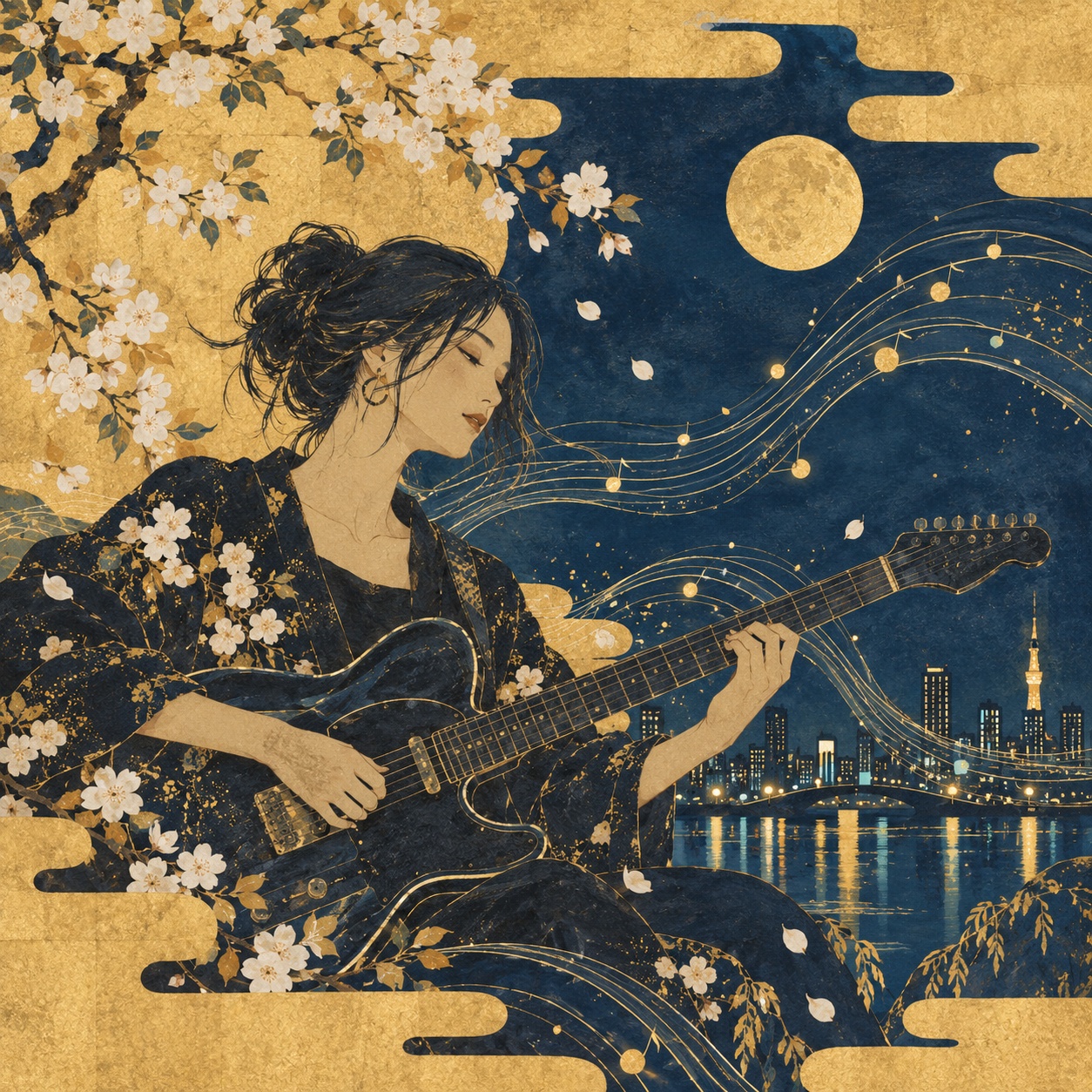
Listeners who first encountered Friday Night Plans through the 2018 cover of Mariya Takeuchi’s “Plastic Love” or the 2019 single “HONDA” may find Blue Hour disorienting. The sleek R&B pulse, nocturnal polish and cool vocal restraint that defined the project’s early image have not vanished, but they are no longer the architecture. On the album released May 28, 2026 by Barcelona’s independent Modern Obscure Music, acoustic guitar, heavily processed vocals, improvisation and ambient space take over. The 15-track record makes Friday Night Plans harder to describe with a single genre label.[1][2]
That shift is less abrupt when viewed through Masumi’s own description of the act. In a 2023 official interview around the first album Visitors, she said Friday Night Plans was both an artist name and a project name. She did not want her role to stop at singing; she wanted to participate in deciding what kind of music to make and how to make it.[3]
By that standard, Blue Hour is not a sudden genre detour. It is the latest stage of a multi-year effort to rebuild the project from inside its own production process.
The starting point: R&B and the feeling of a Friday night
Friday Night Plans began releasing music in earnest in 2018. The first single, “Happy Birthday,” arrived in July and was selected for Apple Music Japan’s weekly new-artist feature. The four-track LOCATION-Los Angeles followed in August, built from demos recorded during a trip to Los Angeles. FNMNL and Spincoaster introduced the project as a new R&B voice with chill textures, 1990s flavor and a cosmopolitan sensibility.[4][5]
A 2019 Spincoaster profile said the name Friday Night Plans came from the feeling Masumi valued most: the excitement of imagining what to do once Friday night begins. Even then, the project’s identity was tied as much to mood, time and urban atmosphere as to a formal genre.[6]
The Japan Times, looking back in 2026, placed her early work in the wave of polished, R&B-inflected Japanese music that emerged alongside the renewed international interest in city pop, mentioning artists such as Wonk, Iri and Sirup as part of the broader context.[1]
“Plastic Love” became the international doorway
In December 2018, Friday Night Plans released a cover of Mariya Takeuchi’s “Plastic Love.” FNMNL noted that it was the project’s first song performed entirely in Japanese. Producer Tepppei approached the arrangement through the premise of what the song might sound like if it had been recorded in 2018, retaining its essential character while rebuilding the sonics around a contemporary production language.[7]
The timing mattered. The internet-driven city-pop revival was already carrying “Plastic Love” far beyond Japan. By September 2026, The Japan Times reported that Friday Night Plans’ version had passed 28 million YouTube views and had received a favorable response from Takeuchi herself.[1]
The cover opened a door, but successful songs can also harden expectations. “Urban,” “R&B” and “city-pop adjacent” became convenient shorthand for a project that was already more restless than those categories suggested.
“HONDA” already contained pop and disruption in the same song
The 2019 single “HONDA” became another early signature. Its polished R&B surface gave way to a markedly different trap-influenced section, an arrangement later cited by younger Japanese musicians. In a Spincoaster interview, members of Billyrrom explicitly identified the structural shift in “HONDA” as an influence on their own songwriting.[8]
That is a useful reminder: Friday Night Plans was never simply a conventional R&B act. Even during the period most associated with that label, the music made room for abrupt sectional changes, noise, degraded recording textures and shifts in tempo or production language.
Working with Ena changed Masumi’s role from vocalist to co-maker
A deeper turning point came through her work with producer Ena. According to the 2023 FNMNL interview, they began collaborating in 2021, released four EPs and eventually made the first full-length album, Visitors. Much of the work happened at Wax Alchemy, a mastering studio equipped for dubplate cutting. Earlier EP sessions sometimes involved cutting vocals or sounds to record, re-recording them and then processing the degraded texture again.[3]
Ena came from a background that moved between experimental electronic music and pop production. He recalled that Masumi was already listening to artists and scenes around M.E.S.H., PAN, Young Echo and Emptyset, so there was little need to introduce her to experimental sound. At the same time, both were deliberate about preserving song and melody rather than turning the project into academic noise music.[3]
Masumi described the collaboration as a learning process: asking questions, finding language for the sound she imagined and carrying lessons from one track into the next. She said she disliked the feeling of finishing a project and realizing that all she had done was sing. That is a fundamentally different role from a vocalist receiving completed songs from a producer.
When I Get My Playground Back introduced the language of space
In a 2022 interview around the EP When I Get My Playground Back, Masumi described playfulness as a form of room or “space.” She said the project functioned as a playground for herself and her collaborators, and that the released tracks were records of experiments and attempts.[9]
That language now sounds almost predictive of Blue Hour. The new record is built less around filling the arrangement than around allowing silence, decay, distance and texture to become part of the song. The “space” is audible.
Visitors was already looking outside genre
The 2023 album Visitors did not simply scale up the sound of the debut singles. Ena said the goal was to be experimental without becoming academic or purely avant-garde, keeping the song and the voice central while expanding the sonic vocabulary.[3]
The important distinction is that this was not a campaign to “reject R&B.” Masumi’s vocal character and melodic instinct remained central. The experimentation happened in production, structure, sampling, noise, studio process and the way songs occupied sonic space.
Blue Hour changes the skeleton of the music
Modern Obscure Music describes Blue Hour as a shift from the project’s pop roots toward a more experimental and ambient sound. Guitar and voice form the main palette. Improvisation was used during production, and the record is framed as a cycle of memory fragments and introspection associated with the hours around dawn.[2]
The album contains 15 tracks, including “blue hour,” “fight and loving,” “baby baby,” “i recall,” “wrong time wrong place,” “letter,” “see you again” and “night stroll,” and closes with a remix of “blue hour” by label founder Pedro Vian. A first pressing of 500 vinyl copies is listed as sold out on the label’s Bandcamp page.[2]
The Japan Times characterized the new sound as dreamlike music built largely from heavily effected vocals and acoustic guitar. Heard against the 2018 singles, it is a dramatic change. Heard after the experiments of 2021–23, it sounds more like an escalation of an existing method.[1]
Why release it through a Spanish independent label?
Blue Hour arrived not through a Japanese major label but through Modern Obscure Music, an independent platform based in Barcelona. The label describes itself as connecting avant-garde heritage with contemporary listening culture. Its catalogue moves across experimental electronic music, ambient and cross-cultural projects, including work by Actress, Arp, Merzbow and Pedro Vian.[10]
That does not automatically mean Friday Night Plans has complete artistic or economic independence. The public sources reviewed for this article do not disclose the contract, masters ownership, royalty split, recording budget or distribution arrangement.
What is visible is aesthetic alignment. Rather than placing Blue Hour as the next installment of an R&B career, the label places it in a catalogue where ambient, electronic and experimental work is already the norm. Distribution context becomes part of artistic context.
Japan’s music economy has changed around artists like Masumi
Friday Night Plans’ career also spans a major transformation in recorded-music distribution. In 2026, the Recording Industry Association of Japan began publishing an estimate of the entire domestic recorded-music market, including non-member companies. It put 2025 physical-plus-digital recorded-music sales at ¥398.8 billion. Subscription streaming contributed ¥137.736 billion and ad-supported streaming another ¥20.22 billion.[11]
That matters because nationwide physical distribution is no longer the only route to an audience. TuneCore Japan said in November 2025 that more than two million tracks had been distributed through its service since launch. In 2026, the company created its “Independent Artist 100” initiative, and Friday Night Plans appeared among the 200 nominated acts.[12][13]
Distribution access, however, is not the same as financial sustainability. Artists now compete inside an environment containing hundreds of millions of tracks. Streaming income may have to be combined with live performance, merchandise, licensing, physical editions, collaborations and other revenue.
Independent does not mean alone
Friday Night Plans’ history is highly collaborative: Tepppei, Atsushi Asada, Ena, Wax Alchemy, video directors, designers and now an overseas label all appear across the project’s releases.
Masumi’s 2023 description of working together on what a track should become captures a more useful meaning of independence. It is not doing every job yourself. It is keeping your own artistic intent at the center and choosing collaborators whose expertise can help realize it.
- Early R&B: The 2018 singles and LOCATION-Los Angeles establish the base.
- Reinterpretation: “Plastic Love” updates an older song without treating it as museum material.
- Co-creation: Work with Ena shifts Masumi further into production decisions.
- Experiment: Vinyl texture, noise, space and improvisation become compositional materials.
- International context: Blue Hour reaches listeners through a Barcelona experimental label.
Not a genre switch so much as a refusal to stay fixed
It is tempting to summarize the story as “R&B singer turns ambient.” That is accurate enough to market an article, but it misses Masumi’s longer-running creative logic.
In 2022 she said the project had relatively few things binding it and described it as a playground. In 2023 she said she did not want to finish a record feeling that she had only sung. Those statements make Blue Hour look less like a rejection of one genre than an extension of a refusal to accept a fixed role.[9][3]
Even as the R&B elements recede, qualities from the early work remain: intimacy, nocturnal mood, restraint and a fascination with texture. The frame has changed more than the emotional center.
There is no longer only one model of a Japanese pop career
Japan’s traditional pop-industry pathway—major label, television exposure, tie-ins, physical releases, national touring—remains powerful. But streaming, social platforms, direct digital distribution, Bandcamp, overseas boutique labels and limited vinyl editions have made other career structures possible.
Modern Obscure Music sells Blue Hour digitally and issued a 500-copy vinyl pressing. That scale is not comparable to a mainstream Japanese pop campaign. It is a different model: place the record in a catalogue that fits it, sell physical objects to a concentrated audience and make international distribution native to the release rather than a later export strategy.[2]
The public record does not show whether that model is economically successful for Friday Night Plans. Sales, streaming income, contractual terms and touring economics are not disclosed. Calling the project a proven financial model for independence would therefore go beyond the evidence.
The mystery has moved from the image into the sound
The Japan Times notes that early Friday Night Plans imagery often obscured Masumi’s face, reinforcing a sense of mystery around the act. Her understated bilingual delivery did the same.[1]
On Blue Hour, that mystery feels less dependent on image. The voice itself is obscured, processed, distanced and folded into the environment. Acoustic guitar does not simply accompany a singer; it creates resonance and decay around her.
The title “blue hour” refers to an in-between period, neither full daylight nor night. The project now occupies similar thresholds: R&B and ambient, pop and experimental music, singer and production project, Japanese scene and international independent catalogue.
Reinvention does not require erasing the earlier self
Career shifts are often narrated as acts of courage in which an artist abandons previous success. Friday Night Plans is more complicated than that.
Without “Plastic Love,” there would have been no similarly large international entry point. Without “HONDA,” the project’s capacity to move between polished songcraft and destabilizing production would be less visible. The early R&B records are part of why the sparse construction of Blue Hour feels consequential.
Reinvention can mean something other than rejecting the past. It can mean refusing to let the expectations created by past success dictate every future release.
The next Friday Night Plans may sound different again
There is little reason to assume Blue Hour is a final destination. Masumi has consistently described Friday Night Plans as a site of experiment rather than a fixed style.
In 2022, she called it a playground. In 2023, she described carrying lessons from one track into the next. In 2026, Blue Hour extends that method beyond the R&B framework through which many listeners first discovered her.
She may return to harder beats, go further into acoustic minimalism or make something entirely different. The more important continuity is not genre. It is that the project has built a mechanism for avoiding its own permanent definition.
Creative independence is not only a question of whether an artist signs to a label. It is the ability to put distance between yourself and your previous hit, the algorithm’s expectations, the genre shorthand and even the persona that once worked. Blue Hour is a record of Friday Night Plans exercising that freedom.
Sources
- The Japan Times: The unmaking of Friday Night Plans (Sept. 25, 2026)
- Modern Obscure Music: Friday Night Plans — Blue Hour (released May 28, 2026)
- FNMNL: Official interview — Friday Night Plans, Visitors (June 30, 2023)
- Spincoaster: Friday Night Plans’ first single and Apple Music new-artist selection
- Spincoaster: LOCATION-Los Angeles EP (Aug. 31, 2018)
- Spincoaster NEXTCOMING 2019: Friday Night Plans profile and origin of the project name
- FNMNL: Friday Night Plans releases cover of Mariya Takeuchi’s Plastic Love
- Spincoaster: Billyrrom interview citing the structure of HONDA
- FNMNL: Official interview — When I Get My Playground Back
- Modern Obscure Music: official Bandcamp catalogue and label description
- Recording Industry Association of Japan: recorded-music sales estimates
- TuneCore Japan: more than two million tracks distributed through the service
- TuneCore Japan: Independent Artist 100 — 2026 nominees
