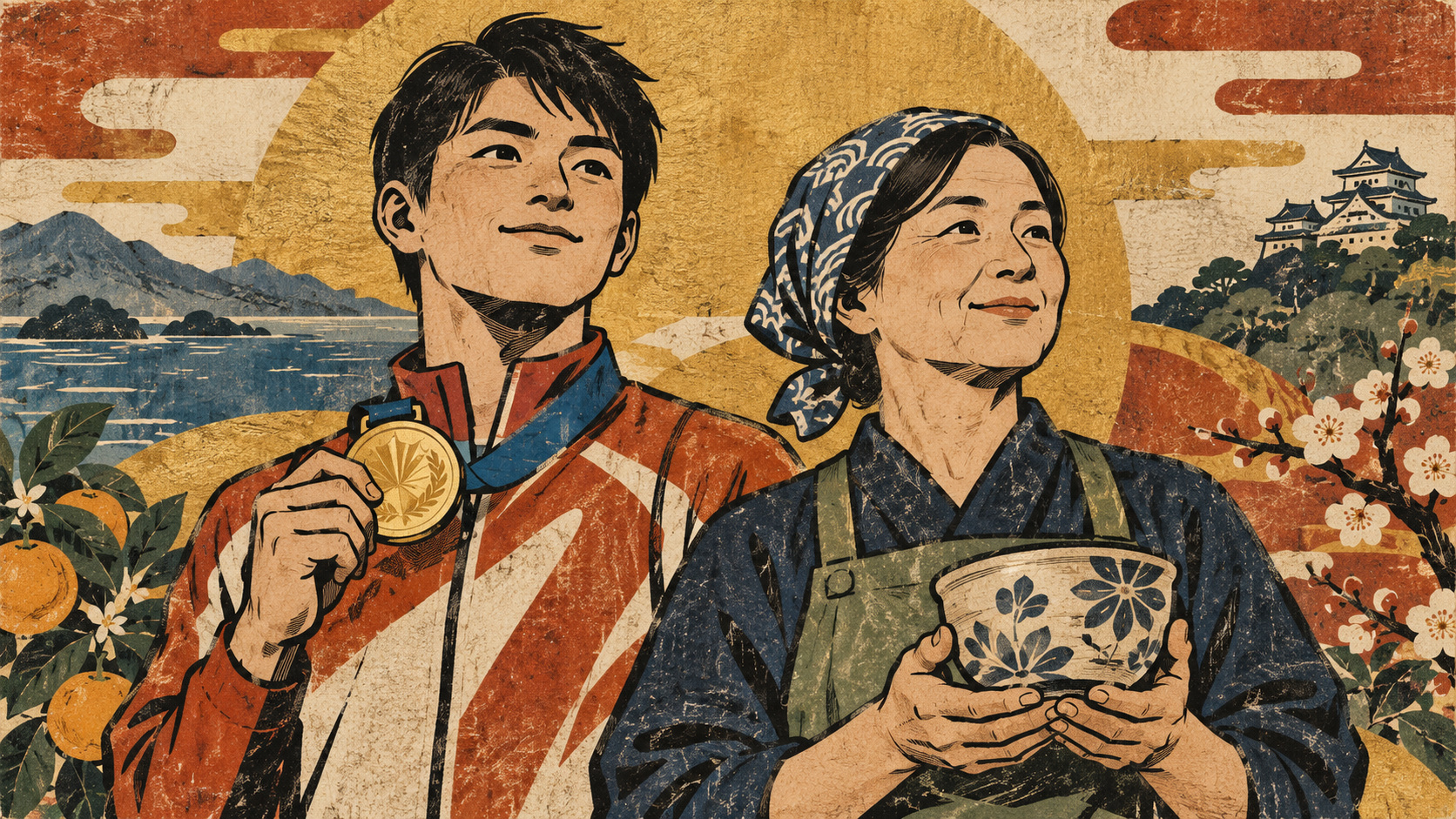
A ceremony that tells a wider story
Ehime Prefecture scheduled its Egao no Ehime Culture and Sports Awards ceremony for October 9 at the prefectural government headquarters in Matsuyama. The official roster recognizes five organizations and 39 individuals for a combined 60 achievements. These numbers describe distinct categories: 60 is the tally of qualifying accomplishments, not a headcount of recipients.
The list reaches from a children’s koto ensemble and established haiku poets to junior cyclists, para-athletes and national champions. Read closely, it is a portrait of the organizations and opportunities that allow talent to develop outside Japan’s largest metropolitan centers.
What the announcement establishes
The prefecture’s October 2 notice gives a 3:15 p.m. start on October 9, at the fourth-floor ceremonial hall of the main prefectural building. Plaques were designated for organizations and medals for individuals. The official documents identify intended honorees and qualifying results; they do not by themselves prove who attended or what was said at the event.
That distinction matters for a Sunday October 11 feature. We can report the roster with confidence, while declining to invent speeches, emotional reunions or onstage scenes that have not been independently documented.
Culture is not a footnote
The official roster names the Seiyo Koto Children’s Classroom, whose elementary-school ensemble won gold at the 44th National Elementary and Junior High School Koto Competition. This is a story of transmission: instructors, rehearsals and access to traditional instruments are what make a children’s performance possible.
Among individual recipients are haiku poet Tsubouchi Nenten, recognized for the 26th Contemporary Haiku Grand Prize, and Nakagoshi Yuko, recognized for a selected teachers’ category verse in the 24th Rinri Haiku awards. Ehime’s haiku inheritance is associated with Masaoka Shiki and Matsuyama, but its relevance today depends on continued participation, not nostalgia alone.
A remarkably deep cycling roster
Matsuyama Gakuin High School’s cycling club earned organizational recognition for winning the boys’ overall team standings at the national high-school selected cycling championships. Individual cyclists, including Matsuda Sotaro and Hidaka Kotaro, appear for national titles and performances; Matsuda’s roster entry includes a junior national record in the 3-kilometer individual pursuit.
The roster extends across track endurance, sprint, road racing and international results. Those disciplines are not interchangeable, nor are junior titles the same as elite world championships. Precision about the event and level gives readers a truer sense of achievement.
Para-athletes belong at the center
Ai Athlete Club is among the five organizational honorees after a victory in the T20 4×400-meter relay at the national intellectual-disability athletics championships. The individual list includes Ishimaru Sho, Fujiwara Yuna, Imon Yui, Mendori Kazue, Yamaguchi Naohide, Kimura Kisaki, Kume Jun and Hirose Junko, across para-athletics, swimming and judo.
Mendori’s two Japanese records in the women’s F57 discus and shot put are particularly notable. A useful follow-up would ask whether accessible venues, transport, specialist coaching and competition budgets match the excellence being celebrated. Recognition is meaningful, but it does not resolve those resource questions.
Excellence across less-visible sports
New high-school fencers won the national girls’ sabre competition, javelin thrower Sakiyama Yuta won the national championship, and golfer Kawamoto Yui won the World Ladies Championship Salonpas Cup. The official awards list also reaches wrestling, rowing, weightlifting, tennis, boxing and other disciplines.
This range should resist the easy temptation to reduce Ehime sport to baseball or one successful athlete. Smaller sports frequently depend on scarce facilities and instructors. For some competitors, the most consequential support comes long before a medal ceremony.
The institutions behind individual names
Iyo Bank’s tennis team appears among the organizational recipients for winning the men’s doubles at the 61st Shimadzu All Japan Indoor Tennis Championships. It shares the list with a school cycling program, a fencing club, a para-athletics organization and a children’s music group.
Those are very different institutional models—corporate sport, school sport, community clubs and arts education—but all help bridge the gap between private enthusiasm and sustained practice. The roster alone, however, offers no evidence of sponsorship returns, budgets or future commitments.
What “connected to Ehime” means
The prefecture says it honors people and groups with ties to Ehime. That wording is broader than having been born within its borders. Likewise, the qualifying accomplishments listed for an award are not full biographies of recipients. Accurate local reporting should avoid converting regional affiliation into unverified claims about birthplace or residence.
The announced ceremony, the published roster and an independently observed ceremony are three different sources of evidence. This report relies chiefly on the first two, and treats onstage attendance and personal reflections as unconfirmed.
History, access and continuity
Ehime’s literary association with Masaoka Shiki sits beside older performing traditions, postwar corporate sport and contemporary para-sport. The province’s cultural identity is not a frozen collection of monuments; it is recreated whenever a schoolchild learns an instrument, a youth cyclist enters a velodrome or an athlete finds a workable training program.
As the population ages and some communities shrink, the essential questions become practical: who trains the next generation, who pays to maintain venues, how do students get there, and can athletes continue once they leave school? An award honors achievement but cannot answer those questions alone.
The standard for next year
A meaningful test of this recognition will come after the photographs and medals: will more children be able to learn koto? Will para-athletes have reliable access to coaching? Will high-school competitors find a route into adult sport without leaving their communities?
Ehime’s 44 named recipients and 60 achievements deserve recognition. The larger measure of the prefecture’s cultural and sporting strength, however, is whether the next generation has an equal chance to begin.
Sources and reporting notes
- Ehime Prefecture: October 9 Culture and Sports Awards announcement
- Ehime Prefecture: full recipient roster (PDF)
- Ehime: March 2026 awards ceremony
- Ehime Culture Promotion Division
- Ehime Regional Sports Division
Reporting cutoff: official documents available by October 9, 2026. Attendance and remarks at the ceremony have not been independently confirmed.