A tiny knot opens onto a large industrial history
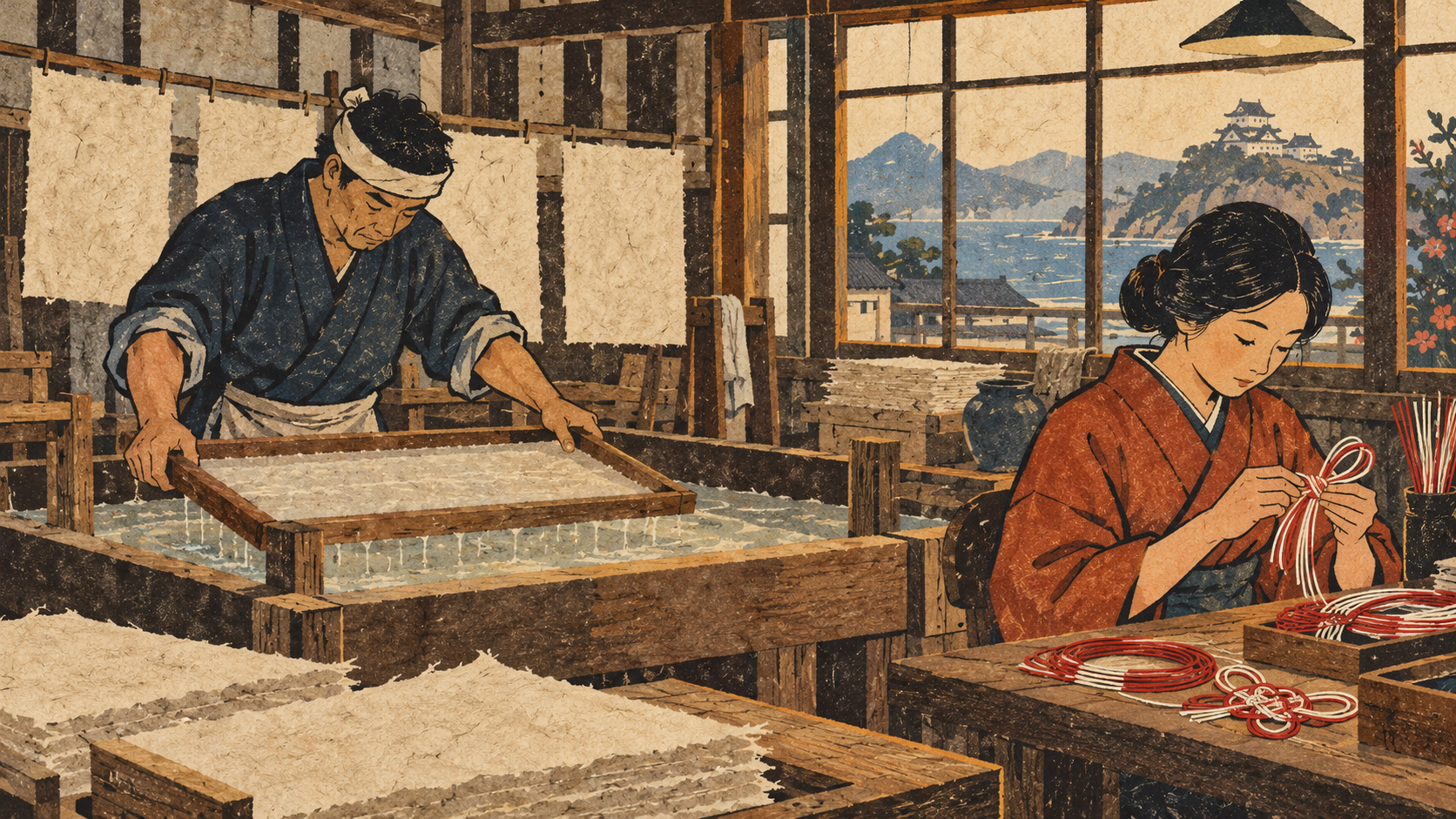
A red-and-white mizuhiki cord is easy to overlook. It may sit on a ceremonial envelope for a wedding gift, yet behind its carefully arranged loop lies a whole economy of papermaking, machinery, logistics and specialized skill in eastern Ehime. The paper is cut, twisted, coated, dried, colored and shaped before it can carry a message of respect.
Ehime’s paper identity also stretches south to Ōzu washi, handmade sheets whose economic history is intertwined with a former castle domain. Understanding both traditions means resisting the idea that Japanese craft is separate from manufacturing. In this prefecture, the two have repeatedly shaped one another.
What makes Shikokuchuo a paper city
Shikokuchuo’s municipal Paper Town Museum says the city has ranked first nationally in the relevant value of paper-related manufactured shipments continuously since the municipality was formed in 2004. The significance is not one celebrated mill but an entire cluster of papermakers, converters, machine suppliers, distributors and skilled workers.
The municipal profile says pulp, paper and processed paper account for more than four-fifths of local industrial shipment value. That is an official characterization, not a freshly calculated 2026 share. It also cannot be used as a measure of traditional handcraft alone.
Mountains, water and a working port
The city sits between the Hōō mountain range and Hiuchi-nada, on the Seto Inland Sea. Its geography helped create a base for water-dependent production and outward shipment, while the Mishima–Kawanoe port supports regional industry. Shikokuchuo was established in 2004 by the merger of Kawanoe, Iyo-Mishima, Doi and Shingu.
The municipality is relatively young; the industries it governs are not. The making, converting and movement of paper have generated interlocking know-how over generations. That concentration is more consequential to industrial resilience than any single branded product.
How a change in hairstyles remade a craft
The Iyo Mizuhiki Kimpū Cooperative traces local mizuhiki to Edo-period motoyui, narrow cords once used to tie hair. As hairstyles changed after the Meiji Restoration, producers diversified into ceremonial gift envelopes, engagement decorations and ornamental products. The history is instructive: keeping a tradition alive has often required changing what it is sold for.
The cooperative also recounts a much older tale linking ceremonial cords to Japan’s early missions to China. That is best described as a traditional origin story, not a securely established account of the industry’s beginnings. Its documented transformation in the modern period is the firmer economic history.
Technology inside the cord
The cooperative’s production guide describes a sequence from paper winding and cutting through twisting, adhesive coating, drying, coloring, cutting to length and bundling. Mizuhiki is therefore not simply string dyed for decoration; it is an engineered paper material designed to hold form yet bend into precise knots.
That process connects mechanized consistency to human design judgment. A reliably manufactured cord is one kind of expertise; the culturally appropriate knot and the final aesthetic are another. They depend on each other.
Ōzu washi, a different industrial inheritance
Southern Ehime’s Ōzu washi serves calligraphy, sliding screens and mounting, among other uses. Designated a national traditional craft in 1977, it carries a history of hand-sheet forming and trade tied to the former Ōzu domain. Historical accounts describe official oversight of raw materials and the shipment of paper to Osaka.
The tradition survives in the Ikazaki area of present-day Uchiko, where visitors can learn about hand papermaking. The story is not a smaller copy of Shikokuchuo’s industrial model: it is another economy of technique, place and specialized demand.
A 2026 stationery initiative points to new customers
The city’s Kami no Machi Bunguza 2026 program showcases how local businesses apply established techniques to stationery, writing papers, gift envelopes and accessories. A foil-stamping workshop describes using ceremonial-envelope expertise on stationery, while the mizuhiki cooperative presents decorative hair accessories and small goods.
The proposition is persuasive, but sales growth remains an open question. A public showcase is not evidence of export contracts, higher margins or sustained employment. Follow-up reporting would need customer and production data, not promotional adjectives.
Craft also helps new residents understand the region
In September 2026, Ehime Prefecture reported that a Tōyo-region leadership course for foreign workers incorporated learning about Shikokuchuo’s paper history and a mizuhiki workshop. The initiative aims to help workers with an interest in settling locally become bridges among businesses, residents and their communities.
A single workshop cannot prove successful integration or improved retention. It does show that local industry is being treated as part of civic belonging: understanding what a town makes can help explain what a town values.
The challenges beyond attractive objects
Demographic change, competition, input costs and altered gift-giving habits place pressure on different parts of the industry. The needs of a capital-intensive paper mill are not the same as those of a workshop producing intricate knots or a small producer of handmade sheets. Treating them as one undifferentiated “craft sector” obscures the challenges.
The most useful questions are concrete: who will train replacements for experienced workers, which products earn adequate margins, how much material is sourced locally, and which channels reach buyers who will pay for quality? The reviewed sources do not settle those questions.
The future is neither nostalgia nor mass production alone
The Paper Town Museum presents the history of manufacturing and opportunities to experience hand papermaking. Such institutions matter because they make otherwise invisible processes legible to children, visitors and prospective workers. Yet appreciation alone cannot sustain a factory or a craft studio.
Ehime’s stronger path may lie in preserving practical know-how while finding new uses for it: industrial paper, graphic applications, distinctive stationery and ceremonial objects. The slender mizuhiki cord, in that sense, is a useful image for a regional economy: strength comes from fibers working together.
Sources and reporting notes
- Shikokuchuo Paper Town Museum
- Shikokuchuo municipal industrial profile
- Iyo Mizuhiki Cooperative, historical account
- Iyo Mizuhiki Cooperative, production process
- Shikokuchuo, Bunguza 2026
- Ehime Prefecture, Tōyo foreign-worker learning session
- Japan Traditional Culture Promotion Organization, Ōzu washi
- Ehime official tourism, traditional paper
Research cutoff: October 8, 2026. Rankings and industrial shares reflect municipal descriptions and their stated statistical scope. Historical legends are identified as such; unverified sales or export outcomes are excluded.