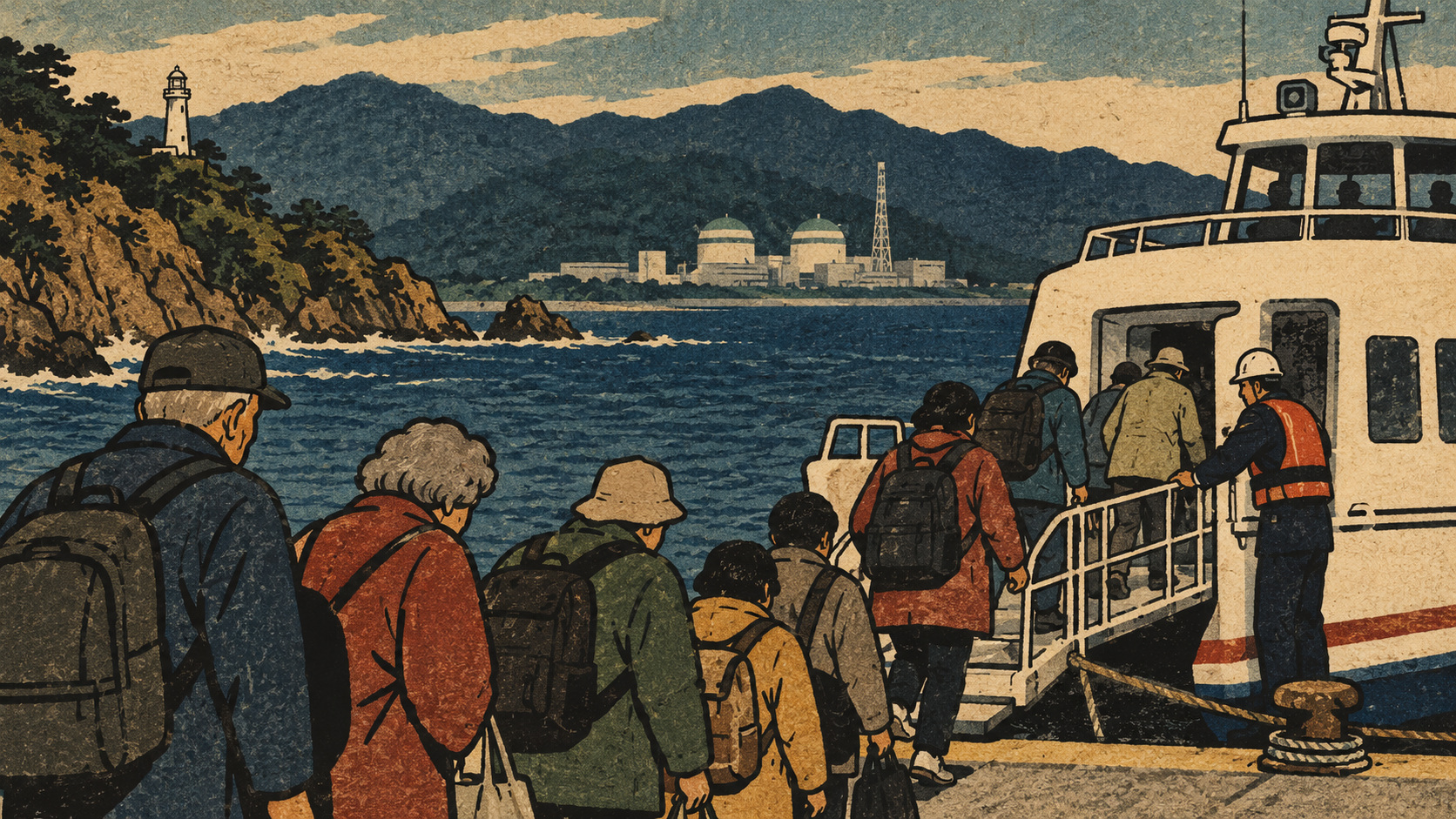
The hardest part may be reaching the harbor
The Sadamisaki Peninsula reaches west between the Seto Inland Sea and the Uwa Sea, a beautiful but unforgiving piece of geography in an emergency. Boats can provide a way out if roads fail. Yet anyone who cannot reach a boarding point, or whose departure is delayed by weather, needs another credible means of protection.
Ehime Prefecture has announced nuclear-emergency exercises for October 13 and 16 around Shikoku Electric Power’s Ikata plant. Authorities plan emergency broadcasts and evacuation practice involving ships and helicopters. These are exercises, not evidence of an ongoing nuclear accident. The prefecture warns that bad weather can change or cancel activities.[1]
Two scheduled days, not two completed evacuations
The first exercise is scheduled for Tuesday, October 13, from 8:45 a.m. until 4:00 p.m.; the second for Friday, October 16, from 8:30 a.m. to 3:00 p.m. The program centers on prefectural offices, Ikata and municipalities broadly within 30 kilometers, with neighboring prefectures also involved.[1]
On the October 11 publication date, those events have yet to happen. A timetable cannot establish that communications worked, that enough people were moved, or that a real emergency could be managed. Those are questions for documented post-exercise evaluation.
Why Ikata has three different planning areas
The Japanese framework defines the PAZ, or Precautionary Action Zone, as roughly five kilometers from the plant. Beyond that, the UPZ—Urgent Protective Action Planning Zone—extends to roughly 30 kilometers. Their protective actions differ: precautionary evacuation is central to a developing emergency in the PAZ, while sheltering indoors and monitoring are central initial responses in the UPZ, with further measures taken as conditions warrant.[2][3]
But Ikata has a geographic exception. Western Sadamisaki communities lie within the UPZ yet face the possibility of losing the land route past the plant. Ehime therefore designates a special preventive-evacuation area west of the PAZ and prepares measures analogous to those in the PAZ. A simple ring on a map cannot capture that danger.[2]
A nuclear plant that began in the oil-shock era
Ikata’s first reactor began operation in September 1977, during an era when Japan was reshaping its energy supply after the 1973 oil shock. The second entered service in March 1982, and the third in December 1994. The Nuclear Regulation Authority lists reactors 1 and 2 as undergoing decommissioning and reactor 3 as operating.[4]
Shikoku Electric says the first two units stopped generating in 2016 and 2018 respectively. Their decommissioning is expected to take about four decades. The plant’s long history thus includes both power generation and the management of facilities no longer producing electricity.[5]
Fukushima changed the meaning of preparedness
The 2011 Fukushima Daiichi accident made the consequences of confused communications, extended displacement, and the protection of vulnerable residents impossible to dismiss. Preventing a severe accident and planning for protective action if one occurs are separate safety responsibilities.
Ehime has practiced maritime evacuation before. In 2016 it simulated blocked roads, moved people by ferry and patrol vessel toward Oita and within Ehime, and included helicopter transport for residents requiring special assistance.[7] The 2026 exercises should not be described as the first local attempt to evacuate people by sea.
A journey is only as strong as its first link
A prefectural demonstration project sets out how residents in the Misaki area would first reach an assembly point at Misaki General Gymnasium and then, if needed, proceed toward Misaki Port. The harbor is identified as an important location with an earthquake-resistant quay on the peninsula.[6]
The more revealing figures in that planning document concern small settlements, the number of residents without cars, and the bus trips needed to collect them. A vessel’s theoretical passenger capacity is irrelevant if roads are blocked between people’s homes and the pier.
Ships are an alternative, not a guarantee
Marine evacuation can bypass a severed road. It also relies on suitable weather, accessible piers, functioning vessels, crews and receiving ports. Helicopters add another route for urgent cases but are much less suitable for moving an entire population.
In a 2017 exercise, Ehime tested coordination with Oita and a route through Beppu Port.[8] Such rehearsals are meaningful evidence of planning and cooperation, but do not establish that every route would remain usable during a compound disaster.
Patients, older people and residents needing assistance
A complete plan must address people who cannot simply drive away: hospital patients, care-home residents, people with disabilities, infants and anyone dependent on medical equipment. Transport is not just a seat on a bus. It may require trained escorts, medical records, medication, suitable vehicles and a receiving institution.
For some people, the journey itself can be dangerous. Decisions about sheltering in protected facilities, relocating gradually or moving immediately must be made according to the emergency and official instructions, not the assumption that all movement is inherently safer.[9]
Communication has to produce understanding
Ehime lists disaster radio, public-address vehicles, emergency mobile alerts and broadcast media as ways to inform residents.[2] Each channel can fail or exclude a different group. People need to understand not merely that an alert exists, but what applies to their particular neighborhood and whether to shelter or leave.
An informative evaluation would ask how long messages took to arrive, whether people with hearing difficulties could access them, and whether residents with limited Japanese proficiency understood the intended action. Sending information and confirming comprehension are distinct tasks.
Why mass flight from the 30-kilometer zone is the wrong assumption
The PAZ, UPZ and special preventive-evacuation area do not have identical initial instructions. An indiscriminate rush of cars from the entire 30-kilometer radius could create traffic risks and make the orderly protective measures envisioned by planners harder to execute.[2][3]
Residents should follow the most current instructions from the prefecture and their municipality. This news report describes the planning framework; it is not an operational evacuation order.
Five things worth measuring after the drills
Post-exercise reporting should go beyond the number of participating agencies. Valuable measures would include warning-to-reception time, the time needed to collect residents at assembly points, actual passengers moved versus planned capacity, the support required for those needing assistance, and how quickly an alternate route was activated after a simulated blockage.
These are editorially proposed evaluation questions, not a claim that the prefecture has promised to publish all such metrics. Honest after-action reports should disclose difficulties as well as successful maneuvers.
The right to protection is not a referendum on nuclear power
Arguments over the role of nuclear generation in Japan are deeply contested. But supporters and critics of Ikata alike depend on clear warnings, realistic contingencies and public explanations of what remains untested. The peninsula’s older residents and small settlements should not disappear behind abstract circles drawn around a reactor.
The decisive question after October 13 and 16 is not just whether a ship departed. It is whether the people who would need it could get there in time—and what would happen if it could not sail.
Sources and reporting methodology
- Ehime Prefecture, 2026 Nuclear Emergency Exercise Notice, October 7
- Ehime Prefecture, How to Act in a Nuclear Emergency
- Ehime Prefecture, Wide-area Evacuation Plan
- Nuclear Regulation Authority, Ikata Plant Overview
- Shikoku Electric Power, Decommissioning
- Ehime Prefecture, Evacuation Access Demonstration
- Ehime Prefecture, Governor Briefing on 2016 Exercise
- Ehime Prefecture, Governor Briefing on 2017 Exercise
- Ehime Prefecture, Nuclear Emergency Regional Disaster Plan
Based on primary official materials available through October 8, 2026. As of the October 11 publication date the October 13 and 16 exercises remain forthcoming. No post-drill performance figures or independent resident interviews are available. In an emergency, follow current official instructions.