- The visitor who does not know where to go
- A famous destination with an unfamiliar emergency map
- A thousand years of arrival and exchange
- Why more languages are not the whole answer
- Learning from specialists before offering solutions
- A test with people who do not share the designers’ assumptions
- Japan already has tools. Can travelers find them?
- Heavy rain, earthquakes and the limits of preparedness
- From explaining heritage to helping protect its visitors
- The test of a welcoming city
The visitor who does not know where to go
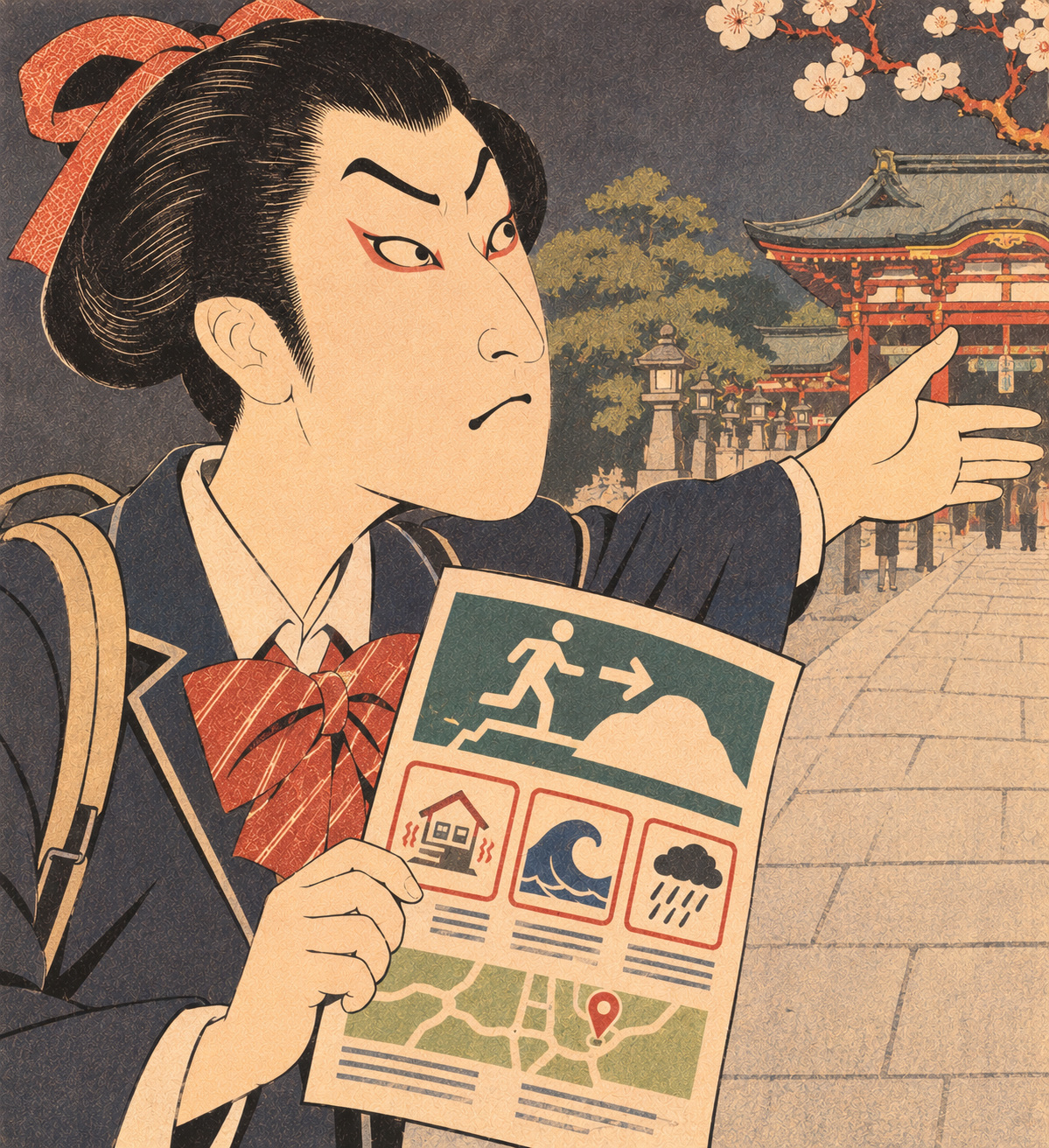
A traveler has arrived in Dazaifu for its shrine, historic streets and centuries of culture. Now imagine that the ground shakes, a railway stops, or a severe-weather warning appears. The traveler may know nothing about the nearest shelter, the meaning of local warning levels, or which official website to trust. A message can be translated correctly and still fail if the person receiving it cannot connect it to a place and an immediate decision.
That problem has become a classroom assignment for roughly 70 students at Linden Hall School’s junior and senior high division in Chikushino, Fukuoka Prefecture. Their project began on November 4, 2026, and was announced by the Tsuzuki Gakuen Group on November 16. The setting is neighboring Dazaifu, one of Kyushu’s best-known heritage destinations. The students are being asked to investigate “tourism disaster preparedness”: not simply whether warnings exist, but whether people unfamiliar with Japan can act on them.
The school has not announced completed, tested tourist evacuation signage. Field research, prototypes, user testing and a formal proposal to the city are still planned for December and January. This distinction matters: the news is the launch of an unusually practical learning process, not a finished public safety system.
A famous destination with an unfamiliar emergency map
Dazaifu’s challenge is magnified by its popularity. The city describes receiving visitors numbering more than 100 times its resident population. Municipal assembly material gives approximately 9.289 million tourist arrivals for fiscal 2025. That is a tourism-arrivals measure, not a count of unique international travelers, and it should not be confused with survey-based estimates of inbound visitation.
Day-trippers create particular logistical problems. Unlike overnight guests, they cannot necessarily return to a hotel for guidance or assistance. Their first points of contact might be a train-station employee, a shopkeeper on the approach to Dazaifu Tenmangu, or an official notice displayed where crowds gather. An outage or congestion could make mobile communication unreliable just when it is most needed.
Dazaifu is not starting from scratch. In March 2026 it adopted a tourism crisis-management manual, publicly explained in April, covering earthquakes, typhoons, infectious-disease emergencies, stranded visitors, business coordination and recovery. Students are therefore working beside an existing municipal framework. Their potential contribution is to test the last mile between that framework and the traveler who has never read it.
A thousand years of arrival and exchange
In the seventh century, political upheaval across the Korean Peninsula and the Battle of Baekgang shaped Japan’s defenses in northern Kyushu. Fortifications including Mizuki and Ono Castle were developed, and by the early eighth century the ancient administrative center known as Dazaifu played a leading role in governing Kyushu and managing diplomacy and defense.
The distinction in Japanese writing is useful: 大宰府 generally denotes the ancient government institution, while 太宰府 is the modern city’s spelling. Beyond the famous shrine honoring scholar-official Sugawara no Michizane, the region preserves the former administrative ruins and temples that speak to its history as a gateway to continental Asia.
The school has framed its project around a vision of preserving the same landscape for visitors a thousand years from now. The point is not just conserving buildings. A place that wants to welcome future generations must also ask what it owes to the visitors walking its streets today.
Why more languages are not the whole answer
The temptation in tourist safety is to equate preparedness with multilingual signs. Translation is essential, but its usefulness depends on sequence and context. What hazard is present? Where am I? Should I remain here or move? How do I find an authoritative update? These questions cannot always be answered by the same poster or by the same generic advice.
The school has floated possible projects including redesigned evacuation-route signs, a website directing visitors to relevant information, and emergency-food recipes that consider different ingredients and dietary needs. They are examples to investigate, not confirmed products or commitments by local authorities.
A good prototype will have to be assessed under realistic conditions. A visitor encountering an instruction for the first time needs to understand it quickly, on a small phone screen or while moving with others. Testing matters more than the elegance of a diagram in a presentation.
Learning from specialists before offering solutions
The announced program includes a November 10 lecture by Kenji Shimoike, an instructor at Daiichi Institute of Technology, on risk awareness, hazard maps and evacuation routes. A November 17 session with Dazaifu’s tourism promotion and disaster-safety sections was also scheduled. The school’s advance notice does not independently establish that every session occurred exactly as planned.
For December 5, the school lists activities with the Fukuoka branch of the Japanese Red Cross Society, including shelter and emergency-food experiences, alongside field observation around Nishitetsu Dazaifu Station, the approach to the shrine and the Dazaifu Tenmangu area. Some external arrangements and dates remained subject to coordination when the school published its announcement.
The distinction between responsibilities will be important. Local government and relevant authorities issue official emergency information; students should not be expected to make safety-critical determinations. They can, however, help reveal where authorized information is hard to find, hard to interpret, or disconnected from what visitors see in front of them.
A test with people who do not share the designers’ assumptions
Four prototype-development sessions are planned between December 16 and January 20. A user test is scheduled for January 23, 2027, drawing on foreign teachers and international students from Japan University of Economics. The aim is to revise the materials in light of the test before presenting proposals to Dazaifu’s tourism promotion office on January 26.
That cycle is the most consequential part of the project. Japanese-speaking students may unconsciously understand local signs, warning categories and public institutions. Someone new to Japan may not. If a user takes a wrong turn, confuses an information point with a shelter, or misses the official warning link, the designer learns something that a classroom discussion cannot reveal.
Yet a small test group cannot stand in for every nationality, age, disability or travel circumstance. The results should be treated as feedback on specific designs rather than proof of universal accessibility or emergency effectiveness.
Japan already has tools. Can travelers find them?
Japan has invested in multilingual visitor-safety infrastructure. The Japan Tourism Agency-supervised Safety tips app provides push notifications for earthquake early warnings, tsunami warnings and other severe-weather alerts. As of the agency’s April 2026 guidance, it supports 15 languages and offers evacuation flowcharts, communication aids and links to further information. An API enables other services to incorporate its alert data.
The Japan National Tourism Organization also maintains emergency-information channels and the Japan Visitor Hotline, a 24-hour help service offering support in English, Chinese and Korean. These services are established, but an arriving tourist may have neither downloaded the app nor memorized a hotline number.
This creates an important design principle for the students: a local website should not impersonate the authority issuing warnings or offer independent hazard judgments. Its most valuable role may be a clear path to the current, official information, reinforced by physical directions at the places travelers actually pass through.
Heavy rain, earthquakes and the limits of preparedness
The Japan Meteorological Agency reports that the nationwide annual frequency of hourly rainfall of at least 80 millimeters, normalized to approximately 1,300 observing sites, increased from roughly 14 events per year in 1976–85 to about 25 in 2016–25. That is about 1.8 times as frequent. It is a national observation trend—not a numerical forecast for Dazaifu itself.
Even without a local disaster, disrupted transport can strand visitors and complicate access to food, shelter and reliable updates. Dazaifu’s municipal manual explicitly addresses coordination with tourism businesses and assistance for visitors unable to get home.
The student exercise should not be interpreted as a warning that a specific earthquake or storm is imminent. It is an effort to examine an uncertainty that every major destination must confront: what will an unfamiliar visitor do if an ordinary day suddenly becomes extraordinary?
From explaining heritage to helping protect its visitors
The school’s annual inquiry program, Wakō no Tane, has worked with Dazaifu’s cultural landscape before. In 2024 students staged an English-language kabuki performance connected with the area’s history. In the 2025 school-year project, students developed Japanese- and English-language guided tours and an augmented-reality stamp rally to introduce sites beyond the main shrine.
An education-industry account of the February 2026 guided-tour event describes about 50 students guiding more than 100 participants around several heritage locations. Those earlier efforts were focused on connecting visitors with the city’s cultural depth. The current project asks a harder question: after encouraging people to visit, how can a destination help them if something goes wrong?
That continuity suggests a promising progression in the school’s local learning, but there is no public evidence yet that this year’s prototypes will become municipal infrastructure. Student learning outcomes and official adoption should be judged separately.
The test of a welcoming city
Success will not be measured only by an attractive sign, a polished presentation or the number of languages on a page. It will depend on whether a real visitor can identify the next safe action, find a reliable source, and understand where help is available. Accessible design, maintenance, clarity under stress and coordination with responsible agencies matter after the classroom project ends.
The students’ undertaking is modest in administrative scale but powerful as a journalistic question. Dazaifu’s public institutions have a preparedness framework. Can young people help demonstrate how that framework appears—or fails to appear—to someone who has arrived for a day of sightseeing?
An ancient center that once connected Japan with the wider region is now examining the conditions of modern hospitality. The promise of this experiment will be tested not by its ambition alone, but by what happens when an unfamiliar reader looks at the students’ work and knows where to go.
Primary sources and reporting limitations
This independently written report is based on public school, municipal and national sources available through November 18, 2026 JST. JAPAN.co.jp did not independently interview students or visitors, inspect prototype materials, or observe field testing. Planned milestones should not be mistaken for completed achievements.
- Linden Hall School / Tsuzuki Gakuen: 2026 tourism disaster-preparedness project (Nov. 16)
- Dazaifu City: Tourism crisis-management manual (April 2026)
- Dazaifu City: Ancient history of Dazaifu
- Dazaifu City: Historical and modern spellings of Dazaifu
- Japan Tourism Agency: Safety tips and multilingual emergency tools
- JNTO: Visitor emergency information and Japan Visitor Hotline
- Japan Meteorological Agency: Long-term extreme rainfall trends
- Education newspaper: Student heritage guides and AR activity (April 2026)
- Japan Tourism Agency: Reducing disaster harm to overseas visitors
- Dazaifu City Assembly: June 2026 meeting record (fiscal 2025 tourist-arrivals figures)