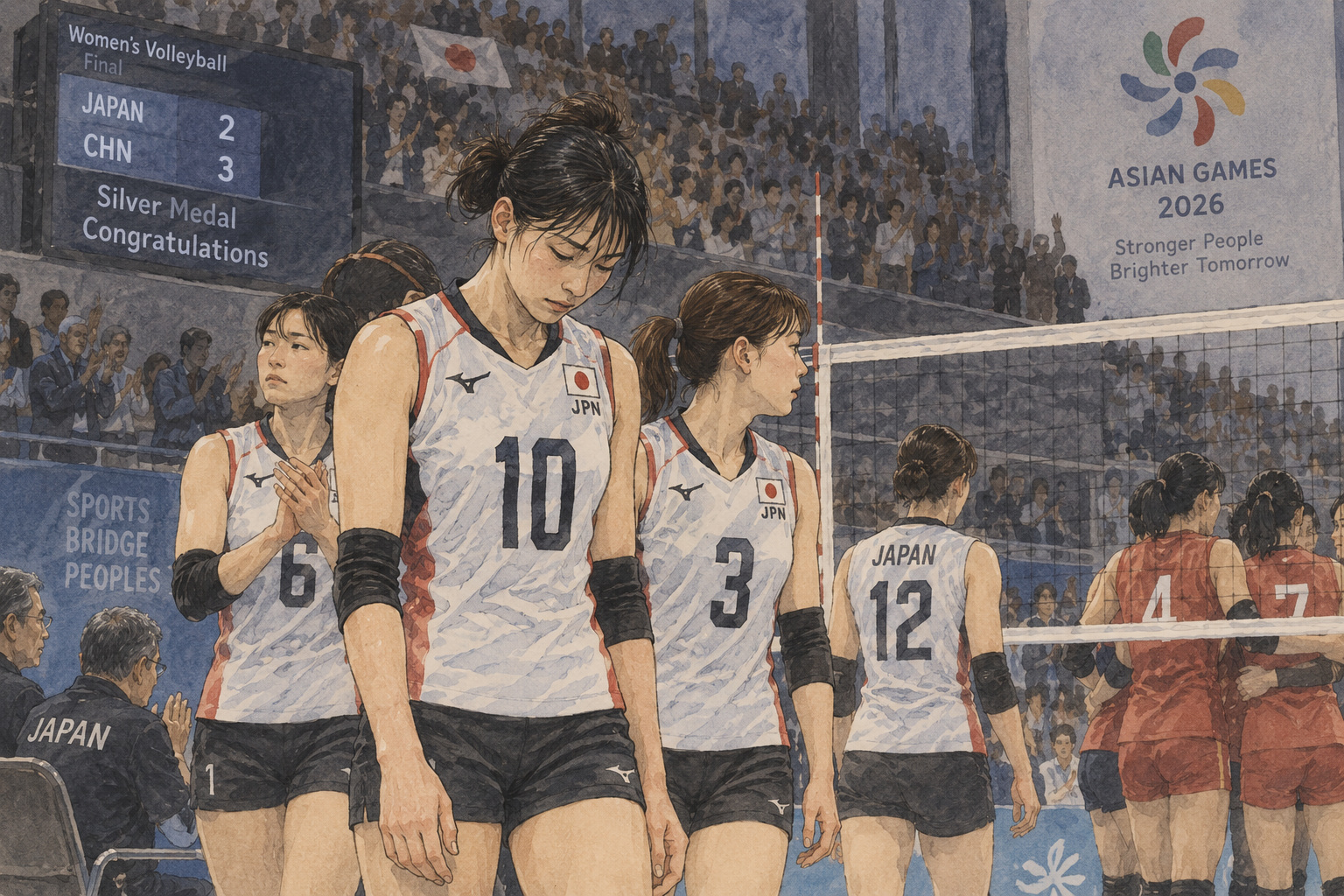
Japan’s women reached the Asian Games volleyball final at home and met China. The result was clear: China won in straight sets, 25-19, 25-20, 25-23.
Japan took silver. Among the players receiving that medal was an outside hitter whose path began in Chiba City and now extends to Italy’s top league: Yoshino Sato, 24.
The JOC lists Sato as a member of Vero Volley Milano and records her final Asian Games result as second place, silver medal. Her connection to Chiba is not merely a birthplace line in a player bio. Chiba City’s own records trace her development through Chiba Chuo Junior Club, Matsugaoka Municipal Junior High School and Keiai Gakuen High School before she moved on to the University of Tsukuba, NEC Red Rockets Kawasaki, the national team and now Milano.
Four wins carried Japan into the final
Japan opened with a 3-0 win over Nepal and then beat Indonesia 3-1. In the later rounds, Japan defeated Chinese Taipei 3-0 and Korea 3-0 to reach the gold-medal match.
China ended that run on September 22. Japan lost the first set 19-25, the second 20-25 and pushed the third to 23 before China closed it 25-23. The final standings were China first, Japan second and Thailand third.
The public JOC and JVA result pages reviewed for this article do not provide Sato’s individual scoring breakdown for the final, so Japan.co.jp does not estimate it.
Sato’s Chiba story is a development path, not a marketing label
Chiba City’s official profile lists Sato as born in Chiba City on November 12, 2001. Her volleyball route is recorded as Chiba Chuo Junior Club, Matsugaoka Municipal Junior High School, Keiai Gakuen High School, the University of Tsukuba and NEC Red Rockets Kawasaki.
In its May 2026 city newsletter, Chiba introduced her as a player “connected to Chiba City,” highlighting her powerful jump serve and stable defense. The city had also publicized her mayoral courtesy visit before national-team competition.
One athlete does not prove a formal “Chiba pipeline”
It would be too strong to claim that one silver medal proves a specific Chiba development system caused Sato’s success.
Her early volleyball years were spent in Chiba, but her later growth also involved the University of Tsukuba, NEC, national-team coaching, international competition and her own ability and work.
So “pipeline” here should be understood descriptively: Japan has a pathway through junior clubs, school volleyball, university, professional competition, the national team and overseas leagues. Sato is a particularly clear Chiba-born example of an athlete moving through those layers.
From Keiai Gakuen to Tsukuba—and the senior national team while still in college
Sato moved from Keiai Gakuen High School to the University of Tsukuba.
In 2022, the Japan Volleyball Association selected her for the senior women’s national-team registration for the first time while she was still a second-year university student. JVA listed her as an outside hitter.
She later won silver at the FISU World University Games and helped Tsukuba win the 2023 All Japan Intercollegiate Women’s Championship.
Her professional breakthrough came quickly
After university, Sato joined NEC Red Rockets Kawasaki.
NEC says that in her rookie 2024-25 SV.League Women season she finished as the highest-scoring Japanese player and earned both Rookie of the Year and a Best Six selection.
J SPORTS recorded her across all 51 official matches that season, third overall in scoring and first among Japanese players.
That matters for the outside-hitter position. An outside hitter is asked not only to terminate attacks but to serve, receive, defend and remain functional through long rotations. Chiba City’s profile emphasizes exactly that balance: a forceful jump serve paired with dependable defense.
By 2025, Japan was back among the world’s top four
Sato’s senior international experience expanded quickly after her 2022 debut.
Japan reached the final four of the 2025 Volleyball Nations League and also finished in the top four at the 2025 World Championship.
She remained on the 2026 national-team list. In July, Japan came back from two sets down to beat Poland 3-2 in Osaka and secure a VNL Finals place. Volleyball World credited Sato with four aces, including a net-cord drop serve that ended the match.
The jump serve Chiba City had highlighted in a local profile became a weapon in a high-pressure international match.
Then came Italy
On March 29, NEC announced that Sato would transfer to Numia Vero Volley Milano for the 2026-27 season.
The Italian women’s Serie A league announced the move the following day, describing Milano as Sato’s first club experience outside Japan. Its official roster lists her as a 178 cm outside hitter wearing No. 5.
She joins a roster with global stars including Paola Egonu and Anna Danesi. That changes the daily competitive environment: training itself becomes exposure to some of the size, speed and physicality Japan encounters in major international matches.
The Asian Games silver came immediately before that overseas chapter
Milano’s September 23 team presentation noted that Sato was absent because she was still on national-team duty. A later club update said she would join the team after the international period.
So the Asian Games silver is both an endpoint and a transition: one of her last major competitions before starting her first European club season.
Japan’s women are increasingly spread across foreign leagues
JVA’s 2026 national-team list shows a broader pattern.
Sato is with Milano. Mayu Ishikawa is with Eczacıbaşı in Turkey. Yukiko Wada and Nanami Seki are in Italy with Busto Arsizio. Libero Manami Kojima is with LOVB Salt Lake in the United States.
Overseas movement does not automatically improve a national team. Playing time, health, system fit and workload all matter. But different leagues expose players to different blocking heights, serving pressure, offensive tempos and tactical styles.
For Japan, which often competes internationally against physically larger teams, that variety can become part of the learning environment.
Japan once won five straight Asian Games women’s titles
The historical standard is demanding.
JOC records that Japan’s women won five consecutive Asian Games volleyball titles from Jakarta 1962 through Bangkok 1978. That span overlaps the era when Japan won Olympic women’s gold at Tokyo 1964 and Montreal 1976.
The famous “Oriental Witches” generation helped establish women’s volleyball as one of Japan’s signature sports.
China’s rise changed the Asian balance. Japan has gone a long time without returning to the top of the Asian Games women’s podium. The 2026 final reproduced that modern reality: Japan reached the gold-medal match but China finished it in three sets.
The third set, 23-25, is where the gap feels smallest—and most important
Japan narrowed the margin in the final set and reached 23 points. At elite level, however, the difference between competing closely and winning a set often lies in only two rotations: serve quality, reception under pressure, attack choice against a set block, or the ability to finish one long rally.
The 23-25 third set therefore captures both sides of Japan’s current position. The team is close enough to push China deep into sets, but not yet consistently converting those late-set moments.
European club experience is one possible way individual players can accumulate more repetitions in precisely those situations.
For Chiba, Sato is also an athlete who returns home
Japan’s women held a national-team intra-squad Mizuno Match at Chiba Port Arena in May 2026. JVA’s calendar lists it as the Chiba event.
Chiba City used the occasion to feature Sato in its municipal newsletter. The significance for younger local players is simple: an international athlete is not an abstract national celebrity but someone who went through schools and gyms in the same city.
Development is not only the production of elite athletes. It is also whether elite athletes become visible reference points for the next group of children deciding whether to start or continue the sport.
Going abroad is not the finish line
Milano is a new challenge, not a guarantee.
Sato will have to earn court time, adapt to a different system, carry serve-receive responsibility, manage a long club calendar and move between European competition and national-team duty.
That is why the Asian Games silver should not be written as the completion of a tidy “Chiba to the world” story.
Her career is more useful as an example of circulation: begin locally, develop nationally, test internationally, go abroad, then bring those experiences back into the Japanese national team.
Sources
- JOC, Yoshino Sato Asian Games profile
- Japan Volleyball Association, 2026 Asian Games women’s results
- Chiba City municipal newsletter, May 2026, Yoshino Sato profile
- Chiba City, Yoshino Sato profile for mayoral visit
- JVA, 2022 women’s national-team registration
- NEC Red Rockets Kawasaki, Sato overseas-transfer announcement
- Italian women’s Serie A / Milano, Sato signing
- JVA, 2026 Japan women’s national team
- JOC, history of Japanese ball sports at the Asian Games
- JOC, history of Japanese Olympic volleyball