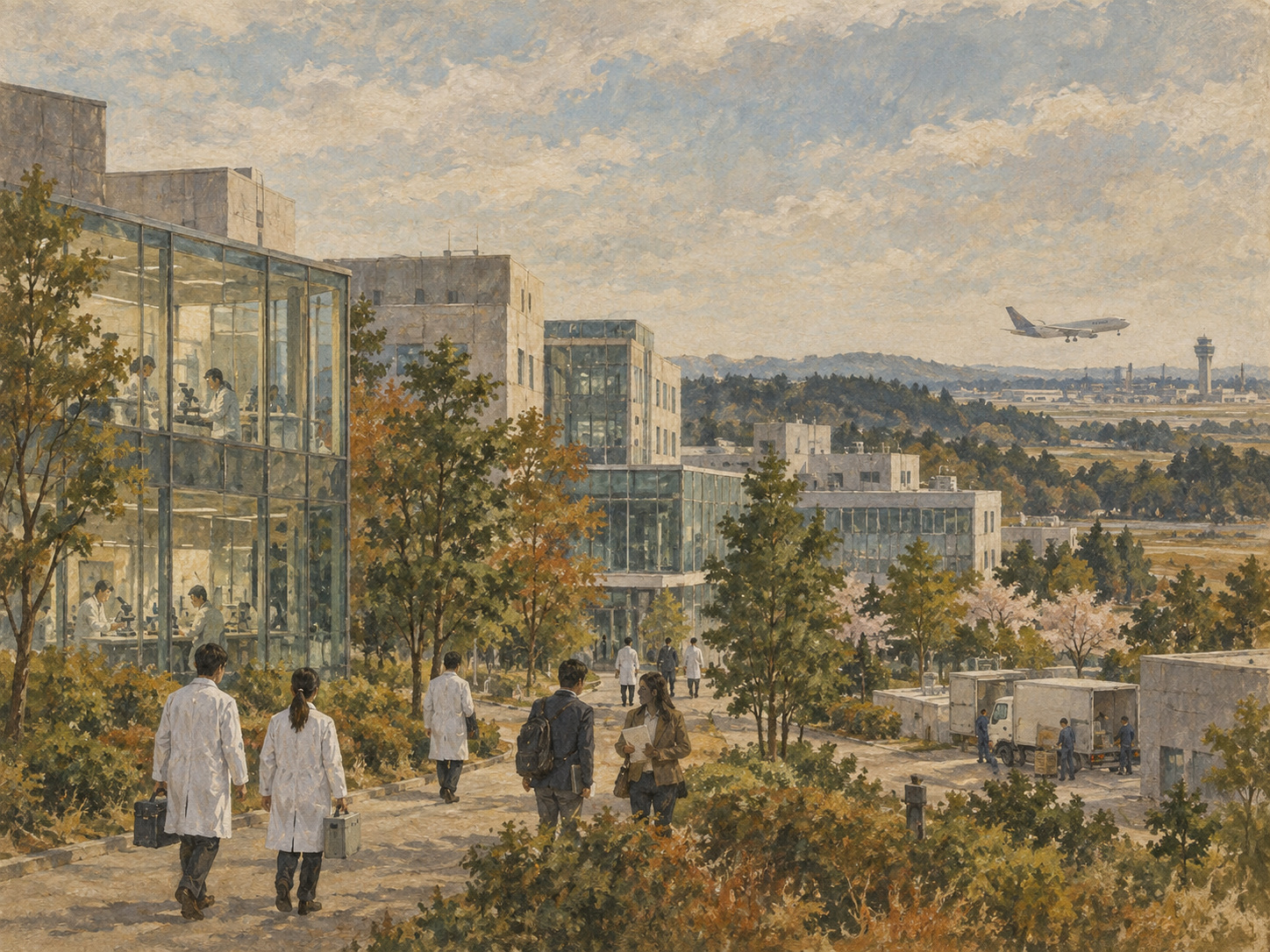
A region can be excellent at life science without becoming excellent at the life-science business. A university may discover a drug target, yet lack the clinical infrastructure to test it. A cell therapy may work in a laboratory, yet fail because nobody can manufacture it consistently at scale. A radiopharmaceutical can be scientifically valuable but commercially unusable if it cannot reach a hospital before too much radioactivity decays.
Chiba Prefecture’s newly adopted Regional Industrial Cluster Plan for drug discovery, advanced medicine and biotechnology is built around that gap. Published September 30 after completion of the national government’s advance review process, the plan treats research, clinical trials, manufacturing, logistics, company attraction and startup support as one industrial system.[1]
The plan is one component of the broader Chiba Prefecture Regional Industry Growth Plan now being assembled under Japan’s Regional Future Strategy framework. Importantly, that overall growth plan is not yet complete. Chiba says it will publish the full plan after all five initial cluster plans—including aerospace, GX, AI/semiconductors and information communications—have cleared the process.[1]
The advantage Chiba is selling is not laboratories alone
The plan’s core argument is geographical. Chiba has major clinical and research institutions: Chiba University, the National Cancer Center’s Kashiwa campus, the National Institutes for Quantum Science and Technology, Kazusa DNA Research Institute and NITE’s Biological Resource Center. Those institutions cover clinical research, genomics, microbial resources, quantum medicine and biotechnology.[2]
Then there is Narita Airport.
The prefecture’s plan cites approximately ¥603 billion in pharmaceutical exports through Narita, about 42.7% of Japan’s total. That matters because pharmaceuticals and regenerative-medicine products can require strict temperature control, while certain raw materials and products have severe time constraints.[2]
Two clusters, with different jobs
For drug discovery and advanced medicine, the prefecture identifies two core areas: Chiba/Kazusa and Kashiwanoha. The listed municipalities are Chiba, Ichihara, Sodegaura, Kisarazu, Kimitsu, Futtsu and Kashiwa. For the broader biotechnology cluster, the core is Chiba/Kazusa without Kashiwa.[2]
Kashiwanoha is the denser clinical-development environment. Chiba University, the University of Tokyo’s Kashiwa campus, the National Cancer Center’s Kashiwa campus and AIST sit around a district with multiple incubation and lab-office facilities occupied by pharmaceutical, medical-device and regenerative-medicine companies. Chiba describes the district as roughly 30 km from central Tokyo and 40 km from Narita Airport.[2]
Chiba/Kazusa is broader: genomics at Kazusa DNA Research Institute, microbial resources at NITE, medicine and biology at Chiba University, quantum medicine at QST, planned radiopharmaceutical production, and biotechnology links to the Keiyo coastal chemical industry and sustainable aviation fuel.
A 1994 decision by Chiba Prefecture still shapes this strategy
The biotechnology push has a long institutional history.
Kazusa DNA Research Institute opened in Kisarazu in 1994 as a core facility of the prefecture-created Kazusa Academia Park. Its history records the foundation’s establishment in 1991 and the institute’s 1994 opening, followed by large-scale work on human cDNA, plant genomes and microbial genomes. The institute itself describes local-government backing for fundamental DNA research as an unusual model in Japan.[3]
In 2003 Chiba created the Chiba Bio-Life Science Network to promote industry-academia-government cooperation, information exchange and joint research. Prefectural officials now describe that effort as more than two decades of biotechnology policy moving from research support toward commercialization.[4]
In 2022 the Chiba/Kazusa and Kashiwanoha areas became promotion hubs within the Cabinet Office-recognized Greater Tokyo Biocommunity. The new cluster plan tries to translate that research network into factories and companies.
Kashiwanoha’s model is to manufacture next to the clinic
The National Cancer Center, Teijin, Japan Tissue Engineering and Mitsui Fudosan announced a regenerative-medicine platform in Kashiwanoha in 2022. A CDMO facility at Mitsui Link-Lab Kashiwa-no-ha 1 was designed to sit close to the National Cancer Center Hospital East and the Exploratory Oncology Research & Clinical Trial Center.[5]
The goal is to support product design, clinical development, business planning and commercial manufacturing in one ecosystem. The National Cancer Center has said the platform aims eventually to support roughly 10 regenerative-medicine projects a year.[5]
CDMO stands for contract development and manufacturing organization. For a university lab or startup, a CDMO can provide process development, quality systems, clinical manufacturing and scale-up without requiring the young company to build an entire factory before it knows whether its product will succeed.
The plan names the companies it expects to anchor the ecosystem
Chiba’s document is unusually specific about participating businesses.
Teijin Regenet operates regenerative-medicine CDMO functions in the prefecture and supports manufacturing-method development through the Kashiwanoha platform. LinkMed develops radiopharmaceuticals using copper radioisotopes and is building manufacturing capacity in Chiba. PeptiDream and subsidiary PDRadiopharma plan production in the prefecture using peptide-based technologies. Tsumura has a laboratory in Chiba. Mitsui Fudosan supplies lab space, community and investment infrastructure. Green Earth Institute operates a biofoundry base in the prefecture.[2]
The list shows that Chiba is not proposing one pharmaceutical park. It is trying to combine regenerative medicine, radiopharmaceuticals, Kampo-related research, bio-manufacturing, lab real estate and outsourced development.
For radiopharmaceuticals, distance to the airport can become a scientific constraint
Many manufactured goods lose little value if transportation takes several extra hours. Some radiopharmaceuticals do.
Radioisotopes decay over time. That makes the chain from production to quality testing to transport to clinical use unusually time-sensitive. Chiba’s logistics argument is therefore not merely “Narita is convenient.” For some products, time is part of product viability.
The National Cancer Center is also developing nuclear-medicine therapies using alpha-emitting isotopes including At-211 and Ac-225 and is building a system that connects radioisotope production with clinical research.[6]
Biotechnology here means far more than medicine
The plan’s biotechnology categories include agriculture, food manufacturing, chemicals and plastics as well as medicine.
Japan’s Bioeconomy Strategy targets expansion of bio-manufacturing and bio-derived product markets from ¥32.5 trillion in 2018 to ¥53.3 trillion in 2030. Chiba wants to connect genomics and microbial resources to the chemical base around the Keiyo coastal industrial zone, including work on sustainable aviation fuel and other forms of so-called white biotechnology.[2]
NITE’s biotechnology center collects, preserves and supplies industrially useful microorganisms and provides safety and functional information. For fermentation-based chemicals or biomaterials, access to biological resources can be as important as access to machinery.
The ¥210 billion figure is not a ¥210 billion prefectural budget
The plan’s most eye-catching target is ¥210 billion in equipment investment over five years. The detailed document describes the investment picture as approximately ¥210 billion over five years, all on the private side, while government contributes subsidies, workforce development and commercialization support.[2]
So Chiba has not appropriated ¥210 billion to spend itself. The number is a KGI based on expected investment in the sector and the level of private capital the prefecture wants its policy environment to support or attract.
432 jobs reveals the type of industry Chiba is pursuing
The other five-year goals are a ¥55.6 billion increase in value added, 432 jobs created and 130 people trained for the industry. For FY2030 alone, the plan uses targets of roughly ¥22.2 billion in incremental value added, 108 jobs and 32 trained workers.[2]
Those employment numbers are modest compared with the investment target. That reflects the capital- and skill-intensive nature of pharmaceutical and biotech manufacturing. Chiba is not primarily chasing labor-intensive factories; it is chasing production with high value per worker.
That also means the broader economic test should include procurement by local suppliers, tax revenue, startup growth, researcher retention and whether university graduates can build careers inside the prefecture.
The prefecture openly identifies its weak point: people and connections
Chiba’s plan says the capabilities of institutions and companies are not shared well enough and that research and development workers are in short supply. It cites a 2025 job-opening ratio of roughly 1.1–1.2 for manufacturing development engineers in the prefecture.[2]
Its response includes research-development coordinators who are supposed to match university technologies with company needs and support joint research, grant applications, development and commercialization. The Bio-Life Science Network is also expected to convene information-sharing sessions about twice a year and recruit newer companies into the network.[2]
The classic failure mode is discovery in Chiba, value creation somewhere else
A strong research region can still lose the economic value of its science. The discovery is made locally; the startup incorporates in Tokyo; manufacturing goes to another prefecture; exports leave through another logistics chain.
The repeated phrase in Chiba’s plan—connecting research and development through manufacturing and supply—is an attempt to stop that leakage.
If a university discovery can move into a Chiba-based startup, then into a local CDMO, then into a local plant and finally through Narita, more of the capital formation and employment stays inside the prefecture.
Narita is being reimagined as part of the manufacturing system
Improved access through the Ken-O Expressway and North Chiba Road is expected to strengthen links between Chiba/Kazusa, Kashiwanoha and Narita. The plan explicitly proposes attracting health and medical manufacturing around the airport as those transport links improve.[2]
This reframes Narita from an airport surrounded by warehouses into one component of a high-value manufacturing system. A factory near the airport can shorten delivery times for sensitive products while also making international movement easier for researchers and specialists.
Biotech clusters need sewers, roads and land—not only scientists
The plan also makes a less glamorous point. More company growth in Kashiwanoha requires land readjustment, road improvements and wastewater infrastructure.[2]
Biopharmaceutical manufacturing can depend on high-quality water, reliable electricity, waste treatment and tightly controlled environmental systems. A cluster is therefore partly an urban-infrastructure project.
Chiba currently offers enhanced location incentives in strategic areas including the Narita airport region, the Aqua-Line/Kazusa area, the North Chiba Road corridor, Kashiwanoha and Makuhari New City for growth sectors including biotechnology.[2]
The startup strategy runs from pre-company research to corporate partnerships
Chiba divides startup support into stages. Before incorporation, deep-tech researchers can receive intensive help building business models. Newly formed companies can receive support on intellectual property and commercialization. More mature startups can be matched with established companies through open-innovation programs.[2]
That matters in life sciences because scientific merit is only one requirement. Regulation, patents, clinical design, quality systems, manufacturing and capital raising can all kill a project after the science succeeds.
A review trigger in 2028 makes the plan unusually testable
The prefecture has annual KPIs for value added, employment and workforce development. The schedule rises toward FY2030 targets of ¥55.635 billion in added value, 432 jobs and 130 trained workers. The plan says that if KPIs are not being achieved around 2028, it will reconsider and revise the strategy.[2]
Industrial-cluster policies often celebrate networks and events without a clear definition of failure. Chiba has at least written a numerical checkpoint into the plan.
But targets are not contracts
The ¥210 billion investment KGI is not a list of fully committed projects. The prefecture says it calculated the target from expected related-industry investment.
Drug development fails. Clinical trials stop. Financing conditions change. Factory projects are delayed. Good logistics do not force companies to invest.
The right way to read the plan is therefore as an attempt to organize and accelerate an opportunity—not as proof that the promised economic impact already exists.
The real product is a supply chain
The significance of Chiba’s plan is not the number of research institutions that can be placed on a map.
The intended system is sequential: discover technology, share it, build a startup, develop a process, manufacture through a CDMO or local plant, move the product quickly to Narita and sell into national or international markets.
If that works, Narita becomes more than a gateway for people and cargo. It becomes part of the industrial equipment through which Chiba exports high-value life science.
If it fails, Chiba may remain scientifically impressive while manufacturing, company value and skilled employment migrate elsewhere.
Five years from now, the most meaningful measure will not be how many research seminars were held. It will be how many companies can genuinely say: the science began here, the product was made here, and the world market was reached from here.
Sources
- Chiba Prefecture, adoption of the drug discovery, advanced medicine and biotechnology cluster plan
- Chiba Prefecture, full Regional Industrial Cluster Plan
- Kazusa DNA Research Institute, history and mission
- Chiba Prefecture, biotechnology industry promotion
- National Cancer Center, Kashiwanoha regenerative-medicine platform
- National Cancer Center EPOC, integrated manufacturing and clinical-development system