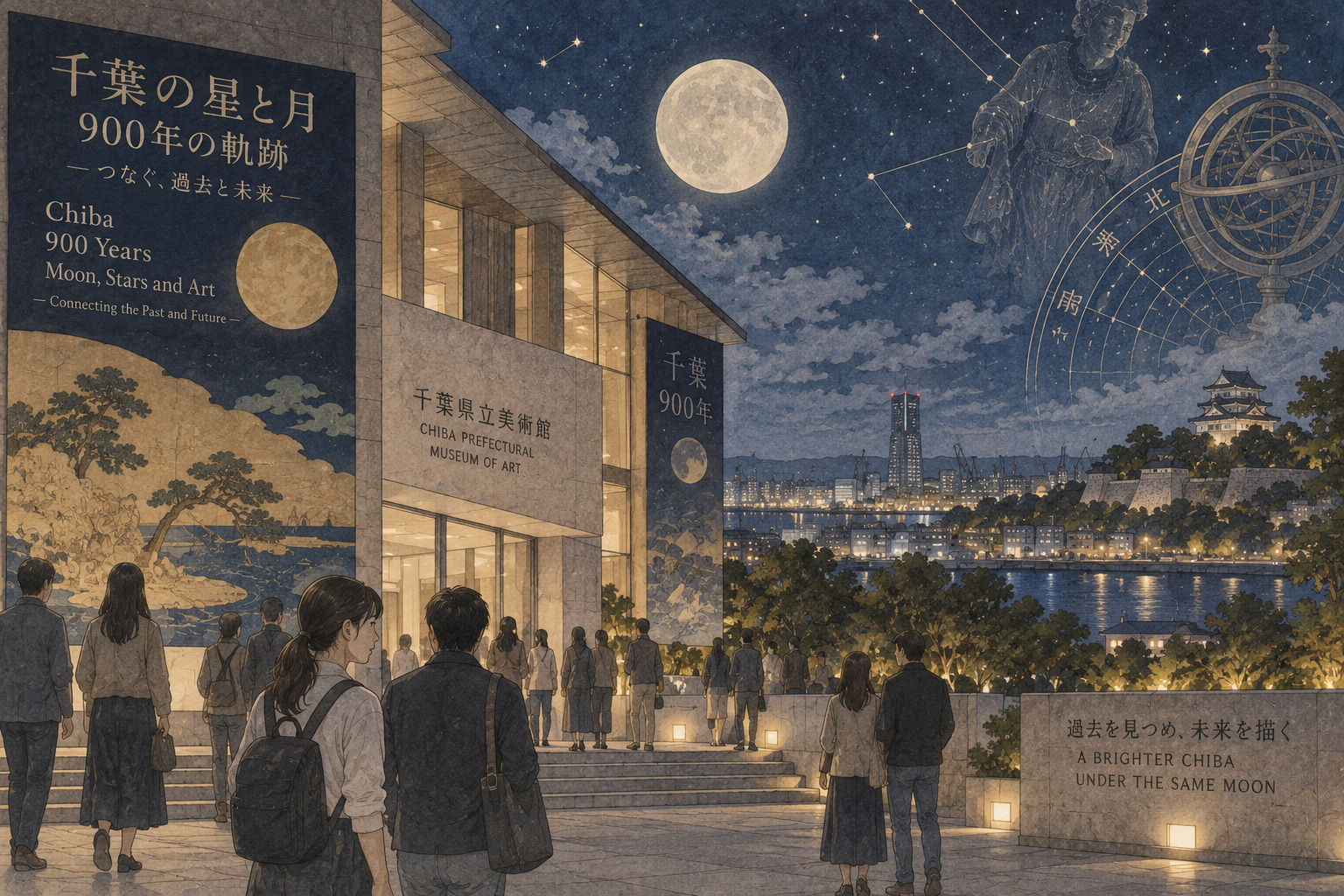
What does looking at the night sky have to do with remembering a city?
Chiba City Museum of Art’s special exhibition for the 900th anniversary of the foundation of Chiba, “Moon, Stars and …: When Art Links Time, People and Things,” builds its answer around one of humanity’s oldest shared subjects. Running from September 16 through November 23, it brings together roughly 150 works from early-modern art to contemporary installations, linking faith, astronomy, painting, sculpture and local memory.
The city’s 900-year marker begins on June 1, 1126
Chiba City defines the beginning of “Chiba” as June 1, 1126, when Tsuneshige moved his headquarters from what is now Ōji in Midori Ward to the Inohana area of present-day Chuo Ward and is said to have adopted the Chiba name.
His son Tsunetane later supported Minamoto no Yoritomo and became a major Kamakura shogunate retainer. The Chiba family’s branches spread widely across Japan.
The anniversary is therefore not the 900th anniversary of Chiba’s modern municipal government, which began in 1921. It commemorates a much older medieval origin story for the place and name.
Why the moon and stars?
The answer begins with Myōken faith.
The museum explains Myōken as a belief that deifies the Pole Star and Big Dipper. Its roots are associated with ancient Central Asian Pole Star worship and later absorbed Buddhist, Taoist, Confucian and yin-yang cosmological ideas as it developed in Japan.
The Chiba clan adopted Myōken as a protective deity. That made the sky more than decoration in local history: stars became part of the clan’s political and spiritual identity.
The Chiba Myōken scroll carries medieval memory
One of the exhibition’s central historical objects is the Chiba Myōken Daiengi Emaki, designated a tangible cultural property by Chiba Prefecture. The narrative is associated with a sixteenth-century formation, with the painting dated to the early Edo period, and the work is held by Eifukuji.
It provides an essential visual source for understanding how the Chiba clan’s identity and Myōken belief became intertwined.
Stars connect faith with science
The show moves beyond religious imagery. A 1247 stone-carved astronomical chart attributed to Wang Zhiyuan sits alongside Francesco Brunacci’s 1687 celestial chart and an eighteenth-century celestial globe associated with Doppelmayr and Jaenisch.
The same sky has been prayed to, measured, mapped and classified. The exhibition places those modes of looking beside one another rather than treating religion and science as disconnected histories.
Hokusai widens the subject from “stars” to the human act of looking
The exhibition also includes “Fuji from Torigoe” from Hokusai’s One Hundred Views of Mount Fuji, dating to around 1834–36.
Fuji is terrestrial, but its pictorial power depends on its relationship with sky, distance and human viewpoint. The exhibition therefore expands from literal celestial objects to the act of looking upward and outward.
An eight-meter Myōken mural returns after restoration
Shunkei Taoka’s 1967 The Appearance of Myōken is a former mural more than eight meters wide from the Chiba City Folk Museum.
The museum says it is being shown for the first time since restoration. The work demonstrates that a medieval religious narrative did not simply survive as an old artifact; it was reimagined in the twentieth century through Japanese-style painting.
Tatsuo Miyajima brings the sky to the ground
Another anchor is Tatsuo Miyajima’s 1996 installation The Sky of the Ground, also being presented after restoration.
Miyajima’s digital counters are built around three ideas: keep changing, connect with everything, continue forever.
The title reverses the relationship between heaven and earth. If Myōken represents a protective presence looking down from the sky, Miyajima places luminous time at ground level. The work turns the vast abstraction of “900 years” back into a physical present of changing numbers and light.
Contemporary artists approach the cosmos through scale, body and perception
The contemporary participants include Noe Aoki, Takuma Uematsu, Rikako Kawauchi, Akiko and Masako Takada, Atsuhiko Misawa, Yuri Miauchi, Tatsuo Miyajima, Nozomi Watanabe and Yasuko Watanabe.
Akiko and Masako Takada’s Attractive force (Moon crater) uses lunar imagery to investigate scale and force. Rikako Kawauchi’s Stars Through a Spider Web moves between body, animal, myth and celestial imagery. Takuma Uematsu’s scene of the observatory reflects a long interest in natural science and philosophy.
Nozomi Watanabe asks, in one title, whether a mere stone can be the moon. Yasuko Watanabe’s work draws on science fiction and SETI as part of a broader interest in travel, mapping and cosmic viewpoints.
Contemporary “space art” is not simply an extension of Myōken belief
An important interpretive distinction is necessary.
The museum uses Myōken as a historical axis for Chiba, but not every contemporary artist in the exhibition is presented as directly continuing that faith.
The connecting device is broader: moon, stars, space, time, scale and human perception. The show lets different periods answer similar questions without pretending they hold the same beliefs.
Nine centuries are not one uninterrupted story
Between 1126 and 2026, Chiba changed repeatedly: medieval warrior center, early-modern settlement, modern municipality, industrial bay city and designated city.
An exhibition cannot erase those breaks, nor should it.
What art can do is place objects from different periods in one room and reveal recurring questions: What does the sky mean? Where is the human body within a larger cosmos? How do we measure time? How do legends survive?
The 900th anniversary is not intended only as Chiba-clan commemoration
Chiba City describes the anniversary project as beginning with the Chiba clan but looking toward the city’s 1,000th year. Citizens, businesses and organizations are invited to participate in shaping what the anniversary means.
The museum’s exhibition follows that logic. Its stated goal is not merely preservation of history and legend but connecting them with the present and using them as a light for imagining the future.
The moon and stars open a local story to everyone
Myōken belief is strongly local to Chiba’s history. Looking at the moon and stars is not.
That makes celestial imagery a useful bridge. A visitor with no knowledge of medieval Chiba can enter through astronomy, Hokusai, contemporary sculpture or simply the experience of looking upward.
The local history becomes legible through a universal subject.
October 18 is free for Chiba Citizens’ Day
The exhibition runs September 16 through November 23. General admission is ¥1,500, university students ¥1,000, and elementary, junior-high and high-school students are free.
Friday and Saturday evening visitors receive a night-museum discount after 6 p.m., and admission is free on October 18 for Citizens’ Day.
Gallery talks, artist talks, workshops and a music event extend the project beyond static viewing.
The moon and stars are also humanity’s oldest clocks
Calendars, seasons, navigation, farming, ritual and direction have all depended on celestial observation.
That makes the exhibition’s choice especially fitting for an anniversary. A city measuring 900 years turns to some of the oldest instruments humans ever used to measure time.
Chiba as a work made out of time
The moon and stars visible when Tsuneshige moved to Inohana in 1126 were not different celestial bodies from those above the city today. What changed was what people thought they meant.
Myōken became a protector. Stars became charts. The moon became an image. Space became material for contemporary art.
“Moon, Stars and …” does not reduce nine centuries to a single neat narrative. Its stronger idea is to place those different meanings together and let the city itself appear as something constructed over time.