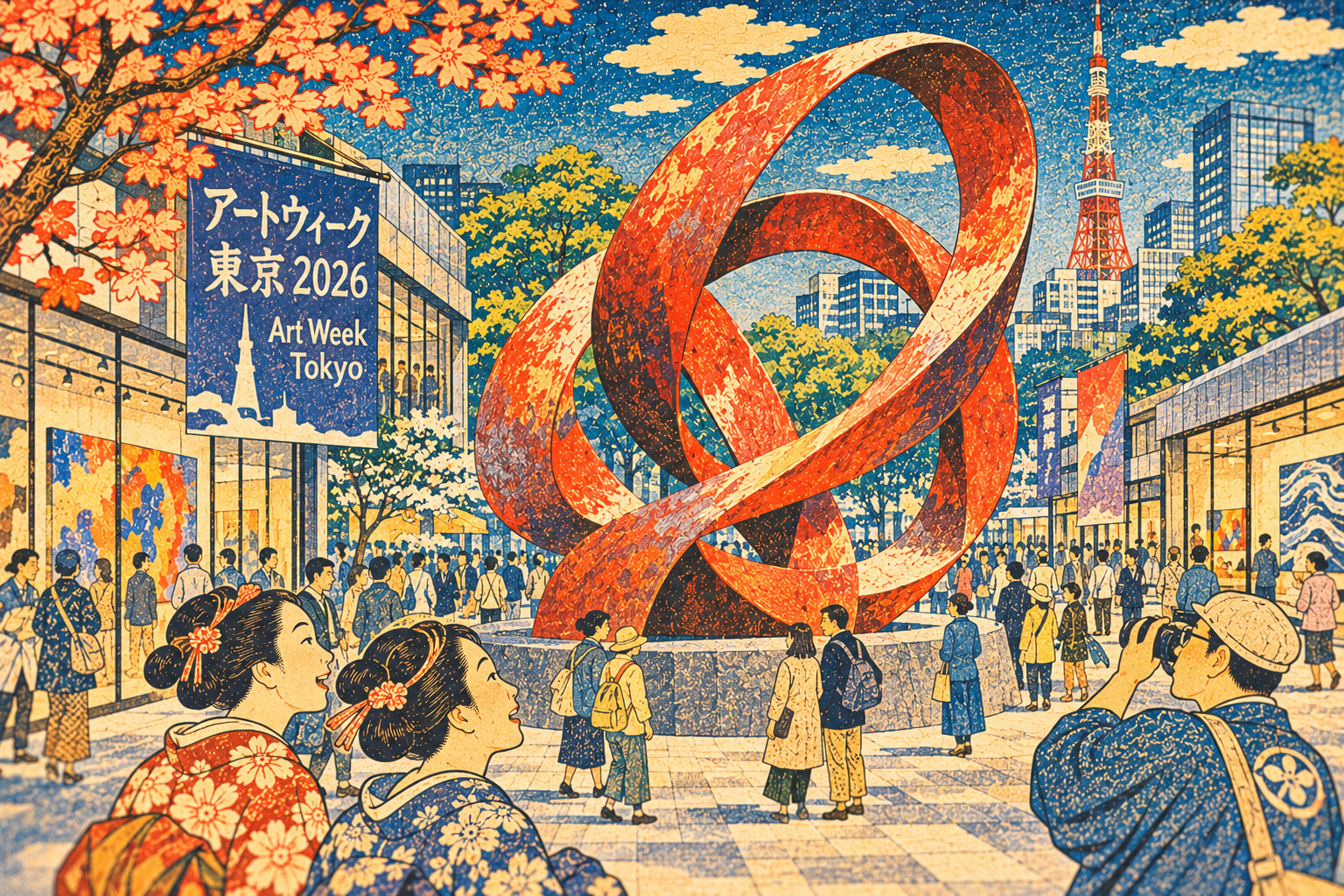
Tokyo’s art scene has a geography problem—and an opportunity
An art lover can stand inside one of Tokyo’s major museums and be only a few train stops from a gallery that barely appears in a tourist guide. The distance is short on a map and vast in cultural habit. Art Week Tokyo, running November 4–8, 2026, attempts to shorten it. Museums, commercial galleries, independent spaces and temporary curatorial projects are presented as parts of one experience. What makes this year interesting is not simply the record number of participating venues, but the decision to distribute the event’s defining exhibition program across ten separate sites. That change asks visitors to encounter art where relationships among artists, curators and local communities are actually formed, rather than treating the city as a backdrop for a single large exhibition.
The numbers, carefully understood
The organizer describes a record edition involving more than 50 venues, including ten specially curated AWT Focus spaces and dozens of galleries and institutions. The most useful conclusion is not a frozen venue tally but the breadth of the network and the new distributed format. Art Week Tokyo is organized by Japan Contemporary Art Platform in collaboration with Art Basel, with support from Japan’s Agency for Cultural Affairs. The Tokyo Metropolitan Government co-organizes the AWT Mobile Project responsible for access infrastructure. These are different roles: collaboration with the international fair organization is not a claim that AWT itself is an Art Basel sales fair.
Ten exhibitions instead of one center
AWT Focus began in 2023 as a platform for curated exhibitions. In earlier editions, a single curator organized a large presentation at a central venue. The 2026 model is different: ten curators or curatorial teams develop ten distinct projects in ten galleries and art spaces, in collaboration with Vienna’s gallery-led curated by initiative. The selection process involves Misako Rosen of Misako & Rosen and Raphael Oberhuber, a board member of curated by Vienna. This is a substantive change in how Tokyo’s contemporary art is presented. It recognizes that the venue has an identity, the curator has an argument, and the work is interpreted through their relationship. A decentralized event can yield unexpected perspectives, though it also asks more of visitors navigating the city.
Japan’s constitution, inside an art gallery
One of the most provocative titles in the Focus program is The Constitution of Japan 2026 at Mujin-to Production, curated by Greg Dvorak and Kenji Ono. The decision to bring a constitutional theme into an art space makes it possible to consider civic rights, public memory and representation through objects and artistic practice rather than a standard parliamentary debate. But a listing is not an exhibition review. Without examining the actual works and hearing from their makers, it would be irresponsible to ascribe a particular partisan position or a settled message to the show. The point for the visitor is precisely to test the curators’ framing against what is displayed. The project also demonstrates why a gallery network can offer subjects that are not principally about art prices.
Komorebi, an American artist and a Japanese word
At Shibunkaku in Ginza, Jeremy Strick curates Mary Weatherford: Komorebi. The Japanese word suggests sunlight filtering through leaves, and its appearance in the title of an international artist’s exhibition creates an intriguing point of entry. How should a visitor read a culturally specific term when it travels into another artistic context? Elsewhere, Nobuko Tsuchiya: Ace of Hearts is curated by Martin Clark at SCAI The Bathhouse, while Jaemin Shin organizes Natsumi Aoyagi: Possible Words, Possible World at Misa Shin Gallery. These confirmed pairings reveal a range of curatorial voices and artistic practices. They do not, on their own, establish what an artwork looks like or how an audience has responded; those remain questions for direct observation and interviews.
From queer-feminist inquiry to everyday objects
Multiple Spirits, the Japanese queer feminist collective, curates Patchwork of Ruffled Wings at Waitingroom. British curator and writer Ekow Eshun works with Julianknxx at space Un on How Much Light Must I Consume? At Yutaka Kikutake Gallery, Augusto Arbizo curates The Quiet; Take Ninagawa presents Koji Kamoji: Everyday Life under Maria Brewińska’s direction. Artist-run XYZ Collective hosts Taro Masushio and Sophie Nys, curated by Olivier Mignon. The diversity of formats matters beyond a checklist of nationalities. Each pairing poses questions about who gets to interpret an artist, where art enters public life, and what language visitors need to discuss what they see. Those conversations can survive the festival if the participating spaces continue them.
A travel guide that refuses to settle on a destination
AWT Video occupies the Earth Garden on the first floor of SMBC East Tower in Marunouchi from November 4–8, 10 a.m. to 6 p.m., with free admission. X Zhu-Nowell, executive director and chief curator of Shanghai’s Rockbund Art Museum, has assembled Your Travel Guide To… with works by ten Japanese and international artists. The roster includes Hiroyuki Oki, Ken Okiishi, Linda Iha, Fuyuhiko Takata, Keiichi Tanaami, Atsushi Yamamoto and Kandis Williams. The curatorial argument treats geography as something shaped by movement, memory, technology and labor, not merely by a sightseeing route. That premise offers a counterpoint to the literal bus network outside: one helps a visitor move through Tokyo, while the video program asks how a place comes to be understood at all.
The road from the pandemic to a citywide institution
The original Art Week Tokyo soft-launched in November 2021 amid the constraints of the pandemic, coordinating 50 museums and galleries. Its first full-scale edition followed in 2022 as international movement resumed. The organizer records more than 32,000 visitors in 2022 and more than 43,000 in 2023; the Tokyo Metropolitan Government reports participation exceeding 50,000 for the previous year’s event. The history reveals a steady ambition to build shared infrastructure, not just another opening-night calendar. Yet headcounts are only one metric. They say little about whether local artists earned sustainable income, whether small galleries retained new visitors, or whether audiences came back during ordinary months. Those outcomes require research beyond event publicity.
Tokyo was never just one gallery district
Japanese contemporary art developed through overlapping networks: public museums, private collections, commercial dealers, artist-run projects and experimental scenes that often challenged the institutions around them. Ginza’s established art trade occupies a different environment from galleries in former residential or industrial buildings. Roppongi and Nishi-Azabu combine international visibility with commercial galleries; Kiyosumi-Shirakawa connects a major contemporary art museum to neighboring spaces; Kyobashi has both historic dealers and newer buildings. No single neighborhood can stand for the whole city. This dispersed geography is a strength for experimentation, but an obstacle for a first-time visitor who may not know what doors are open or whether entry is welcome.
A free bus is cultural infrastructure
The AWT Bus operates November 6–8, not throughout the full five-day event. The city says six circular routes run roughly every 15 minutes between 10 a.m. and 6 p.m., complemented by an express connection between AWT Bar in Minami-Aoyama and AWT Video in Otemachi. Stops serve institutions including the National Museum of Modern Art, Tokyo; the Museum of Contemporary Art Tokyo; Artizon Museum; Mori Art Museum; and the National Art Center, Tokyo, alongside commercial galleries and smaller spaces. Visitors may board for free at any stop. A no-cost daily wristband can also secure discounted admission to some participating museum exhibitions. This logistical detail is also a policy choice: reducing the friction of travel changes who is able to encounter a gallery for the first time.
What is actually free?
Admission to participating galleries, AWT Focus and AWT Video is free, according to the organizer. Many conversations and other programs are also free but may require advance registration. Museum exhibitions can carry separate charges, and wristband discounts are not universal. On November 6, the announced program includes a Focus curators’ conversation at Sogetsu Kaikan and a symposium at Keio University’s Mita Campus. Tours and workshops may require reservations, have limited capacity or use lotteries. An accessible event is not the same as a costless operation: staffing, translation, transport and venue maintenance all have to be financed. A trustworthy visitor guide should distinguish free admission from guaranteed entry, and public programming from ticketed exhibitions.
An art market is not the same as an art community
The gallery is a commercial actor, but it is also an intermediary that can provide artists with time, space, introductions, documentation and long-term relationships. A museum’s obligations to collect, preserve and interpret are different. Bringing both into one festival can encourage productive contact, but it does not erase their competing needs. The arrival of international collectors is a potential opportunity; it is not proof of sales. Likewise, a headline attendance figure cannot establish that younger, less connected artists benefited equally. The 2026 Focus model decentralizes curatorial authority across venues, creating a test of whether shared attention can be distributed beyond a few obvious names. Its ultimate success will be measurable only over time.
How to see the city without trying to see everything
A practical way to approach the event is to choose one district and leave space for discovery. In Kyobashi, pair Artizon Museum with nearby galleries. In Ginza, compare longstanding dealers with newer exhibition programs. In Roppongi or Nishi-Azabu, move between museums and the international gallery scene. The AWT routes offer ways to connect districts, but the calendar matters: the free bus starts on Friday, November 6. Consult venue pages for individual opening hours, capacity restrictions, charges and reservations before setting out. Visitors following art rather than collecting it need not feel obligated to understand the market. Looking closely, asking a thoughtful question and returning to a gallery another day are ways of participating in the cultural ecosystem too.
Tokyo’s next test comes after the last bus
Art Week Tokyo can draw international professionals to the city for five days, but the work of artists and curators continues all year. The real measure of a citywide initiative is whether unfamiliar doors remain open in people’s minds after the temporary signs come down. Did a first-time visitor discover a new artist and return? Did a small gallery build a relationship with a museum or a curator? Did a Tokyo-based artist gain an audience beyond Japan? None of those questions can be answered in advance from the program alone. What can already be said is that the event has chosen a distinctive structure for 2026: one city, many independent spaces, and ten curatorial propositions that refuse to compress contemporary art into a single room.
Sources and reporting method
Official program and government sources underpin this article. Venue hours, availability and program details may change during the event.
- AWT, official 2026 program and participating venues
- AWT, 2026 Focus program: ten curatorial projects
- AWT, English Focus curators and exhibitions
- AWT, Video 2026 curated by X Zhu-Nowell
- AWT, bus stops and six loop routes
- AWT, fees and reservations
- AWT, events November 4–8
- Tokyo Metropolitan Government, October 1, 2026: mobile project
- AWT, organizers and governance
- AWT, 2021 original initiative
- AWT, 2023 previous curatorial model
- AWT, visitor ticket and program conditions (English)