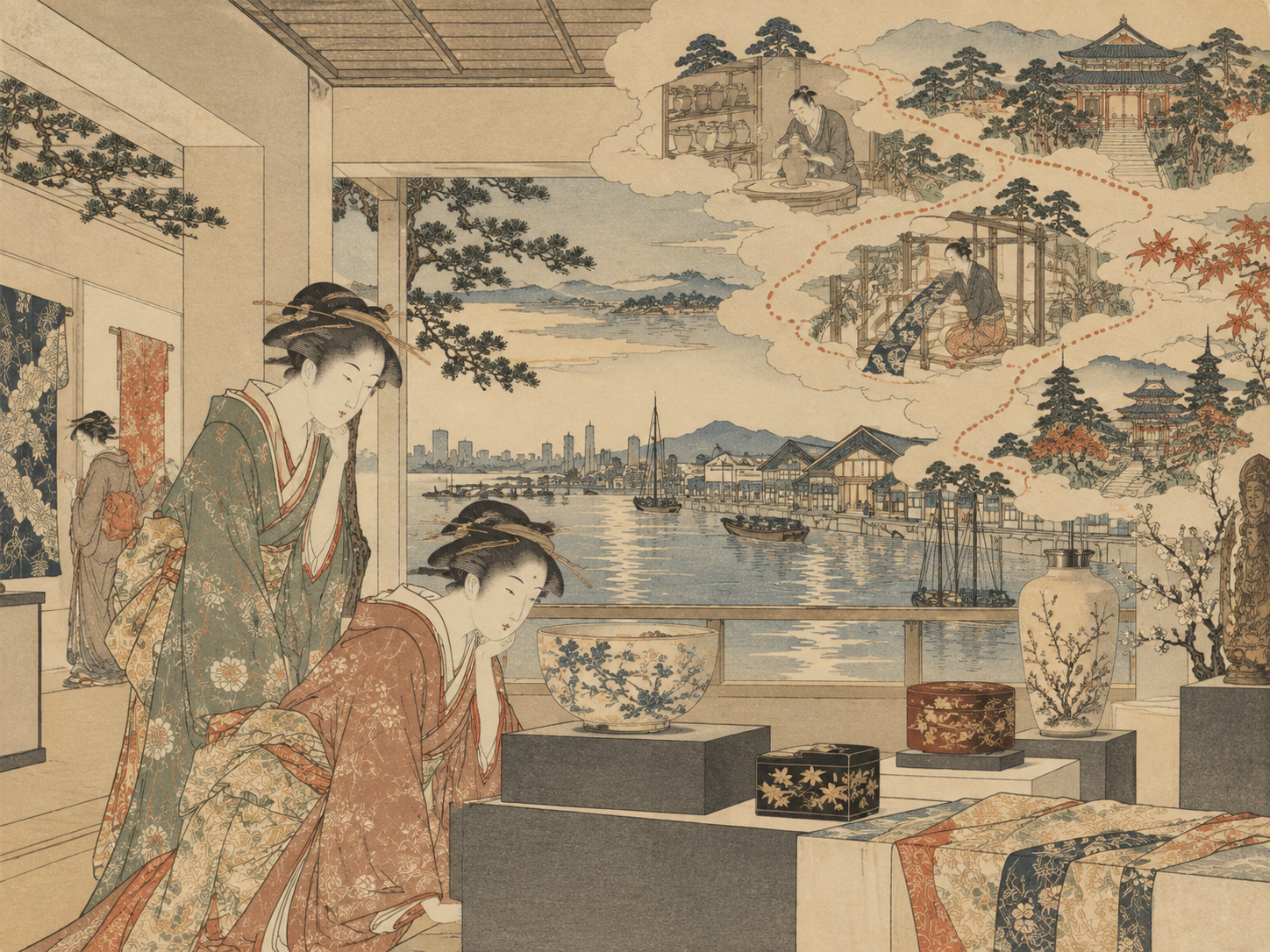
The most interesting thing about ART KOGEI is not that it sells Japanese craft in Tokyo. Galleries already do that. The more unusual proposition is what happens after someone likes an object: leave Tennoz, travel to the place behind it, enter a workshop, visit a temple or regional cultural site, and encounter the material and technique where they are actually embedded.
The Tennoz Canalside Vitalization Association opened ART KOGEI on September 15 inside TERRADA ART COMPLEX II. The space will exhibit and sell work through January 30, 2027. From autumn 2026, the association says it plans to launch private two-night, three-day journeys under the title “Journey to the Source of the Work,” aimed particularly at affluent and inbound travelers and visiting craft workshops and temples in production regions. [1][2]
That makes the Tokyo gallery less a destination than a departure lounge. Tennoz provides the encounter; regional Japan is supposed to receive the longer stay, the guided visit, the meal, the hotel night, the workshop fee and potentially a deeper relationship with the maker.
The official announcement confirms a two-night, three-day private-tour model beginning in autumn 2026 and says tours will visit workshops and temples. It does not yet publish routes, prices, departure dates, workshop partners, temple names, group size, interpreter arrangements or whether participating artists themselves will meet travelers. ART KOGEI says a multilingual AI concierge and related tools are planned for tour proposals and arrangements after sales begin. [1]
The object comes before the itinerary
ART KOGEI does not begin with a regional brochure. It begins in Room 305 of TERRADA ART COMPLEX II with an object that can be looked at and purchased. The project then tries to convert curiosity about that object into a trip to the material, technique and place behind it. [1]
That reverses a familiar craft-tourism sequence. A visitor usually chooses Kyoto, Kanazawa or Toyama first and finds a workshop after arriving. ART KOGEI proposes the opposite: discover a maker in Tokyo, then allow the work to decide where in Japan you travel next.
The difference could alter the questions a traveler asks. Seeing a lacquer box first may lead to questions about why this form was chosen, how a surface was built, where materials come from or what the artist has changed from inherited practice. The journey becomes less “watch a craft demonstration” and more “read the work backwards into its conditions of making.”
The ten artists do not form a catalogue of traditional souvenirs
The opening group spans textiles, ceramics, lacquer, glass and metalwork, with Ishikawa especially prominent. [1] But the lineup would be misread if “kogei” were reduced to government-designated traditional craft products or heritage replicas.
Keigo Kamide, for example, inherits the history of Kutani porcelain while moving between overglaze painting, ink, painting and sculptural ceramic work; his own statement describes a practice moving across craft, art and painting while reading memory embedded in place. [9] Yoca Muta uses Kutani-derived overglaze techniques but reconstructs animals, mythical beasts and classical motifs into contemporary porcelain. [16] Kie Terasawa uses blown glass to approach life through decay, death and transformation rather than simply making functional glassware. [11]
At another end of the spectrum, Jigoemon Ohara XVI belongs to a Jōhana lacquer lineage tracing its workshop history to 1575 and also works on preservation and restoration of local festival cultural property. [8] Yuma Ishii uses Yuzen and paste-resist dyeing as a contemporary expressive language in which bleeding and control become part of the work. [10]
| Artist | Field | Region listed in the official release |
|---|---|---|
| Yuma Ishii | Textile/dyeing | Kanagawa |
| Narumi Itaya | Ceramics | Ishikawa |
| Jigoemon Ohara XVI | Lacquer | Toyama |
| Keigo Kamide | Ceramics | Ishikawa |
| Kie Terasawa | Glass | Ishikawa |
| Masahiko Toide | Ceramics | Ishikawa |
| Kenta Toyoumi | Lacquer | Kyoto |
| Kodo Murakami | Metalwork | Ishikawa |
| Shiho Morita | Lacquer | Ishikawa |
| Yoca Muta | Ceramics | Ishikawa |
Ishikawa’s weight in the lineup reflects an ecosystem, not one style
Seven of the ten artists are listed under Ishikawa in the opening announcement. They do not represent one school. Terasawa came through the Kanazawa Utatsuyama Craft Studio after glass training in Toyama; Narumi Itaya studied ceramics at Kanazawa College of Art and works in Ishikawa; Kamide is the sixth-generation successor to a Kutani kiln; Kodo Murakami works in metal inlay; Shiho Morita developed lacquer-coated silk thread; Muta works in colored porcelain. [11][17][9][14][15][16]
That density matters because contemporary craft needs more than workshops. It needs schools, studios, juried exhibitions, museums, galleries, buyers and peers. Kanazawa’s dedicated KOGEI Art Fair is one visible part of that market infrastructure, bringing dozens of galleries together around craft. [20]
If ART KOGEI sends visitors to Ishikawa, the useful outcome is not simply “consume Ishikawa craft.” It is to expose the network that allows these makers to keep working, teaching, exhibiting and selling.
Why Tennoz works as the front door
ART KOGEI sits in a district already engineered around art circulation. Warehouse TERRADA opened the first TERRADA ART COMPLEX building in 2016 and the adjoining second building in 2020. By 2021 the complex housed 14 contemporary-art galleries, while nearby projects included WHAT MUSEUM, WHAT CAFE and PIGMENT TOKYO. [6]
The warehouse background is not incidental. Art needs storage, handling, packing, shipping, insurance and spaces large enough to move objects safely. Warehouse TERRADA describes WHAT MUSEUM as a museum that could only emerge from a storage company, connecting works held in warehouses with public exhibition. [19]
ART KOGEI extends that logic one step further. The warehouse district already receives collectors, gallery visitors and international art traffic. The new project asks whether the district can also become a departure point that sends those visitors outward to makers and regions.
This is also a DMO experiment
The Tennoz Canalside Vitalization Association has operated as a registered Destination Management/Marketing Organization since 2024 and appears on the Japan Tourism Agency’s registered DMO list. [3][5] Its own strategy explicitly mentions high-value cultural-tourism content, tourism DX and cooperation with other regions. [3]
The national DMO framework asks organizations to build a region’s earning power, coordinate stakeholders, collect and analyze data, improve visitor reception and manage tourism through a clear strategy. [4] The Tourism Agency’s current support programs also emphasize dispersing overseas visitors beyond the major metropolitan areas, encouraging wider touring and longer stays. [18]
ART KOGEI translates that policy language into a simple funnel: one gallery visit in Tokyo becomes two hotel nights elsewhere. If it works, spending spreads into transport, guides, food, accommodation, workshop fees and potentially art purchases.
A workshop cannot become scenery without cost
Workshop access is compelling because finished objects hide time. A visitor can hear polishing, see tools, understand drying cycles and observe how a material resists a maker’s intention. Ohara’s career makes the point especially clearly: the same inherited lacquer knowledge can produce contemporary art objects and contribute to restoring festival floats and cultural property. [8]
But a workshop is first a place of production. Lacquer follows humidity and curing time. Ceramics follow firing schedules. Dyeing changes with process and environment. A maker may be at the least visually dramatic part of the job on the day a group arrives. Stopping work for visitors also has a real labor cost.
Japan.co.jp’s view is that craft tourism should therefore be judged by more than visitor counts. Are workshops paid adequately for access? Are photography and trade-secret boundaries clear? Can guides carry part of the interpretation so artists are not forced into repetitive performance? Can a visit generate revenue even if the visitor does not buy an expensive work?
Without those answers, “authentic access” can become unpaid theater performed by the people the tourism product claims to support.
Temples are more than atmospheric backdrops
The ART KOGEI release says the private journeys will include temples as well as workshops. [1] It does not name the temples. That distinction matters because the Japan Art Kogei committee, which supports ART KOGEI, held a 2025 exhibition at Kyoto’s Sennyu-ji, but the current announcement does not say Sennyu-ji is a stop on the new tours. [7]
The earlier program does show an existing interest in placing contemporary craft within historical religious architecture rather than only in white-cube galleries. That can be meaningful: temples have long been patrons, users and custodians of lacquer, metalwork, textiles, woodwork, ceramics and architectural craft.
It can also become superficial if a sacred site is treated only as visual proof of “Japaneseness.” Good interpretation needs to explain a temple’s religious function, rules and local history, not merely stage objects against photogenic architecture.
An AI concierge can remove friction; it cannot manufacture context
ART KOGEI plans to use multilingual AI concierge tools for tour suggestions and arrangements after the private tours go on sale. [1] The practical case is strong. Japanese craft is dense with difficult names: processes, materials, kiln lineages, regions, artist names and historical vocabulary. Translation and itinerary-building can become a barrier before a traveler ever reaches a workshop.
AI can help sort interests and routes. Someone drawn to colored porcelain can be pointed toward one region; someone interested in lacquer or metalwork toward another. It can handle basic explanations and multilingual logistics.
But context still requires human oversight. A mistranslation can collapse distinctions between a traditional lineage and a contemporary reinterpretation, between a temple ritual and an attraction, or between a workshop and a factory. The best use of AI may be to save human experts from routine scheduling so their time can be spent where interpretation is actually difficult.
Connecting a purchase to a journey changes how price is understood
In a gallery, the price is attached to the object. In a production region, the visitor begins to see some of what sits behind it: material sourcing, tool maintenance, failed firings, repeated prototypes, workshop overhead, assistants, restoration work, local festivals and years of training.
Not all of those costs can be traced directly into one price tag. But the journey can correct a common misconception that handmade work is simply “expensive because it is handmade.” It can show that a practice survives only if time, space, materials and skill have an economic structure around them.
ART KOGEI’s decision to exhibit and sell work before selling travel is therefore significant. [1] The object is treated first as contemporary art/craft with a market value, not merely as a souvenir attached to an experience.
The risk runs in the other direction: if only affluent private-tour customers receive meaningful access, craft may be compressed into a luxury-tourism product. A healthy ecosystem still needs public museums, ordinary shops, open studios, affordable exhibitions and ways for people who cannot buy a major work to learn about the practice.
One artist does not equal one prefecture
The official release attaches a region to each participating artist. That is useful but incomplete. Artists move through schools, workshops, residencies, kilns and family lineages that cross administrative borders.
Ishii is listed under Kanagawa in the ART KOGEI release, yet current profiles place him in Kanazawa graduate study and working through Kaga Yuzen-related methods. [10] Kamide is deeply rooted in a Kutani kiln in Ishikawa while moving across painting and contemporary art. [9] Toyoumi was born in Osaka, trained deeply in Kanazawa lacquer and is listed under Kyoto in the opening program. [13]
That means “source of the work” is not always a single pin on a map. The source may be a material region, a teacher, a family workshop, a school, a temple commission, a market network and the place where the artist currently lives. The strongest tours will make that network visible rather than force every artist into a simple prefectural brand.
Success should be measured outside the gallery
ART KOGEI is scheduled to operate from September 15 through January 30, generally from 1 p.m. to 6 p.m., closed Sundays, Mondays and public holidays with specific exceptions. It is organized by the Tennoz association, operated by Warehouse TERRADA and supported by the Japan Art Kogei committee. [1]
Those facts describe the gallery. They do not tell us whether the tourism model works. The more revealing measures will appear elsewhere: how many visitors actually travel onward; how many nights they stay; how much revenue reaches workshops and regional businesses; whether art purchases continue after the trip; whether visitors return; and whether makers experience the program as sustainable rather than disruptive.
The national DMO framework explicitly emphasizes continued data collection, analysis and evaluation. [4] If ART KOGEI wants to prove that Tokyo can become a funnel toward regional craft economies, the strongest evidence will not be opening-week footfall. It will be what happens after people leave Tennoz.
If the gallery door really leads to the workshop door
A great object can stand alone. It does not need tourism to justify itself. But some works become richer when a viewer understands the stubbornness of clay, the patience of lacquer, the unpredictability of dye, the local festival a craftsman also repairs, or the kiln history an artist is deliberately rewriting.
ART KOGEI is trying to connect the moment of curiosity directly to movement: see the glass in Tennoz, then go to Kanazawa; encounter lacquer, then travel toward Jōhana or another production setting; look at colored porcelain, then learn what Kutani means beyond a label. The exact routes are still to come, but the proposition is clear.
The deepest effect may appear when the traveler returns to the gallery. The object is the same, but the viewer is not. A workshop’s light, a kiln’s heat, the smell of lacquer, a temple’s scale or a maker’s explanation can remain inside the act of looking.
If ART KOGEI succeeds, its innovation will not be turning craft into tourism. It will be making travel part of how a work is understood—and then sending that understanding back to the object.
Sources and references
- Tennoz Canalside Vitalization Association: ART KOGEI opening and “Journey to the Source of the Work” announcement (Sept. 15, 2026)
- Tennoz Canalside Vitalization Association / PR TIMES: participating artists and operating details (Sept. 15, 2026)
- Tennoz Canalside Vitalization Association: business overview — cultural tourism, tourism DX and inter-regional cooperation
- Japan Tourism Agency: What is a Destination Management/Marketing Organization (DMO)?
- Japan Tourism Agency: Registered DMO list including Tennoz Canalside Vitalization Association
- Warehouse TERRADA: TERRADA ART COMPLEX history — Building I in 2016 and Building II in 2020
- Japan Art Kogei committee: 2025 Sennyu-ji exhibition and prior craft programs
- Jigoemon Ohara XVI: official profile — Jōhana maki-e lineage and cultural-property restoration
- Keigo Kamide: official profile — Kutani porcelain, materiality and narrative
- CITIZEN KOGEI ARTIST: Yuma Ishii — Yuzen and paste-resist dyeing
- KOGEI Art Fair Kanazawa: Kie Terasawa — glassblowing, fusing and metal welding
- Arts Council Kanazawa: Masahiko Toide — Kutani porcelain clay and overglaze decoration
- KOGEI Art Fair Kanazawa: Kenta Toyoumi — lacquer and material-based expression
- Japan Kogei Association: Kodo Murakami — metalwork and inlay
- Japan Art Kogei: Shiho Morita — lacquer-coated silk-thread practice
- Japan Art Kogei: Yoca Muta — overglaze porcelain rooted in Kutani techniques
- KOGEI Art Fair Kanazawa: Narumi Itaya — ceramics, working in Ishikawa
- Japan Tourism Agency: DMO support program — regional dispersal, touring and longer stays
- Warehouse TERRADA: WHAT MUSEUM and Tennoz as an international art-district hub
- KOGEI Art Fair Kanazawa: craft-focused art fair and international presentation
Evidence reviewed September 16, 2026, Japan time. The Tennoz Canalside Vitalization Association’s September 15 announcement controls the opening date, exhibition period, participating artists, planned two-night/three-day tours, workshop/temple concept and multilingual AI-concierge plan. Routes, prices, departure dates, named workshops and temples, capacity and interpretation arrangements were not public at the reporting cutoff and are not inferred here. Artist techniques and biographies are drawn from official or specialist institutional profiles; DMO roles and regional-dispersal policy come from the Japan Tourism Agency. Analysis is Japan.co.jp’s unless otherwise attributed.