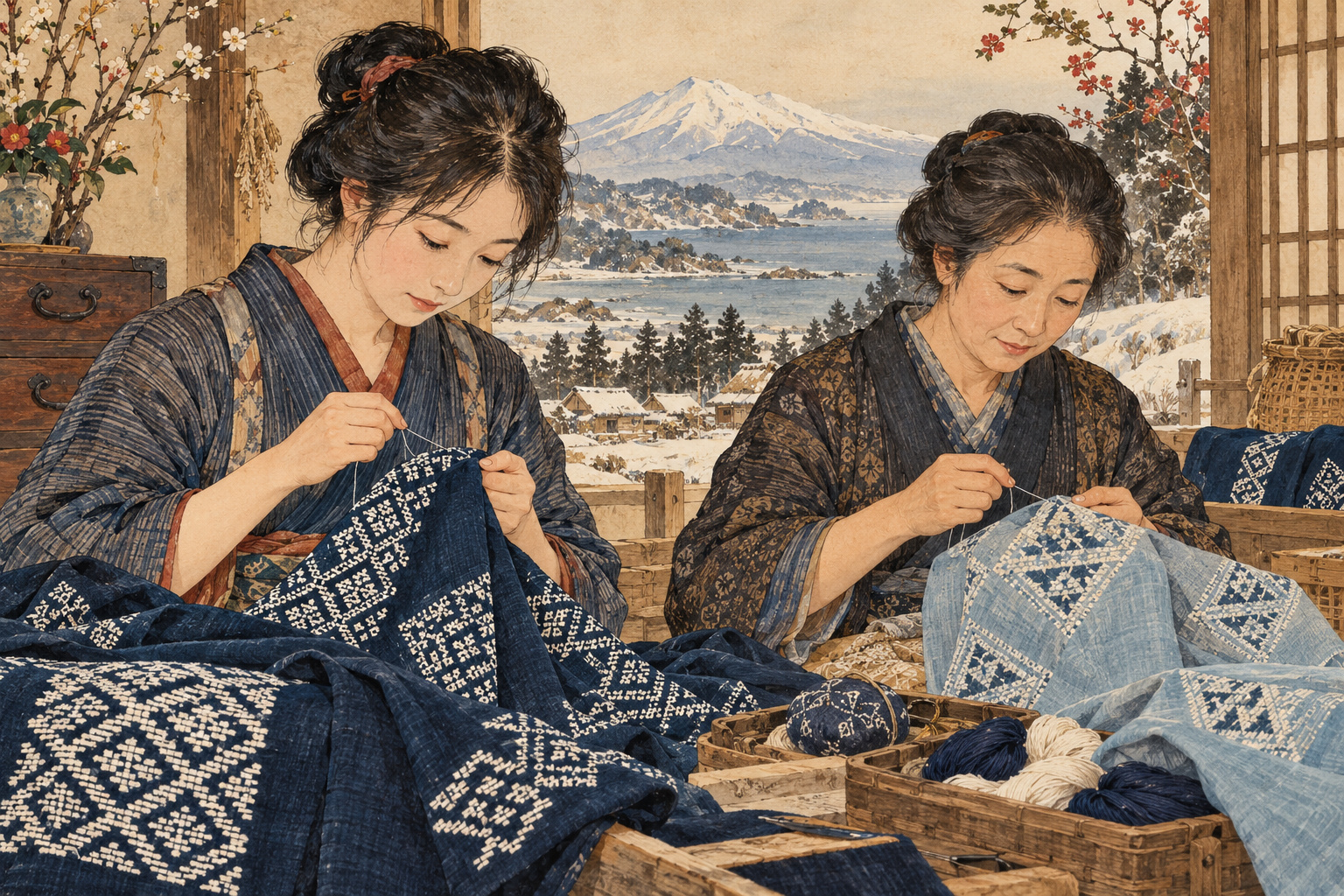
Look closely at a piece of Tsugaru kogin or Nanbu hishizashi and the pattern resolves into a succession of counted threads. What appears at first to be decoration also belongs to the history of making clothing last. Aomori’s heritage account traces the designs to stitching used to reinforce vulnerable areas of precious cloth.[12]
These two embroidery traditions grew in different parts of the prefecture, responding to the need for warmer, stronger garments. Their interest lies in the choices made within that necessity: where to add thread, how to organise a surface and how to make something worth wearing. A small contemporary accessory can carry a history that once covered shoulders, backs and legs.
A fabric shaped by constraints
The Agency for Cultural Affairs describes northern Tohoku as a region where cold conditions made cotton cultivation difficult and early-modern restrictions also affected clothing materials. Open-weave bast-fibre cloth served for everyday and working garments. Its account records the name “kogin” in a Hirosaki domain diary in 1695 and stitched clothing in Omin zui in 1788. These are documentary landmarks, not proven invention dates.[1]
The distinction matters. A craft can develop through many households and generations before a written description survives. The available cloth and the demands placed on it give us a firmer starting point than the search for a single inventor. Look beneath the stitching: the material being strengthened is part of the design.
Two ways of counting
Aomori Prefecture identifies a basic technical difference. Kogin, associated with the Tsugaru area around Hirosaki, picks up odd numbers of warp threads; hishizashi, associated with the Nanbu area around Hachinohe, uses even numbers. Their characteristic diamonds are respectively taller and wider. The basic motif units are called modoko and katako.[2]
| Feature | Tsugaru kogin | Nanbu hishizashi |
|---|---|---|
| Warp-thread count | Typically odd | Typically even |
| Characteristic diamond | Taller | Wider |
| Motif unit | Modoko | Katako |
This describes the threads counted in the ground fabric, not the total number of needle movements. The Nanbu Hishizashi Study Group explains that both methods work along the weft. It also demonstrates how the proportions of the fabric’s weave alter the resulting diamond. Choosing cloth is therefore a design decision, not merely preparation for following a chart.[5]
Once that becomes visible, a dense geometric surface is easier to read. Repetition supplies a structure, while combinations allow variation. The maker works with a grid already present in the cloth.
There is more than one kogin landscape
The Hirosaki Kogin Institute distinguishes eastern, western and three-stripe kogin. Eastern examples often continue a pattern from front to back; western examples have distinctive shoulder stripes. The third grouping, associated with the lower Iwaki River area, is marked by three broad bands. Even within Tsugaru, “kogin” encompasses regional differences.[4]
The institute’s motif list includes names such as mameko and “cat’s paw.” Such names offer an approachable way to begin examining a complex design: find a small recurring unit, then follow its place in the larger arrangement.[4] The surface becomes a composition made through repetition, rather than an indivisible pattern.
The ground cloth changes the result
Aomori’s prefectural history describes many kogin garments as stitched on a single layer of indigo-dyed cloth. Nanbu examples include pale-blue bast-fibre or mixed-fibre fabric backed with older cotton. It also distinguishes hemp and ramie among Tsugaru ground fabrics. The Japanese historical term asa should therefore not automatically be translated as flax linen or treated as one uniform material.[3]
These differences complicate a simple blue-and-white picture of the traditions. To understand an older garment, consider its layers, thread weight and the placement of stitched areas as well as its colours. The pattern and the fabric beneath it were made to work together.
Work, dress and the life of a garment
Aomori City’s clothing guide identifies hishizashi aprons embroidered in wool as fashionable dress for Nanbu women. It also shows the stitched leg garments known as tattsuke.[7] Looking at how these objects were worn restores the body to designs now often encountered as flat images.
The national record for the surviving sashiko clothing collection explains that elaborate garments could serve as best clothes, with older examples subsequently used for ordinary wear and work. Beauty was not simply discovered later by collectors; it belonged to the clothing’s use.[6]
That history also contains change and decline. The same record links the spread of patterned cotton fabrics to the rapid retreat of older sashiko practice around the end of the Taisho period. New materials changed the reasons for undertaking such labour-intensive stitching.[6] Its present survival should not be mistaken for an unchanged way of dressing.
Preserving objects and preserving knowledge
The collection called 津軽・南部のさしこ着物—Tsugaru and Nanbu sashiko clothing—comprises 786 objects and was designated an Important Tangible Folk Cultural Property on April 13, 1983.[6] On March 24, 2026, the stitching techniques themselves were selected for documentation under the category 記録作成等の措置を講ずべき無形の民俗文化財.[1]
The two measures concern different things: surviving garments and knowledge of making. A finished piece permits examination of the result. Teaching and recording the work can also convey decisions made along the way. Both are needed if an embroidered surface is to remain something people can create as well as admire.
New uses, continuing practice
The Hirosaki Kogin Institute dates its continuation of the research to 1942 and describes an ongoing commitment to hand-stitched products.[10] The Nanbu Hishizashi Study Group, established in April 2012, reports teaching through schools and workshops.[11] These are concrete forms of transmission, bringing knowledge into contact with new hands.
Aomori’s craft guides list kogin pouches, bags, obi and ties, with contemporary work also using cotton or wool ground fabrics and broader colour choices.[8] Hishizashi likewise appears in table textiles, bags and tapestries.[9] The function can change while counted stitching remains central to the object.
When examining a piece, ask about the motif, the fabric and the person who stitched it. That conversation can connect an attractive design to choices of material and labour. The most revealing detail may be a small one: a repeated unit, a change of thread, or the place where the maker decided reinforcement should also become pattern.
Sources and further reading
- Agency for Cultural Affairs: Tsugaru and Nanbu sashiko techniques, selected in 2026
- Aomori Prefecture: technical distinctions
- Aomori prefectural history: materials and regional variation
- Hirosaki Kogin Institute: regional forms and modoko
- Nanbu Hishizashi Study Group: counting and fabric proportions
- Agency for Cultural Affairs: historic sashiko garment collection
- Aomori City: historic clothing, aprons and tattsuke
- Aomori Prefecture: kogin products and contemporary materials
- Aomori Prefecture: Nanbu hishizashi products
- Hirosaki Kogin Institute: research and hand stitching
- Nanbu Hishizashi Study Group: foundation and teaching
- Aomori Prefecture: reinforcement and the history of clothing
