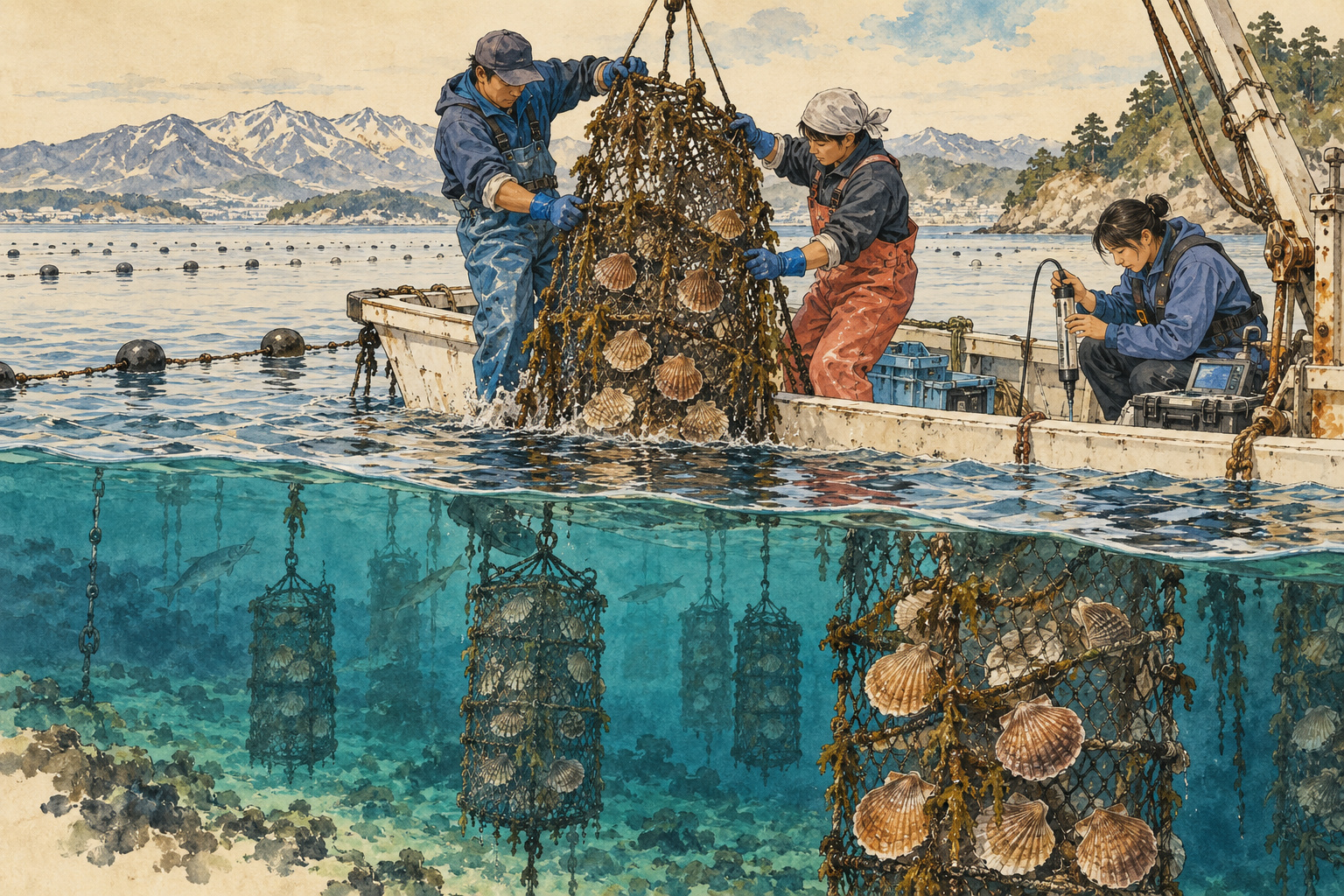
A scallop’s journey to the table depends on work that remains largely invisible to diners: collecting young shellfish, checking their condition and following changes in the surrounding water. In Mutsu Bay, public research and monitoring provide part of the information farmers use to make those decisions.
Making the water visible
The fisheries institute of the Aomori Prefectural Industrial Technology Research Center operates Umi Navi Aomori, a service bringing together buoy observations of temperature, salinity and dissolved oxygen with weather information and forecasts.[1]
Each reading needs context: its time, location and measurement depth. An observation describes what a sensor recorded; a forecast describes an expected development. Neither should be treated as a single verdict on conditions throughout the bay.
Farming begins with small shellfish
The institute’s educational material describes collecting young scallops on equipment suspended in the sea, then transferring them to nets at appropriate densities for further growth. This seed-collection stage supplies the shellfish that farmers will raise.[2]
A dedicated scallop seed-collection bulletin has been published since 1967. Its May 22, 2025 edition was the 800th issue, according to the center—a record of sustained information-sharing across successive farming seasons.[3]
Handling matters alongside water conditions
An August 26 management bulletin shows how observations become practical advice. It reported daily average temperatures above 25°C at mid-depth in some districts on August 25 and cautioned against moving facilities or handling stock stressed by warm water. That advice addressed conditions at the time; it does not establish conditions for September 27.[6]
The institute explains that scallops eat phytoplankton. It also warns that overcrowding in suspended culture can cause animals to collide and damage their mantles, with potentially fatal consequences.[4]
That makes farm management part of the biological picture. Knowing the water conditions is useful, but so is understanding what happens to the animals inside the growing equipment. Monitoring does not remove the need to assess the condition and growth stage of the stock.
Research follows the practical problems
The institute’s scallop unit studies stable production and ways to reduce organisms attaching to scallops and cages. Its published program includes natural seed-collection forecasting, surveys of suspended and seabed culture, and the use of information and communications technology to improve farming efficiency.[5]
These activities connect the wider marine environment with the practical work of raising shellfish. Their value lies in giving farmers better evidence for decisions, rather than guaranteeing a particular harvest.
Behind the finished dish
For consumers, this is another way to understand Mutsu Bay’s scallops: as the result of continued observation as well as harvesting. This report describes that support system. It is not a September 27 water-condition bulletin or an instruction to carry out a particular operation; current observations and management notices remain the relevant sources for those decisions.
Sources and further reading
- Aomori research center: Umi Navi marine information service (Japanese)
- Fisheries institute: scallop seed collection and rearing (Japanese)
- Aomori research center: history of the scallop bulletin (Japanese)
- Fisheries institute: scallop growth and culture (Japanese)
- Fisheries institute: scallop research unit and programs (Japanese)
- Scallop Management Bulletin No. 3, August 26, 2026 (Japanese)
