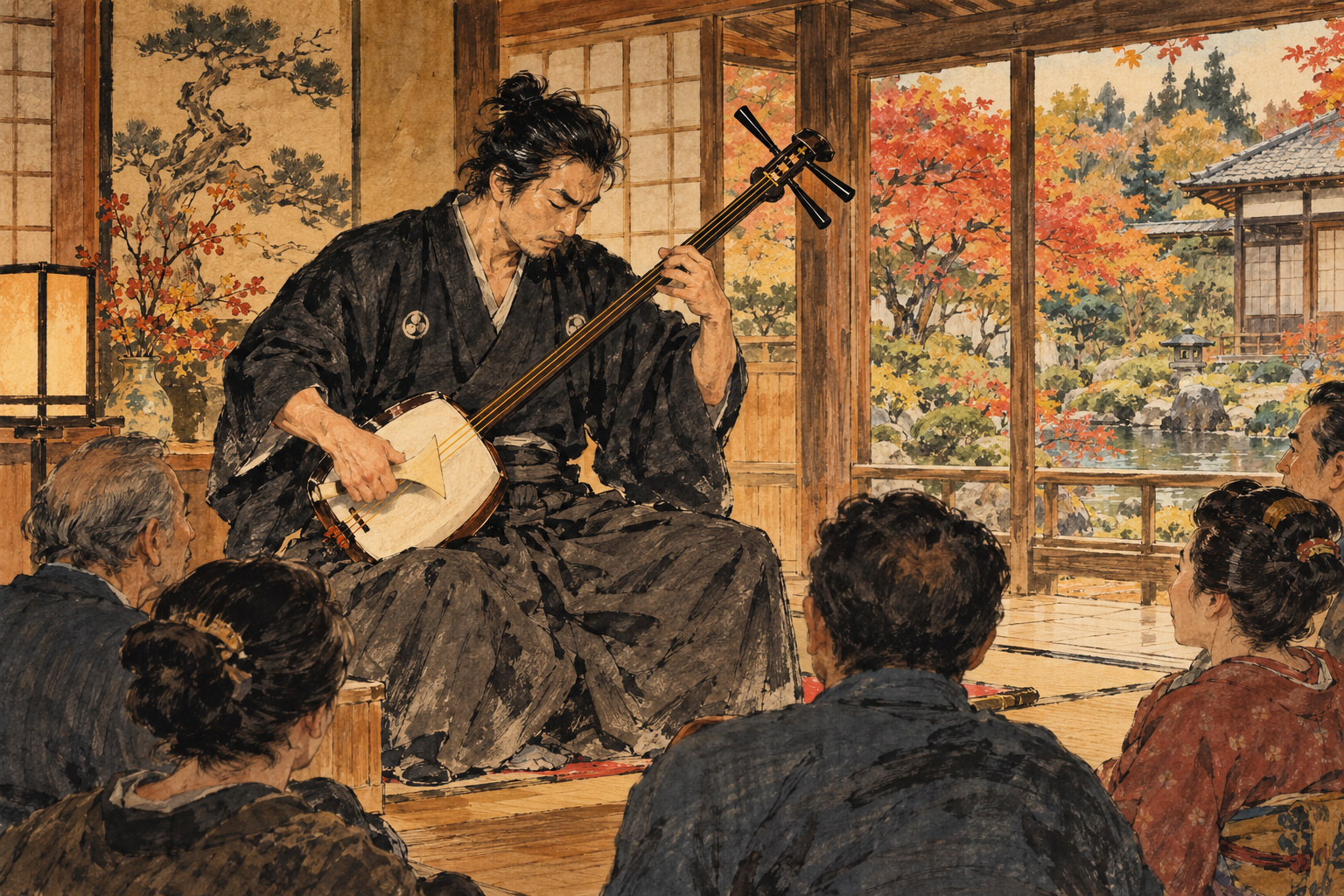
A visit to Kanagi’s Tsugaru Shamisen Hall works best when it is planned around a performance. The instrument belongs in a display about regional history, but its meaning also depends on what a musician does with it now: the attack of a note, the shape of a phrase and the choice of what comes next.
The hall in Goshogawara offers both exhibitions and live playing. For visitors to Aomori, that combination makes it a useful introduction to a tradition too easily reduced to speed and volume. The deeper story concerns livelihoods, folk song and the expressive possibilities that successive performers found within a shared musical language.[2]
A hometown story, with more than one protagonist
Goshogawara City identifies Nitabō, born Akimoto Nitarō in 1857 and deceased in 1928, as the figure regarded as the tradition’s founder. He came from the former town of Kanagi. The city connects his striking technique with the need to earn a living and credits subsequent musicians with developing the music. The hall opened in spring 2000.[1]
That founder narrative deserves attention without being mistaken for a complete account of how every aspect of modern playing emerged. The operator’s historical introduction describes Kase no Momo’s contribution to folk-song forms and contrasts Shirakawa Gunpachirō’s plucking-oriented approach with Nitabō’s striking. Even within the remembered lineage, there was room for different musical priorities.[3]
A museum can therefore be read in two ways: as a place that honours a local figure, and as a starting point for following relationships among musicians. The second approach leaves space for change, disagreement and individual choices. It makes the tradition more interesting than a single invention story.
Music as work
An introduction featuring performer Kohei Inoue, published by the Lifelong Learning Development Foundation, places visually impaired itinerant musicians in this history. It uses the historical term bosama for male performers associated with going from household to household. Remembering that work matters: hardship should not become a picturesque explanation for an exciting sound.[6]
The same account describes instrumental introductions to folk songs developing into independent solos. Hiranai, the hometown of Takahashi Chikuzan, highlights his role in establishing the music’s artistic standing and international recognition. Kanagi’s heritage is thus one important part of a story extending across communities and generations.[6][12]
Nor should accompaniment be treated as a discarded apprenticeship on the way to the supposedly higher achievement of solo performance. Supporting a singer and holding an audience alone are different musical tasks. Both remain visible in the tradition’s contemporary institutions.
Understanding the instrument without reducing the music
The Japan Arts Council classifies Tsugaru shamisen among the thick-necked instruments known as futozao. That broad family also includes the shamisen used for the gidayū narration of bunraku puppet theatre. Sharing a category does not make the musical functions or playing styles identical.[5]
For a first-time listener, a useful exercise is to separate the beginning of a note from what follows it. Notice the sharp attack made with the bachi, or plectrum, and then attend to the string’s continuing sound. A rapid passage may command attention, but a sustained note or a moment between phrases can be equally revealing.
This is a listening suggestion, not a claim about the programme on a particular day. There is no need to identify every technique before enjoying a performance. Watching one hand for a while, then listening with eyes closed, can shift attention from visible effort to musical shape.
Improvisation has a vocabulary
Musicologist Gerald Groemer’s 1993 study offers a helpful corrective to the idea that improvisation means making everything up without a framework. Its abstract traces important musical elements to folk-song accompaniment and the solo elaborations of performers including Shirakawa Gunpachirō. It identifies recurring motifs and progressively shorter phrases among the devices shaping improvisation.[7]
One implication for the audience is simple: listen for a pattern returning. Does it arrive with the same length and emphasis? Does a phrase feel compressed the next time? Recognising a small piece of musical material allows a listener to notice what has changed. Familiarity becomes a way into freedom.
The 2026 rules of the Tsugaru Shamisen World Championship in Hirosaki give a practical example of the continuing relationship between solo playing and song. They list individual instrumental categories alongside song-accompaniment divisions, with Tsugaru folk song providing the basis for the repertoire. This is a separate event from Kanagi’s competition.[8]
The distinction helps visitors avoid treating every contest, venue and style as interchangeable. It also suggests a richer standard for listening than simply asking who can play the fastest.
What the hall adds
The city’s exhibition guide includes instrument construction, string instruments from around the world, local folk singers and regional performing arts, as well as historical musicians. That range encourages visitors to connect the shamisen with voices and communities rather than viewing it as an isolated virtuoso instrument.[4]
Try choosing one question in the exhibition before taking a seat: how does the instrument work, how does it relate to song, or how did one performer differ from another? Returning to the displays after a live set can make the historical material easier to interpret.
The venue also connects commemoration with current musicians. Goshogawara’s announcement for the 31st Nitabō Festival scheduled a September 5, 2026 event featuring leading finishers from the Kanagi competition. That notice is evidence of the planned programme, not a report of what occurred, and the date precedes this Sunday edition.[9]
Plan around a live set
The operator’s fiscal 2026 notice gives opening hours of 9 a.m. to 4 p.m., with closure from December 1 through March 31. For an autumn visit, distinguish ordinary admission and performances from a hands-on lesson.[11]
| Item | Published information |
|---|---|
| Regular live sets | 10 a.m., 11 a.m., 1 p.m., 2 p.m. and 3 p.m.; about 20 minutes each |
| Admission | Adults ¥600; high-school and university students ¥400; elementary and junior-high students ¥250 |
| Address | 189-3 Asahiyama, Kanagimachi, Goshogawara |
| Rail access | About seven minutes on foot from Kanagi Station on the Tsugaru Railway |
| Telephone | 0173-54-1616 |
These operator and city listings were checked on September 26, Japan time. Confirm the current programme before travelling.[2][4]
The hands-on experience requires a reservation at least seven days ahead, according to the operator. It should not be assumed to be available on arrival. Confirm the session time, group arrangements and price when booking.[10]
Kanagi offers the chance to move between explanation and sound. The lasting value of the visit may be a more attentive ear: one that hears the performer’s decisions alongside the history carried by the instrument.
Sources and further reading
- Goshogawara City: the local origin tradition
- Kanagi Genki Club: museum, performances and admission
- Kanagi Genki Club: historical performers
- Goshogawara City: exhibitions and access
- Japan Arts Council: futozao shamisen
- Lifelong Learning Development Foundation: performer Kohei Inoue on Tsugaru shamisen
- Gerald Groemer: analysis of improvisational elements (1993; abstract)
- Tsugaru Shamisen World Championship: 2026 rules and categories
- Goshogawara City: announcement of the 31st Nitabo Festival
- Kanagi Genki Club: hands-on lessons
- Kanagi Genki Club: fiscal 2026 opening hours
- Hiranai Town: Takahashi Chikuzan and his hometown
