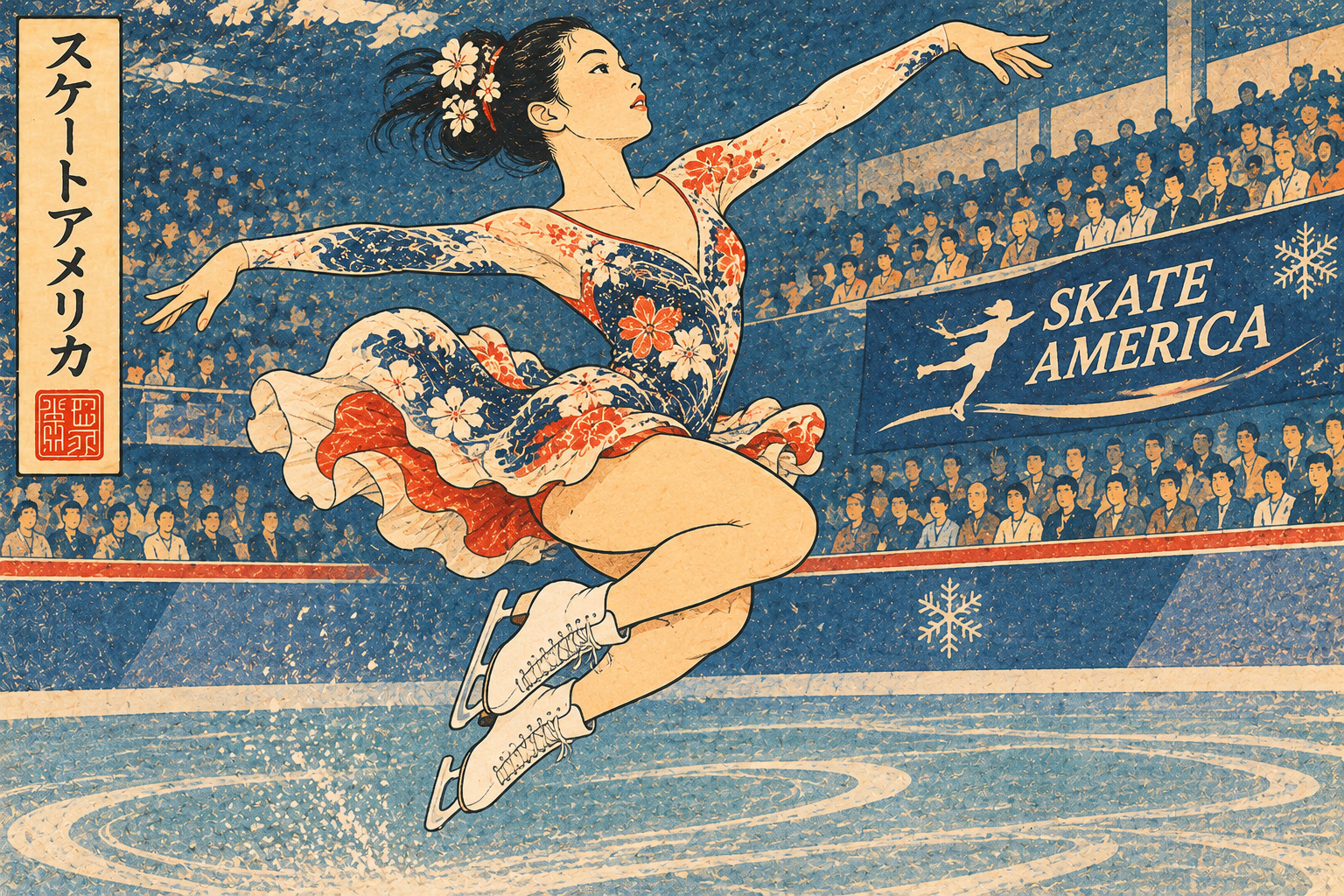
- Two days, two triple Axels, one convincing win
- Reading the score rather than the headline
- How the podium was settled
- The athlete behind the breakthrough
- Why the triple Axel still changes an event
- A program must also move with the music
- Japan’s women have built this road over decades
- What a ticket to Chongqing means
- The question after a personal best
Two days, two triple Axels, one convincing win
At the Angel of the Winds Arena in Everett, Washington, Ami Nakai turned a demanding two-day competition into a statement about the depth of Japanese women’s figure skating. The 18-year-old won Skate America on November 15 with 236.81 points, topping both the short program and the free skate. It was her second Grand Prix victory of the 2026–27 season and secured her place at the Grand Prix Final in Chongqing, China, in December.
The defining technical moment came twice. Nakai landed a triple Axel in the short program and again at the start of her free skate. The second jump earned 9.94 points, including a 1.94-point grade of execution bonus over its 8.00-point base value. Yet reducing this win to a single jump would miss the bigger achievement: technical content, consistent execution, and program components all contributed to a personal-best total.
Reading the score rather than the headline
The International Skating Union recorded an 82.20 short program on November 14, divided into 48.25 technical points and 33.95 program-component points. On November 15, Nakai scored 154.61 in the free skate—82.71 technical points and 71.90 program-component points, without deductions. Her 236.81 combined score was a personal best and the highest women’s total on the ISU’s 2026–27 season-best list as of November 15.
That is a seasonal benchmark, not an all-time world record. It tells us how she compares with scores posted so far under the current competition calendar. The exact components matter, too: judges assessed composition, presentation, and skating skills separately from the technical panel’s evaluation of jumps, spins, and steps. A reader who sees only the final number misses where the margin came from.
How the podium was settled
Alexandra Ignatova, competing under the individual neutral athlete designation, finished second with 213.90 points. Japan’s Rino Matsuike, representing Chukyo University, took bronze with 211.63 after rising from fifth place in the short program to second in the free skate. Her 141.33 free-skating score was behind only Nakai’s. The two-segment format makes those shifts important: a strong final program can transform the podium without necessarily winning the event.
Nakai’s winning margin was 22.91 points. It reflected not merely her advantage after the opening program but her ability to extend it on the second day. The official protocols substantiate the arithmetic; descriptions of pressure, nerves, or competitors’ private intentions would require athlete testimony that JAPAN.co.jp did not independently obtain.
The athlete behind the breakthrough
Nakai was born in Niigata on April 27, 2008. The ISU profile lists her home base in Chiba, her club as Tokio Inkarami, and her start in skating in 2013. Coaches named by the ISU include Kensuke Nakaniwa, Makoto Nakata, and Momoe Nagumo. The geographic movement from Niigata to a training base in Chiba reflects a practical feature of elite skating: talented athletes need access to ice time, coaching, choreography, and a competition structure capable of supporting long-term development.
She was not an unknown entering Everett. Her résumé includes bronze at the 2023 World Junior Championships, bronze at the 2024 Junior Grand Prix Final, and a fourth-place finish at the 2025 junior worlds. She won the Grand Prix de France in 2025 and finished runner-up at that season’s Grand Prix Final. In 2026 she won Olympic bronze in Milan–Cortina, then began the new Grand Prix season by winning in France again. Skate America was the continuation of an established rise, not a sudden debut.
Why the triple Axel still changes an event
The Axel takes off forward, unlike the other standard figure-skating jumps. A triple Axel therefore requires three and a half rotations before the skater lands backward. The combination of takeoff mechanics, rotation, alignment, and landing quality makes it a demanding element. It also comes with risk: an under-rotation, poor landing, or fall can erode the scoring advantage quickly.
At Skate America, Nakai’s opening free-skating triple Axel produced 9.94 points. The next listed element, a triple Lutz–triple toe-loop combination, received 11.79 points. Both figures come from the ISU judges’ protocol. Together they demonstrate why an ambitious element has to be executed convincingly rather than merely attempted. They do not prove that a particular jump is universally decisive; the scoring system rewards a complete program.
A program must also move with the music
Nakai’s official 2026–27 repertoire lists “Por Una Cabeza” by Carlos Gardel for the short program and music associated with George Gershwin’s “An American in Paris” for the free skate. Those are markedly different musical worlds. The athlete must translate rhythm and mood into movements that remain physically precise despite the demands of elite jumping.
The ISU’s three program-component categories—composition, presentation, and skating skills—provide a structured way of judging more than technical elements. Nakai’s 71.90 free-skating component total was consequential alongside her technical score. To say precisely what a particular gesture meant artistically would be interpretation, not a score-sheet fact. What the official results establish is that judges valued her full program, not only its most difficult leap.
Japan’s women have built this road over decades
The latest Japanese results belong to a longer history. Midori Ito made the triple Axel an emblem of Japanese women’s technical ambition. Shizuka Arakawa won Olympic gold in Turin in 2006, while Mao Asada became another defining figure in the development of high-difficulty women’s skating. Those careers are not interchangeable, and none guarantees what a young successor will achieve. They do, however, help explain why technical innovation and complete performance matter so much to Japanese audiences.
In the first four women’s Grand Prix events of 2026–27, Japanese skaters captured every title: Nakai in France, Mao Shimada in Canada, Mone Chiba in China, and Nakai again in the United States. The Japan Olympic Committee documented the streak after Everett. It is a measure of depth across athletes, not a world championship or an Olympic medal count. Results at the sport’s biggest events remain to be contested.
What a ticket to Chongqing means
The Grand Prix is a six-event senior series whose leading finishers qualify for a final with six entries per discipline. According to the ISU’s season guide, the 2026–27 final is scheduled for December 10–13 in Chongqing, China. Nakai’s two early victories made her a confirmed qualifier before the remaining regular-season events in Finland and Japan were completed.
Qualification changes the calendar, not the outcome. The lineup will be settled only after the final two stops; form can change, technical choices may be altered, and managing training between competitions becomes part of the challenge. It would be premature to describe Nakai as the Grand Prix Final champion or suggest this result carries a new Olympic qualification benefit. The victory guarantees an opportunity to compete for the next title, nothing more.
The question after a personal best
Skate America made Nakai the holder of the leading women’s total posted that season, but sport seldom offers a straight line from November form to December victory. Skating is a delicate negotiation among risk, execution, endurance, choreography, and health. A triple Axel is a spectacular image; repeating it successfully under changing conditions is the deeper test.
The achievement in Everett deserves recognition on its own terms: a short-program lead, the best free skate, two successful triple Axels, a 22.91-point margin, and qualification for the next major event. For a skater who already knows what it means to compete at the Olympics and a Grand Prix Final, the next phase will be measured not in headlines about limitless potential, but in the quality of the performances she can deliver again.
Primary sources and reporting limits
Scores, athlete history and schedule were checked against ISU records and contemporary Japanese reporting. This report does not imply an on-site interview or an independent technical-panel re-scoring.
- ISU: official Skate America 2026 competition results
- ISU: women short program
- ISU: women free skating
- ISU: free-skating judges details
- ISU: Ami Nakai profile and career results
- ISU: 2026/27 Grand Prix schedule and qualification
- JOC/Kyodo: November 16 results
- JOC/Kyodo: November 15 short program
- Kyodo Deep Edge Plus: full results
- ISU: 2026/27 women season-best totals (as of Nov 15)