- At 20–20, the Final Became a Test of Nerve
- How the Two Games Unfolded
- Why Wang Zhi Yi Made This a Serious Test
- The Draw Was Harder Than the Final Score Suggests
- From Fukui’s Junior Courts to a Professional Base in Kumamoto
- What a Super 500 Title Means—and Does Not Mean
- Eighty Years of Japanese Badminton Behind a Modern Champion
- The Intelligence Inside Defensive Badminton
- A Personal Homecoming, Not a Prediction of the Next Title
At 20–20, the Final Became a Test of Nerve
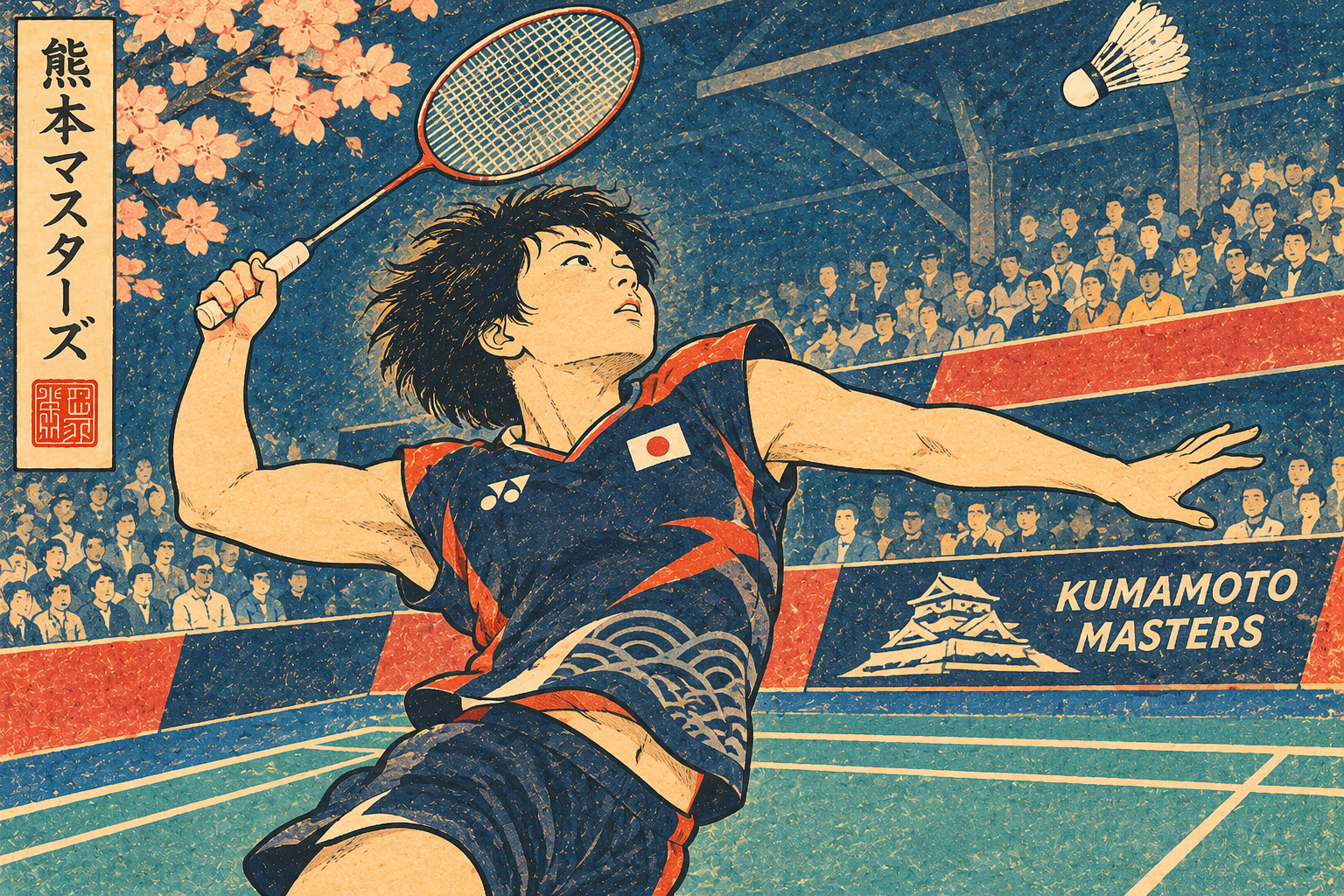
The scoreboard at Kumamoto Prefectural Gymnasium offered no refuge. Japan’s Akane Yamaguchi had taken the opening game against China’s Wang Zhi Yi 21–14, but the second was tied at 20–20. The next two rallies would decide whether she could finish the final without a third game. She won them both. On November 15, 2026, the 29-year-old emerged with a 21–14, 22–20 victory and her second Kumamoto Masters women’s singles title, the first having come in 2024.
That score is more revealing than a routine straight-games label. Yamaguchi had trailed 4–9 in the second before reversing the momentum. Against an opponent ranked immediately behind her in the world, she had to solve a changing match rather than simply repeat the pattern that won the first game. The 49-minute final brought an elite contest to a Japanese city that has become central to her professional life.
Her story contains a geographical distinction worth remembering: she comes from Fukui Prefecture, not Kumamoto. Yet the city is home to the Saishunkan Pharmaceutical badminton program that has supported her adult career. Winning here was a home-court experience in the professional, rather than birthplace, sense.
How the Two Games Unfolded
Yamaguchi established control in the opening game and closed it 21–14. Japan’s specialist badminton reporting described her building separation through the middle phase, while Wang sought to keep the rallies competitive. Any attempt to assign exact shot-selection percentages would exceed the published match record: the accessible sources give the score and select descriptions, not a fully audited shot-by-shot data set.
The second game demanded adjustment. Yonex’s November 16 tournament report says Yamaguchi faced a 4–9 deficit. Japanese television coverage describes a combination of extended rallies, movement to the front and back of the court and a difficult close-range retrieval in the late stages. These are reported observations, not independent video-coded analysis by JAPAN.co.jp.
One point at 19–19 reportedly drew special attention when Yamaguchi reacted sharply near the net. Yet the outcome should not be reduced to one spectacular defensive shot. It also required sustained concentration to draw level and then take the two decisive points after 20–20, when the rules demand a two-point advantage unless a game reaches 29–29.
Why Wang Zhi Yi Made This a Serious Test
The final brought together the world No. 2, Yamaguchi, and No. 3, Wang, according to the November 15 reporting. Wang represented another formidable generation of Chinese women’s singles players, accustomed to long rallies and the tactical demands of international finals. A Super 500 event is not the world championships, but its classification does not preclude a final between players of the highest standard.
Yamaguchi, listed by the Badminton Association of Japan at 156 centimeters tall, has built her international success around fast court coverage, low positioning, changes of pace and the ability to shift between recovery and attack. Those attributes help explain her style; they are not a claim that any one physical characteristic determined this particular match.
Some Japanese reports described the head-to-head record as 10–10 before this final. Such counts depend on which matches are included and when the statistics were updated, so this article does not present that figure as an independently verified lifetime record. The evidence that matters most here is immediate: Wang pushed the second game to 20–20 and Yamaguchi finished it.
The Draw Was Harder Than the Final Score Suggests
Two days before the final, Yamaguchi beat fellow Japanese player Riko Gunji 21–13, 21–12 in the quarterfinal. Her semifinal against China’s Chen Yu Fei took a different course. Chen won the opener 21–18; Yamaguchi responded 21–8. With Yamaguchi ahead 11–4 in the decider, Chen retired. It is important not to write that Yamaguchi won a completed third game: the match ended through retirement.
Wang’s own route included a 21–10, 21–15 semifinal victory over Japan’s Tomoka Miyazaki, one of the country’s younger talents. The tournament therefore placed established champions and developing Japanese players in the same competitive frame. It also reminded observers that a title path can depend on a retirement as well as fully played contests.
Japan had success beyond singles. Rin Iwanaga and Kie Nakanishi defeated Japanese opponents Chiharu Shida and Ririna Hiramoto 21–19, 21–15 for the women’s doubles crown. That result deserves its own account, but in this story it provides context: the host nation’s performance was broader than Yamaguchi’s individual win.
From Fukui’s Junior Courts to a Professional Base in Kumamoto
Yamaguchi was born on June 6, 1997, in Fukui Prefecture. According to the Badminton Association of Japan, she began playing at age five and progressed through Katsuyama’s junior and school badminton programs before attending Katsuyama High School. Her career was already internationally distinctive in adolescence: she won back-to-back world junior singles titles in 2013 and 2014.
She joined Saishunkan Pharmaceutical after graduating in 2016 and has since developed an enduring association with Kumamoto. As a professional home, the city gives an athlete a different sense of belonging than a hometown: it is where training, coaching, recovery and teammates become part of the work of staying among the world’s best.
The larger résumé is remarkable. The national association lists women’s singles world titles in 2021, 2022 and 2025, and quarterfinal appearances at the 2016 Rio, 2020 Tokyo and 2024 Paris Olympics. These achievements do not diminish the November 2026 title. They explain why its significance lay less in proving she could win and more in where, and against whom, she did it.
What a Super 500 Title Means—and Does Not Mean
The Kumamoto Masters Japan is part of the Badminton World Federation’s World Tour at Super 500 level. The 2026 event ran November 10–15 and comprised men’s and women’s singles, men’s and women’s doubles and mixed doubles. It was the event’s fourth edition, according to Yonex, and Yamaguchi’s second women’s singles victory there.
Super 500 is a recognized tier of international competition; the title is not interchangeable with an Olympic medal, a world championship or the season-ending World Tour Finals. Rankings and qualification decisions require their own calculations and publication dates. None follows automatically merely because a player has won a single tournament.
Yonex, a sponsor and equipment supplier, reported cumulative attendance exceeding 20,000 during the competition. That is a company-reported count rather than an independently audited public figure. Still, hosting a major world tour event beyond Tokyo has cultural value: young local players can see global standards in person, and international athletes encounter a different part of Japan’s sporting geography.
Eighty Years of Japanese Badminton Behind a Modern Champion
Yamaguchi’s title occurred in a milestone year for the sport in Japan. The Badminton Association of Japan traces the spread of organized play to YMCA programs and other instruction in the early twentieth century. The association was established on November 2, 1946, held its first national championships in the 1947 fiscal year and joined the international governing body in 1952. It marked its 80th anniversary in 2026.
That history matters because international champions rarely emerge from isolated individual talent. They depend on community clubs, school competition, professional teams and coaching institutions that can sustain intensive training over years. Yamaguchi’s pathway runs through local junior clubs in Fukui, a high-school program and a company-backed team in Kumamoto.
Japan’s contemporary strength in women’s badminton thus reflects a network rather than one athlete alone. The Kumamoto tournament offered a public view of that network: a champion from one prefecture winning in the prefecture where she now trains, alongside doubles teams and younger singles players testing themselves against global rivals.
The Intelligence Inside Defensive Badminton
Yamaguchi is often introduced through her defense, a style that makes improbable retrieving look effortless. But a defensive retrieval is valuable only if it prevents the opponent from taking the next easy point—or creates a chance to attack. A player must select the height, direction and pace of the return while anticipating what will come back. The distance between survival and initiative can be a single shot.
The second game illustrates that principle without proving a new technical breakthrough. Down 4–9, Yamaguchi had to revise her responses. With the score tied at 20–20, she needed two points under maximum scoreboard pressure. News reports identify sharp reactions near the net; they do not establish a comprehensive statistical profile of every rally.
For young players, the lesson is not a slogan about simply never giving up. It is that elite badminton asks competitors to keep observing, correcting and competing even when an opponent changes the rhythm. The title was built on years of preparation, but won through decisions made in less than an hour.
A Personal Homecoming, Not a Prediction of the Next Title
After the victory, Yonex described Yamaguchi as particularly pleased to win in the city where she is based. Local coverage also reported her appreciation for the support in the hall. We attribute those comments to the organizations that reported them; JAPAN.co.jp did not interview Yamaguchi or witness the match in person.
A 21–14, 22–20 score establishes the winner and the tension of the second game. It does not establish what happens next: whether her ranking changes at the next update, whether she qualifies for a later event, or whether she can repeat this performance against a different field. Those claims require future official records.
What the November result does establish is a powerful arc. A child who started badminton in Fukui moved to a club program in Kumamoto, became a three-time world champion and returned to win before the audience closest to her professional life. The final two points at 20–20 made that story visible to everyone in the arena.
Sources and reporting limitations
Player remarks are attributed to published Yonex and other reports. Rankings reflect reporting at the time of the final; we have not independently charted every rally.
- Badminton Association of Japan: Official final-day report (Nov. 16, 2026)
- BAJ: 2026 Kumamoto Masters team announcement
- BAJ: Akane Yamaguchi official profile
- BAJ: History of badminton in Japan
- BAJ: Association history and 80th anniversary
- Yonex: Kumamoto Masters 2026 results and player comments
- Badminton Spirit: Final match report and all five results
- Badminton Spirit: Semifinal results
- Nippon TV reporting: Key passages of the final
- Official Kumamoto Masters website