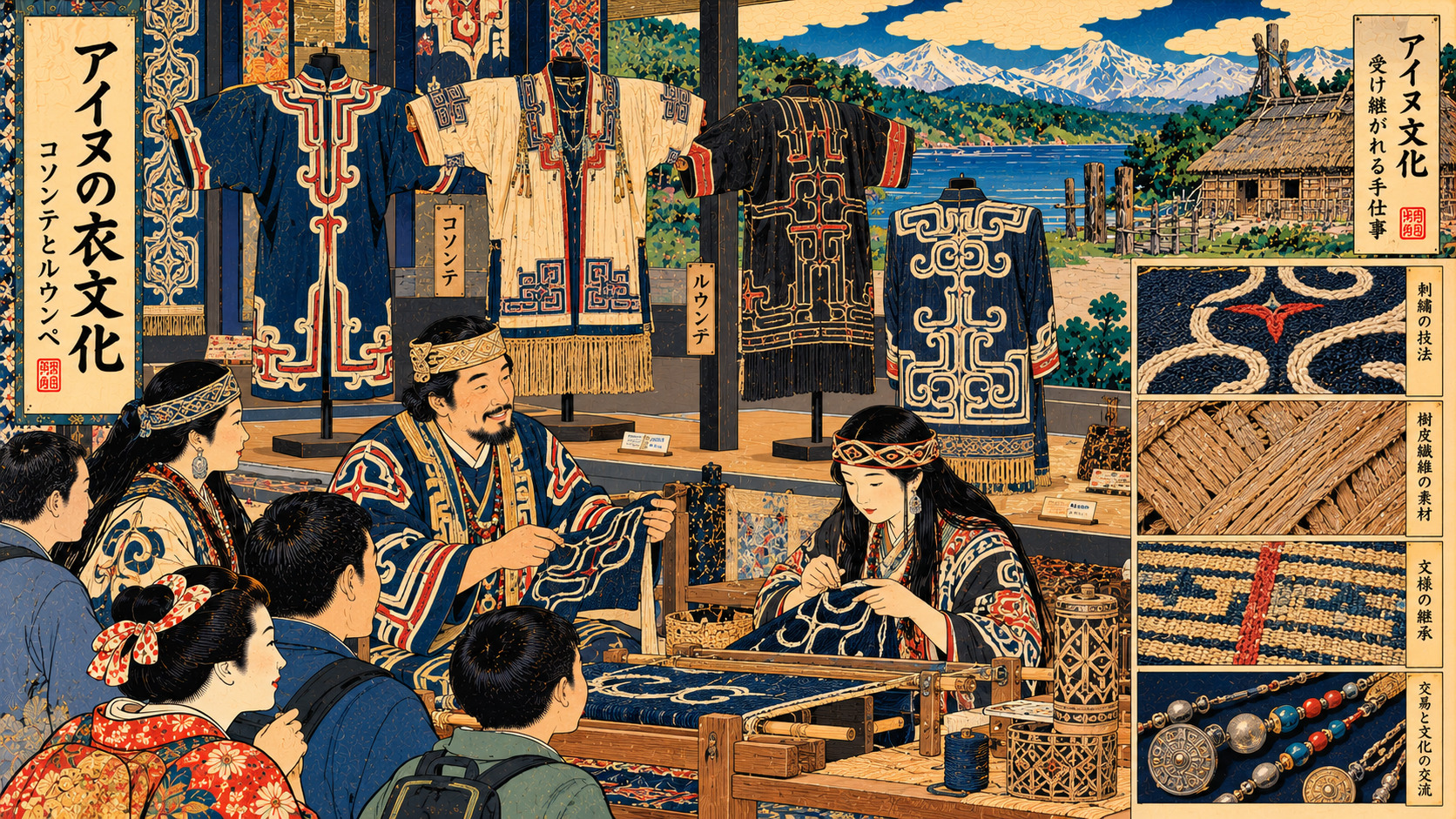
A garment travels—and changes its meaning
At the National Ainu Museum in Shiraoi, Hokkaido, an exhibition running from September 19 to November 23, 2026, asks visitors to look closely at what happens when clothing crosses cultural boundaries. A kosode, a Japanese robe associated with women of the warrior class, could become kosonte, Ainu formal wear used by men in ceremonial settings. Cloth could then be dismantled and incorporated into ruunpe garments. The story is not merely that Japanese fashions reached the north; it is that Ainu makers made active, inventive choices about what those materials would become.
What is kosonte?
Kosonte is an Ainu-language name derived from kosode, the predecessor of the modern kimono. The museum explains that examples entered Ainu communities through exchange and were worn as distinguished ceremonial garments. Related clothing preserved among Sakhalin Ainu is known as kosonto. The pieces differ in age, original use and construction: some originate in garments made for elite women, others in theatrical costume. Calling all of them simply “traditional Ainu robes” would erase the journeys that made them distinctive.
A Momoyama-period robe and the geography of exchange
One noteworthy object discussed by the exhibition is a kosode dating to Japan’s Azuchi–Momoyama period that was preserved as Sakhalin Ainu kosonto. Its survival invites a broader historical question. Hokkaido, Sakhalin, northern Honshu and neighboring continental regions were not isolated cultural boxes: people, textiles and ideas traveled between them. Yet an object’s survival does not necessarily reveal every intermediary in its journey. Responsible interpretation separates documented provenance from an imagined biography of a particular garment.
The fabric is not the finished idea
Ruunpe craftsmanship brings the maker’s agency into view. Some pieces apply substantial sections of patterned kosode cloth; others cut the material into narrow strips that contribute to a new decorative arrangement. A piece of silk designed for one garment can acquire an entirely different rhythm against another ground cloth. It would be reductive to describe this only as recycling. Valuable fabric was conserved, certainly, but transformed through decisions about scale, contrast, position and embroidery.
The global geography hidden inside a textile
The exhibition describes silk, cotton, wool and European printed fabrics among the materials used in ruunpe. Museum research also documents garments made with local bast fibers and imported textiles. These are tangible clues about trade networks, not proof that every garment passed along the same route. The presence of European printed cloth especially challenges the notion of an untouched, self-contained “traditional” costume. The history of Ainu clothing includes adaptation and outward connections as well as local skill.
Look beyond the motif to the stitch
The most striking feature in a gallery photograph may be the pattern, but close examination of seams, thread, applied cloth and stitch spacing tells a second story. How does an embroidered area survive tension? How did a craftsperson negotiate the differences between imported silk and locally available textiles? The museum’s associated October 31 symposium included planned talks on textile conservation and the needle’s role in the transmission of skills. Those subjects show why this is also a story of materials science, careful documentation and the labor of teaching.
Cultural exchange was not a single arrow
A central gallery section examines Japanese kosode themselves, including clothing used by women of the warrior class and in Edo-period elite settings. The exhibition also notes that Ainu patterns found their way into kabuki costumes and kimono design. Exchange cannot be adequately described as Honshu exporting culture to passive recipients in Hokkaido. At the same time, aesthetic borrowing should not obscure unequal political and trading relationships. Beautiful clothing and difficult histories can occupy the same frame.
A museum exhibition across five chapters
The roughly 130 objects shown across the exhibition’s two installation periods are organized into five themes: kosonte; the relationship between kosonte and ruunpe; the world of kosode; varieties of ruunpe; and ruunpe made today. Works are drawn from different collections, including the National Ainu Museum and local museums such as those in Urakawa and Kushiro. Their provenance, collection history and the details of ownership deserve the same attention as the beauty of the fabrics.
Preservation is more than freezing tradition
The final section turns to living makers. Contemporary ruunpe can employ inherited techniques while exploring new color choices, materials and compositions. That does not make modern work less authentic than a museum-held example. The questions become practical: Who can learn the skills? Who has access to materials and instruction? How are makers credited, and who controls reproductions of their work? An exhibition of clothing can therefore be a discussion of cultural continuity and creative rights.
The symposium’s agenda, not invented testimony
An exhibition-related symposium was scheduled for October 31 in the historic Hokkaido Government Office building in Sapporo. Its announced speakers included Ainu craftsperson Michiko Tsuda and scholars addressing garment history, conservation, embroidery and transmission. The public program documents what was planned; it does not establish exactly what anyone said or concluded. Without recordings or interviews, attributing striking quotes to its participants would be unwarranted.
Planning a November 3 visit
Upopoy’s Culture Day program on November 3 provides free admission to the park and National Ainu Museum, while parking and certain workshops may still carry charges. A curator-led gallery talk for the textile exhibition is listed at 10:30 a.m. with space for 20, followed by a children’s conversational gallery talk at 2 p.m. for 15 participants. Capacity and ticketing arrangements can change. Visitors should consult the museum’s current schedule, particularly if hoping to attend a small-group program.
How to see a garment without flattening its history
The exhibition’s most compelling lesson is that a garment can carry several histories at once: the world in which the original cloth was woven, the exchanges that carried it north, the Ainu hands that selected and transformed it, the collector who later acquired it, and the artist who continues related practices today. The makers were not simply custodians of a frozen past. Seeing their work as design, technical knowledge and cultural agency makes the exhibition more illuminating than any tidy story about influence moving in one direction.
Sources and reporting notes
Based on museum primary documentation, research reports, its exhibition catalogue description and regional news coverage. No original interviews or firsthand gallery inspection were conducted; the October 31 symposium program is verified as an announcement, not as an account of actual remarks.