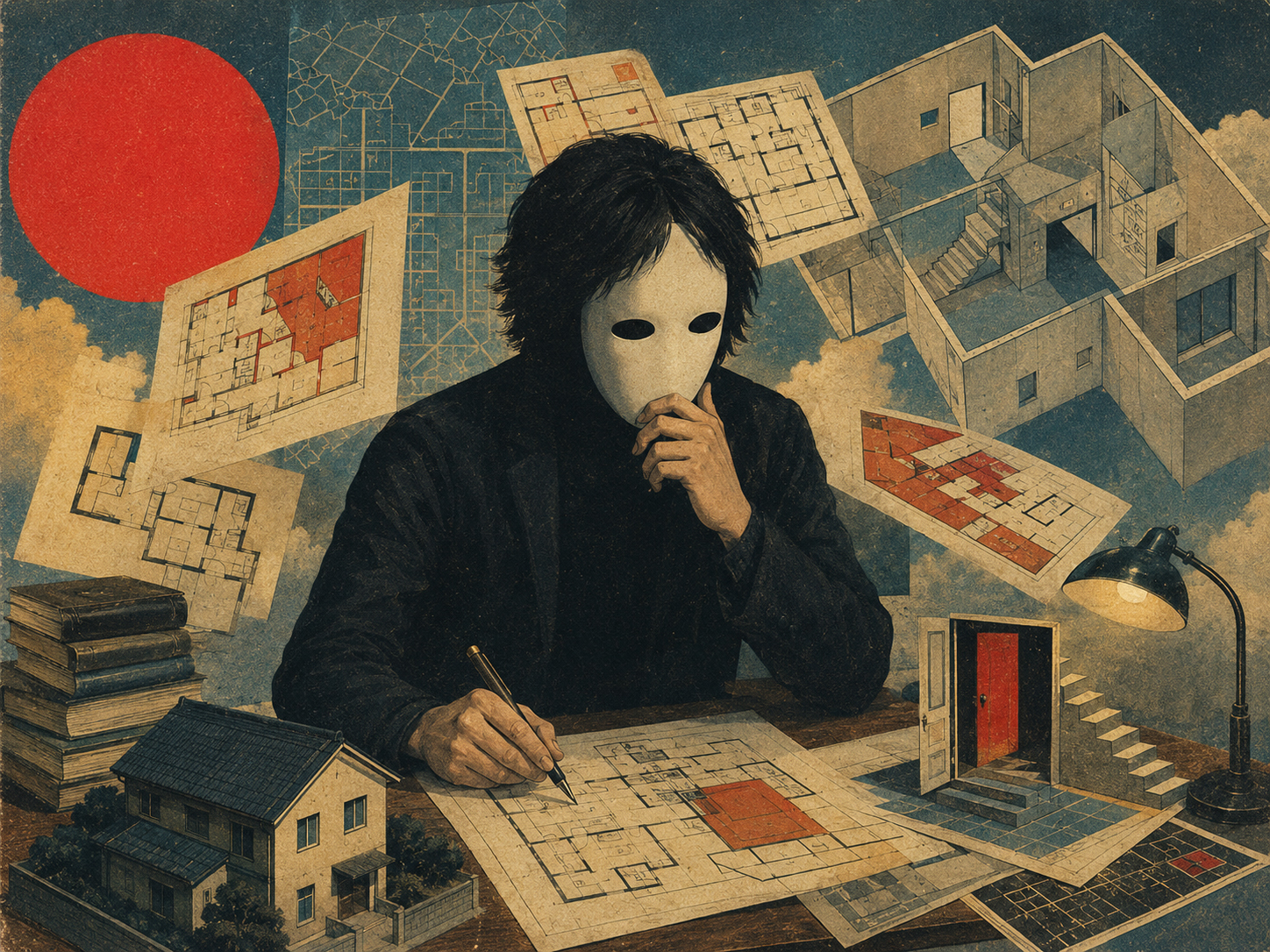
It began with one floor plan
The entrance was not a ghost, corpse or cursed videotape. It was an ordinary-looking plan for a two-story suburban house. Then the eye began to resist it. There was an unexplained void between the kitchen and living room. Upstairs, a windowless child’s room required an absurd detour to enter. Its toilet could be accessed only from inside the room.
On October 12, 2020, the Japanese web magazine Omocoro published “Real Estate Mystery: The Strange House.” Uketsu and an architectural consultant called Kurihara examined the plan through short, polite dialogue. The article repeatedly returned to the drawing, allowing readers to discover each contradiction alongside them.
The article and video spread rapidly. A book followed in 2021, then Strange House 2: Eleven Floor Plans, Strange Pictures and, on October 31, 2025, Strange Map. By July 2026, the “Strange” series had passed nine million copies, and Strange Map had become Japan’s top-selling literary book for the first half of the year.
Who is Uketsu?
Very little biographical information is publicly confirmed. Uketsu appears in a smooth white mask, black full-body clothing, a dark bob-like wig and an electronically raised voice. The name combines the Japanese words for “rain” and “hole,” which the author has said are simply two favored words.
Legal name, age, gender and birthplace have not been disclosed. Reporting in 2025 said roughly 30 people, including close professional contacts, knew the unmasked identity. Uketsu has linked the costume less to a monster than to the Japanese theatrical kuroko: a black-clad stagehand visible to the audience but conventionally treated as absent.
That principle matters. Uketsu appears on screen while subtracting personal facial expression and biography. Viewers focus instead on voice, hands, diagrams, pauses and the document under examination.
Before the house: an eerie and funny web performer
Before Strange House, Uketsu made Omocoro articles and videos involving peculiar crafts, music, food and short horror. Familiar objects changed in one wrong detail: asparagus resembling fingers, inexplicable machines, domestic routines that slipped slightly out of reality.
The method was already consistent. Do not begin with a monster. Begin with a normal room, meal, conversation or object and insert one detail that cannot be comfortably explained. Hold the audience between laughter and fear.
The masked persona works the same way. The appearance is alarming, but the hesitant movements, high voice and exaggerated politeness are strangely gentle. Unease and affection coexist.
Why floor plans are frightening
A floor plan normally promises control. It tells us where the entrance, kitchen, bath and bedrooms are. Property advertising uses it to help buyers imagine a safe future.
Uketsu reverses that trust. Dimensions fail to match. A window is missing. A corridor bends for no practical reason. Overlaying two floors reveals an enclosed void. What looked like drafting error becomes evidence of intention.
A ghost may be escaped. An architectural abnormality says that someone built the wall, placed the door and forced a household to live around that design. Architecture preserves a past act.
The ancestors of diagram mystery
Uketsu did not invent the use of plans in detective fiction. Maps of locked rooms, mansions, trains and islands have long been part of fair-play mystery, giving readers the same spatial evidence available to the detective.
Japanese honkaku mystery strongly connected architecture and crime through writers from Edogawa Ranpo and Seishi Yokomizo to Soji Shimada and Yukito Ayatsuji’s “Mansion” novels. The strange building was not merely a location; it materialized the criminal logic.
Uketsu’s innovation was to replace the grand Gothic mansion with a plan everyone recognized from a property listing. The horror could be hidden inside a plausible new-build suburban home.
| Form | Traditional role | Uketsu’s transformation |
|---|---|---|
| Building plan | Shows locked rooms and movement routes | The design itself becomes evidence of family secrecy or crime |
| Child’s drawing | Symbol of innocence, memory or psychology | Line, color, omission and viewpoint become solvable clues |
| Map | Organizes place and travel | Broken routes, missing places and impossible distances generate story |
| Interview | Delivers witness information | Contradictory testimony becomes an interactive puzzle |
| Video | Usually promotes a finished work | Functions as the original story, later expanded into print |
The reader studies evidence, not decoration
In Strange Pictures, drawings replace floor plans: a childlike image, a blog illustration, the angle of a portrait, the composition of a mountain scene. The pictures do not decorate prose. They contain information prose alone cannot deliver.
Strange Map expands the field further. Roads, distances, place names, travel records and blank areas become clues. Horror leaves the sealed house and spreads across towns, regions and historical Kyoto.
These books resist simple forward reading. Readers return, compare, rotate, overlay and re-read earlier testimony. The physical act resembles puzzle games and internet investigation even while remaining a paper book.
Why younger readers responded
Uketsu has said the work is designed to remain accessible to people who do not enjoy reading. Short dialogue, frequent diagrams, chapter-level mysteries and video-like cuts lower the threshold.
This is not merely literary simplification. It recognizes that readers raised on manga, games, YouTube and social media already possess sophisticated visual-search skills. Looking for clues in an image is also reading.
Critics sometimes object to plain dialogue, heavy explanation or coincidence. The books prioritize momentum and puzzle delivery over elaborate literary style. The reason for their accessibility and the reason for criticism are often the same.
The fear of documentary realism
Uketsu’s stories proceed like records of real consultations. The author receives a question, calls an expert, interviews witnesses and assembles plans, emails, blogs, photographs and testimony. Fiction and investigative report blur.
This connects to mockumentary, found footage, internet urban legends and Japan’s long culture of supposedly submitted true horror. The innovation is the choice of evidence. Instead of a visibly cursed tape, Uketsu frightens readers with documents that look rational and trustworthy.
In 2024, a floor plan became a ¥5 billion movie
The film Strange House opened March 15, 2024 and passed 3.96 million admissions and ¥5 billion at the Japanese box office—an exceptional result for domestic horror.
A film could not simply show two people quietly discussing diagrams for two hours. It expanded characters, pursuit, sound and bodily danger, becoming a larger entertainment object. That divided readers who preferred the restrained logic of the source.
Commercially, however, it proved that a static property plan could lead to a giant cinema screen. Film sent viewers back to the diagram; books sent readers back to the original video.
Manga fills the space between diagram and body
Strange House and Strange Pictures received manga adaptations, now moving into English publication as well. Manga preserves the diagrams while adding faces, depth and temporal movement.
Yet visualizing every scene can reduce the original’s unseen space. Each medium creates a different fear rather than reproducing one definitive version.
Why the world can read “Uketsu”
The English edition of Strange Pictures appeared in January 2025, followed by Strange Houses in June. Translation projects expanded across more than 35 countries and regions.
Visual clues reduce part of the language barrier. A windowless room or useless corridor can be understood immediately. Building customs differ, but the question—who designed this space, and why?—travels well.
Translation must still carry Japanese housing scale, family patterns, land costs, tatami rooms and the emotional geography of suburb and city. The books combine universal puzzle logic with specifically Japanese domestic space.
Is the white mask branding or artwork?
The mask is a powerful sales symbol on book jackets, television appearances and store displays. The anonymous author is more instantly recognizable than many authors who reveal their faces. Secrecy became branding.
But it also matches the fiction. Witness identity is uncertain, documents remain after people disappear, and voices pass through devices. The author seems to inhabit the same mock-documentary world as the stories.
The meaningful question is not the legal identity behind the mask. Speculating about undisclosed private information adds little and can violate the boundary the creator has deliberately set. The constructed persona should be analyzed as part of the work.
- Confirmed: Uketsu publicly performs in a white mask, black clothing and altered voice.
- Confirmed: the work spans Omocoro, YouTube, novels, manga, film and music.
- Confirmed: Uketsu has cited mystery influences including Edogawa Ranpo.
- Not appropriate to speculate: legal name, gender, age, address or unmasked appearance.
- The important issue is how anonymity directs the audience’s attention, not the creator’s civil identity.
Strange Map takes horror outside the house
Released October 31, 2025, Strange Map began with a 200,000-copy first printing plus a 50,000-copy pre-release reprint. It passed 700,000 copies in one month and entered 2025 annual bestseller top tens despite having fewer than 20 days of sales eligibility.
A floor plan is enclosed by walls. A map opens into roads and landscapes. Yet maps also contain erased places, mismatched distances and deliberate boundaries. They reveal how people divide, remember and conceal land.
For Uketsu, the map becomes a floor plan at enormous scale. An entire town can become one strange house.
Are readers buying horror or a puzzle?
The books contain murder, abuse, ritual and family secrets. But the strongest force pulling readers forward may be the desire to know what an inconsistency means.
A strange line must have a reason. Separate testimonies will connect. A tiny early detail will return as structure. That promise allows even readers who dislike horror to continue.
Uketsu therefore writes honkaku-style mysteries wearing horror skin: design over monster, placement over blood, comparison over scream.
Paper diagrams win inside a publishing downturn
Uketsu came from the internet, yet paper books remain central. Readers can compare spreads, return to earlier plans, place a finger on a line and gather around one image with friends.
Free video creates the entrance. Books provide complete and expanded puzzles. Manga and film reach different audiences. Instead of one medium replacing another, every movement between media increases attention.
This has become a model for 2020s publishing: test a narrative form online, build an audience, then expand it into a physical object whose operation differs from the screen.
How Uketsu changed the meaning of reading
Reading is not limited to printed sentences. A line on a plan, blank area in a drawing, distance on a map, pause in a video, processed voice and cut between screens can all carry meaning.
Rather than telling visually literate young audiences they cannot read, Uketsu invites them to bring the interpretive skills they already use in games and online media into the novel.
The person behind the mask may remain unknown. The blueprint left in Japanese publishing is visible: widen the entrance, hand evidence to the reader and construct an investigation room inside the book. Once readers enter it, an ordinary floor plan never looks entirely innocent again.
Sources and further reading
- Echoes, July 2026: nine million cumulative “Strange” series copies and Strange Map as the first half of 2026’s top-selling literary title.
- Futabasha, January 22, 2026: 700,000 Strange Map copies in one month and 8.5 million author total at that point.
- Omocoro, “Real Estate Mystery: The Strange House,” October 12, 2020: the original floor-plan story.
- Associated Press, January 16, 2025: mask, altered voice, global expansion, YouTube reach and film performance.
- The Guardian, January 27, 2025: early videos, anonymity and the kuroko influence on the costume.
- HarperCollins: English publication of Strange Houses.
- Futabasha, September 17, 2025: announcement of Strange Map and translation plans across 35 countries and regions.
- Official Strange House film account: 3.96 million admissions and more than ¥5 billion box office.