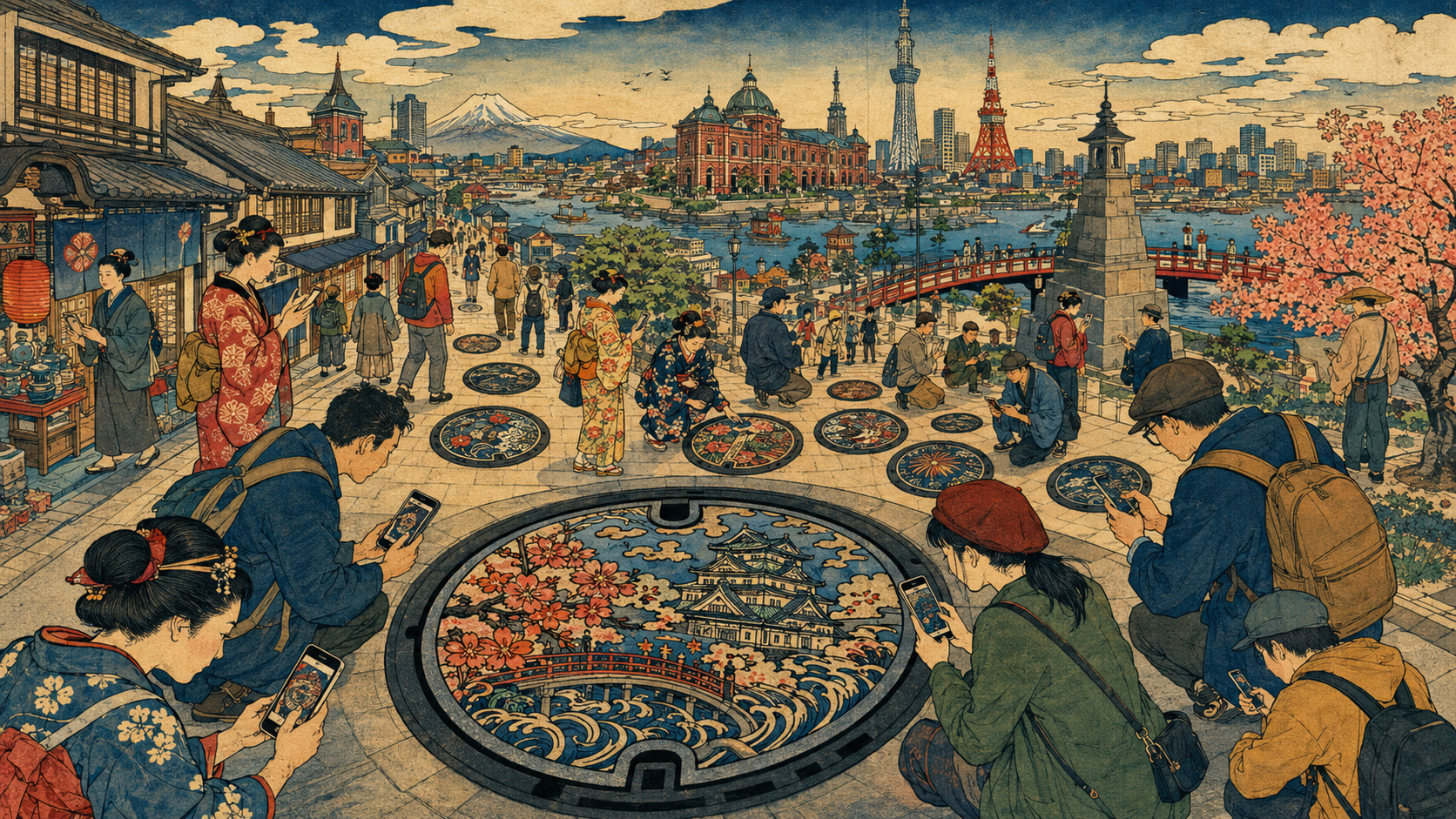
The Tokyo Design Manhole Digital Rally 2026 runs through March 31, 2027; prize applications close January 31. A participant opens the website on a smartphone, checks in by GPS and receives stamps and points. Fifty points can enter a draw for one of 50 merchandise sets, 30 for one of 200 manhole cushions, and six for one of 1,000 desk calendars.
How it works—and what the numbers mean
| Feature | 2026 edition | Qualification |
|---|---|---|
| Dates | July 10, 2026–March 31, 2027 | Prize deadline is January 31 |
| Coverage | 62 municipalities; about 100 starting spots | Expansion to roughly 230 |
| Check-in | On-site smartphone GPS | Data, location and browser storage required |
| Fee | Free | Users pay transport and connectivity |
The final figure includes tourist attractions, not 230 manhole covers alone. The English site says roughly 100 spots are planned in each category. Completion is not the obligation. Stopping in residential paths, stepping into traffic or walking while looking at a phone turns playful discovery into a hazard.
A cover is a safety device first
Manholes sit where underground pipes change direction or depth and where lines meet, giving crews access for inspection, cleaning and repair. The street cover must resist pedestrians and vehicles, remain stable, avoid dangerous uplift during storms and resist unauthorized opening. Slip resistance, locking, hinges and the fit with its frame come before illustration.
Round covers are common because a circular disk cannot fall through a same-sized circular opening, rolls for transport and distributes load evenly. Color is one layer on a demanding industrial product. Never open a cover or enter a roadway for a photograph.
Under Tokyo lies a public-health history
The Japan Sewage Works Association dates Tokyo's modern Kanda sewer to 1884, after cholera epidemics sharpened demand for urban sanitation. Japan enacted its old Sewerage Law in 1900. In 1922, Tokyo's Mikawashima plant began operating as the country's first modern sewage-treatment facility.
Clean streets conceal a vast system carrying wastewater and stormwater, treating pollution and protecting rivers and bays. A cover is one of the few pieces citizens encounter daily. That visibility made it unusually powerful as public communication.
From anonymous iron to local pictures
Japan's government-supported Web Japan identifies a 1977 Naha cover as an early designer example: happy fish in water cleaned by sewerage. Colored covers appeared in 1981. As sewer construction expanded in the 1980s, municipalities used flowers, trees, festivals and landmarks to build understanding and soften the image of an expensive, invisible service.
Decoration began as infrastructure advocacy. Later came mascots, anime, manga and sports teams, turning communication into tourism. The clever shift was not abandoning utility, but allowing one necessary object to perform a second civic job.
Sixty-two Tokyos, not one
The metropolis consists of 23 special wards, 26 cities, five towns and eight villages, including mountain and island communities. Covers become pocket-sized regional museums in a common format, letting visitors compare a central avenue, a Tama neighborhood and a distant island.
Licensed characters attract attention but can overwhelm place. Strong designs explain why a figure belongs here by connecting it to a local flower, industry, event or landscape. Pairing covers with attractions encourages visitors to enter a museum or shopping street instead of taking one photograph and leaving.
How Manhole Cards created collectors
The GKP sewer-publicity network and local governments launched Manhole Cards in 2016. Their fronts show a cover and coordinates; backs explain the motif and sewer facts. Distribution generally requires an in-person visit. With the 28th series in April 2026, GKP projected 1,264 designs from 769 municipalities and four organizations, and 23 million cards issued cumulatively.
Cards turn travel into a physical souvenir. A digital rally reduces print inventories, connects a wide area through GPS and allows locations to change. It may also exclude people without smartphones, those unwilling to share location, or users who struggle with data and interfaces. Public programs should preserve paper maps, information desks and exhibitions as alternatives.
What does a GPS rally really collect?
Players collect stamps; organizers design movement. A six-point prize gives casual and less mobile participants an entry, while higher tiers encourage cross-city travel. Varying points by area can disperse visitors away from the center.
Location records can also become personal data. Users should read rules on retention, third-party sharing, cookies and browser storage; private browsing may fail to preserve stamps. Government evaluation should look beyond registrations toward geographic balance, repeat visits and local spillover—using anonymized data.
The complications of public art
Unlike museum objects, street covers face tires, shoes, rain, ultraviolet light and road works. Color wears and covers are replaced. Preservation cannot justify slippery surfaces or keeping a component beyond its safe life.
Popular covers can block residents and shop entrances. Character artwork remains protected intellectual property even when installed in public. A public location does not automatically grant commercial reuse rights.
Five rules for responsible drainspotting
- Plan one walkable district and check attraction opening hours before leaving.
- Stop in a safe place before operating GPS; never walk while watching the screen.
- Stay out of traffic, never open a cover, and keep residential and shop paths clear.
- Read what utility the cover belongs to and why the local motif was chosen.
- Visit nearby museums and businesses so movement becomes learning and local spending.
Reading the city from the ground up
Designer covers are compelling because a necessary object performs two jobs. Below, it is a secure maintenance entrance; above, a neighborhood calling card. Cards and GPS then turn a stationary piece of iron into a medium that moves people.
If visitors consume only the picture, the sewer becomes invisible again. A more meaningful measure of success than prize entries is whether participants wonder why an opening exists there, where rain and wastewater travel, and who maintains the system at night. The treasure is not only on the cover. It is the work keeping the city alive underneath.
Reporting and sources
- Tokyo Metropolitan Government: official 2026 rally announcement
- Tokyo Design Manhole Digital Rally official site
- GKP: Manhole Card series 28 and cumulative figures
- Japan Sewage Works Association: sewer history
- Web Japan: history of designer manhole covers
- Tokyo sewer bureau: design covers and Mikawashima centenary
Dates, locations and prizes reflect Tokyo's July 2026 announcement. Spots will be added progressively; participants should check the official site for current locations and safety information.