Japan’s oldest surviving prose tale looks upward
The Tale of the Bamboo Cutter—Taketori Monogatari—was probably composed in the late ninth or early tenth century by an unknown author. It is commonly described as Japan’s oldest surviving fictional prose narrative. More than a thousand years before rockets, its heroine arrives from another world, grows among humans and is taken back to the Moon by luminous beings.
That makes Princess Kaguya an irresistible companion to a modern Japanese space-industry edition. Yet calling the work “Japan’s first science-fiction story” is an interpretation, not a medieval classification. The tale belongs equally to court satire, wonder narrative, romance, poetry and religious imagination.
The opening every Japanese reader recognizes
The story begins with an old bamboo cutter, Taketori no Okina, working among mountain bamboo. Inside one shining stalk he finds a tiny child, only a few inches tall. He and his wife raise her. Gold begins appearing in other stalks, transforming their poverty, and the child grows to adulthood with supernatural speed.
She is named Nayotake no Kaguya-hime, the radiant princess of the supple bamboo. News of her beauty spreads even though the family tries to shelter her. The luminous bamboo is both cradle and border crossing: another world enters ordinary labour through a plant familiar across Japan.
The celebrated opening’s plain diction is important. Wonder does not arrive in a distant kingdom; it interrupts a working person’s day.
What “oldest” really means
Older Japanese texts survive, including the eighth-century chronicles Kojiki and Nihon Shoki, the poetry anthology Man’yōshū, and Buddhist narrative materials. Taketori Monogatari is called the oldest surviving monogatari-style fictional prose tale, not the first words or narrative ever written in Japan.
Its exact date and author remain uncertain. Later copies preserve a text whose earliest physical manuscripts are much younger than the presumed composition. Scholars infer age from language, historical allusions and references in other Heian works.
By the early eleventh century it was already canonical. The Tale of Genji famously treats the bamboo-cutter story as a foundational ancestor of tales.
Heian Japan and the birth of monogatari
The Heian period, conventionally dated 794–1185, saw the court centered at Heian-kyō, modern Kyoto. Chinese writing, Buddhism and continental learning carried enormous prestige, while phonetic kana enabled new forms of Japanese prose and poetry.
Monogatari means the telling of things: narrative shaped by reported events, poems, gossip, fantasy and social observation. The genre would grow into court romances, travel tales and the extraordinary psychological world of Genji.
Taketori stands near that beginning. Its compact structure already joins prose with waka poems, worldly comedy with supernatural departure, and private emotion with court politics.
Five suitors and five impossible objects
Five high-ranking men seek Kaguya’s hand. Rather than accept the marriage market imposed upon her, she asks each to retrieve an impossible treasure: the Buddha’s stone begging bowl; a jeweled branch from the immortal island of Hōrai; a robe made from the fire-rat; a jewel from a dragon’s neck; and a cowry born from a swallow.
The objects map an imagined world reaching toward India, China, Daoist immortals, dragons and maritime trade. They also expose the suitors. Some fabricate evidence, outsource danger or purchase frauds; others retreat when actual risk appears.
The episodes are comic adventure and sharp social criticism. Rank, wealth and masculine performance cannot compel Kaguya’s consent.
A heroine who refuses the available endings
Kaguya does not select the least objectionable suitor. She designs tests that reveal the entire competition as false. When the Emperor later approaches, she refuses him too, although their exchange of letters develops tenderness.
Modern readers often see unusual female agency. That reading is productive, but her freedom is also paradoxical. She can resist earthly men because she does not fully belong to earthly society; in the end, the Moon’s command overrides her own attachments.
The story offers no simple liberation. Kaguya escapes marriage but cannot choose to remain with the parents she loves.
The Moon before astronomy
Heian readers did not imagine the Moon through spacecraft photography. It was a calendar, poetic object, religious symbol and distant luminous realm. Court culture cultivated moon viewing; waka used moonlight to express autumn, separation, clarity and longing.
Continental traditions mattered. Chinese stories of Chang’e linked the Moon with immortality and an elixir; Daoist islands and feathered celestial beings circulated through literature and art. Buddhist cosmology supplied multiple worlds, karmic consequence and release from attachment.
Taketori does not simply copy one source. It makes an original Japanese narrative machine from shared East Asian materials.
Her tears change the story’s scale
As the full Moon appears, Kaguya begins to weep. She eventually reveals that she came from the lunar capital and must return on the fifteenth night of the eighth month. Her earthly life may be connected to punishment, though the text leaves the cause tantalizingly incomplete.
The comic quest tale becomes a story of foster parenthood, migration and impending loss. The old couple’s wealth cannot purchase one more day. The Emperor’s authority cannot close the sky.
This shift is one reason the work survives. Its fantasy is not an escape from human feeling; fantasy creates the conditions for grief.
The descent from the Moon
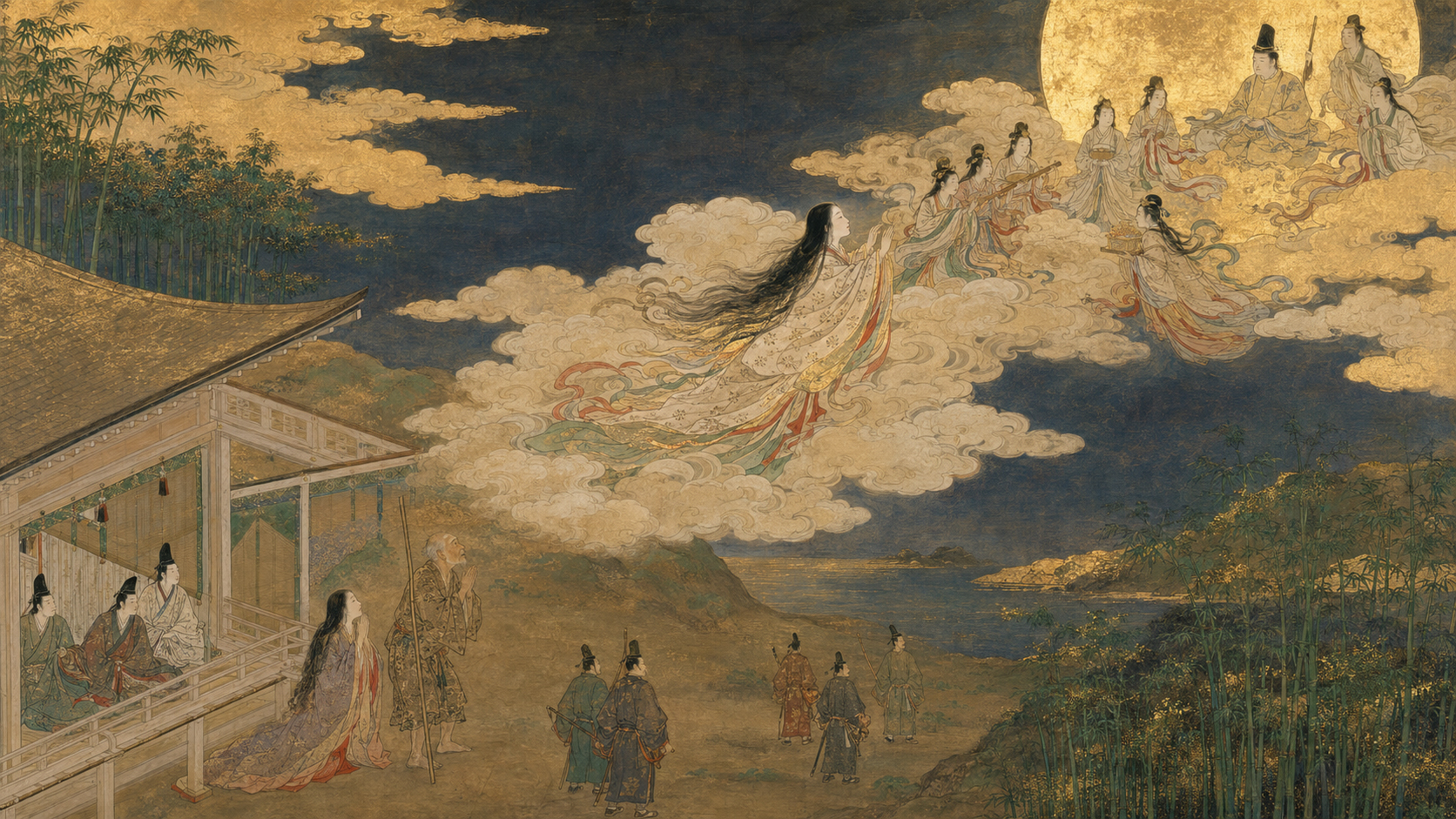
The Emperor sends soldiers to guard the house. They occupy roofs and prepare bows, treating the event as a security problem. At midnight the surroundings become brighter than day. The lunar delegation descends on clouds, and earthly defenses lose their power.
The scene can look remarkably like an arrival from space to modern eyes: intense light, airborne visitors, technological or magical superiority and extraction of a nonhuman person. But the text describes celestial beings and a heavenly vehicle within premodern cosmology, not aliens in a scientific universe.
Its ambiguity is the source of later reinvention. Each age can decide whether it sees angels, immortals, invaders or astronauts.
The feather robe and the erasure of attachment
Before departure, Kaguya writes farewell letters and leaves part of the elixir of immortality. Then a celestial feather robe is placed on her shoulders. Once she wears it, earthly sorrow and attachment vanish.
The moment is beautiful and frightening. Immortality appears not as an uncomplicated gift but as freedom from the very bonds that make a human life meaningful. Her parents retain grief; Kaguya is removed from it.
Modern adaptations often dwell here because the robe can be read as enlightenment, coercion, memory loss or the cold perfection of an advanced world.
The Emperor refuses immortality
Kaguya sends the Emperor a letter and elixir. Unable to see value in endless life without her, he orders both burned on the mountain closest to heaven. The tale associates the smoke with Mount Fuji and plays with words connected to immortality and abundant warriors.
The etymology is literary rather than a reliable modern account of Fuji’s name. Yet the ending joins lunar absence to Japan’s most famous mountain. A vertical chain runs from bamboo root to mountain summit to Moon.
The Emperor’s refusal completes the tale’s argument: mortality with attachment may be worth more than eternal life without feeling.
Is it science fiction?
If science fiction requires modern science, technological explanation and a post-Enlightenment genre system, the label is anachronistic. Taketori explains lunar travel through celestial power, not physics.
If the category includes speculative encounters with nonhuman worlds, strange vehicles, altered memory, impossible materials and a visitor returned to her home planet, the resemblance is exciting. Scholars and readers can use “proto–science fiction” as a comparative lens as long as it does not replace the work’s historical categories.
The intellectually honest answer is double: no, the author did not write science fiction; yes, the story gives modern space culture an extraordinarily early ancestor.
Impossible treasures as a technology test
Each suitor fails not only morally but epistemically. He cannot distinguish authentic sacred or exotic technology from a fake. Claims are tested: the fire-rat robe is placed in flame; craftsmen reveal a manufactured jeweled branch; danger exposes boasts.
The tale repeatedly asks how one verifies an object from beyond ordinary experience. Provenance, material test, witness and performance matter. That makes the episodes unexpectedly congenial to scientific thinking, even though their world is magical.
Kaguya is the most difficult object of knowledge. Everyone sees her radiance, but no earthly institution can fully classify or possess her.
From manuscript to picture scroll
The story has circulated through manuscripts, illustrated handscrolls, picture books, prints, theater, school texts, film, manga and animation. No Heian-period illustrated original survives; later artists imagined Heian interiors and lunar processions through the visual language of their own eras.
Yamato-e narrative painting uses Japanese subjects, strong colour, rhythmic landscape and devices such as cloud bands to divide time and space. Emaki unrolls gradually, so revelation is controlled by the viewer’s hand.
For today’s illustration, luminous clouds are not decoration alone. They are a traditional visual technology for crossing from bamboo grove to courtly house to Moon.
Kaguya in modern film
A 1935 Princess Kaguya film involved the young special-effects artist Eiji Tsuburaya, later central to Godzilla and Ultraman. Miniatures, multiple exposure and luminous effects turned the ancient tale into an early laboratory for Japanese screen fantasy.
Kon Ichikawa’s 1987 film leaned into spectacular lunar visitation. Isao Takahata’s 2013 Studio Ghibli film The Tale of the Princess Kaguya returned to hand-drawn movement, social constraint and devastating parental grief.
The adaptations reveal the tale’s range: it can become effects cinema, space encounter, feminist tragedy, ecological memory or intimate family story.
JAXA sends KAGUYA to the Moon
Japan’s SELENE lunar explorer, launched in 2007, received the public nickname KAGUYA. The mission used a main orbiter and two smaller relay satellites to study lunar composition, topography, gravity and plasma environment.
Its high-definition images of Earth rising and setting over the lunar horizon created a modern reversal. In the tale, Earth watches Kaguya disappear toward the Moon; through the spacecraft named for her, Japan looked back from lunar orbit at Earth.
The name made cultural memory part of engineering communication. It told the public that lunar exploration was not foreign to Japan’s imagination.
Why the story belongs in a space-industry edition
Space industries need rockets, satellites, capital and regulation. They also need stories that explain why distant worlds matter. Cultural names give missions public identity, while ancient narratives supply metaphors for arrival, departure, immortality and the limits of power.
Kaguya also warns against easy triumphalism. The Moon’s people possess overwhelming capability, yet their perfection costs memory and attachment. The Earth is poor, temporary and emotionally unbearable—and still worth loving.
That is a profound counterweight to language about conquering or commercializing space.
How to read the art choice
| Visual element | Traditional meaning | Modern resonance |
|---|---|---|
| Glowing bamboo | Miraculous birth and hidden value | Arrival capsule or portal |
| Gold cloud bands | Separate scenes, times and realms | Atmosphere and transit |
| Full Moon | Season, longing and celestial home | Destination world |
| Ascending Kaguya | Return beyond earthly authority | Launch and departure |
| Figures below | Attachment and grief | The human cost of exploration |
The tale’s enduring question
The suitors want possession, the Emperor wants authority, the lunar delegation wants return, and the parents want time. None receives exactly what they seek. Kaguya herself is divided between origin and affection.
That tension makes the work more than a charming folktale and more than a clever candidate for “first space story.” It asks whether a perfect, immortal realm is desirable if entering it requires forgetting love.
More than a millennium later, as Japan builds machines to reach, map and work around the Moon, Princess Kaguya still poses the essential question: what part of being human should travel with us?
Sources and further reading
- National Diet Library Digital Collections — historical editions and illustrated materials for Taketori Monogatari.
- University of Virginia Japanese Text Initiative — electronic Japanese text.
- Donald Keene, “The Tale of the Bamboo Cutter,” Monumenta Nipponica 11:4 (1956) — influential English translation and scholarship.
- Donald Keene, Seeds in the Heart — history of early Japanese literature.
- JAXA KAGUYA (SELENE) — lunar mission, instruments and results.
- Metropolitan Museum of Art collection search — later visual traditions of Princess Kaguya.
- Studio Ghibli, The Tale of the Princess Kaguya — modern animated adaptation.
- Haruo Shirane, ed., Traditional Japanese Literature: An Anthology, Beginnings to 1600 — literary and historical context.