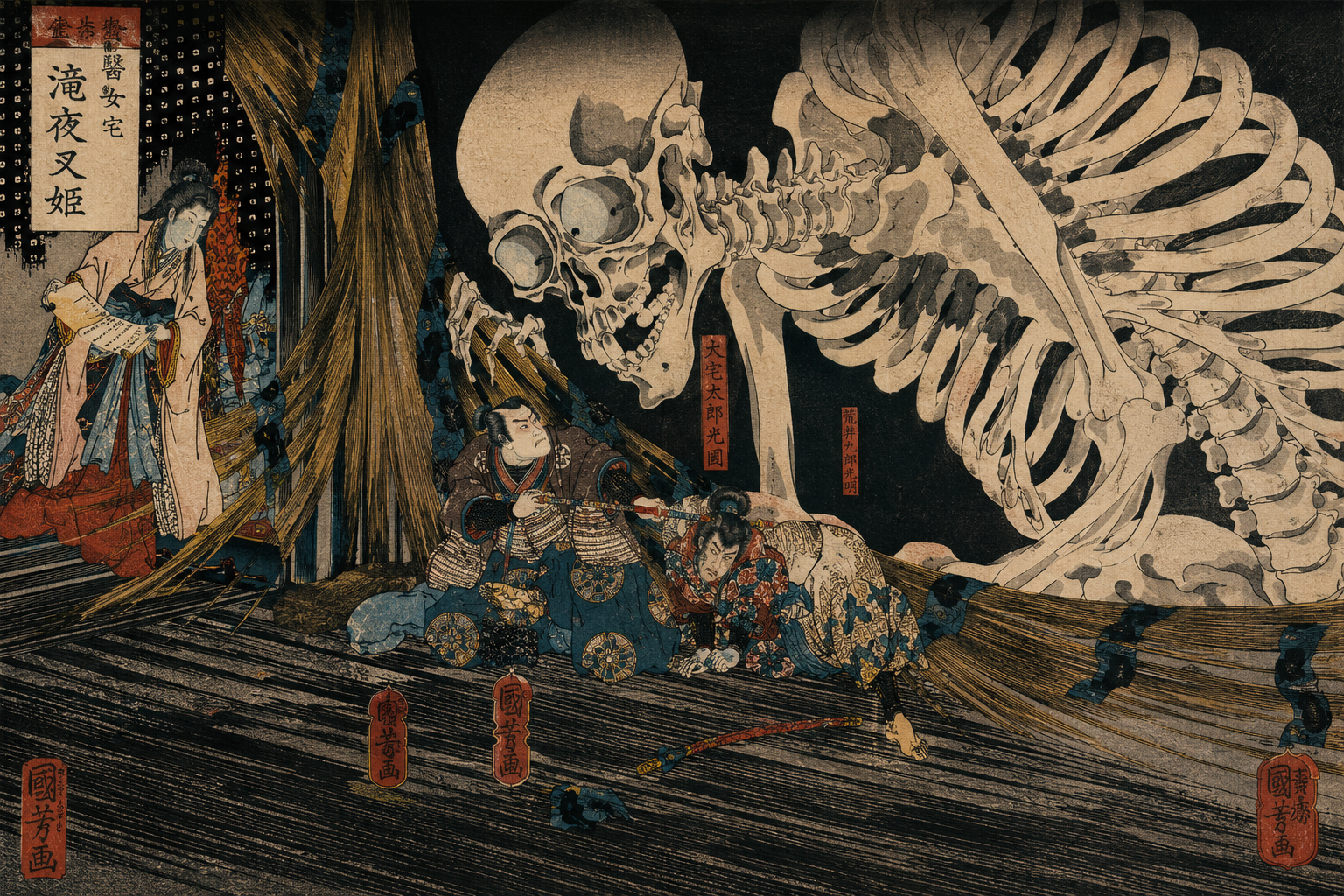
One skeleton across three sheets
The first encounter is almost always the skull. It does not fit inside one sheet. Ribs and spine spread across the right half, while a hand reaches toward the central struggle. The humans look small because death has been given the scale of architecture.
Kuniyoshi used an ōban triptych—three large color woodblock sheets placed side by side. Each is about 37 by 25 centimeters, creating a combined width of roughly 75 centimeters.
Triptychs often provided space for battles, festivals or actor groups. Kuniyoshi gave almost the entire field to one supernatural body.
What is happening?
The setting is the ruined palace of Taira no Masakado at Soma. At left, Princess Takiyasha holds a scroll and performs sorcery. In the center, Masakado’s henchman Araimaru struggles with the imperial warrior Ōya Tarō Mitsukuni.
Takiyasha summons the skeleton to frighten and destroy the intruder. Mitsukuni does not flee; he subdues the henchman while confronting the apparition.
Three narratives coexist: a daughter’s revenge, a loyal warrior’s mission and the dead returning to history.
Who was Taira no Masakado?
Masakado was a 10th-century warrior who built power in eastern Japan. In 939 he attacked provincial offices and was said to proclaim himself a “new emperor.” He was defeated and killed.
Official history remembered a rebel. Eastern traditions could remember a hero, an unjustly destroyed leader or a powerful vengeful spirit. Tokyo’s Masakado mound remains a place treated with respect.
Rebel, local champion, ghost and deity coexist in one historical figure.
Was Princess Takiyasha real?
Masakado may have had daughters, but the sorceress Takiyasha belongs primarily to later fiction. She is a legendary figure created and expanded by novels, theater and prints.
After her father’s defeat, she hides in the ruined palace and tries to restore his cause through magic.
She can be read as villain, witch, loyal daughter, tragic survivor and inheritor of rebellion.
The literary source: Santō Kyōden
Kuniyoshi’s scene derives from Santō Kyōden’s 1806 yomihon, commonly translated as The Tale of Utō Yasutaka’s Loyalty.
Yomihon were long prose narratives combining history, loyalty, karmic consequence and the supernatural. Kyōden was a major writer and illustrator in Edo commercial publishing.
Kuniyoshi did not merely illustrate a page. He selected the story’s strongest instant and rebuilt it as a triptych spectacle.
Why one skeleton instead of many?
Earlier visual versions reportedly showed Takiyasha summoning numerous small skeletons. Kuniyoshi fused them into one giant.
Many skeletal soldiers can be fought individually. A single embodiment of death cannot be handled by ordinary combat.
The change turns a supernatural attack into a universal image of mortality.
| Element | Historical or literary role | Kuniyoshi’s transformation |
|---|---|---|
| Masakado | 10th-century rebel, eastern hero and vengeful spirit | Absent physically, but controls the ruin and haunting |
| Takiyasha | Fictional sorceress daughter | Quiet figure at left who activates the entire image |
| Mitsukuni | Imperial agent and loyal warrior | Body that refuses to collapse before the supernatural |
| Skeleton | Summoned spirit and accumulated dead | One colossal anatomy occupying all three sheets |
| Ruined palace | Site of Masakado’s destroyed power | Torn blinds, beams and darkness become a haunted stage |
Is the skeleton anatomically correct?
The skull, ribs, vertebrae, shoulder blade and arm bones are unusually specific for a supernatural print, though not fully accurate by modern medical standards.
Late Edo culture had increasing access to Dutch-learning medicine, anatomical images and displayed skeletons. Kuniyoshi may have drawn directly or indirectly from such visual knowledge.
Persuasion mattered more than precision. The recognizable connections make the monster feel like an extension of an actual human body.
A skull becomes a face
Human perception searches for faces. A skeleton lacks skin and muscles, yet eye sockets, nose cavity and teeth create an unmistakable expression.
Kuniyoshi tilts the skull, opens the jaw and directs the sockets toward the warriors.
Because no true emotion exists, viewers project hunger, anger or laughter into the bones.
Why is Takiyasha so calm?
The monster seems to roar and the men collide, but Takiyasha remains controlled, looking toward her scroll.
Her stillness makes the event more frightening. The skeleton is not an accident or uncontrolled emotion; it is a deliberate result of knowledge.
She is physically small yet compositionally sovereign.
The seams behave like cinematic cuts
A triptych contains physical borders. Kuniyoshi uses them as transitions rather than obstacles.
Left is the operator, center the struggle, right the apparition. The eye can travel from spell to monster or from skull back to its source.
In manga terms, three large panels join into a spread while the skeleton violates the frame.
Kuniyoshi, master of warrior prints
Utagawa Kuniyoshi was born in Edo in 1797 or 1798 and trained under Utagawa Toyokuni. His breakthrough came in the late 1820s with muscular heroes from the Chinese novel Water Margin.
He became known for warriors, tattoos, ghosts, giant animals, explosions, supernatural feats and violent waves.
The British Museum places him beside Kunisada and Hiroshige as one of the principal late-Edo ukiyo-e artists, distinguished by bizarre and comic invention.
From commercial struggle to monster master
Kuniyoshi did not succeed immediately. Actor and beauty prints were crowded fields, and he endured periods of difficulty.
The Water Margin hero series changed his career. Edo audiences embraced its rebellious, tattooed champions.
That success encouraged his fusion of history with dreams, ghosts and impossible scale.
Tenpō censorship and hidden politics
The Tenpō Reforms of 1841–43 restricted luxury and urban entertainment, including actor and courtesan prints. Artists and publishers shifted toward history, allegory and comic disguise.
Modern viewers sometimes read political criticism into Kuniyoshi’s ghosts and historical rebels. A defeated rebel’s daughter raising the dead against an official warrior could have carried provocative resonance.
There is no conclusive proof that the print was designed as explicit anti-shogunate propaganda. Its power comes partly from allowing entertainment and political implication to overlap.
The artist did not work alone
Ukiyo-e was collaborative. Kuniyoshi supplied the design, a publisher financed and marketed it, block cutters carved separate colors, and printers aligned them on paper.
A triptych demanded precise continuity. Ribs crossing sheet borders had to meet correctly.
Kuniyoshi’s imagination became physical through Edo’s division of publishing labor.
Why the night is not simply black
The darkness contains torn blinds, beams, flooring and patterned clothing. Night is built from barely visible information.
The skeleton’s pale body rises through paper tone and restrained color. Red, indigo and earth colors keep the human world alive below.
By limiting color, Kuniyoshi makes bone function as the image’s light source.
The work has more than one title
Japanese catalogues often use the long title Princess Takiyasha at the Old Palace of Soma. English museums use titles including Takiyasha the Witch and the Skeleton Spectre and Mitsukuni Defying the Skeleton Spectre.
Ukiyo-e titles can derive from inscriptions, later catalogues and translation rather than one fixed artist-assigned title.
Different titles also change the protagonist: Takiyasha, Mitsukuni or the skeleton itself.
- Begin with the skull and follow the ribs across the sheet boundaries.
- Study the physical knot formed by Mitsukuni and Araimaru.
- Move left to Takiyasha’s still gaze and scroll.
- Use the torn blinds and floor lines to reconstruct the ruined room.
- Ask whether the skeleton advances toward us or peers from a deeper darkness.
Why it feels like modern horror and manga
A giant face, extreme perspective, diagonal flooring, falling bodies and anatomy that exceeds the frame are familiar in movie posters and manga spreads.
Kuniyoshi knew no cinema, but he mastered mass visual storytelling: immediate legibility, escalating scale and directed eye movement.
The image feels manga-like partly because later Japanese visual culture inherited ukiyo-e’s exaggeration and cutting.
Influence moved both directions
Ukiyo-e later influenced European Impressionism and poster design through bold outline, flat color and asymmetry.
Kuniyoshi himself absorbed Western engravings, perspective and anatomical imagery. Ukiyo-e was not a sealed “pure Japanese” style but an urban medium capable of digesting imported images.
The giant skeleton can be read as Japanese ghost narrative meeting global anatomical vision.
Takiyasha is more than a wicked woman
Modern games, manga and anime reinterpret Takiyasha as witch, avenger, priestess and inheritor of rebellion.
From the imperial perspective she is a criminal. From the destroyed family’s perspective, her sorcery is a form of loyalty.
Kuniyoshi does not make her grotesque. She is beautiful, controlled and intellectually powerful.
Whose dead does the skeleton represent?
Within the story it is a summoned spectre. Visually it can also become the accumulated memory of Masakado’s defeated cause.
Official history ends with rebellion defeated and order restored. Ghost stories allow the defeated to return.
The skeleton is the size of memory that history failed to bury.
Why this is today’s choice
Japan.co.jp’s July 12, 2026 edition gathers yokai, uncanny dolls, robot wolves, kaiju and strange machines under the theme of “Strange Japan.”
Kuniyoshi’s triptych anticipates the whole edition: history and entertainment, fear and humor, tradition and technology, death and merchandise.
Its survival is not due to shock alone. The composition remains powerful, the narrative allows competing loyalties and the protagonist changes each time we look.
Takiyasha opens the scroll. Mitsukuni stands his ground. The skeleton crosses three sheets. In that moment, an Edo woodblock print stops being an old artifact and becomes a visual machine still operating today.
Sources and further reading
- British Museum: triptych format and the scene at Masakado’s ruined Soma palace.
- British Museum, alternate impression: Japanese title, Kōka era and Kuniyoshi attribution.
- Google Arts & Culture / British Museum: 1844 date and approximate sheet dimensions.
- Japan Past & Present: Santō Kyōden’s novel, Masakado and Takiyasha’s literary history.
- Sainsbury Institute: historical, religious, anatomical and political readings.
- British Museum, Utagawa Kuniyoshi biography: warrior prints, comic subjects and late-Edo innovation.
- Brooklyn Museum, Utagawa: the school’s dominance of nineteenth-century print culture.
- Metropolitan Museum of Art: Kuniyoshi’s ghost and warrior triptychs in Japanese art history.