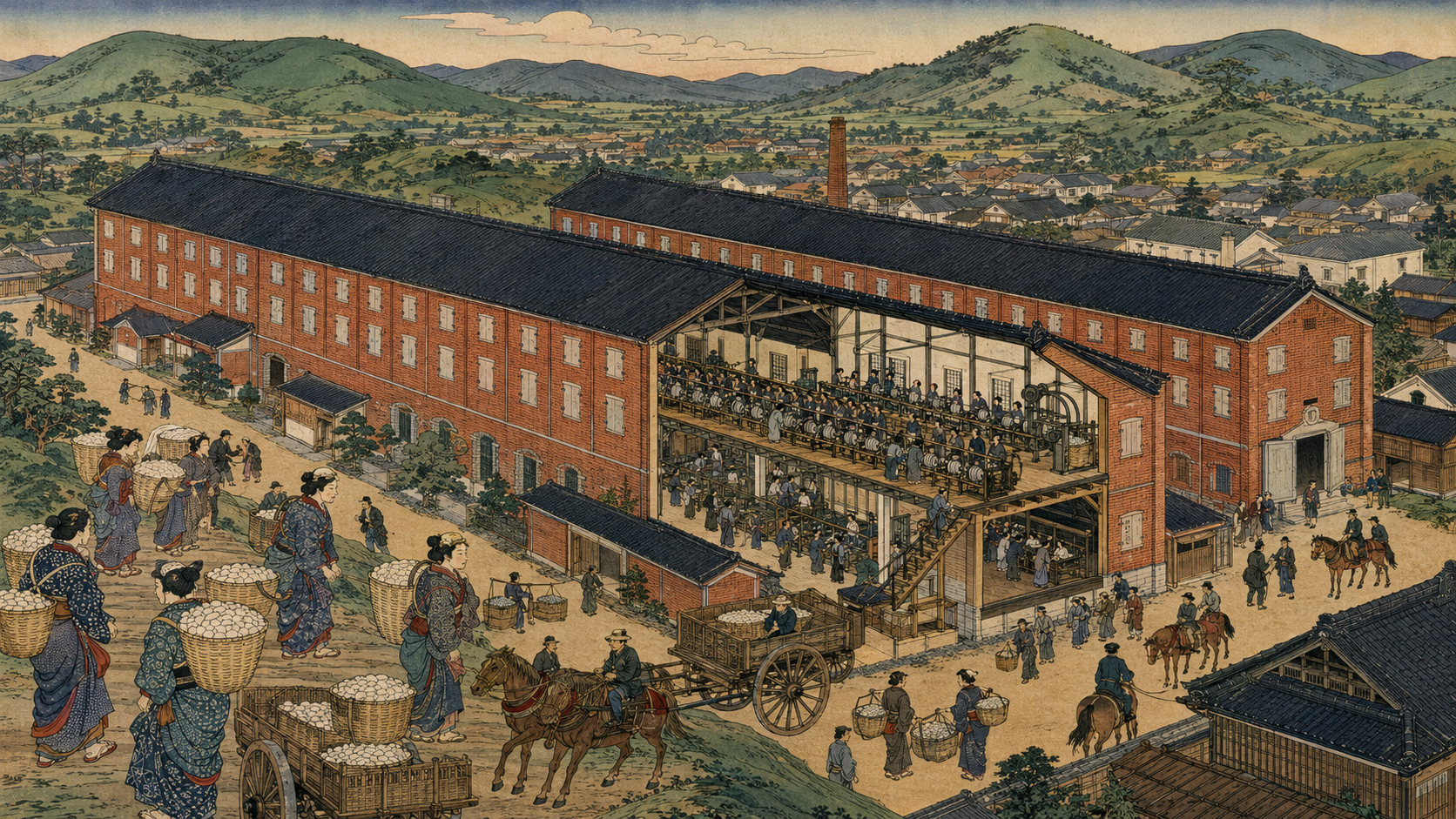
At first glance, Kuniteru II’s Tomioka Silk Mill in Kōzuke Province looks like an advertisement for progress. Across three sheets, red-brick buildings stretch into the distance. Chimneys, pipes and a steam engine promise disciplined power. Inside the long reeling room, women sit in repeated ranks before imported machines. The viewpoint rises impossibly above walls and roofs so that the whole industrial system can be understood at once.
The work: three sheets of industrial wonder
The print is generally catalogued as an 1873 color woodblock triptych by Utagawa Kuniteru II (1830–1874), published by Daikokuya Heikichi. Its Japanese title, Jōshū Tomioka seishijō no zu, means “Picture of the Tomioka Silk Mill in Jōshū,” using an old name for Kōzuke Province, now Gunma Prefecture. Each large ōban sheet is roughly 34 by 24 centimeters; joined together, they create a broad news-like panorama.
A triptych was ideal for spectacle. The publisher could sell three standard sheets while the artist could build a cinematic field wider than a single block. Kuniteru combines oblique perspective, cutaway architecture and bird’s-eye mapping. We can see the mill’s exterior, its power system and its laboring interior in one glance—something no person standing at Tomioka could actually see.
Who was Kuniteru II?
“Kuniteru” is not a simple modern surname. It is an art name carried by more than one artist in the Utagawa school, so museum and market records sometimes require care. The maker associated with this print is conventionally called Kuniteru II, also known as Yamada Kuniteru. Active during the collapse of the Tokugawa order and the first Meiji years, he designed actor prints, scenes of city life, railways, Western buildings and other signs of a society in motion.
That range matters. Ukiyo-e artists were commercial image workers, not isolated studio painters. Publishers selected subjects, block carvers translated drawings into cherrywood, printers registered successive colors, and shops distributed the finished sheets. The system was collaborative, fast and reproducible. A print about mechanized silk production was itself produced through a sophisticated division of labor.
Why Tomioka existed
After the ports opened in the 1850s, raw silk became one of Japan’s most valuable exports. Demand brought foreign currency, but uneven quality damaged confidence. The new Meiji government wanted a model plant that could standardize thread, demonstrate machinery and train workers who would carry techniques to private mills.
French silk inspector Paul Brunat planned the factory. Construction began in 1871, and operation started in 1872. Tomioka was chosen inside a major cocoon-producing region, with water, fuel and land available. French reeling equipment and advisers met Japanese timber framing, local brickmaking and climatic adaptation. The mill’s roughly 140-meter reeling building held 300 basins, making it one of the world’s largest mechanized silk-reeling plants of its day.
How the picture teaches machinery
Kuniteru does not offer an engineering diagram. He creates intelligibility through repetition. Rows of roof windows echo rows of workers; belts, wheels and vessels form a chain; bright brick walls separate stages of work. The high viewpoint gives the viewer managerial vision—the fantasy that a complex institution can be surveyed, ordered and controlled.
The print’s brilliant reds and blues belong to the visual culture of early-Meiji “civilization and enlightenment.” Kaika-e, or enlightenment pictures, made locomotives, gas lamps, foreign dress and brick architecture exciting consumer subjects. They did not merely document modernization after it happened. By circulating attractive images of novelty, they helped create an audience for it.
The women inside the modernity story
The most consequential figures are also the smallest. Women recruited from across Japan worked as trainee reelers, learning to draw fine filaments from heated cocoons and combine them into consistent raw silk. Many later returned home and spread technical knowledge. Official history therefore remembers Tomioka as both factory and school.
Yet the orderly rows can conceal as much as they reveal. Silk depended on women’s skilled attention at the machine and on farm households raising silkworms, gathering mulberry leaves and protecting cocoons. Later Japanese mill labor could be harsh, regimented and unhealthy; Tomioka’s early model conditions should not be used to romanticize the entire industry. The print turns workers into a repeating unit of national progress. A modern viewer should restore their agency, bodies and knowledge to the foreground.
From national project to private industry
French advisers departed by 1876, after which Japanese staff operated the mill. The government sold it to private ownership in 1893. It passed through Mitsui and Hara interests and later Katakura, continuing production until 1987. Katakura preserved the buildings rather than demolishing them. Tomioka City took ownership in 2005.
UNESCO inscribed “Tomioka Silk Mill and Related Sites” in 2014. The four-part property is important because it links the production system: Tomioka’s mill, the Tajima Yahei Sericulture Farm, the Takayama-sha Sericulture School and the Arafune Cold Storage. Together they show that industrialization was not one heroic factory but a network of eggs, worms, cocoons, experiment, education, machinery and global trade.
What Kuniteru leaves outside the frame
Industrial images invite questions about omission. The print does not show failed thread, noise, heat, fatigue, procurement disputes or the government’s financial risk. Nor does it trace the silk onward to Yokohama and foreign textile markets. Its purpose is synthetic and affirmative: architecture, technology and disciplined labor appear harmoniously aligned.
That does not make the work false or useless. It makes it a source to read critically. Historical images tell us both what existed and what contemporaries wanted viewers to believe. Kuniteru’s impossible perspective is evidence of aspiration: the nation imagined that industry could be made visible, teachable and reproducible.
Why this is today’s art choice
Japan.co.jp selected Kuniteru’s Tomioka language for today’s illustrations because many of July 14’s stories concern small manufacturers, AI in factories, regional succession, food technology and local reinvention. The historical print knows how to hold machines and people in the same frame. Its crowded clarity is warmer than a technical schematic and more analytical than generic corporate photography.
But “in the style of” requires honesty. Today’s image is newly generated editorial art, not a Kuniteru print, restoration or undiscovered historical object. It borrows compositional ideas—triptych breadth, elevated viewpoint, saturated color, repeated workers and explanatory architecture—without claiming the authority of the original. Readers should be able to enjoy the visual echo while knowing where history ends and interpretation begins.
A five-step way to look
- Scan the whole: notice how the three sheets turn a factory into a single system.
- Follow the power: trace steam, shafts and repeated machines rather than treating the building as scenery.
- Count the people: ask why labor is numerous but individuality is reduced.
- Test the viewpoint: identify what could never be seen from one physical position.
- Read the omissions: imagine the farms, export routes, bodily effort and environmental costs beyond the frame.
The old medium was part of the new world
It is tempting to oppose “traditional woodblock” and “modern factory.” Kuniteru’s print dissolves that easy contrast. Woodblock publishing was already urban, specialized, commercial and capable of rapid reproduction. The factory introduced a different scale and energy regime, but the image explaining it came from an established information industry.
That is the print’s lasting lesson. Modernization does not arrive as a clean replacement of old by new. Imported machines are rebuilt for local bodies and climate; timber frames hold brick walls; women transmit technical knowledge; a centuries-old print technology advertises steam power. Kuniteru made contradiction look coherent. Our task is to admire that achievement without mistaking coherence for the whole truth.
Reporting and sources
- Tomioka Silk Mill: official historical overview
- Tomioka Silk Mill: buildings and machinery
- UNESCO: Tomioka Silk Mill and Related Sites
- Gunma World Heritage Office: Tomioka Silk Mill
- Japanese Gallery: Kuniteru II triptych catalogue record
- SOAS: Envisioning Meiji Modernity: kaika-e
Editorial note: the hero is a contemporary Japan.co.jp illustration inspired by the visual grammar of Kuniteru II’s 1873 work. It should not be represented as the original print.