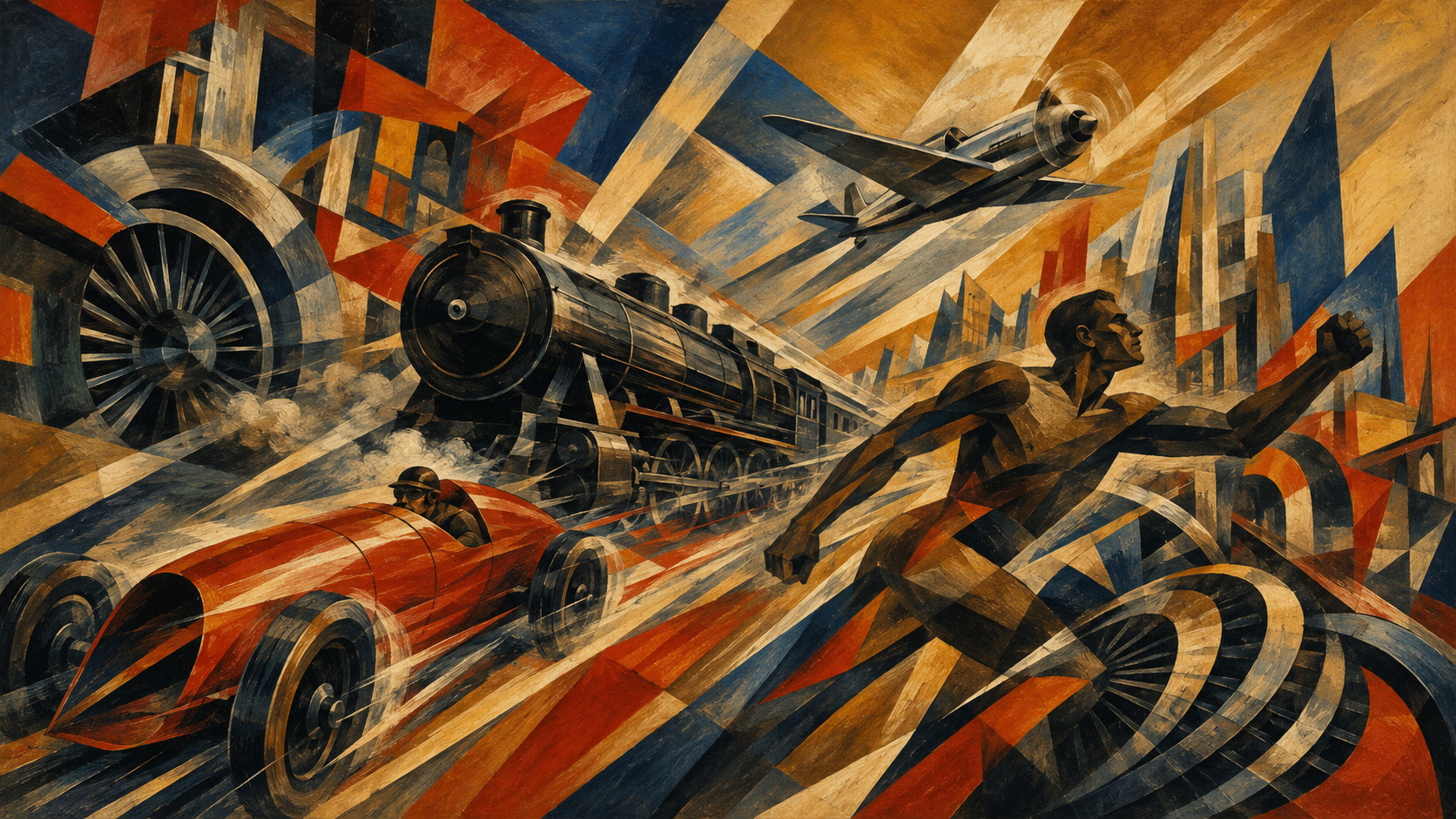
Why this style fits this edition
A bond selloff is invisible until numbers move. A tanker is massive but slow, while the market around its cargo moves in milliseconds. A startup exists between prototype and promised future. Italian Futurism gives all three a common grammar: diagonals, repeated forms, compressed viewpoints, radiating lines, sharp color and a frame that seems unable to contain its subject.
That grammar turns systems into felt pressure. A yield curve can become an ascending wedge. Currency volatility can break the picture plane. A tanker’s bow can project force through sea, refinery, pipeline and city. Founders can appear not as static portraits but as bodies caught in networks of capital, code and expectation.
Before the style: a manifesto manufactured an audience
Filippo Tommaso Marinetti’s founding manifesto appeared in 1909 and gained international force through publication in the Paris newspaper Le Figaro. This was itself a media strategy. Futurism did not wait for critics to classify a body of paintings; it announced a brand, enemies, slogans and a future before the visual language was fully settled.
The text attacked inherited authority and praised youth, velocity, the automobile, industrial cities, danger and aggressive rupture. It also glorified war and voiced contempt for women. Museums and libraries were cast as obstacles to life. The contradictions were present from the beginning: a movement demanding liberation imagined it through exclusion and destruction.
Manifestos are technologies of acceleration. They simplify differences among participants, turn argument into publicity and create a deadline called “now.” Contemporary startup launches, campaign platforms and brand decks still use the form: declare an obsolete world, name an inevitable future, invite people to join before evidence is complete.
From declaration to visual method
In 1910, Umberto Boccioni, Carlo Carrà, Luigi Russolo, Giacomo Balla and Gino Severini signed painters’ manifestos. They sought to place the viewer inside modern sensation rather than outside a stable scene. The street enters the room; the body incorporates surrounding space; movement exists as a sequence rather than a frozen pose.
The painters drew from Italian Divisionism, whose separated strokes and colors made light vibrate, and from Cubism’s fragmentation and multiple viewpoints. But Cubism and Futurism are not synonyms. Cubism often asks how an object can be known from several positions; Futurism asks how object, observer and environment become one event in time.
| Device | What it does | Editorial use today |
|---|---|---|
| Diagonal thrust | Destabilizes the horizontal and implies direction. | Market surge, policy pressure, launch or collision. |
| Repeated contour | Shows successive positions at once. | Price ticks, traffic, production cycles, human motion. |
| Force lines | Extends energy beyond the object’s edge. | Capital flow, supply routes, data and political influence. |
| Fragmented planes | Merges subject, setting and observer. | Interdependent systems rather than isolated portraits. |
| Simultaneity | Compresses different moments and places. | Global market reaction and supply-chain consequence. |
| High-contrast color | Converts light and noise into visual intensity. | Urgency, heat and competing signals. |
Boccioni: making the city and body unstable
Boccioni’s The City Rises of 1910—first titled The Work—does not present construction as orderly progress. Workers, horses, buildings, smoke and color strain through one another. Modernization is muscular, collective and difficult to control. That ambiguity makes the painting more useful than simple machine worship.
His 1913 sculpture Unique Forms of Continuity in Space opens a striding figure to the atmosphere around it. The body seems carved by its own passage. The work synthesizes walking rather than recording one instant: legs, air, metal and momentum become a single system.
For editorial art, this is the core lesson. Do not paste speed lines behind an unchanged object. Let the object be transformed by the forces it produces and encounters. A bond market should alter the politician standing inside it. An oil tanker should carry the geometry of ports, insurance, currency and climate, not float as a decorative ship.
Balla, Severini and the measurement of motion
Giacomo Balla studied small movements—the repeated legs of a dog, a girl running on a balcony, swifts crossing the sky, the path of a speeding car. Photography and chronophotography had already divided motion into intervals; Balla returned those intervals to a single luminous surface.
Gino Severini linked Parisian Cubism to Italian Futurism. Dancers, trains and wartime machinery became rhythmic structures. His position between cities reminds us that modernism traveled through exhibitions, magazines, railways, translations and personal networks. “Italian” Futurism was nationalistic in rhetoric but transnational in formation and effect.
Russolo: when the machine entered the ear
Luigi Russolo’s 1913 Art of Noises argued that industrial life had trained modern hearing for a broader sound world. He developed intonarumori, mechanical noise instruments associated with roars, buzzes, crackles and explosions. The project widened the definition of musical material and anticipated later experimental sound practices.
A visual newspaper can learn from this without illustrating sound literally. Layered type, interrupted rhythm, cropped words and repeated shapes can make readers sense alarm, engines or trading-floor chatter. But noise must not destroy comprehension. Editorial design has a civic obligation that a provocation in a gallery may refuse.
Typography became a moving object
Marinetti’s “words-in-freedom” broke conventional syntax and page order. Different weights, scales, directions, mathematical signs and onomatopoeia made reading spatial and performative. The page no longer carried language quietly; it staged impact.
That legacy runs through advertising, comics, concrete poetry, punk graphics, motion design and digital interfaces. Today a headline can tilt, accelerate and collide. Yet accessibility creates a productive limit: semantic text should remain selectable, legible and structured, while expressive movement belongs in illustration or carefully controlled display type.
The first catastrophe: Futurism and World War I
Many Futurists campaigned for Italian intervention in World War I, imagining combat as cleansing modernization. The reality was industrial slaughter. Boccioni volunteered and died in 1916 after a military training accident. Architect Antonio Sant’Elia, whose drawings envisioned cities of lifts, power stations and circulation, was killed in battle the same year.
This is not a side note to the aesthetic. The same compression that makes a train or crowd exhilarating can erase individual suffering. A style that celebrates energy easily turns logistics into destiny and bodies into fuel. Editorial reuse must restore the people whom the original rhetoric reduced to motion.
Futurism and Fascism: neither identical nor separable
Futurism began before Mussolini’s Fascist movement and included artists with divergent politics. It should not be collapsed into a single party label. But neither can the connection be washed away. Marinetti promoted nationalism and intervention, helped organize Futurist political activity, aligned with Fascism and later entered the Royal Academy of Italy under the regime.
Fascism valued discipline, empire and a mythic national rebirth; Futurism valued rupture, machines and permanent novelty. Their relationship included cooperation and tension—Fascist culture could also favor Roman grandeur and conservative order. The overlap was strongest where violence, masculinity, militarism and technological domination were made virtues.
| Responsible statement | Misleading shortcut |
|---|---|
| Futurism had a substantial, documented relationship with Italian Fascism. | Every Futurist work is simply Fascist propaganda. |
| The movement existed before the Fascist regime and contained internal differences. | The politics can be ignored because the forms came first. |
| Marinetti’s political commitments matter to interpretation. | Dynamic diagonals themselves possess one fixed ideology. |
| Contemporary reuse should disclose and critically redirect the history. | A disclaimer automatically neutralizes the imagery. |
Women were present—but equality was not
The founding rhetoric’s misogyny cannot be excused as theatrical excess. Valentine de Saint-Point answered with her 1912 Manifesto of the Futurist Woman, although her own language also engaged the movement’s cult of strength. Benedetta Cappa developed painting, writing, stage design and aeropittura, and other women worked across dance, textiles, ceramics and performance.
Recovering these figures expands the archive but does not retroactively make the movement equal. The lesson for a modern newsroom is direct: do not use a historical style’s heroic male body as the default image of innovation. Show who operates, maintains, finances, cleans, protests and bears risk.
The second Futurism: air, empire and the view from above
After the first generation fractured during World War I, Futurism continued into the 1920s and 1930s. Aeropittura, or aeropainting, used the airplane’s view to twist land, architecture and horizon into vertiginous fields. It extended simultaneity into altitude and celebrated aviation as a new sensorium.
The aerial view is powerful because it makes systems legible: port, refinery, highway and metropolis can share one image. It is also the viewpoint of bombing, surveillance, border control and imperial power. Today’s satellite dashboard inherits the same double condition—knowledge through distance, and distance from consequence.
Japan did not merely copy the future
Futurist ideas reached Japan through translation, magazines, correspondence and exhibitions. Painter and critic Kambara Tai engaged the movement and corresponded with Marinetti. In 1921, poet Hirato Renkichi distributed the first manifesto of the Japanese Futurist movement in Tokyo, turning speed, typography and urban sensation into Japanese poetic material.
The avant-garde group Mavo, formed in 1923 under Murayama Tomoyoshi, absorbed Futurist energy alongside Dada, Constructivism, anarchism and experience from Berlin. Performance, collage, architecture, illustration and magazines attacked the border between art and daily life. Mavo was not an Italian franchise; it was a local recombination.
The Great Kanto Earthquake of 1923 made reconstruction an immediate material and political question. Machines and new buildings could signify liberation, exploitation, disaster response or state control. Japanese artists transformed the imported “future” because their modernity had different institutions, catastrophes and power relations.
| Italian source | Japanese transformation | Why it matters |
|---|---|---|
| Manifesto as publicity weapon | Hirato’s hand-distributed 1921 declaration. | Translation becomes an event in Tokyo’s streets. |
| Machine and city as subjects | Poetry, print, performance and architectural experiment. | Modern life crosses media, not painting alone. |
| Attack on cultural institutions | Mavo’s anti-establishment actions and publications. | Imported form enters local institutional conflict. |
| European international network | Berlin, Russian avant-garde and Japanese debate intersect. | Influence is a network, not a one-way pipeline. |
Why it fits bond markets
Finance is movement without a visible machine. Prices update, yields rise, capital shifts and expectations feed back into policy. Futurist simultaneity can place chart, trader, government bond, household mortgage and currency in the same unstable space. Force lines make causation look contested rather than linear.
The danger is aestheticizing volatility as heroic energy. A yield spike may raise financing costs and alter pensions, public budgets and business investment. The image should include drag, fracture or counterforce. Speed is a distribution mechanism: gains and losses arrive at different people at different times.
Why it fits oil tankers and energy
A tanker embodies industrial scale: curved steel, engines, wake, navigation and global route. Futurist geometry can connect Mexican crude, Japanese refinery, Middle Eastern concentration, yen pricing and energy security in one directional field. The ship becomes a node rather than an isolated object.
But early Futurism often treated fuel and machines as pure emancipation. In 2026, fossil energy also means emissions, spills, stranded assets and climate risk. Responsible art should let smoke, sea, heat and vulnerable coastlines push back against the heroic bow. Diversification is not decarbonization; the composition can teach the distinction.
Why it fits startups—and exposes their rhetoric
Startup culture speaks Futurist fluently: disruption, acceleration, scale, launch, iteration and the death of the old. A pitch deck is a mild manifesto. Networks of founders, investors, code and customers translate naturally into repeated planes and vectors.
The style can celebrate invention, but it can also reveal the coercion inside inevitability. Who performs invisible platform labor? What happens when “move fast” externalizes safety, privacy or environmental cost? Which public research made the private breakthrough possible? A critical Futurist image makes the promised future collide with its maintenance bill.
An editorial grammar for ten images
| Story family | Visual strategy | Critical counterweight |
|---|---|---|
| Bonds and the BOJ | Ascending wedges, repeated numerals, fractured institutional architecture. | Household, pension and public-budget consequences. |
| Oil and energy security | Tanker arc, route vectors, refinery circles, currency pulses. | Emissions, ocean, climate and import dependence. |
| Startups and patents | Prototype fragments assembling into a networked machine. | Failure, labor, public research and unequal access to capital. |
| United Nations and SDGs | Multiple scales and goals in simultaneous orbit. | Friction between targets, implementation and national interest. |
| El Niño | Atmospheric bands, ocean heat and seasonal arrows. | Human vulnerability rather than weather as spectacle. |
| Art and local community | Circulating bodies, food, forests and waterfront space. | Care, slowness, memory and ecological limits. |
How to borrow the language without laundering the politics
First, name the source. “Italian Futurist-inspired” is more honest than presenting the look as neutral geometry. Second, do not copy a specific composition; study devices—simultaneity, repetition, force, typographic rhythm—and build an original editorial argument.
Third, redirect the heroism. Show maintenance beside invention, consequences beside velocity, collective systems beside the lone male machine-body. Fourth, keep readable headlines, alt text and strong contrast. Historical experiment does not excuse contemporary inaccessibility.
Fifth, introduce resistance inside the image. Curves can oppose wedges; human scale can interrupt a monumental tanker; a red market arrow can bend under debt service; heat can distort the machine. Criticism should exist in form, not only in the caption.
How to read today’s artwork
Begin with direction. Which way does the picture push, and what resists? Then find repetition: is it measuring time, multiplying an object or creating crowd pressure? Trace the largest force line to see what the composition claims is causal. Notice where human bodies are enlarged, reduced or absent.
Next separate subject from judgment. A dynamic tanker does not necessarily praise oil; it may reveal the force of dependency. A fractured city may represent excitement or instability. Read the caption and story, then return to the image and ask whether its structure supports the journalism.
Finally inspect what lies outside the frame: emissions after combustion, interest payments after the market close, workers after launch day, maintenance after the festival. Futurism excels at the instant of acceleration. Historical literacy restores the before and after.
The historical meaning today: acceleration has become ordinary
In 1909, the automobile and industrial city could be staged as shocks. In 2026, algorithmic markets, global shipping, real-time weather models and startup platforms make acceleration an operating environment. Futurism no longer predicts our surface appearance; it helps diagnose our governing faith that faster systems are inherently better systems.
That faith is unstable. Finance can transmit panic faster than institutions respond. Tankers secure supply while extending carbon dependence. Startups can diffuse knowledge and concentrate power. Cities gain connection and lose attention. Speed produces access and exclusion together.
Italian Futurism is therefore the strongest choice for this edition because it does not merely decorate its topics. It exposes their common ideology: the promise that motion will solve contradiction. Used critically, its fractured geometry can make readers feel both propulsion and cost.
The artwork’s final lesson should not be “the future is fast.” It should be more demanding: every vector has an author, every machine has a fuel, every launch has a ground crew, and every acceleration leaves someone to manage the momentum.
Sources and further reading
- Museum of Modern Art: Futurism — movement overview and representative works.
- MoMA: Boccioni, Unique Forms of Continuity in Space — motion, body and machine-age form.
- MoMA: Umberto Boccioni — works including The City Rises and States of Mind.
- Guggenheim: Italian Futurism, 1909–1944 — full historical range, media and politics.
- Guggenheim collection: Futurism — movement and collection context.
- Tate: Futurism — concise definition and historical orientation.
- Metropolitan Museum of Art: Italian Futurism — visual methods and historical development.
- Estorick Collection: Futurism — specialist collection of modern Italian art.
- Getty Publications: Futurist manifestos and visual culture — primary texts and scholarly context.
- University of California Press: Gennifer Weisenfeld, MAVO — Japanese artists and the avant-garde, 1905–1931.
- National Museum of Modern Art, Tokyo — Japanese modern-art collections and research context.
- Ohara Museum of Art — Kambara Tai materials and Japanese avant-garde connections.