Begin with the roof
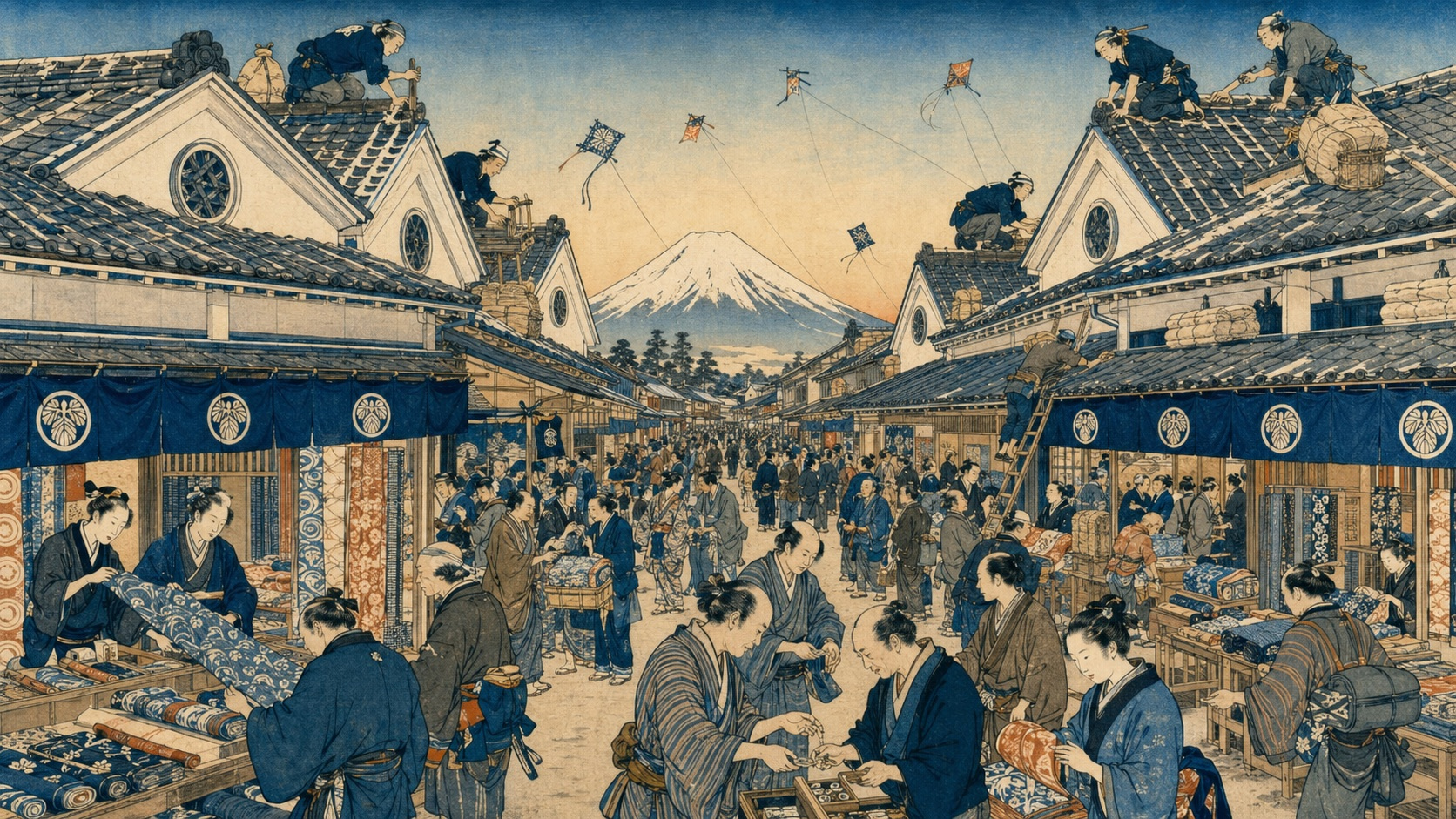
Mount Fuji stands in the center, but it is not the first thing the body feels. Two huge roofs rise from left and right. Hokusai lowers the viewpoint until Surugachō’s street nearly disappears, leaving a valley of architecture open to the sky. Fuji sits precisely in that opening. Nature does not simply dominate the city; the city frames nature.
The Japanese title is Fugaku sanjūrokkei: Kōto Surugachō Mitsui mise ryakuzu (冨嶽三十六景 江都駿河町三井見世略図). Museum translations range from The Mitsui Shop in Surugacho in Edo to A Sketch of the Mitsui Shop. “Kōto” denotes Edo, and “ryakuzu” signals an abbreviated or schematic view. The title itself warns us not to treat the design as a surveyor’s record.
Why Thirty-six Views contains forty-six prints
Hokusai designed the series in his early seventies for the publisher Nishimura Yohachi, whose firm used the name Eijudō. The initial group was thirty-six. Its success apparently led to ten more designs, now commonly called the “rear Fuji” group, bringing the total to forty-six. Beside the Great Wave and Red Fuji, the Surugachō print offers no maritime danger or meteorological drama. It makes the ordinary economy of Edo monumental.
Nor was the sheet the solitary product of Hokusai’s hand. A publisher financed, coordinated and sold it; Hokusai supplied the design; carvers transferred its lines to blocks; printers balanced paper, pigment, moisture and pressure. The key drawing was sacrificed in carving. Every surviving sheet is one performance of a collaborative, repeatable system.
The new blue
The series became famous for indigo and for Berlin blue—Prussian blue, a powerful synthetic pigment then relatively new to Japanese prints. It created saturated water, sky and distance. Surviving impressions of the Mitsui design include versions with green on the workers’ clothing and distant trees, and later blue-dominant states documented by Japanese collections.
A different color on a museum website is therefore not necessarily a bad reproduction. Printing changed from run to run; yellow components may fade and turn former greens blue; photography and screens introduce further shifts. To look closely at ukiyo-e is to look at an image and an object’s biography at the same time.
Surugachō, the street that looked toward Suruga
Surugachō occupied what is now Nihonbashi Muromachi in Chūō, Tokyo. Its name is traditionally linked to the view down the street toward Mount Fuji in Suruga Province. It sat just north of Nihonbashi, at the commercial heart of the shogun’s capital. Hokusai transformed that southwest axis into a stage: Mitsui on both sides, Fuji at the vanishing point.
But this is edited space. Perspective gives depth while Hokusai enlarges roofs, elevates workers, removes most street traffic and makes Fuji the conclusion. The place was real; the composition is an argument about it.
Echigoya’s retail revolution
Mitsui Takatoshi opened the Echigoya textile shop in Edo in 1673 at age fifty-two. In 1683 it moved to the location of today’s Nihonbashi Mitsukoshi. Mitsui’s official histories emphasize two linked innovations: genkin kakene nashi—cash sales without an inflated bargaining price—and cutting cloth in the quantity a customer required.
Elite textile houses commonly visited clients, took orders and extended credit. Collection time and negotiation entered the price. Echigoya accelerated turnover with store sales, cash, stated prices and smaller units, opening luxury textiles to a wider urban market. It is safer to call this a radical reworking of Edo textile practice than to repeat sweeping claims that Mitsui invented fixed prices for the entire world.
The signs in Hokusai’s print announce “cash” and “no markup” across the buildings. Architecture has become media. Yet no established document proves Mitsui commissioned the print. We should call it a portrait of a store already treated as a famous place—and an image that powerfully reinforced a brand—not a paid advertisement unless new evidence appears.
The people working above Fuji
On the right roof, tilers bend, pass materials and continue a repair. They are tiny, but they supply the emotional center. Fuji appears immovable. The commercial buildings look mighty, yet they endure only through maintenance. Corporate longevity depends upon unnamed hands.
Tile roofs belong to Edo’s longer history of fire, regulation and status, although this sheet cannot tell us why that particular work was underway. What it does show is decisive: Hokusai refused to turn successful architecture into a still life. The store is always being made.
A publisher flies his name
Two kites cross the open sky. The character on one is widely interpreted as kotobuki, “longevity,” and as an allusion to Eijudō’s 寿. If so, three identities share the sheet: Echigoya’s signs, Hokusai’s signature and the publisher’s name floating overhead. The publisher is not invisible; he has launched himself into the picture.
Kites evoke New Year play and harmonize with snowcapped Fuji, although they cannot conclusively date the imagined season. Formally, they make wind visible between heavy tiles and an apparently motionless mountain.
A machine made of triangles
Gables, roof ridges, Fuji’s slopes, workers’ bodies and kite strings repeat triangles and diagonals. The repetitions give speed to an otherwise quiet view. Hokusai blends perspective methods learned through imported imagery with the strong flat patterns of Japanese print design. He does not imitate a foreign system; he bends several systems to his own geometry.
Fuji is small partly because it is distant, and partly because a giant merchant house makes Edo appear self-confident. Yet every roofline ultimately yields to the mountain. Commerce is celebrated, then placed inside a much longer time.
A famous place in a consumer city
Road travel, pilgrimage, guidebooks, souvenirs and commercial publishing broadened the audience for landscape prints in early nineteenth-century Japan. The Thirty-six Views brought Fuji into the worlds of fishermen, barrel makers, travelers, farmers and townspeople. Here, a mountain of national and sacred meaning meets metropolitan retail.
Ukiyo-e was not created as a unique museum treasure. It was an urban publishing product. A commercial print depicts commerce and circulates through commerce. Echigoya’s rapid cash turnover and Eijudō’s ability to print and sell another run belonged to different trades, but shared the tempo of the same city.
Hokusai’s reinvention in his seventies
Born in Edo in 1760, Hokusai moved from actor prints in the Katsukawa school through poetry albums, popular fiction, manuals, book illustration and painting. His many names—Shunrō, Sōri, Hokusai, Iitsu and Gakyō Rōjin Manji among them—marked repeated changes of artistic identity. During the Iitsu period from about 1820, he produced the landscape series later generations made canonical.
As the British Museum notes, he never left Japan, but synthesized Chinese painting, multiple Japanese traditions and European-derived images entering through controlled exchange. The extreme low viewpoint at Surugachō is not a quiet retrospective gesture by an old master. It is the result of decades of restless experiment.
Which sheet is the original?
Collections differ slightly in romanized title, date and measurements. Izumi City Kubosō Memorial Museum records one sheet at 25.2 by 37.1 centimeters; other impressions differ because borders were trimmed, sheets mounted, colors altered and printings made at different moments.
| What to inspect | What it can reveal | What it cannot prove alone |
|---|---|---|
| Lines and blocks | Sharpness, wear and small breaks distinguish states. | Sharp lines do not establish an absolute date. |
| Green and blue | Collections report early colored and later blue-dominant impressions. | Fading and digital capture also alter color. |
| Margins and size | Clues to trimming, mounting and ownership. | A smaller sheet is not automatically a later printing. |
| Kite, signs, signature | Publisher, retailer and artist coexist visibly. | They do not prove a paid advertising commission. |
Hiroshige returns to the same street
Roughly a quarter-century later, Utagawa Hiroshige depicted the same axis in “Suruga-chō” from One Hundred Famous Views of Edo. Mitsui buildings flank the view and Fuji closes the street, but Hiroshige opens a snowy avenue filled with moving people. Together, the works demonstrate that a city view is never fixed; artistic selection makes two cities from one place.
Today Nihonbashi Mitsukoshi stands on one side, with the Mitsui Main Building and Mitsui Memorial Museum across the way. Tokyo’s skyline largely defeats the old Fuji vista. Yet retail, finance, collecting and display retain Mitsui’s historical footprint. The print preserves more than a lost view; it places memory back on the ground.
Why this is today’s choice
Read only as a corporate success story, the print becomes shallow. Behind the great roof are tilers, shop staff, textile producers, customers, carvers and printers. The signs announce a managerial innovation; the image reveals that durability is built from labor and repair.
Nor does it set art against commerce. Edo prints emerged from a market, watched the market and sold within it. Hokusai could depict a store without producing a brochure, and depict Fuji without making only a devotional icon. His achievement is to hold the tension between the small mountain and the enormous roof without resolving it.
In 2026, brands fill our screens, platforms govern cultural circulation, and cities rebuild themselves without pause. This print is not a quaint escape. It asks who frames the view, who repairs the stage, and what might outlast the company—a thoroughly contemporary set of questions.
Principal sources and further viewing
- Sumida Hokusai Museum: object record
- Tokyo Fuji Art Museum: print commentary
- Cultural Heritage Online: commentary and impression differences
- Izumi City Kubosō Memorial Museum: dimensions and record
- Art Institute of Chicago: collection record
- Mitsui: Takatoshi and Echigoya
- Mitsui Public Relations Committee: Edo-period business history
- British Museum: Hokusai timeline
- Metropolitan Museum of Art: Hokusai, perspective and Prussian blue
Editor’s note: Collections vary in dating, so this article uses “about 1830–32.” Dimensions and colors differ by impression. We found no primary documentation establishing a Mitsui commission and do not describe the print as proven paid advertising. The hero is a modern editorial illustration. The supplied exchange rate is reproduced as given; July 21, 2026 at 1:27 a.m. UTC converts to 10:27 a.m. JST.