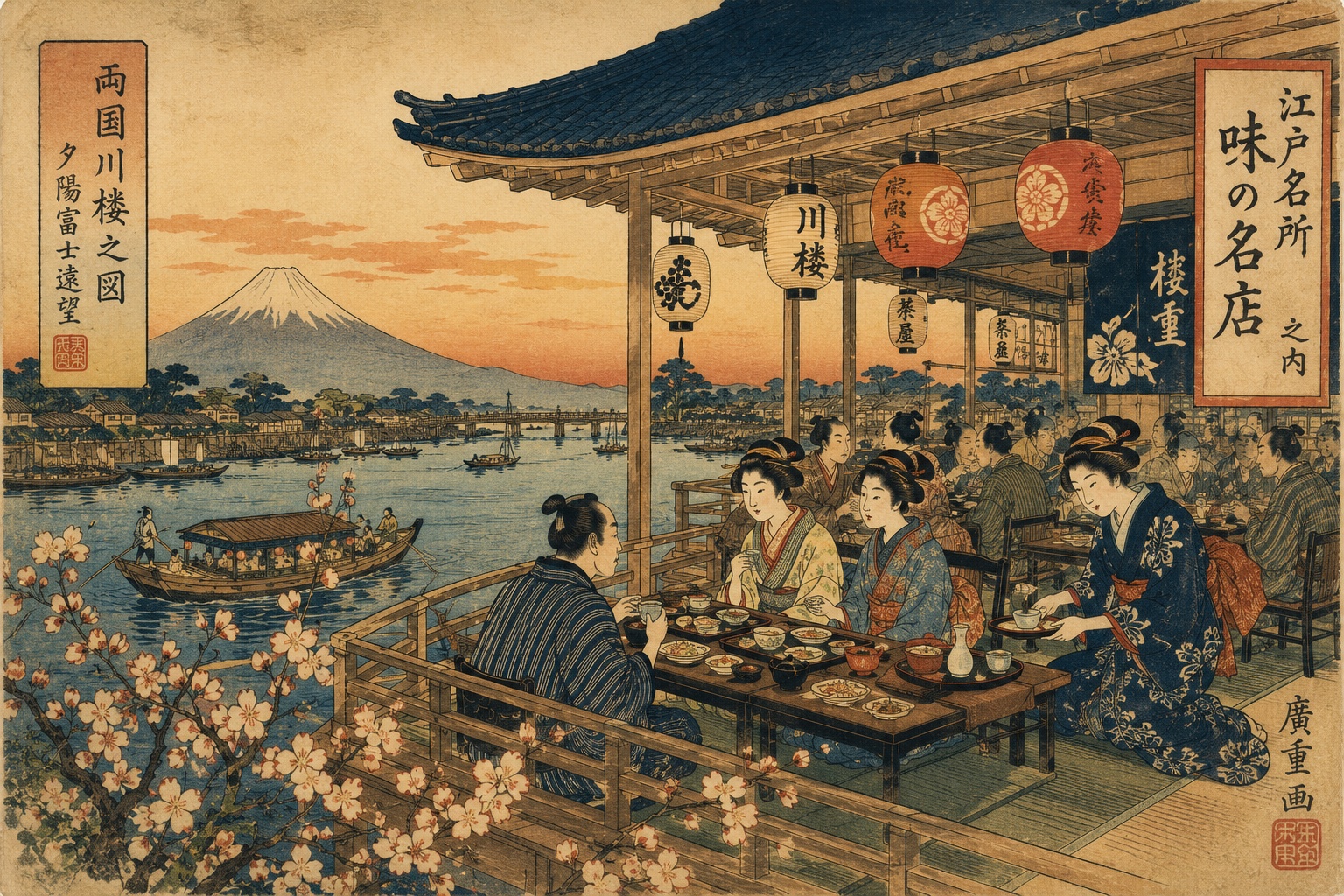
Famous Restaurants of Edo (Edo kōmei kaitei zukushi) is a thirty-print series associated with Utagawa Hiroshige and produced during the Tenpō era. The Metropolitan Museum of Art dates major impressions to about 1838–40; research from Japan’s National Museum of Japanese History divides production, partly through changes in Hiroshige’s signature, into groups around 1837–38 and 1839–40. Today’s hero is an AI-generated editorial image that reinterprets the series’ method of joining a restaurant interior to a recognizable landscape. It is not an original Hiroshige print, a facsimile, a restoration or a reconstruction of a lost work. Its inscriptions are decorative rather than transcriptions of historical text.
He did not paint food; he painted a reason to go
A plate by itself turns a meal into still life. Hiroshige refused that limitation. At Kawachirō on Shitaya Hirokōji, an attendant portions sashimi from a large blue-and-white platter while Shinobazu Pond opens beyond the room. At Kawachiya near Yanagibashi in Ryōgoku, guests unfold paintings and inspect calligraphy as the Sumida River lies outside an upstairs tatami room. At Musashiya in Ushijima, bathers in light robes relax beside a garden and pond, freshwater fish arranged before them. The restaurant is never only a container for a dish.
Famous Restaurants of Edo is about a sequence of experience: entering, sitting, looking, receiving, talking and lingering. Contemporary hospitality advertising often compresses the plate, the room, the view, the staff and the guest’s expression into a few seconds of video. Hiroshige did something structurally similar in a horizontal woodblock print. He presented the establishment not as a single commodity but as time purchased within the city.
That is why this Art Choice is not a proposal to put modern food inside a generic ukiyo-e costume. It draws on the specificity of Yaozen and Kawachirō, the visual passage from room to landmark, the attendant completing a dish at the table, and the restaurant as a place where people encounter one another. Those principles bind the entire August 3 restaurant-and-café edition together.
The artist of the open road also understood the art of staying
Utagawa Hiroshige was born in Edo in 1797, trained under Utagawa Toyohiro and became celebrated for landscapes of the Tōkaidō, the provinces and his native city. The British Museum describes a career encompassing roughly 5,000 print designs, in which travel, weather, season and the relationship between people and nature were rearranged with poetic calm and unusual points of view. A meisho, or famous place, was more than attractive scenery. It was a site made desirable by poetry, history, religion, travel, reputation and repeated representation.
Restaurants therefore did not pull Hiroshige away from landscape. They allowed him to extend the logic of the famous-place print indoors. Shinobazu Pond or the Sumida River identifies where the guest sits. Trays, cups, hanging scrolls, open screens and floor coverings explain what kind of time can be purchased there. By joining the room to the view, he converted an address into desire.
In his later One Hundred Famous Views of Edo, Hiroshige would place enlarged foreground forms against distant landscapes and draw the viewer into the scene. The restaurant series anticipates that logic in another way: Edo is not viewed from the street or hilltop but from a seat inside a dining room. The customer’s line of sight becomes a way of knowing the city.
A thirty-sheet restaurant guide to Edo
Research by Junichi Okubo of the National Museum of Japanese History compares the thirty prints with contemporary restaurant rankings and detects a possible change during production. Based partly on Hiroshige’s signature styles, the earlier group contains many highly ranked establishments and tends to concentrate on interiors or the restaurant building itself. The later group includes more establishments placed lower in the rankings—or absent from them—and more often combines the restaurant with a nearby landmark or landscape.
The scholarly inference is provocative. The series may first have established its authority by depicting famous restaurants, then used that demonstrated publicity value to encourage lesser-known establishments to contribute publishing funds. In that reading, the later prints were intentionally promotional: they did not only praise a restaurant, but helped viewers locate it. This remains an interpretation built from images, signatures and rankings rather than a surviving advertising contract. Yet the increasing emphasis on “where the restaurant is and what you will see there” has a striking resemblance to the mapped restaurant review.
Nishiki-e moved through print shops, could be collected and compared, and carried fashion and urban news into ordinary homes. A restaurant name, a famous view, a signature food, an imagined clientele and a visual atmosphere could be compressed onto one affordable sheet. The result was art, information and an invitation to go out.
Yaozen: when a restaurant became a publisher
The symbolic center of the series is Yaozen in San’ya. The British Museum’s historical guide places its origins near Asakusa in the late 1710s to early 1730s. It initially catered to nearby Buddhist priests and expanded into one of Edo’s defining establishments for refined cuisine. A later exhibition at Showa Women’s University treated Yaozen through three inseparable histories: its food, its architecture and the human networks that gathered there.
Yaozen’s influence depended on making its identity travel beyond the dining room. In 1822, fourth-generation proprietor Kuriyama Zenshirō issued the first part of Edo ryūkō ryōri tsū, a guide to fashionable Edo cuisine, followed by parts in 1825, 1829 and 1835. Menus, ingredients and presentation became print. Readers who had never entered San’ya could learn to recognize the name and imagine the table.
The Tokyo National Museum also preserves an 1822 publication compiled by Asakusa Yaozen under the title Collection of Recipes. The restaurant did not stop at the kitchen and tatami room. It built a brand through recipes, images, rankings, literary association and reputation. Two centuries before chefs used books, video, retail products and social media to extend their worlds, Yaozen was creating customers outside the premises.
A cultural network gathered inside a cookbook
The importance of Edo ryūkō ryōri tsū lies not only in its recipes. The first part included prefaces by the poet and intellectual Ōta Nanpo and the calligrapher and Confucian scholar Kameda Bōsai. Illustrations involved prominent artists including Tani Bunchō, Sakai Hōitsu, Kitao Masayoshi and Katsushika Hokusai; later parts included Utagawa Kunisada and others. Yaozen sat where food culture, publishing and literary society crossed.
Here the restaurant becomes more than a food provider. It edits taste and learning. The author of the preface, the designer of the image, the vessel, the season and the name of the guest all contribute to culinary value. High price alone does not create a famous restaurant. Memory requires a system through which the establishment is discussed, quoted and carried into other media.
When Hiroshige pictured Yaozen, he was not simply recording a reputation already made. He joined the mechanism that circulated it. Proprietor, chef, publisher, block cutter, printer, writer, artist and guest were producing the same restaurant story through different forms of labor.
Kawachirō: turning Shinobazu Pond into an address
The print of Kawachirō at Shitaya Hirokōji makes the series’ method unusually clear. The Metropolitan Museum notes that the surrounding landscape is rendered precisely enough to identify the restaurant’s location. Shinobazu Pond, already familiar from famous-place imagery, lies beyond the room. Anyone who knew the landmark could connect the dining interior to the mental map of Edo.
Inside, an attendant transfers sashimi from a large porcelain platter to smaller serving dishes. This is not simply a catalogue of ingredients. The meal is being completed in the guest’s presence, through the scale of the vessels, the sequence of service and the attendant’s hand. The plate emerging from the kitchen is not yet the full experience; hospitality gives it its final form.
A view still forms part of the price of a hotel restaurant or rooftop café. Hiroshige’s image goes further than using scenery as decoration. Geography, room and service are integrated so that dining at Kawachirō becomes another way of experiencing Shinobazu Pond.
Kawachiya: the restaurant as cultural venue
At Kawachiya near Yanagibashi, the guests are doing more than eating. A painting-and-calligraphy gathering unfolds in the upstairs room. An attendant holds up a painting of turtles; another visitor unrolls an inscribed work; a fan carries an ink bamboo design; pigment dishes, brushes and a rinsing bowl show that creation is taking place on site. The Met describes such a shōgakai as an event at which established artists and calligraphers made works before an audience, who could then purchase favored pieces.
Kawachiya, overlooking the Sumida River, was also rented for storytelling and other elegant gatherings. Restaurant, gallery, performance room and marketplace occupied the same address. Food supported the event; the event increased the restaurant’s cultural value.
This is why restaurant usefulness cannot be measured only by table turnover. Relationships formed there, reputations travelled and works changed hands. Collaboration cafés, wine dinners, roastery events and hotel salons use different technologies, but they still rely on the old ability of food space to gather culture.
Musashiya: bath, garden and freshwater fish as one itinerary
Musashiya in Ushijima appears as a restaurant and bathhouse. Guests, perhaps newly bathed, rest in yukata within a tatami room opening toward a broad garden and pond. Freshwater fish is served in lacquer and blue-and-white porcelain. The establishment sells a quieter time beyond the dense city center.
The composition anticipates destination dining as practiced by the modern onsen inn, resort spa, farm restaurant or coastal food workshop. People travel not for a plate alone but for water, garden, season, view and companionship. The meal fixes the memory of the day in taste.
Hiroshige does not explain the facility through an architectural diagram. Open screens, robes, the garden, vessels and the relaxed posture of guests communicate the pace of the stay. The value of the famous restaurant expands from “what is served” to “how time moves here.”
Five scenes and the operating system of Edo hospitality
| Restaurant or print | What appears | What it reveals |
|---|---|---|
| Yaozen, San’ya | Formal rooms, guests, trays and the atmosphere of a culturally connected house | Food, publishing and literary networks jointly created a restaurant brand. |
| Kawachirō, Shitaya Hirokōji | Shinobazu Pond, sashimi service, a large platter and small dishes | The landmark communicated both location and experience. |
| Kawachiya, Yanagibashi | Painting party, brushes, pigments, scrolls and the Sumida River | A restaurant could function as gallery, performance venue and market. |
| Musashiya, Ushijima | Yukata, bathhouse leisure, garden, pond and freshwater fish | Destination hospitality bundled food with recovery and landscape. |
| Aoyagi, Ryōgoku | A varied Edo clientele and a playful verse tied to the establishment | Restaurant information circulated through humor and popular urban observation. |
Vessels and architecture are part of the meal
To read Famous Restaurants of Edo as food history, it is not enough to enlarge the contents of the plates. The attendant portioning from one vessel to another, the height of the tray, the grain of the tatami, the red floor covering, the open shōji, the veranda, the garden and water all structure the act of eating.
Blue-and-white porcelain brings brightness and apparent cleanliness; black and vermilion lacquer frame the food with depth. Large and small vessels organize sharing and individual service. Open walls admit wind, light and season. In Hiroshige’s compositions, the meal extends beyond the center of the table: river blue, autumn leaves, snow, sunset and patterned clothing prepare the viewer to imagine taste.
The same attention is required in contemporary restaurant writing. Regional ingredients alone do not describe how a dish is staged, at what height it arrives, what hand presents it or what landscape accompanies it. Hiroshige’s achievement was less the beautification of food than the visualization of the conditions under which it becomes memorable.
Rankings, flyers and prints: Edo’s recommendation system
Edo diners did not choose restaurants through rumor alone. There were advertising handbills, illustrated games, nishiki-e and mitate banzuke that arranged restaurants in the format of a sumo ranking. The National Museum of Japanese History preserves a Yaozen restaurant ranking in which Yaozen appears as an organizer and famous establishments occupy judge and upper-tier positions. Its 1863 Edo Restaurant Ranking similarly turns reputation into a single printed hierarchy.
These were not neutral star systems. Editorial judgment, established fame, sponsorship, humor and social hierarchy could mix on the page. In that sense they resemble the modern search result, reservation score or influencer video, none of which measures flavor alone. Visibility, photography, location, advertising and cultural attention work together.
There is also a difference. An Edo sheet made its selection visible as a whole. Contemporary recommendation is personalized and its ranking logic often concealed. Calling Hiroshige’s series “the Instagram of Edo” is too easy. The deeper continuity is that restaurants had already learned to become landmarks through media.
Feeding a city of more than a million
The British Museum notes that Edo had more than one million residents by around 1700. The alternate attendance of feudal lords brought large entourages; merchants, artisans, servants and travelers moved through a cash economy. Fresh fish reached the city from Edo Bay, vegetables arrived from the surrounding region, and expanding circulation of soy sauce, vinegar and sugar widened culinary possibility.
Both ends of urban dining developed together. Sushi, tempura, soba and eel could be eaten quickly at stalls or taken away. Ryōri-jaya sold gardens, rooms, entertainment, vessels and season as a longer experience. Fast food and refined restaurants were not opposites; they were products of the same population density, logistics and appetite for going out.
The 1782 cookbook Tōfu Hyakuchin classified one hundred tofu preparations into six ranks and inspired sequels. Such books demonstrate a readership that enjoyed organizing, comparing and collecting culinary knowledge. Restaurant rankings and Hiroshige’s famous-dining prints required not only hunger, but a market that treated food as information and culture.
Hiroshige’s color: blue creates distance and time
Today’s visual direction uses sage green, persimmon red, lacquer black, warm cream and pale river blue. It is not a mechanical sampling of one historical sheet. It translates the broader Hiroshige method of creating season and distance within a restrained palette.
Hiroshige used bokashi, controlled gradation applied during printing, to give sky, water, rain and evening a sense of continuous time. The British Museum praises his color and his lyrical connection between people and nature. Prussian blue, widely popularized in Japanese prints around 1830, expanded the depth available to late-Edo landscape artists. That does not mean every sheet in this restaurant series carries an identical pigment formula; individual impressions and editions must be examined rather than generalized.
The crucial issue is not making an image appear “old.” Warm interior colors and cool exterior colors place the nearby tray against the distant landmark. Persimmon lanterns draw the eye toward the room; pale blue carries it across water. That movement turns the restaurant from a sealed interior into part of the cityscape.
In 1852, restaurant imagery met celebrity culture
Hiroshige’s interest in dining establishments continued beyond the thirty-print set. Around 1852, he collaborated with Utagawa Kunisada on Famous Restaurants of the Eastern Capital, combining popular actors with the entrance, specialty food and identity of approximately fifty restaurants. Yaozen, sushi houses and establishments serving imported or hybrid dining styles entered the same sheets as kabuki celebrity.
This was a further development in promotional form. The buyer might desire the print because of an actor, role or fashionable costume, while the restaurant borrowed that cultural association. Publisher, performer and proprietor reached overlapping audiences. The structure has descendants in the character café, the branded chef collaboration and the limited menu tied to film or music.
The later series confirms that restaurant pictures were not a one-off curiosity. Dining houses had become a powerful artistic subject and a practical way to organize the fashions of the city.
From the water teahouse to Kahiichakan
The National Diet Library’s exhibition on café culture describes the Edo-period mizujaya as distinct from tea merchants, full restaurants and theater teahouses. It offered a restorative cup at roadsides and leisure districts, spreading from places such as Asakusa and Ryōgoku into the wider city during the eighteenth century. It already joined refreshment to pause, view and encounter.
In 1888, Kahiichakan opened in Ueno with newspapers, magazines, cards, go, shogi, writing materials, a dressing room, coffee, tea, bread, sweets and simple dishes. Its founder, Tei Ei-kei, drew on overseas coffeehouses and aimed not at an elite Rokumeikan but at a social salon for ordinary citizens and students. The business was short-lived, yet its conception anticipated the Japanese café as a place where a beverage provides permission to share information and time.
A water teahouse, a refined ryōri-jaya and Kahiichakan were not the same business. Their continuity lies in a city’s need for places where movement stops temporarily and the presence of other people becomes part of the experience. The river outside Hiroshige’s room survives, transformed, in the café window.
1902 and 1911: Ginza sells a new kind of time
In 1902, Shiseido opened what it identifies as Japan’s first soda fountain in a corner of its pharmacy. Machinery, glasses, straws, spoons and syrups were imported from the United States; soda and then-rare ice cream turned American novelty into a Ginza experience. The operation developed into Shiseido Parlour.
In 1911, Café Printemps, Café Lion and Café Paulista opened in or around Ginza in quick succession. Printemps sought a European-style salon for artists and writers. Lion was more accessible to the general public. Paulista offered inexpensive Brazilian coffee, male youth attendants and a broad clientele; its upstairs women’s room was used by members of the Seitosha circle, while Ryūnosuke Akutagawa arranged meetings there.
Again, the menu is only part of the story. Who gathers, how long one may remain, what hangs on the walls and which floor one occupies create culture. Yaozen’s literary network, Kawachiya’s painting party and the Ginza café belong to different periods and beverages, yet each edits the conversation of the city.
After the earthquake, the kissaten helped rebuild Tokyo
The 1923 Great Kantō Earthquake damaged many Ginza establishments. Yet statistics presented by the National Diet Library show coffee shops in Tokyo rising from 55 immediately after the disaster to 671 by 1928, while also warning that business classifications were not perfectly consistent. The scale of growth still reveals the small café as part of urban reconstruction.
As the word “café” became associated with alcohol and hostess service, regulation intensified. During the 1930s, the term jun-kissa, or pure coffee shop, distinguished establishments that emphasized respectable refreshment, culture and a place where students, office workers and writers could remain. Music, lighting, furniture, the proprietor’s taste and a particular strength of coffee gave each shop a personality.
From Hiroshige’s dining rooms to the kissaten, Tokyo’s hospitality spaces changed with disaster, modernization, regulation and fashion. Their role connecting room and city survived. The river view became the urban street, and the painting party became literary discussion or recorded music, but the guest still carried away a memory of having been a particular person in a particular place.
Why this history belongs to the August 3, 2026 edition
Every story in today’s edition extends beyond the question of what to eat. Park Hyatt Tokyo’s Delicatessen connects a luxury hotel to neighborhood routine. The Awajishima cheese project and Maison KEI incorporate landscape into the meal. Tottori Wagyu, Niigata edamame, Shiseido Parlour and Qu’il Fait Bon carry regional agriculture into urban vessels. Mango Tree Café, the Sumikko Gurashi café and the changing izakaya make food a form of community and narrative.
Philocoffea opens the memory of a roastery to the public. Käfer and The City Bakery test what a brand preserves as it crosses borders. The restaurant labor shortage and CAFERES JAPAN expose the usually invisible ordering, cleaning, training and equipment behind a cup. Hiroshige’s rooms also contain that operating system: attendants, vessels, routes, architecture and cultural programming.
| Hiroshige motif | Echo in the 2026 edition | What today’s art preserves |
|---|---|---|
| A room opening toward a landmark | Hotel dining, Gotemba, Awaji Island and the Forest Beer Garden | Interior and place share one line of sight. |
| Vessel and service | Fruit parfaits, tarts, Wagyu and Thai small plates | The hand and manner of presentation remain visible. |
| Cultural gathering | Character cafés, izakaya and specialty roasteries | Guests and relationships, not food props, occupy the center. |
| Landscape identifying the establishment | Funabashi, Tenjin, Ginza and Orchard Road | The restaurant appears as an address within a city. |
| Invisible operation | Labor scarcity, foreign workers, coffee equipment and digital systems | Tools, attendants and preparation are not erased. |
The responsibility of invoking a historical artist in the AI era
An AI image referring to a historical artist requires a clear boundary. Today’s visual is not a restored, copied or colorized sheet from Famous Restaurants of Edo. It does not claim to reconstruct precisely the architecture of Yaozen, Kawachirō, Kawachiya or Musashiya, and it should not be presented as a newly discovered Hiroshige.
What is being borrowed is method rather than authorship: opening a room toward landscape; treating the guest as a person spending time rather than decoration beside food; allowing vessel, architecture, season and city to work together. Sage green, persimmon red, lacquer black, warm cream and river blue are editorial tools for translating that method into a contemporary newspaper image.
The accompanying article must therefore identify original works, dates, scholarly inference and generated imagery separately. Art history should not become a warehouse of anonymous atmosphere. The purpose is to explain why the composition developed, what commercial life it served and how it taught viewers to see restaurants as parts of the city.
Before the meal, we consume the story of the city
A guest of Yaozen may have known the restaurant before arriving. Perhaps through a ranking, a cookbook or a Hiroshige print, the San’ya room had already entered the imagination. A person heading for Kawachirō might have experienced Shinobazu Pond in the image first.
The contemporary guest also sees the restaurant before reserving. Window, light, counter, plate, staff and street are consumed in advance. The difference is speed and volume. The mechanism—images creating expectation and turning an address into memory—remains.
Famous Restaurants of Edo still feels modern not only because it records lost establishments, but because it understood the restaurant as an urban machine in which cooking, labor, architecture, landscape, art and conversation meet temporarily. From Yaozen to Tokyo’s café boom, and onward to the hotel delicatessen, roastery, collaboration café and technology exhibition of 2026, people enter to eat. A restaurant becomes culture when they leave carrying the view and the time with them.
Sources and verification
Japan.co.jp checked object records from the Metropolitan Museum of Art; research and collection data from the National Museum of Japanese History; Tokyo National Museum-linked data; and British Museum material for Hiroshige and Yaozen. The modern café history draws primarily on the National Diet Library and Shiseido Parlour. The promotional interpretation of Famous Restaurants of Edo is presented as Junichi Okubo’s scholarly inference from images, signatures and rankings—not as a confirmed surviving advertising contract. The hero is generated editorial art, not a historical document.
- The Metropolitan Museum of Art: Kawachirō Restaurant, Shitaya Hirokōji
- The Metropolitan Museum of Art: Yaozen Restaurant, San’ya
- The Metropolitan Museum of Art: Kawachiya Restaurant, Yanagibashi
- The Metropolitan Museum of Art: Musashiya Restaurant, Ushijima
- National Museum of Japanese History: Junichi Okubo, “Ryōri-jaya as Seen in Nishiki-e”
- National Museum of Japanese History: Yaozen restaurant ranking
- National Museum of Japanese History: 1863 Edo restaurant ranking
- British Museum: Historical city travel guide to Edo and Yaozen
- British Museum: Hiroshige’s life, color and famous-place imagery
- Art Platform Japan / Tokyo National Museum: Yaozen’s 1822 Collection of Recipes
- National Diet Library: Water teahouses, Kahiichakan and the Shiseido soda fountain
- National Diet Library: Tokyo café culture in 1911
- National Diet Library: Post-earthquake cafés and the rise of jun-kissa
- Shiseido Parlour: History from the 1902 soda fountain
- Ajinomoto Foundation for Dietary Culture: Yaozen in the 1852 actor-and-restaurant series
