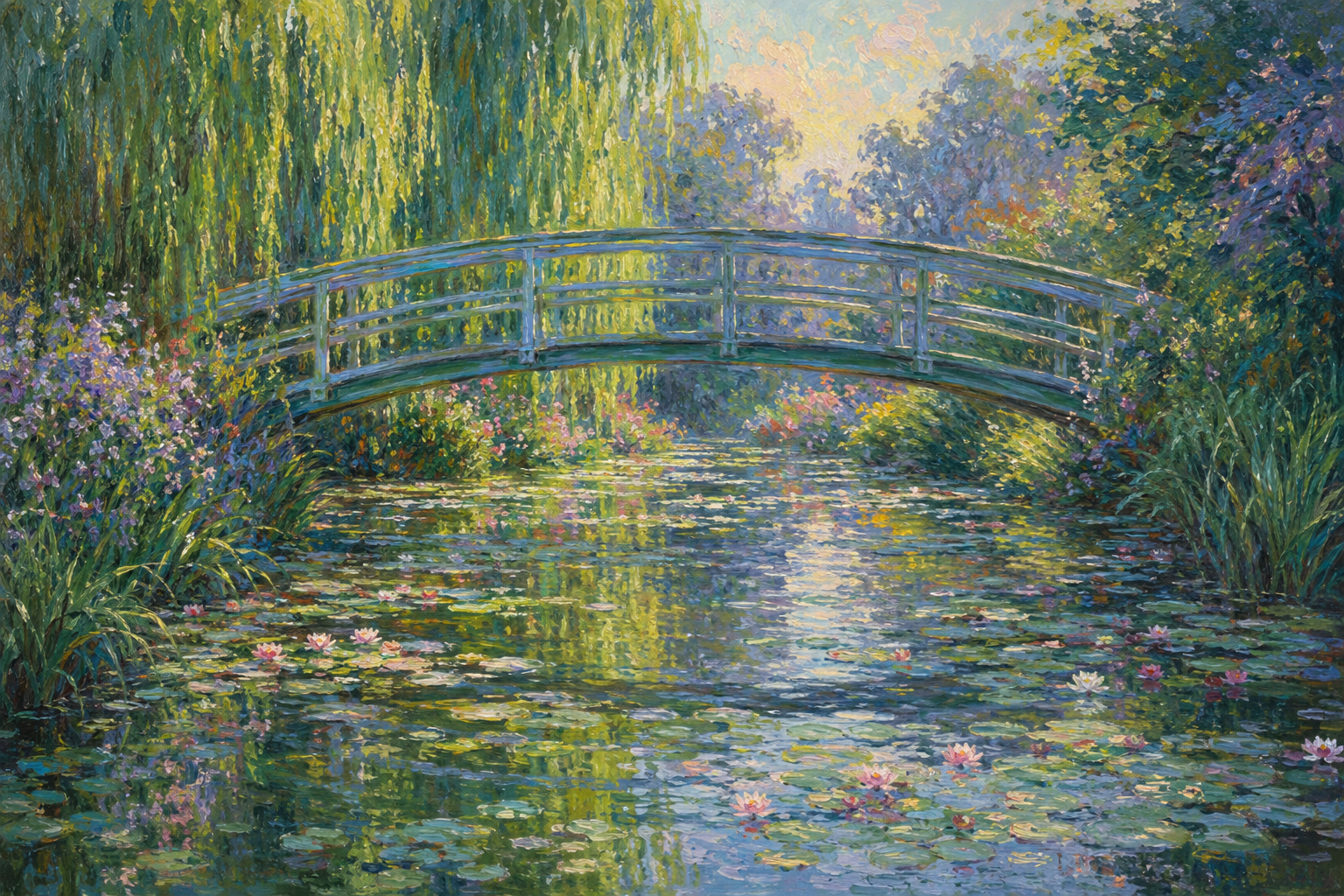
Claude Monet’s The Japanese Footbridge: The Landscape He Built to Paint
A turquoise arch, a skin of reflected green, and lilies floating between depth and surface: Monet’s 1899 painting looks effortless. In fact, it joins decades of artistic experiment, a deliberately engineered garden, a French fascination with Japan, and a radical question—what exactly do we see when we look at water?
The work at a glance
Claude Monet painted The Japanese Footbridge in 1899, when he was 58 or 59 and no longer the financially precarious rebel of Impressionism’s first exhibitions. The oil on canvas measures 81.3 by 101.6 centimeters and belongs to the National Gallery of Art in Washington. A pale blue-green wooden bridge crosses the upper portion of the canvas; below it, water lilies advance in broken bands while plants, trees, bridge and sky dissolve into the pond’s reflections.
The subject existed in several versions. The National Gallery says Monet painted twelve works in 1899 from one viewpoint, centered on the bridge and the small universe of the water garden. The Metropolitan Museum of Art describes an initial project of eighteen views, twelve completed that summer. These are not copies. Their formats, color temperatures, density of foliage and balance between bridge and water differ.
Which “Japanese bridge” painting?
Monet gave related canvases overlapping titles, and English museum titles vary: The Japanese Footbridge, Bridge over a Pond of Water Lilies, Water-Lily Pond. This article’s anchor is the horizontal 1899 National Gallery of Art painting, accession 1992.9.1—not the Met’s vertical canvas and not Monet’s much later, stormier bridge paintings.
First lesson: Monet made the motif
Traditional landscape painting implies that nature waits for the artist. At Giverny, Monet reversed the relationship. He moved there in 1883 with his sons, Alice Hoschedé and her children; rented the house, bought it in 1890, and in 1893 acquired marshy land across the railway line. He petitioned local authorities to divert water from the Ru, a branch connected with the Epte, into a new pond.
Neighbors worried that exotic plants might foul the water or harm laundry and livestock. Monet nevertheless secured permission and developed the water garden with gardeners. He chose the pond’s shape, lilies, willows, irises and other plantings. He built the arched wooden bridge and later added a wisteria trellis. The scene was nature, but curated nature—an outdoor studio designed years before it became his dominant subject.
Monet did not simply paint a garden. He gardened a painting into existence.
This matters because the canvas becomes a chain of authorship: Monet selected living materials, arranged their growth, waited for changing light, then translated the designed environment into paint. The garden is simultaneously subject, instrument and artwork.
How to look: four visual systems at once
| System | What to notice | What it does |
|---|---|---|
| Bridge | A shallow arch cropped by the side edges, placed high in the frame. | Provides the only firm geometry, but its reflection makes even that stability uncertain. |
| Lilies | Horizontal flecks of pink, yellow and white resting on water. | Tell the eye where the surface is. |
| Reflections | Vertical greens and purples that belong to trees, sky and bridge outside or above the pond. | Open an illusory space beneath the surface. |
| Brushwork | Marks remain visibly separate instead of disappearing into polished description. | Reminds us that the scene is also pigment on canvas. |
The painting makes the eye oscillate. Follow the lily pads and the canvas feels flat. Follow the dark reflection under the bridge and it becomes deep. Notice the strokes and the illusion collapses into material paint. Monet does not resolve these readings; he keeps them active together.
Try the ten-second test
Cover the bridge with your hand. Without that architectural anchor, the lower field can become almost abstract. Now uncover it: the arch reorganizes the colors into a garden. Monet lets one recognizable object discipline a field that is already moving toward twentieth-century abstraction.
Impressionism was not just “painting quickly”
Monet helped give Impressionism its name when critic Louis Leroy mocked his Impression, Sunrise after the group’s 1874 exhibition. The artists challenged official Salon finish and academic hierarchies, painted modern leisure and landscape, used brighter color, and made visible brushwork part of the image. Portable paint tubes, railways and new pigments supported work outdoors, though Monet also revised canvases in the studio.
By the 1890s he had developed the “series” method: haystacks, poplars and Rouen Cathedral painted repeatedly under changing conditions. A series shifts the subject from “this object” to “this object as perception changes.” The bridge group applies that method to a place Monet controlled more completely than a cathedral façade or a row of poplars.
Serial practice also had a market logic. Dealer Paul Durand-Ruel helped turn groups of related paintings into exhibitions and recognizable bodies of work. Artistic research and commercial success were not opposites; Monet’s prosperity made the costly garden possible, and the garden generated desirable paintings.
What made the bridge “Japanese”?
After Japanese ports were forcibly opened to wider international trade in the 1850s, ukiyo-e prints, ceramics, fans, textiles and decorative objects entered European markets in large quantities. At the 1867 Paris Exposition and later fairs, “Japan” became a powerful category in French design and collecting. The enthusiasm was called Japonisme.
Monet collected more than 200 Japanese prints—works by artists including Hokusai, Hiroshige and Utamaro—and displayed them densely in his Giverny home. He admired their high viewpoints, cropped forms, asymmetry, flattened color, strong diagonals and attention to weather and ordinary life. Hiroshige’s bridge images offered obvious comparisons, but no single print should be treated as a blueprint for Monet’s bridge.
The physical bridge was a French garden structure in a Japanese style, painted green rather than the red often imagined today. Its wisteria, water lilies and surrounding vegetation combined species and ideas from multiple places. Giverny was not an authentic Japanese garden transplanted intact; it was Monet’s French, horticultural and artistic construction of Japan.
Influence is not a one-way fairy tale
Japonisme produced admiration and serious study, but it also selected, renamed and marketed Japanese culture for European desires during an age of imperial power. Later, Japanese artists studied European oil painting and Impressionism, while collectors in Japan embraced Monet. The history is reciprocal—but not equal, simple or free of stereotypes.
Water as a machine for changing space
In earlier bridge pictures the horizon, banks and architecture help orient us. Across the Water Lilies project, Monet gradually removes those supports. The pond becomes sky because it reflects sky; depth sits on top of surface; a cloud may appear below a flower. By the large late canvases, the frame often contains no horizon at all.
This is not failed realism. It is a more exact account of perception. The eye receives simultaneous signals—solid pad, transparent water, reflected tree, moving light—and the mind sorts them. Monet makes that sorting visible. The “subject” is less the pond than seeing itself over time.
Technical research on related Chicago canvases finds open brushwork, thin initial washes, wet-on-wet and wet-over-dry strokes, visible ground, and later adjustments. The spontaneous effect was built through layers and decisions. An Impressionist “moment” could take repeated sessions.
A bridge through Monet’s life
1840
Monet is born in Paris and grows up in Le Havre, where Eugène Boudin encourages him to paint outdoors.
1874
The first independent Impressionist exhibition opens; Impression, Sunrise helps supply the movement’s name.
1883
Monet’s extended household moves to Giverny.
1890
Growing success allows him to purchase the house and land.
1893
He acquires the wet meadow, obtains water-diversion permission and begins the pond.
1899
Monet paints the first concentrated Japanese-footbridge group, including the Washington canvas.
1909
Durand-Ruel exhibits 48 Water Lilies paintings in Paris to major acclaim.
1911–1914
Alice dies; Monet’s son Jean dies; cataracts worsen. Monet resumes a vast decorative project.
1918
The day after the Armistice, Monet offers Water Lilies panels to France as a peace memorial, working with his friend Georges Clemenceau.
1923
He undergoes cataract surgery on one eye, continuing to paint and revise.
1926–1927
Monet dies in December 1926. The Orangerie Water Lilies rooms open the following year.
1966–1980
His son Michel bequeaths Giverny to the Académie des Beaux-Arts; the neglected garden is reconstructed and opens to the public.
The late bridge: same place, different world
Monet returned to the bridge around 1918–1924. In late works the arch can nearly disappear beneath dense vertical strokes and burning reds, oranges, browns and dark greens. The tranquil garden becomes claustrophobic and turbulent. Cataracts affected his color discrimination and acuity; after surgery he sometimes perceived unusually blue-violet light. Yet it is reductive to diagnose every late brushstroke as a symptom.
Age, grief, war, changing artistic ambitions, altered eyesight and deliberate experiment all mattered. Monet rejected some canvases, reworked others and made aesthetic choices. Medical history can illuminate the conditions of vision; it cannot replace interpretation.
| 1899 bridge | Late bridge paintings |
|---|---|
| Bridge reads clearly as structure. | Bridge may dissolve into foliage and pigment. |
| Cool green harmony, airy intervals. | Hot, dense color and heavier impasto. |
| Pond feels like a legible garden. | Space presses toward the canvas surface. |
| Serial observation of changing conditions. | Memory, bodily vision and expression become harder to separate. |
From decoration to modern environment
Monet’s ultimate Water Lilies project exceeded the easel picture. The Musée de l’Orangerie’s eight vast compositions wrap two elliptical rooms in nearly continuous water, arranged with sunrise effects toward the east and sunset toward the west. Offered to the nation after the 1918 Armistice, the installation was intended as a peaceful environment.
It initially looked old-fashioned beside Cubism, Dada and Surrealism. Attendance lagged; temporary walls sometimes hid the panels. After the Second World War, artists and critics saw them anew. Their horizonless, “all-over” fields seemed to anticipate Abstract Expressionism and immersive installation. What had appeared to be the last breath of Impressionism became one origin of postwar modernity.
Five questions to take to any painting
| Question | Ask it here |
|---|---|
| What is represented? | A bridge, pond, lilies and vegetation. |
| How is space organized? | High bridge, cropped edges, no broad sky, unstable reflection. |
| How is paint behaving? | Strokes describe objects while announcing themselves as strokes. |
| What history made the image possible? | Horticulture, wealth, rail access, global trade and Japonisme. |
| What does the work make uncertain? | Surface versus depth, nature versus design, instant versus construction. |
Why choose it today?
The Japanese Footbridge is easy to love and therefore easy to stop seeing. Its calm beauty can hide the rigor of the experiment. Monet built an environment, returned to one viewpoint, and allowed small differences in light, growth and paint to become the real subject. Repetition was not lack of imagination; it was a tool for detecting change.
The painting also offers a responsible way to discuss cultural exchange. Japan helped European artists see composition differently, while Europeans often converted a complex culture into an aesthetic category. Admiration and appropriation can coexist. Historical understanding begins when “Japanese” becomes a question rather than a decorative adjective.
Finally, the bridge is a threshold. Above it lies the familiar world of objects. Below it, reflections turn the pond into an unbounded field. Monet lets us stand between recognition and abstraction—and teaches that careful looking is not passive reception, but an active construction of the world.
Sources and Further Reading
- National Gallery of Art: The Japanese Footbridge — object record, visual description and 1899 group.
- National Gallery of Art: Claude Monet — artist and collection record.
- Metropolitan Museum of Art: Bridge over a Pond of Water Lilies — related 1899 canvas and garden history.
- Art Institute of Chicago: Water Lily Pond — related work.
- Art Institute of Chicago: Scholarly Catalogue, Water Lily Pond — technique, sources and series context.
- Art Institute of Chicago: Water Lilies — scope of the larger cycle.
- Musée de l’Orangerie: The Water Lilies by Claude Monet.
- Musée de l’Orangerie: History of the Water Lilies Cycle — Armistice gift, installation and reception.
- Musée de l’Orangerie: Monet’s Gift to France — letters and acquisition history.
- Fondation Claude Monet: Garden Rescue and Restoration.
- The Met: The Great Wave—Japanese Woodcuts and French Prints.
- The Met: Early Collectors of Japanese Prints — Monet’s collection.
- National Gallery, London: The Water-Lily Pond — a related 1899 view.
- Museum of Modern Art: Claude Monet — late works and modern reception.
- Guggenheim Museum: Claude Monet — works and artist context.
- Encyclopaedia Britannica: Claude Monet — biographical chronology.