The “single cause” Takaichi rejected
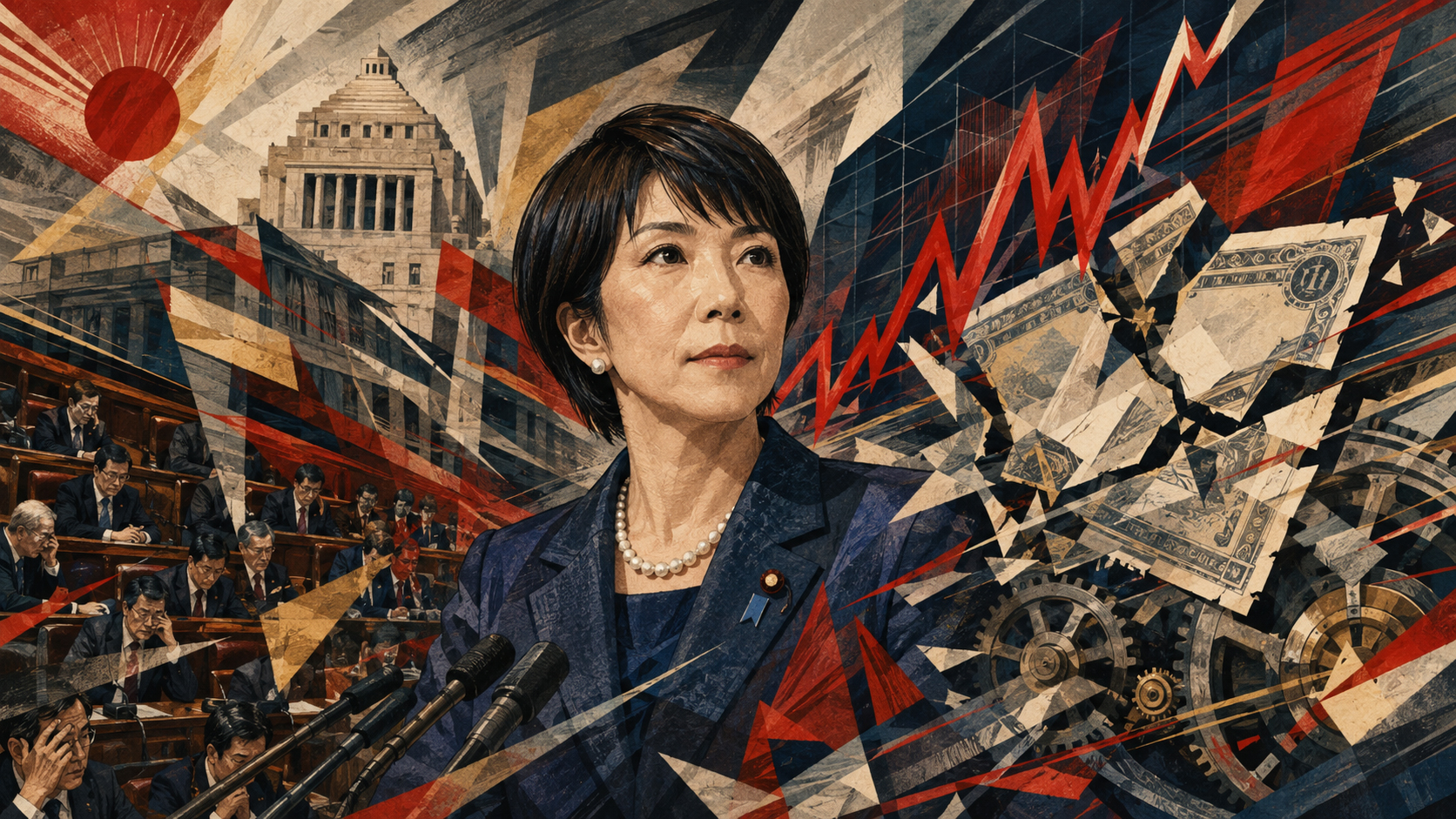
Prime Minister Sanae Takaichi pushed back in parliament on July 15 against the claim that her government’s draft economic blueprint caused the sharp selloff in Japanese government bonds. The document had not even been approved by the cabinet, she argued, and interest rates and currencies are shaped by many forces, including United States rates and employment data.
Strictly speaking, that is correct. A sovereign-bond market is not moved by one sentence alone. Oil prices, conflict in the Middle East, Treasury yields, expectations for Bank of Japan policy, domestic inflation, auction demand, bank and insurer positioning, and foreign trading all interact. July’s move extended through nine consecutive sessions of rising benchmark yields, the longest such sequence in 19 years. Reducing it to a single headline would be bad analysis.
But “not the only cause” is not the same as “had no effect.” An early version of the blueprint said it was extremely important for monetary policy to be guided appropriately toward building a stronger economy. Investors read that as a possible request for the BOJ to keep rates lower than inflation conditions warranted. Delayed tightening could weaken the yen, lift import costs and erode the value of the fixed yen payments promised by long-dated bonds. The wording may not have started the fire, but it could act as a spark in an already dry market.
First lesson: bond prices and yields move in opposite directions
A government bond is an IOU. An investor lends money today; the government promises interest and the return of principal at maturity. Because the coupon on an existing bond is fixed, its market price must fall when investors demand a higher return. As the price falls, the effective yield available to a new buyer rises. When prices rise, yields fall.
Take a simplified bond that pays ¥1 a year and is issued at ¥100. Its coupon rate is 1%. If the market price falls to ¥90, the buyer receives the same ¥1 after paying only ¥90, and may also receive ¥100 at maturity. Its yield is therefore higher. A headline saying “JGB yields surged” usually also means “JGB prices fell sharply.”
On July 9, the 10-year yield reached 2.900%, the 20-year 3.890%, the 30-year 4.030% and the 40-year 4.055%. The longer the maturity, the more years of inflation and fiscal uncertainty the investor must accept. A two-year bond is highly sensitive to the BOJ’s next few policy decisions. A 30- or 40-year bond is more exposed to distant inflation, future issuance, insurer demand and confidence in the state’s long-run finances.
Why a growth plan becomes a bond-market story
The Takaichi government wants to mobilize roughly ¥370 trillion of combined public and private investment by 2040 across 17 strategic sectors, including artificial intelligence, semiconductors, shipbuilding and space. The concept is to use government commitment, multi-year budgeting and possibly bridge bonds to unlock private capital. For an aging country seeking higher productivity, that is a serious objective.
The number must be read correctly. ¥370 trillion is not all new government spending, and it is not intended to be spent in a single year. It is a combined public-private ambition extending to 2040. Even so, bond investors ask three unavoidable questions: How large is the government share? If borrowing comes first, what revenue will redeem the bridge bonds? And how will the state carry higher interest expense until investment produces growth and tax receipts?
Productive investment can improve debt sustainability. Semiconductor capacity, research, power grids, skills and automation can raise potential growth, nominal GDP and revenue. But if subsidies are allocated politically and fail to raise productivity, the bonds remain while the promised growth disappears. A bond market is not simply voting for “spending” or “austerity.” It is pricing how much future income each borrowed yen is likely to create.
| Government promise | Market question |
|---|---|
| ¥370 trillion across 17 strategic sectors | What are the public-private shares, additional investment and measurable results? |
| Multi-year budgets | Do they improve planning or weaken annual spending discipline? |
| Bridge bonds | Which future revenue will redeem them? |
| Growth-oriented policy coordination | Could political priorities delay BOJ tightening needed for price stability? |
| Possible temporary food-tax cuts | What is the duration, household benefit and permanent funding source? |
Why one footnote suddenly mattered
After the market reaction, the government revised the monetary language to emphasize stable inflation. It then moved toward adding a footnote citing the Bank of Japan Act’s protection of central-bank autonomy. That may look like a technical edit. The need for it is itself significant: investors wanted the boundary between elected government and monetary authority made explicit.
Article 3 of the Bank of Japan Act says the BOJ’s autonomy regarding currency and monetary control must be respected. Article 4 simultaneously requires close contact and sufficient exchange of views so monetary policy remains compatible with the government’s basic economic-policy stance. Independence and coordination are not alternatives. The law deliberately contains both.
Central-bank independence does not place monetary policy outside democracy. The government and Diet establish the price-stability mandate, select leadership and demand public accountability. Operational independence protects the decision to raise or lower rates at the next meeting from an election calendar or the government’s immediate financing needs. The larger the debt stock, the more valuable that distance becomes. Low rates ease the budget’s interest burden; but postponing necessary tightening can deepen inflation and currency depreciation.
From 1882 to 1998: Japan’s long road to central-bank autonomy
The Bank of Japan was founded in 1882 to unify money and credit in the modern Japanese state. The boundary between government and central bank, however, has never been permanent. The 1942 wartime law subordinated the institution more directly to national objectives. Even after the war, the Ministry of Finance retained powerful influence and monetary independence was less explicit than it is today.
The collapse of the asset bubble and the financial crises of the 1990s forced a reconsideration. Bank failures, bad loans, deflation and delayed policy responses raised basic questions: Who decides, who explains and who is responsible? The revised BOJ Act was enacted in 1997 and took effect in 1998, codifying autonomy and transparency. Policy Board decisions, minutes and regular communication became part of the modern framework.
Then came a historical irony. Soon after independence was strengthened, deflation required extraordinary coordination between the government and the BOJ. Japan moved through zero interest rates in 1999, quantitative easing in 2001, “quantitative and qualitative monetary easing” in 2013, and negative rates and yield-curve control in 2016. An operationally independent central bank chose, on its own authority, to enter the government-bond market more deeply than ever before.
| Period | Policy and historical meaning |
|---|---|
| 1882 | The Bank of Japan is founded to unify the modern currency and credit system. |
| 1942 | Wartime legislation strengthens state control and mobilizes the central bank for national policy. |
| 1998 | The revised BOJ Act takes effect, codifying autonomy and transparency. |
| 1999–2001 | Zero rates and quantitative easing begin the experiment beyond the conventional rate limit. |
| 2013 | Governor Haruhiko Kuroda launches QQE to break deflationary expectations. |
| 2016 | Negative rates, followed by a policy targeting the 10-year yield around zero. |
| 2024 | Governor Kazuo Ueda ends negative rates and YCC, returning to a short-rate framework. |
| 2026 | The policy rate reaches 1%; markets test whether normalization can coexist with enormous debt. |
The 2016 experiment moved interest rates from market to policy
In January 2016, the BOJ imposed a negative 0.1% rate on part of financial institutions’ reserves. The vote was an unusually close 5–4. Detailed minutes released a decade later showed dissenters worried about bank profitability, weak effects on lending and investment, currency competition and inadequate preparation. In September, the BOJ introduced yield-curve control, or YCC, aiming to hold the 10-year JGB yield around zero.
Under YCC, a central bank commits to buy enough bonds to keep a selected yield near a target. Quantitative easing focuses on how many bonds the bank buys; YCC focuses on the price of money it wants those purchases to produce. The goal was to lower borrowing costs for households, companies and the state while finally ending deflation.
The longer such control lasts, however, the more it can weaken price discovery. With the BOJ as dominant buyer, private trading thins. The JGB yield becomes both an economic thermometer and an administered policy price. Beginning in 2022, global inflation and yen depreciation brought repeated tests of the cap. The BOJ widened its tolerance. In March 2024, saying a sustainable wage-price cycle had come into sight, it declared that negative rates and YCC had fulfilled their roles.
That is why 2.9% in 2026 is not simply “a high rate.” It is a market long held under a lid trying to discover the price of inflation, fiscal policy and bond supply again. Comparisons with 1996 require care. Japan’s debt, BOJ balance sheet and inflation regime are radically different. The same yield does not carry the same meaning.
Why Japan’s debt did not already become a crisis
Japan’s public debt is exceptionally large among advanced economies, yet the country has avoided a foreign-currency or default crisis for several reasons. Almost all the debt is denominated in yen. Most is held domestically. Japan has substantial net foreign assets and foreign-income flows. Households, banks, insurers and pensions have long formed a stable investor base. The BOJ ultimately bought close to half of the JGB market.
“The debt ratio is huge, therefore default is tomorrow” is wrong. But “Japan issues its own currency, therefore debt does not matter” is also wrong. On a consolidated government-central-bank view, some government interest paid to the BOJ returns through BOJ remittances. Yet when rates rise, the BOJ also pays more interest on bank reserves. A sovereign can create yen; it cannot create unlimited confidence in what a yen will buy.
Most JGBs carry fixed rates and Japan has lengthened average maturity. A 2.9% market yield does not instantly reprice the entire debt stock. The cost rises gradually as old securities mature and are refinanced. That lag gives the government time, but it does not erase the arithmetic. If higher rates persist, debt service competes with education, defense, social security, science and the very growth investments the government wants to make.
What “fiscal dominance” actually means
One term haunting this debate is fiscal dominance. It describes a condition in which the central bank cannot set the policy required for price stability because it must protect the government’s financing position. The larger the debt and the more painful a rate increase becomes for the budget, the stronger the political desire for cheap money. But if cheap money feeds inflation, households pay through prices and currency depreciation instead.
There is not enough evidence to declare that Japan is already fiscally dominated. The BOJ ended its extraordinary framework in 2024 and raised its policy rate to a 31-year high of 1% in June 2026. Two hawkish members dissented from an April hold; one dovish member opposed the June increase. Those divisions also demonstrate that the Policy Board is making consequential choices rather than mechanically following the cabinet.
Still, when a government document appears to direct monetary policy toward a “stronger economy,” investors test whether fiscal needs are beginning to constrain price stability. That is why the Article 3 footnote mattered. Independence is not ceremonial etiquette. It is an economic asset reflected in the risk premium on long bonds, the exchange rate and household inflation expectations.
The yen, oil and U.S. rates: where Takaichi is right
Takaichi was right to cite American rates and labor data. Sovereign-bond markets are connected. When Treasury yields rise, investors demand more return to hold lower-yielding JGBs. When conflict lifts oil prices, an energy importer faces higher inflation and a weaker trade balance. At more than ¥162 to the dollar, the same dollar price for fuel, food and industrial inputs becomes more expensive in yen.
The BOJ is therefore caught in a triangle. Higher rates can support the currency and restrain prices, but they burden companies, mortgages and the state. Delayed tightening can support activity, but may prolong currency weakness and imported inflation. A July corporate survey found that 49% of respondents had experienced some harm from rate increases and 80% opposed or wanted to delay further tightening. Yet more than half also said the weak yen was hurting earnings. Japanese business is living inside the same contradiction as policymakers.
Can bringing pension money home solve the problem?
The government has also discussed encouraging pension funds and households to invest more in Japanese assets. If the ¥293.6 trillion Government Pension Investment Fund increased domestic-bond exposure, it could support JGB demand, reduce capital outflow and help the yen. Mere discussion of such a shift was enough to trigger bond and currency rallies.
But a pension fund is not a convenient government wallet. GPIF has a legal fiduciary responsibility to invest for beneficiaries’ long-term security and return. A domestic shift may be reasonable if supported by portfolio analysis. If compelled primarily to stabilize the market or finance policy, it merely transfers the independence problem from the BOJ to pensions. Trust is not manufactured by ordering someone to buy.
How to judge Takaichi’s defense
The prime minister’s defense is persuasive in one respect: causation in markets should not be reduced to a single draft. But political responsibility does not end with proving that a document was not the only cause. If its language amplified an existing fear, the government must resolve that fear with specifics.
The final plan needs at least five things: a clear statement that the BOJ chooses the tools required for price stability; a public-private breakdown of the ¥370 trillion ambition; identified resources for redeeming bridge debt; deadlines and productivity tests for strategic investments; and stop-or-adjust rules if growth disappoints. A footnote can mark the institutional boundary. It cannot complete the fiscal arithmetic.
| What to watch next | Why it matters |
|---|---|
| Final economic blueprint around July 21 | Will BOJ independence, investment funding and fiscal discipline be explicit? |
| BOJ meeting, July 30–31 | How will the bank balance a 1% policy rate, energy inflation and yen weakness? |
| Bid-to-cover ratios and auction tails | Will banks, insurers and foreign investors buy at the new yield levels? |
| Superlong JGB yields | They reveal long-run fiscal and inflation confidence beyond the next BOJ move. |
| Budgeted debt-service cost | How quickly are market yields becoming a real spending constraint? |
| Real wages and underlying inflation | The core evidence for choosing between tighter policy and growth support. |
The historical meaning: relearning the price of money
“The highest in 30 years” is more than a dramatic headline. In 1996, Japan was moving from the aftermath of its bubble toward banking crisis and deflation. Over the generation that followed, the country cut interest rates, reached zero, expanded the monetary base, went negative and ultimately controlled the 10-year yield itself. The JGB yield became less a free market price and more a component of public policy.
In 2026, Japan is traveling in the opposite direction. Wages and prices are moving. The BOJ has restored a 1% policy rate, reduced its control over bond purchases and returned more price-setting power to investors. But the debt stock being returned to market discipline is vastly larger than it was three decades ago. Normalization is not merely raising a policy rate. It is asking the government, banks, companies and households to relearn that borrowing has a price.
Bond markets do not vote, but they place a price on government promises every day. Takaichi’s investment-state ambition need not be an enemy of the market. If borrowed funds become productivity, the BOJ’s autonomy is protected, and future revenue and spending are presented honestly, faster nominal growth can make debt easier to carry.
If growth rhetoric instead becomes a reason to suppress rates, leave financing vague and tolerate inflation through a weaker yen, investors will demand a higher yield. July’s 2.9% was not a verdict. It was a question: after ending the long age of zero interest rates, can Japan preserve growth, price stability and fiscal trust at the same time? The answer will not be written in one footnote. It will emerge through budgets, BOJ meetings, bond auctions and actual productivity.
Sources and further reading
- Reuters: Takaichi’s parliamentary response — the draft, market shock, U.S. rates, the yen and consumption-tax debate.
- Reuters: Japan’s benchmark yield reaches a 30-year high — yields from two to 40 years, curve steepening and auction demand.
- Reuters: BOJ-independence reference in the blueprint — revisions and the proposed footnote to the BOJ Act.
- Reuters: ¥370 trillion public-private investment ambition — 17 sectors, multi-year budgeting and bridge bonds.
- Reuters corporate survey — the conflicting pressures from higher rates and a weaker yen.
- Reuters: full minutes of the 2016 negative-rate decision — the 5–4 vote and objections within the Policy Board.
- Bank of Japan: QQE with Yield Curve Control, September 2016 — the zero target for the 10-year yield and JGB operations.
- Bank of Japan: Changes in the Monetary Policy Framework, March 2024 — the end of negative rates and YCC.
- Ministry of Finance: Debt Management Report 2025 — JGB stock, holders, maturity and debt management.
- Bank of Japan Act — Article 3 autonomy and Article 4 government coordination.
- Reuters: GPIF and the proposed domestic-asset shift — pensions, domestic bonds and policy boundaries.