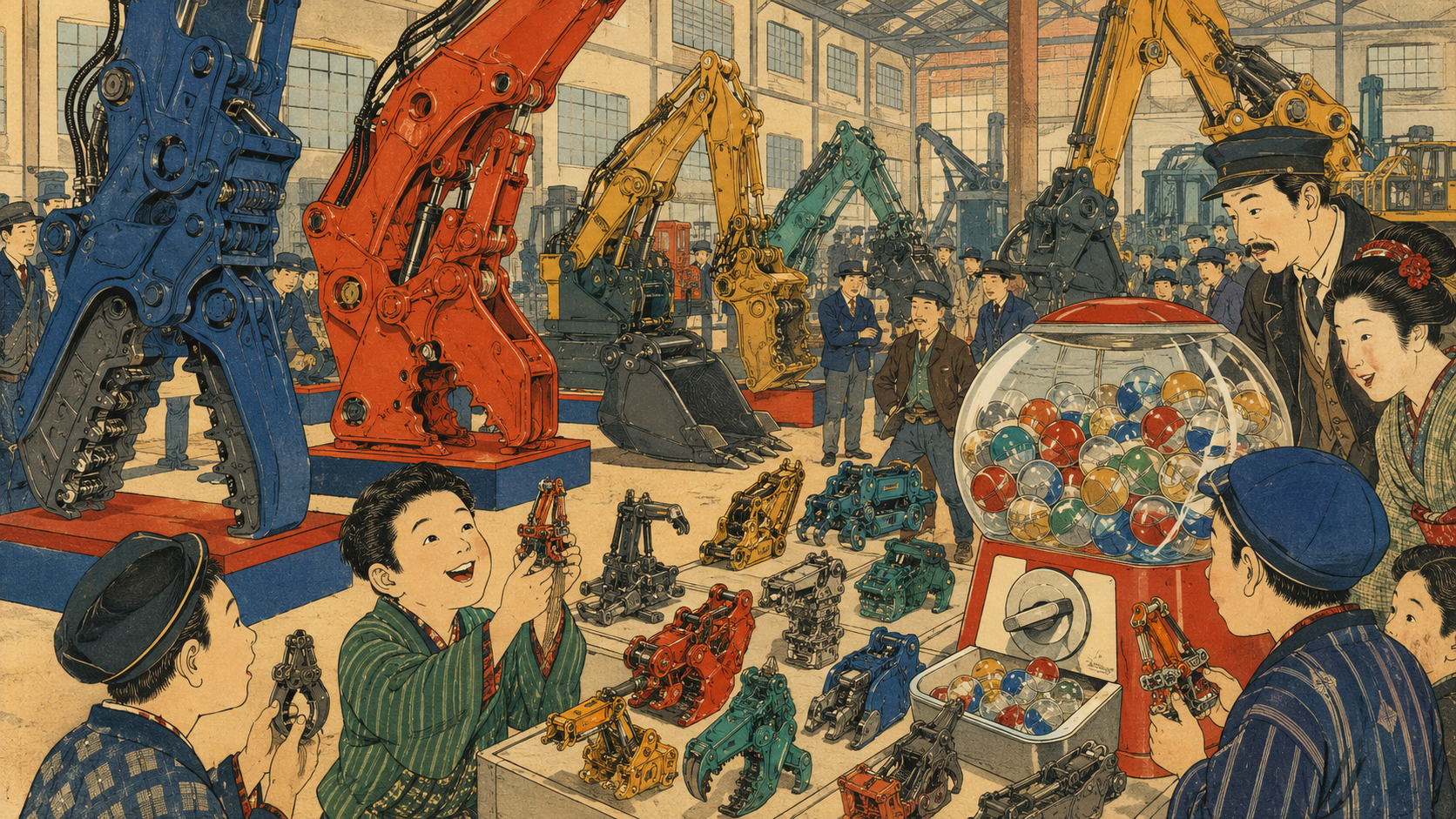
A Construction Site Inside a 65-Millimeter Capsule
In July 2026, Taguchi Industrial began releasing 1:32 capsule-toy versions of its hydraulic excavator attachments across Japan. Each turn costs ¥400; the capsule is about 65 millimeters. The four miniatures reproduce real nameplates and stickers and include ball chains.
The set contains the DXGG steel cutter, rotating Grasper VS, Kusakaru-gon brush cutter, and hydraulic One Catch quick hitch with bucket. The cutter and grasper open and close, and the models can be paired with commercially available 1:32 excavators.
What Is an Excavator Attachment?
An excavator supplies the arm and hydraulic power. Changing the tool at its tip changes the job: a bucket digs, a crusher demolishes concrete, a cutter shears steel, a grapple handles debris and a mower clears brush.
It resembles placing a pen, scissors or wrench in a human hand. A good attachment does more than amplify force. It converts hydraulic pressure into a specific motion and reduces time, labor and risk.
Four Models, Four Engineering Lessons
| Model | Real work | Engineering |
|---|---|---|
| DXGG Cutter | Shears structural steel and reinforcement. | Hydraulic cylinders, leverage and concentrated force. |
| Grasper VS | Grips debris or timber and rotates fully. | Grip force, rotary joint and center of gravity. |
| Kusakaru-gon | Cuts brush and small growth on difficult ground. | Rotating cutter, containment and terrain following. |
| One Catch + bucket | Changes tools from the cab. | Quick hitch, hydraulic lock and setup reduction. |
A model cannot reproduce hydraulic pressure, but the position of links, pivots, blades and coupler can preserve the logic of the machine. A good industrial miniature is not merely an exterior copy; it extracts how the product works.
Japan's Attachment Industry
Through postwar reconstruction, highways, dams and urban growth, Japanese construction machinery developed around durability, hydraulics and service. As excavators spread, attachments made one base machine useful across many tasks.
Demolition evolved from knocking a building down into separating steel, concrete and timber for recycling. Gripping, cutting and crushing support circular use of material. Brush cutters reduce human exposure on slopes. Behind the miniature sit labor scarcity, safety and resource recovery.
Japan's Capsule-Toy History Began in the 1960s
Toy vending arrived from the United States and spread in Japan from around 1965. Bandai entered the business in 1977 under the Gashapon brand, building a market for affordable detailed miniatures of characters, animals, food, household objects and art.
Early products primarily targeted children. Better sculpting and paint created adult collecting. Surprise, the wish to complete a set and the shock of shrinking reality all became part of one crank.
The modern market often celebrates objects too ordinary to notice—signals, gas meters, packages and tools. Excavator attachments are an ideal example: equipment once seen only by specialists enters popular culture.
Why Would a Machinery Company Make Toys?
| Goal | Value |
|---|---|
| Awareness | Reach families and young people who do not know the company. |
| Recruitment | Show students careers in design, welding and machining. |
| Customer relations | Create affection and conversation at exhibitions and sites. |
| Education | Make attachment types and functions visible. |
| Brand | Add playfulness to a serious B2B manufacturer. |
Construction equipment has a limited professional buying audience. A conventional advertisement reaches contractors and operators. A ¥400 model carries the brand into homes, schools and collectors' cabinets.
Taguchi also runs factory tours. It reports 15 visits and more than 220 guests at its Fukuyama plant between October 2025 and March 2026. The capsule toy is a factory tour reduced to its smallest portable exhibit.
Miniaturization Is Hard Design
At one thirty-second scale, not every component can shrink literally. A thin blade breaks, a tiny pin cannot be molded and lettering disappears. Designers need clearance for motion without losing the weight and identity of the machine.
Model design is translation: which lines make a DXGG recognizable, and which movement communicates the Grasper? Reproduced plates and stickers show that industrial equipment carries visual brand identity as well as function.
Children's Toy or Adult Collection?
Movement encourages children's inquiry, while accurate scale, actual products and a four-model set appeal to operators and adult machinery fans. Ball chains make the pieces portable; matching excavator models turn them into dioramas.
Random vending produces duplicates. That is part of collecting, but also a mechanism encouraging repeated purchases. Makers must consider age grading, small-part safety, clear information and responsible marketing. QR links to real-machine videos could deepen the educational value.
Turning Manufacturing into Culture
Japan is a “hidden B2B nation”: it builds excellent components and production equipment whose companies and work remain unknown to the public. In a labor shortage, manufacturers must explain not only pay, but what they make, why society needs it and why the work is interesting.
A miniature removes the force of the real machine and gives it understandability. Tons of equipment become safe enough to hold, move and name. From there may come interest in a factory visit, construction work or engineering.
The ¥400 capsule contains more than plastic. It carries Okayama design, machining, hydraulics, demolition knowledge—and Japan's distinctive culture of explaining heavy industry by making it delightfully small.