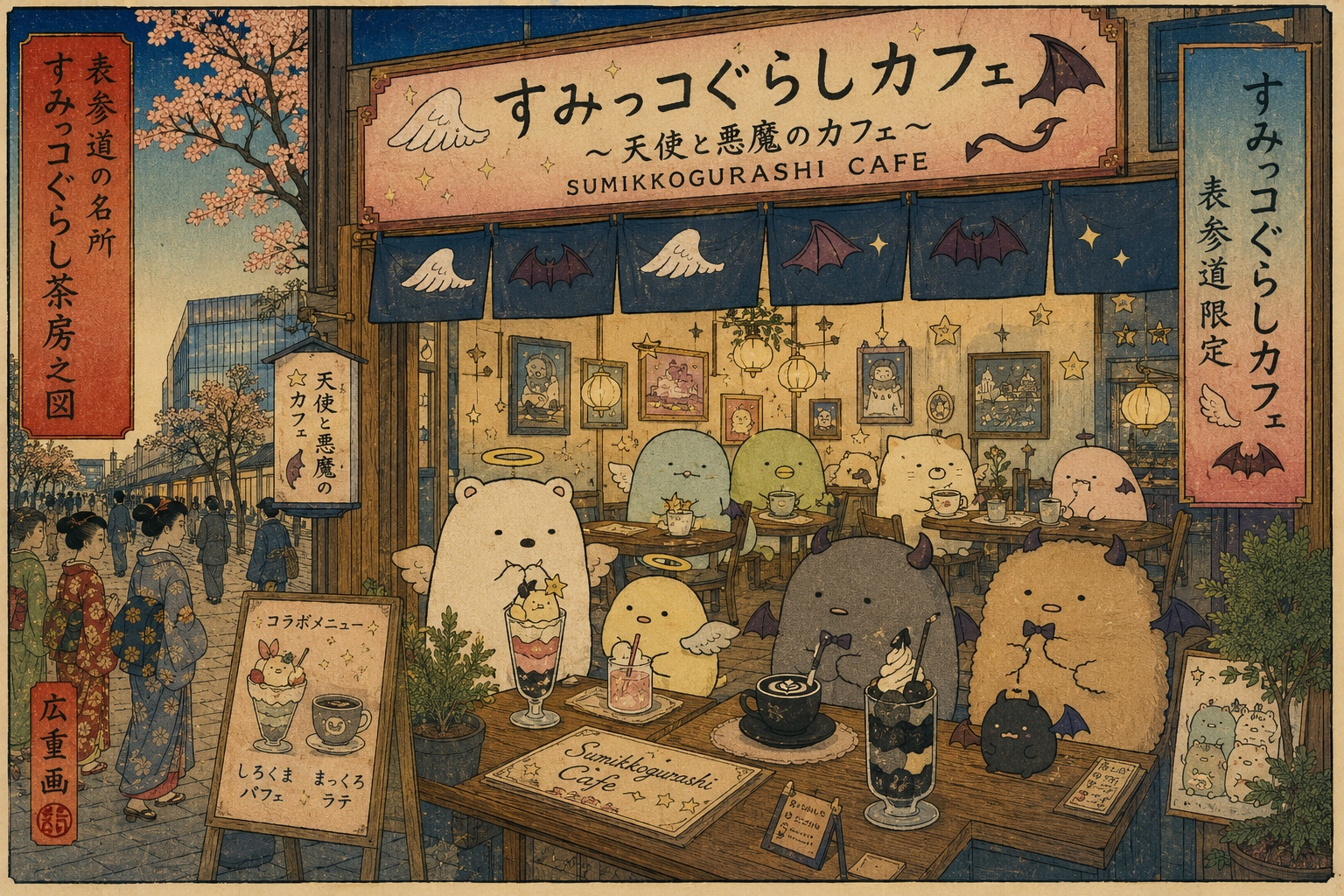
The “Sumikko Gurashi Tenshi to Akuma na Shippos Café” opened at TOWER RECORDS CAFE Omotesando on July 23, 2026, and is scheduled to run through August 23. August 3 falls within the first period, through August 7, when the angel design is used for the period-specific dessert, bottle and reservation benefit. The announced schedule is six 80-minute sessions from 10:30 a.m. to 9:00 p.m. Japan.co.jp reviewed organizer announcements, official character records, company history and research available by 6:00 a.m. Japan time on August 1. This is an analysis of the published program and documented history, not a claim of an independent interior inspection. Menus, benefits, inventory and operating rules may change or end.
The corner moves to the center of Omotesando
One minute from Meiji-jingumae Station, guests assemble on the Jingumae sidewalk ten minutes before their assigned session. Admission, menu ordering and merchandise access proceed in electronic-ticket seat order. From 10:30 in the morning until 9 at night, the room closes and resets every 80 minutes before receiving the next group.
The stars of that room are characters who were never designed to love the center. Shirokuma is shy and feels safest drinking warm tea in a corner. Penguin? is unsure what it is. Tonkatsu is the fatty end piece left uneaten. Neko is self-conscious and timid enough to surrender a coveted corner to someone else. Tokage conceals its true identity. Their appeal is not triumph, perfection or relentless confidence. It is the possibility of remaining together while carrying discomfort, uncertainty and the memory of being left behind.
That creates the café’s central paradox. Characters made popular by staying at the edge now occupy the center of a reservation-driven, photographable and collectible experience in one of Tokyo’s most visible fashion districts. Does putting Sumikko onstage break the emotional world that made them matter? Or can the stage become a new kind of corner—a place where they do not have to become different characters merely because everyone is looking?
What “angel” and “devil” mean on the August 3 menu
The program combines dishes served throughout the run with desserts and takeaway bottles that change between the first and second periods. On August 3, the first-period items apply: Shirokuma and Ajifurai no Shippo’s pale cake plate, the angel bottle drink and the angel reservation sticker. Penguin? and Tokage’s devil-themed Japanese-sweets plate and the devil bottle are scheduled to begin with the second period on August 8.
| Category | Announced item and tax-included price | Narrative design |
|---|---|---|
| Food, full run | Neko and Ebitten no Shippo’s angel cream-sauce gnocchi — ¥1,990 | White cream, a beet accent and character monaka build the softer angel side. |
| Food, full run | Tonkatsu and Ebifurai no Shippo’s devil black curry — ¥1,990 | Black curry, pork fillet cutlet and fried shrimp return the usually discarded ends to the center of the plate. |
| Special sweet, full run | Angel-and-devil Shippos doughnut plate — ¥1,990 | Soy and chocolate doughnuts, tea and vanilla ice creams, monaka and edible film place both identities on one plate. |
| First-period sweet | Shirokuma and Ajifurai no Shippo’s angel cake plate — ¥1,790 | Rare cheesecake, mille crêpe, berries and heart marshmallow in white and soft red; planned through August 7. |
| Second-period sweet | Penguin? and Tokage’s devil Japanese-sweets plate — ¥1,790 | Matcha roll cake, azuki, yomogi dumpling, gyūhi and salt ice cream; planned from August 8. |
| Drinks, full run | Five drinks — ¥990 each | Strawberry milk for Shirokuma, green-apple lemonade for Penguin?, printed latte for Tonkatsu, mixed-fruit juice for Neko and blue soda for Tokage. |
| Takeaway | Original bottle drink — ¥980 | Angel strawberry-and-cultured-milk drink in the first period; devil grape version in the second. Available without dine-in use. |
Every dine-in guest must order at least one food item or sweet and one drink. Adding the lowest first-period prices produces a minimum published menu order of ¥2,780. That figure excludes the advance reservation ticket and fees, additional dishes and merchandise. The meal is therefore both food and a ritual that completes participation after entry.
Food becomes a translation device
A character-café dish is only half understood when judged by flavor alone. Its second task is to translate line, color, personality and relationship from a two-dimensional world into an edible object. White cream signifies angel; black curry signifies devil. Faces and costumes become monaka wafers or edible film. Strawberry, ramune blue, matcha green and beet red become a narrative vocabulary.
The black curry for Tonkatsu and Ebifurai no Shippo is especially telling. In the official biographies, both exist because they were left uneaten. On this plate, pork and fried shrimp are not marginal scraps; they return as the visual and culinary center. The composition does not solve real-world exclusion, and it should not be burdened with that claim. It does, however, show the characteristic Sumikko method: rejection is not erased, but rearranged into another form of value.
The doughnut plate refuses to force a choice between angel and devil. It serves both. In the official August 2026 story, Shippos are considering new idol costumes. The cute angel and cool devil designs proposed by their friends are both appealing, so they decide to try both. The conclusion is not a search for one final, authentic self. It is permission to enjoy two apparently contradictory performances on the same stage.
A world built around “This is where I feel at ease”
Sumikko Gurashi debuted in 2012 around the phrase “This is where I feel at ease.” Its insight is grounded in ordinary physical behavior. Corner seats on trains fill first. In cafés and restaurants, many people prefer a wall or edge where movements are easier to anticipate and fewer eyes seem to arrive from behind. Moving one step away from the center can create a small zone of control.
Yet Sumikko Gurashi cannot be reduced to “characters for introverts.” Its cast includes a polar bear that fled the cold, a creature uncertain of its own species, a fatty cutlet end, a cat embarrassed by its body and a dinosaur hiding as a lizard. Their problems are not cured, and no transformation gives them permanent confidence. The stories offer something less conditional: they may sit together before becoming better versions of themselves.
The corner is therefore not merely a place of isolation. It becomes a shared space where weakness does not require an explanation. The more these characters gather at the edge, the less alone they are. That emotional arrangement, not rounded geometry by itself, is the foundation of the franchise’s longevity.
Five Sumikko and the Shippos: profiles of incompleteness
| Character | Core official premise | Role inside the café |
|---|---|---|
| Shirokuma | A cold-sensitive, shy bear that fled from the north and is happiest drinking warm tea in a corner. | Strawberry milk and the first-period white cake plate carry comfort and softness. |
| Penguin? | Unsure whether it is a penguin; it vaguely remembers once having a dish on its head. | Green-apple lemonade and the second-period devil sweet turn uncertainty into play. |
| Tonkatsu | The end of a pork cutlet: 1% meat and 99% fat, left behind because it was too greasy. | Black curry and printed latte place the “leftover” directly in view. |
| Neko | Shy, worried about body shape and likely to give away a corner rather than insist on keeping it. | Angel gnocchi and mixed-fruit juice create a central presence without aggressive self-display. |
| Tokage | Actually a surviving dinosaur pretending to be a lizard to avoid capture. | Blue soda and the second-period devil sweet carry secrecy and transformation. |
| Shippos | Ebifurai no Shippo, Ajifurai no Shippo and Ebitten no Shippo—linked by being left behind, friendship and an idol dream. | The story center that connects the angel and devil costumes in the 2026 theme. |
Tonkatsu is a food “edge” but has been a narrative center from the beginning. Ebifurai no Shippo, also discarded for being hard, understands Tonkatsu without much explanation. Ajifurai no Shippo interprets survival positively. Ebitten no Shippo was left in a tendon bowl but dreams of becoming an idol. A similar event is transformed into hurt, companionship, optimism and ambition.
From Ebitten no Shippo to an idol unit
The 2026 angel-and-devil design did not emerge as an isolated decoration. Its narrative line begins with the 2024 “Angel Ebitten Idol” theme. Tonkatsu brought home a new companion resembling Ebifurai no Shippo. Left behind in a tendon bowl, Ebitten no Shippo trained to become a food idol, and the Sumikko made an angel costume as a gift.
That year Ebitten made its first greeting-character appearance at a Tokyo Dome event, while themed cafés opened at Tokyo Solamachi, Shibuya and Osaka. Menus borrowed the signs of idol culture—fans, penlights, stages and cheering. A new character’s introduction became a “debut” across plush toys, music, dance, food, photographs and live encounters rather than a single product release.
In 2025, Ebifurai no Shippo, Ajifurai no Shippo and Ebitten no Shippo came forward as Shippos. A “Dreaming Shippos Café” in Yokohama expanded the story of the trio pursuing a stage together. The 2026 costumes sit on that continuum. Angel recalls the original aspiration; devil reveals another performance; choosing both expands rather than abandons the idol identity.
From paper goods to emotional worlds
San-X traces its business to a paper-products shop founded in Kanda in 1932. It adopted the present company name in 1973, debuted its first character in 1979, embraced the “100% original company” principle in 1980 and expanded character licensing in earnest in 2004. It moved from placing designs on stationery to transplanting character worlds across products, partners and media.
Sumikko Gurashi arrived in 2012 within that accumulated system. A fifth-anniversary exhibition followed in 2017. In 2019 it received the Japan Character Award and reached theaters for the first time, followed by films in 2021, 2023 and 2025. The producer says the first three movies, released through 2023, drew more than three million admissions in total. A first television animation based on the picture book Sky-Colored Days appeared in 2023, and one-minute “This Is Where I Feel at Ease” shorts began inside a morning television program in 2025.
Exposure alone is not the significant part. San-X describes its characters as carrying distinctive personalities and layered stories that invite identification and empathy. A café is one of the clearest media for that approach. It translates a personality once held on paper or screen into seats, waiting, food, lighting, conversation, photographs and objects taken home.
Kawaii is not completed by shape alone
Research in kansei engineering has described the causes of kawaii feelings toward artificial objects as including not only morphology but behavior, facial expression and the relationship between viewer and object. In another controlled study, participants looking at kawaii animal toys spent more time smiling, talking and looking at other people than a comparison group. These are small studies under specific conditions, not direct proof of what this café does. They nevertheless suggest that kawaii can affect social behavior, rather than remaining a private visual judgment.
Sumikko Gurashi’s attachment cannot be explained only by round forms and muted colors. Fans want to offer Shirokuma warm tea, return a corner to Neko, avoid abandoning Tonkatsu and encourage Ebitten’s dream. Even when a printed face on a dish is imperfect, the viewer can complete it through remembered personality. The relationship makes the food more than a test of visual resemblance.
Anthropological work on Japanese themed cafés has examined how relationships with fictional characters can extend into physical reality. A maid café and this licensed character café are not the same institution. The useful comparison is narrower: a designed venue can shorten the perceived distance between a fictional world and the person who already cares about it. Here, visitors do not merely look at Sumikko. They order, wait, eat and take photographs inside a temporary version of the world.
An 80-minute refuge requires precise control
Behind the presentation of comfort sits a strict turnover system. The Omotesando venue lists 36 seats, and the event offers six sessions a day. If every published seat were used in every slot, the theoretical ceiling would be 216 seat visits per day. That is arithmetic based on published capacity and sessions—not a disclosure of tickets sold or actual attendance.
Guests line up in seat-number order for admission, ordering and merchandise. Arriving late does not extend the ending time. After 30 minutes, a reservation becomes invalid. Bills are settled by table, merchandise can be purchased once, and trading, searching packages and buying for resale are prohibited. To create a temporary emotional “corner,” time and movement are centrally managed.
This is less a contradiction than a condition of the limited-experience business. Letting guests remain for hours, as in an ordinary neighborhood kissaten, would exclude many fans. Moving them too quickly would erase time for food, photography, conversation and shopping. Eighty minutes is an engineered compromise between comfort and throughput.
Cards, stickers and acrylic: taking experience home
Advance-reservation guests receive a smartphone-size sticker—angel in the first period and devil in the second. Menu orders bring one of eight random trading cards per period. The doughnut plate has its own postcard, as does the takeaway bottle. Merchandise includes 12 named acrylic keychains across angel and devil designs, two random six-design sets of connecting acrylic mascots, two tote bags and a custom tumbler.
These objects are portable evidence. Food disappears. The decorations will be removed. Eighty minutes ends. A card or keychain transfers the visit to a desk, bag or phone. Customers purchase an object, but they also use the object to extend the life of an experience.
Random distribution also creates desire to trade and purchase again. The organizer’s limits—one merchandise opportunity, quantity caps, no in-store trading, no package searching and no resale purchasing—recognize how quickly scarcity can heat a market built around gentleness. Exclusivity can strengthen memory, but it can also intensify fear of missing out. That tension between the reassurance of the characters and the anxiety of limited distribution deserves careful management.
Why Omotesando is the stage
TOWER RECORDS CAFE Omotesando opened in January 2015. It stands one minute from Meiji-jingumae Station, three minutes from Harajuku Station and eight minutes from Omotesando Station. A company known for music retail uses the site to turn works and artists from things people hear or buy into experiences they eat, photograph and carry home.
The border between Harajuku and Omotesando is symbolically useful for character culture. Fashion, youth culture, global luxury brands, the forest of Meiji Shrine and everyday tourism overlap there. Sumikko Gurashi does not answer that bright urban field by hiding a silent corner outside it. It inserts pale colors, short stories and a refusal to ridicule weakness into the spectacle itself.
The theme is also angel and devil. White or black, cute or cool, good or bad might normally demand a choice. The characters do not stage a battle. They try both costumes. In a district built around visible self-expression, the inability—or refusal—to choose one fixed presentation becomes its own contemporary fashion statement.
What visitors should verify before going
| Item | Published information | Practical caution |
|---|---|---|
| Run | July 23–August 23; first period through August 7, second from August 8. | Some menus and benefit designs change between periods. |
| Hours | 10:30 a.m.–9:00 p.m., six 80-minute sessions. Takeaway-only access 12:30–8:00 p.m. | Meet ten minutes before the slot. Late arrival does not extend the visit. |
| Location | Imon Harajuku Building 2F, 6-3-9 Jingumae, Shibuya, Tokyo. | The queue forms on the sidewalk; summer heat precautions are specifically requested. |
| Reservation | First-come electronic tickets through Ticket Pia; same-day tickets only when seats remain. | Same-day admission has no seat charge but does not include the reservation benefit or meal coupon. |
| Ordering | At least one food or sweet plus one drink per person. | No individual checks; dine-in menu items cannot be taken away. |
| Allergens | A table covers Japan’s 28 specified allergen categories. | No ingredient removal; shared equipment and storage may create contact risks. |
| Merchandise | For dine-in guests only, with quantity caps and one purchase opportunity. | Items may sell out or return, and the method of sale may change. |
Success should not be measured only by sellouts
A limited café can appear successful when reservations fill and merchandise disappears. A stricter Sumikko-appropriate test asks more. Can a newcomer understand the relationships rather than see only decorated food? Can children and adults, dedicated collectors and accompanying friends share the same room comfortably? Can food safety, outdoor heat, staff workload and resale controls be managed without contradicting the gentle world being sold?
It also matters whether angel and devil feel like a chapter in Shippos’ growth rather than a pair of product variations. If Ebitten’s 2024 dream, the trio’s 2025 formation and the two 2026 costumes form one continuing story, fans have a reason to care beyond obtaining the latest object. The characters can change without abandoning the emotional core.
After 80 minutes, guests return to the bright Omotesando street. Tables are cleared and the next numbers are called. What Sumikko may send with them is a small rebuttal to the belief that entering the center requires discarding weakness.
A corner is not only a place for withdrawing from the world. It can be a place to recover, sit beside others and prepare for a stage. When angel and devil are both appealing, both may be tried. A discarded tail can still have a dream. In 36 Omotesando seats, Sumikko Gurashi turns that quiet idea into food, time and small objects that can travel home.
Sources and verification
Japan.co.jp reviewed organizer announcements, official San-X materials, company history, animation-production records and research in kansei engineering and cultural anthropology available by 6:00 a.m. Japan time on August 1, 2026. Café operations, menus, benefits and inventory may change. Academic work is used as background for understanding kawaii and themed spaces, not as direct proof of psychological effects at this particular event. The displayed exchange rate is the supplied value of ¥157.57 per U.S. dollar at 9:00 p.m. UTC on July 31, equivalent to 6:00 a.m. JST on August 1.
- TOWER RECORDS: dates, sessions, menu, prices, merchandise, reservations, same-day admission and rules
- San-X: café overview, decoration and reservation or menu-order benefits
- San-X: official August 2026 Angel-and-Devil Shippos story
- Official Sumikko Gurashi profiles: Shirokuma, Penguin?, Tonkatsu, Neko, Tokage and the tails
- San-X: company chronology from 1932 through Sumikko Gurashi and the films
- San-X: original-character, licensing, story and identification strategy
- TOWER RECORDS CAFE Omotesando: 36 seats, January 2015 opening, address and access
- San-X: 2024 Angel Ebitten Idol theme and Ebitten no Shippo debut
- LTR: 2024 Angel Ebitten Idol café at Tokyo Solamachi
- San-X: 2025 Dreaming Shippos café and trio development
- Fanworks: more than three million cumulative admissions through the third film and fourth-film announcement
- Fanworks: the 2023 first television animation, Sky-Colored Days
- San-X: 2025 television shorts, This Is Where I Feel at Ease
- Japan Society of Kansei Engineering: objects and causes of kawaii emotions
- Japan Society of Kansei Engineering: observable behavior associated with kawaii emotion
- Asian Anthropology: themed cafés and the extension of fictional-character relations into physical reality
