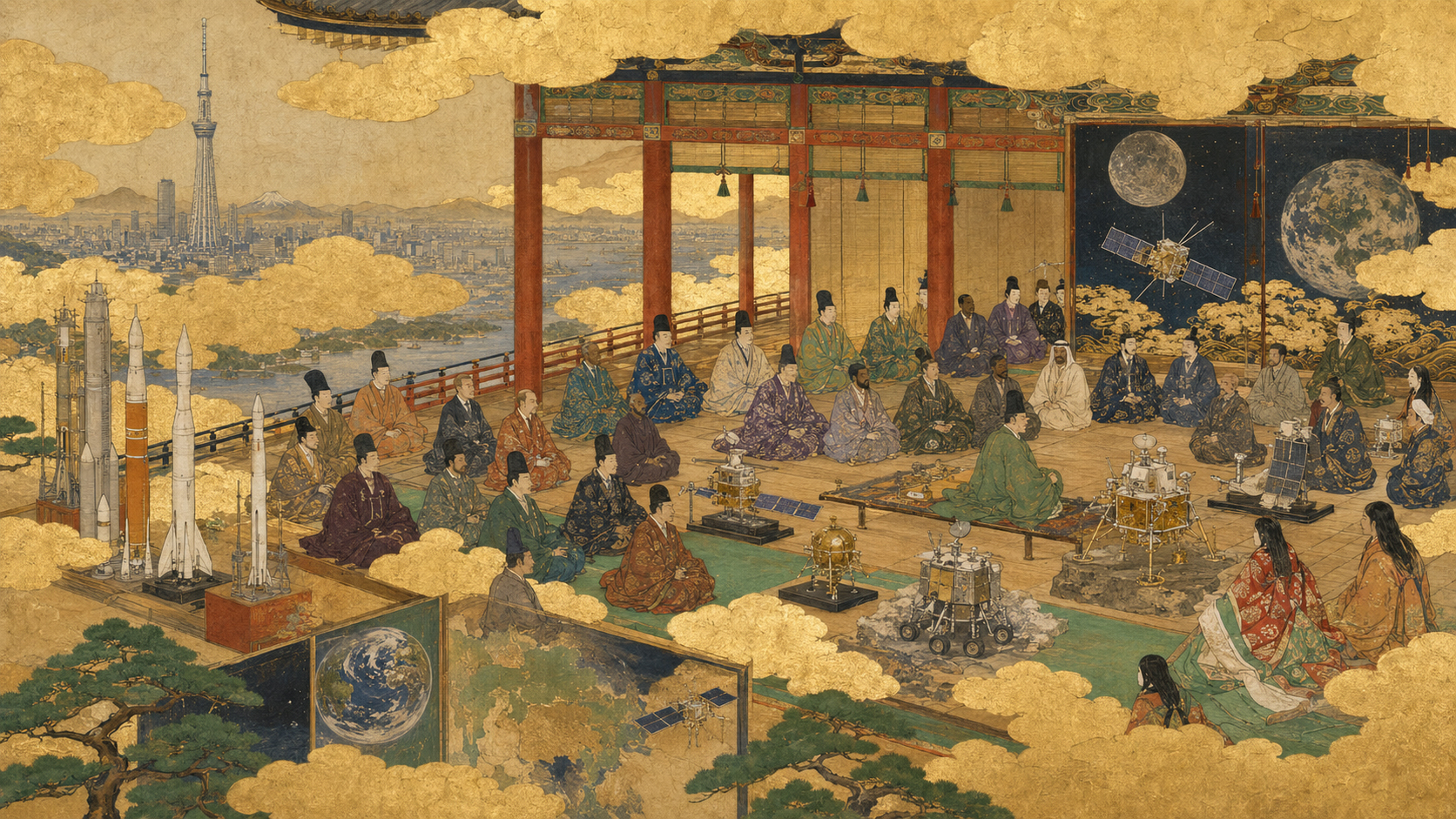
Four days when the space economy came to Toranomon
From July 6–9, SPACETIDE 2026 filled Toranomon Hills with agencies, aerospace primes, startups, banks, universities, insurers, data companies and delegations from across the Indo-Pacific and beyond. USGIF described the gathering as more than 2,000 participants, more than 200 executive-level speakers and representatives from over 35 countries.
SPACETIDE’s program spread across four days and more than 70 sessions, with business meetings and side events in a second venue. The agenda moved deliberately beyond rockets: mobility, real estate, consumer markets, lunar logistics, dual-use systems, finance, low-Earth-orbit stations, manufacturing, regional clusters and artificial intelligence.
A crowded conference does not make Tokyo Asia’s uncontested space capital. It does show convening power—the ability to place government budgets, technical expertise, corporate customers and foreign partners within walking distance.
From a 2015 forum to an industry institution
SPACETIDE was founded in 2015, when Japan’s commercial-space sector was smaller and “NewSpace” still sounded like a challenge to an establishment dominated by government missions and major contractors. The foundation positioned itself as a neutral platform connecting industry, government and academia.
The 2026 meeting was its 11th edition. That continuity matters. Ecosystems are built through repeated encounters: an engineer meets an investor one year, forms a pilot the next, and returns later with a customer or acquisition.
SPACETIDE’s theme, “Unlocking Space for All Humanity,” is expansive. Its real institutional achievement is more concrete: making a recurring commercial calendar around which Japanese and foreign organizations plan announcements, delegations and meetings.
Why Tokyo, and why Toranomon?
Toranomon sits close to the Cabinet Office, ministries, corporate headquarters, embassies, financiers and professional-services firms. Japan’s aerospace factories and launch sites are elsewhere, but many decisions about budgets, regulation, alliances and investment pass through central Tokyo.
The venue’s density lets a foreign startup meet JAXA, a trading house, a bank and a potential customer without crossing the country. SPACETIDE explicitly marketed this “Tokyo prime location” as part of the conference design.
That advantage also reveals a weakness: Japan’s space economy can be Tokyo-centric. Hokkaido, Kyushu, Wakayama, Tohoku and other regions host spaceports, manufacturers and universities. A true national industry must send capital and contracts outward, not merely bring regional displays into a Tokyo hall.
The Space Strategy Fund changes the room
Japan’s Space Strategy Fund is a multi-year public initiative intended to support ambitious technology across transportation, satellites and exploration. Its scale changes conversations because startups and universities can pursue projects too large for ordinary research grants or venture rounds.
JAXA hosted one-on-one business matching around the conference for selected fund participants. This moves policy from stage speeches into partner searches: a propulsion company needs a test provider; a satellite firm needs customers; a university technology needs a prime contractor.
Public money can crowd in private capital by reducing technical risk. It can also produce grant-dependent companies if milestones reward development rather than customers. SPACETIDE’s finance sessions confronted the central question: how does subsidized technology become a durable business?
Japan’s startup generation on one stage
Speakers included ispace founder Takeshi Hakamada, Astroscale founder Nobu Okada and Synspective CEO Motoyuki Arai—companies representing lunar transportation, orbital servicing and radar Earth observation. International executives from Blue Origin, Rocket Lab and commercial-station developer Vast widened the comparison.
Japan’s first NewSpace generation has now launched hardware, listed shares, won government contracts and suffered visible failures. That maturity changes conference discussion. The issue is no longer whether startups belong in national space programs, but how they scale, survive capital cycles and sell globally.
A healthy ecosystem also needs a second and third generation. Sessions on talent and next-generation technology matter because a conference dominated forever by the same founders would signal stagnation.
Cross-industry is the real growth engine
Space companies alone cannot create a large space economy. Satellite data become valuable when agriculture, insurance, logistics, construction, telecommunications, energy and government operations change their decisions because of it.
SPACETIDE devoted a day to cross-industry collaboration and linked space to Japan’s strategic industrial sectors. NTT, IHI and other established companies joined startups and agencies. This is where Japan may have an advantage: deep corporations with manufacturing, networks and customer relationships.
Large companies can provide patient customers and supply chains; they can also suffocate startups through slow procurement and endless demonstrations. The useful metric is not memoranda signed but products purchased and deployed.
Spatial Edge brings intelligence into the open
On July 8, the United States Geospatial Intelligence Foundation hosted Spatial Edge: Japan inside SPACETIDE. Its theme—“GEOINT Without Borders”—brought together U.S., Japanese and Indo-Pacific officials and companies to discuss AI, interoperability, data sharing, national security and civil applications.
GEOINT turns location-linked information into understanding. Satellite images are one input among maps, signals, weather, vessel tracks and economic data. AI can search volumes no human team can inspect, but models need trusted data, validation and analysts who understand context.
The track’s presence shows a structural change in commercial space. Earth-observation companies increasingly sell into defense and intelligence markets, while tools developed for security serve disaster response, climate monitoring and maritime safety.
Dual use: opportunity and discomfort
Japan’s postwar space policy emphasized peaceful use, but security and civil applications are difficult to separate. A radar satellite can map floodwater or track ships. A communications constellation can connect disaster teams or military units. A servicing spacecraft can repair or approach another satellite.
SPACETIDE placed dual use at the centre rather than hiding it. This can improve honesty and attract government demand, but it raises export-control, ethics, secrecy and alliance questions.
Commercial firms need clear rules: which customers they serve, how imagery is shared, how AI decisions are audited and how they protect technology. “Dual use” is not a business model by itself; it is a governance obligation.
The APAC gravity thesis
The conference argued that commercial-space gravity is shifting toward Asia-Pacific. The region combines large economies, vulnerable coastlines, rapid urbanization, strategic competition and governments building new agencies and constellations.
Japan offers launch capability, advanced manufacturing, JAXA science and growing startups. India offers scale, low-cost engineering and ISRO heritage. South Korea has electronics and defense industry. Singapore has finance and regional business networks. Australia offers geography, ground stations and security partnerships. China has enormous state-backed capacity but operates in a different political and commercial sphere.
No single city monopolizes these strengths. Tokyo’s opportunity is to become the connective capital: where Japanese depth meets regional demand and global partners.
Tokyo versus the other Asian hubs
| Hub | Distinct strength | Constraint |
|---|---|---|
| Tokyo | Full-spectrum industry, JAXA, large corporations, public funding | Slow procurement, language and risk-capital gaps. |
| Singapore | Finance, regulation, ASEAN access, international talent | Small domestic market and no conventional launch range. |
| Seoul/Daejeon | Electronics, defense, manufacturing and state ambition | Smaller international convening network. |
| Bengaluru | ISRO ecosystem, engineering talent, cost competitiveness | Infrastructure and procurement friction. |
| Sydney/Canberra | Ground geography, allied security, resources | Limited manufacturing scale and dispersed ecosystem. |
Capitals specialize. Singapore can finance a Japanese satellite using Indian software and Australian ground stations. The winner may be the city best at connecting hubs rather than defeating them.
The lunar economy moved from fiction to procurement
Sessions on the cislunar economy took place as ispace announced a $50 million reservation for 500 kilograms aboard a future Starship lunar landing. The timing turned abstract talk about lunar logistics into a contract-sized example.
Lunar business remains dependent on government science, Artemis procurement and unproven transportation. Yet companies are beginning to define layers: landers, shared cargo, surface mobility, communications, navigation, power and resource prospecting.
Conferences help these layers find one another. They can also inflate expectations. A panel titled “lunar economy” is not evidence of lunar revenue. Follow signed payloads, funded missions and delivered services.
LEO after the International Space Station
With the ISS approaching retirement, commercial stations are competing to host astronauts, research and manufacturing. Japan must decide how to preserve Kibo expertise, astronaut access and microgravity users after the current station.
Vast Japan CEO and former astronaut Naoko Yamazaki joined a program that examined low-Earth-orbit markets. Japanese pharmaceutical, materials and robotics companies could become customers; JAXA can serve as anchor and certifier.
The transition carries a classic market problem. Private stations need demand before they launch, while users want proof of reliable stations before committing. Long-term procurement signals matter more than inspirational speeches.
Finance: the missing propulsion system
Rockets and satellites require large upfront capital, long development and binary technical risk. Japanese banks and corporations are comfortable with established industrial projects but venture-scale space returns can be uncertain.
Public funds, corporate venture capital, export credit, project finance and equity each fit different stages. Hardware development cannot be financed like an app, while recurring satellite data can resemble software once a constellation operates.
Tokyo’s financial depth is an advantage only if capital learns the industry. Investors must distinguish launch backlog from revenue, technical milestones from product-market fit and government awards from sustainable margins.
Deals behind the stages
The week produced government and institutional agreements, including Japan–Singapore agency cooperation and renewed Japan–Philippines commercial dialogue. Company, university and industry-group partnerships were announced around the event.
These deals validate SPACETIDE as a coordination point, but announcements vary in weight. A memorandum may create a useful channel without revenue. A funded demonstration is stronger. A recurring customer contract is stronger still.
A serious post-conference report should track agreements a year later. Which produced engineers, hardware, data and sales? Convening becomes capital only when follow-through occurs.
The workforce behind the 200 speakers
Space growth requires systems engineers, welders, optical technicians, software developers, analysts, lawyers, salespeople and operators. Japan faces an aging population and competition for AI and semiconductor talent.
SPACETIDE included education, career and next-generation programming, while Spatial Edge discussed an AI-transformed GEOINT workforce. Human-machine teaming changes jobs rather than eliminating the need for judgment.
Internationalization is essential. Bilingual sessions and overseas delegations help, but companies must hire foreign talent, simplify workplace communication and create careers that move between government, university and industry.
What Tokyo must prove next
To deserve the title “Asia’s space-business capital,” Tokyo must convert density into outcomes: more export customers, faster contracts, successful launches, follow-on investment and globally competitive companies. It must make room for regional partners as co-creators, not merely buyers.
Japan also needs regulatory speed, procurement that tolerates startup risk and enough launch cadence to test what its funds develop. Tokyo’s conference leadership cannot compensate indefinitely for bottlenecks at factories, ranges and customer agencies.
SPACETIDE 2026 showed that the world will come to Tokyo for the conversation. The next edition will reveal whether the conversation produced traffic. A capital earns its status not through one crowded week, but because deals, talent and ideas keep returning after the exhibition booths are gone.
Sources and further reading
- SPACETIDE 2026 program — history, sessions, speakers and conference concepts.
- SPACETIDE 2026 official site — event and participant information.
- USGIF Spatial Edge: Japan — 2,000+, 200+, 35-country figures and GEOINT agenda.
- JAXA Space Strategy Fund overview — national investment context.
- Space Strategy Fund business matching — conference-linked deal facilitation.