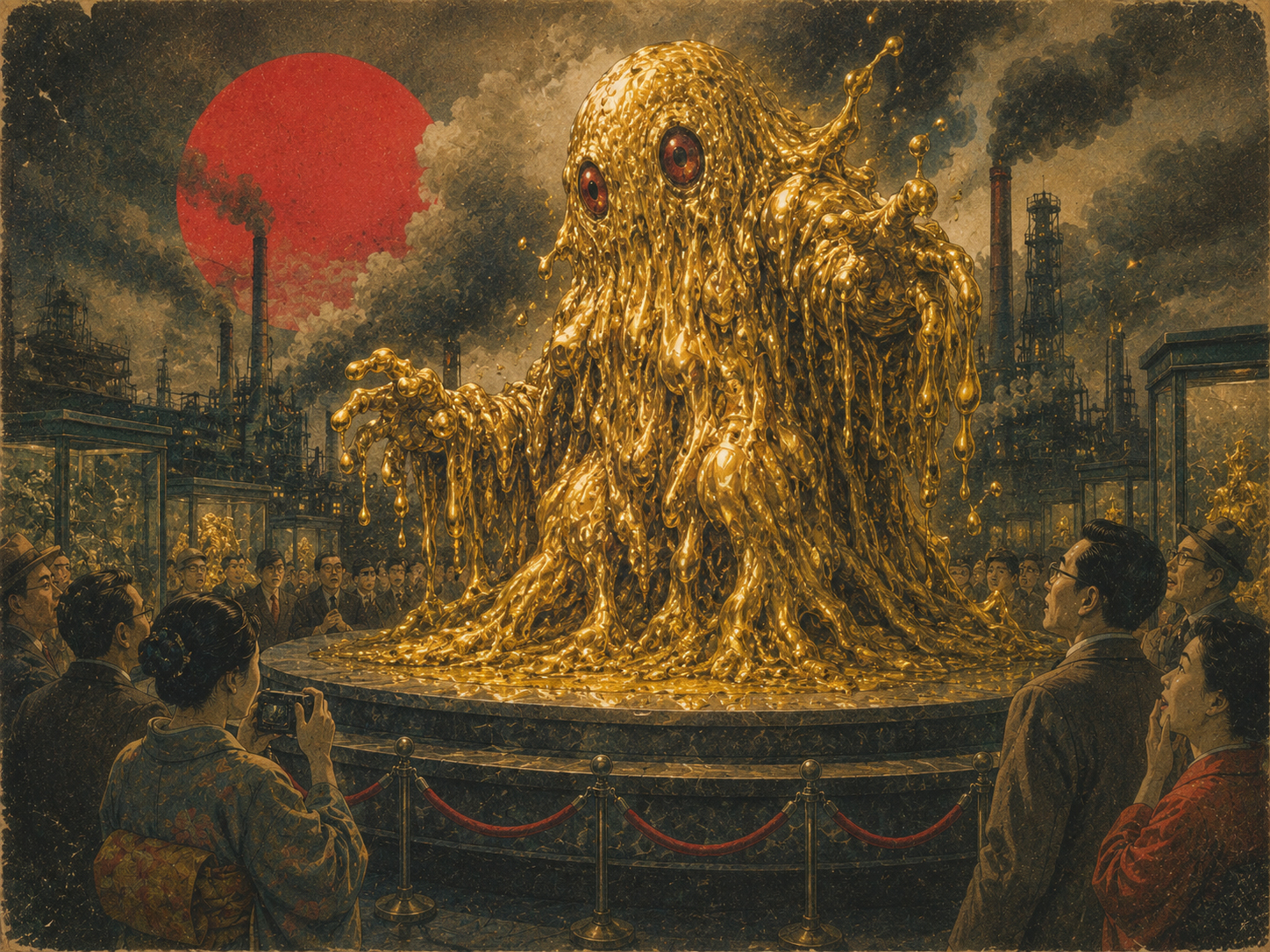
Toxic sludge enters the jewelry case
Hedorah corrodes whatever it touches, spreads poisonous gas when it flies and grows by consuming oil, wastewater and smokestack emissions. Its face is asymmetrical, its eyes vertical and its skin hangs like melting refuse.
In summer 2026 that monster became a precious-metal miniature from U-TREASURE. Reservations for the Hedorah (1971) Gold Model run from July 2 through August 3. It costs ¥93,500 including tax and is limited to 100 pieces worldwide.
The figure is approximately one centimeter tall. The material is K18 yellow gold—not pure K24. The maker says the fine relief recreates Hedorah’s dripping, sludge-like texture.
Solid gold does not mean pure gold
Headlines may call it a pure-gold monster, but the specification is K18. In Japan, K24—99.9 percent purity or higher—is generally called pure gold. K18 contains 18 parts gold out of 24, or 75 percent, with other metals added.
Pure gold is soft. Tiny projections and sculptural details can deform. K18 is harder and better suited to jewelry and miniature figures while retaining the color and value associated with gold.
“Solid gold” can mean that the object is a gold alloy rather than plated, but it should not be confused with “pure gold.”
In 1971, pollution became a monster
Godzilla vs. Hedorah opened in Japan on July 24, 1971. Yoshimitsu Banno directed, with special effects by Teruyoshi Nakano. It was the 11th Godzilla film.
In the story, an alien microorganism feeds on Earth’s pollution and changes through aquatic, land, flying and giant final forms. The name Hedorah comes from hedoro, meaning sludge.
If the 1954 Godzilla embodied nuclear weapons and radiation, Hedorah embodied factories, wastewater and consumer society. Humanity does not merely awaken the monster; it feeds it every day.
High growth changed Japan’s air and water
From the late 1950s through the early 1970s, Japan rapidly expanded petrochemicals, heavy industry, automobiles and electricity generation. Income rose, but industrial districts suffered sulfur oxides, soot, heavy metals and toxic discharge.
Minamata disease, Itai-itai disease, Yokkaichi asthma and Niigata Minamata disease became known as the four major pollution diseases. Oil slicks, dead fish, detergent foam and foul rivers became familiar images.
Banno’s idea was shaped by black smoke over industrial cities and foam floating on polluted water. The film’s nightmare imagery grew from landscapes that already looked like special effects.
Hedorah is an expanding pollution system
Hedorah does not keep one form. It grows from aquatic organisms into a crawling land form, a disc-like flying form and a towering biped.
The transformations visualize pollution moving among water, soil and air, concentrating and spreading across systems.
Pieces torn from the body can grow again. As long as humans continue supplying pollution, the enemy returns.
| Form | Environment | Symbolic meaning |
|---|---|---|
| Aquatic | Sea and wastewater | Oil slicks, industrial discharge and water pollution |
| Growing land form | Coast and city edge | Expansion and bioaccumulation |
| Flying form | Atmosphere | Smog, acidic mist and regional exposure |
| Final form | City and industrial zone | Pollution becoming an uncontrollable social system |
| K18 miniature | Jewelry shop and display case | Environmental warning transformed into luxury scarcity |
A children’s film in which people dissolve
The movie uses animation, pop graphics, songs and psychedelic editing associated with children’s entertainment. It also shows people reduced to skeletons by acid and cities covered in poisonous gas.
Young people hold a music gathering near Mount Fuji as the world appears to approach its end. The environmental message is direct; the form is unstable and dreamlike.
That mixture drew criticism in 1971 and later built cult admiration. The film is loved not because it is polished, but because anxiety and experimentation erupt from every sequence.
Godzilla becomes an environmental defender
The 1954 Godzilla destroyed human society as a nuclear monster. By the 1970s, the franchise increasingly presented Godzilla as a protector.
Here, Godzilla fights a pollution creature created and nourished by humans. Humanity requires one monster to rescue it from another produced by its own economy.
In the film’s most notorious scene, Godzilla uses atomic breath as propulsion and flies. It remains one of the franchise’s strangest images.
Why are Hedorah’s eyes vertical?
Hedorah’s huge red eyes evoke oil-film colors, minerals, insects and unsettling organic shapes. No single interpretation fully defines them.
The asymmetry and hanging skin reject the noble dinosaur or dragon silhouette of other kaiju. Hedorah appears unable to maintain bodily form.
Miniaturizing that unstable surface into one centimeter of metal is technically difficult. Too much polish erases the sludge; roughness creates the complex reflections that make the gold version recognizable.
Sofubi culture rescued Hedorah
Hedorah was not the franchise’s dominant star at release. Soft-vinyl collecting later transformed its weakness into advantage.
Pink, fluorescent, clear, marbled, glow-in-the-dark, metallic gold and silver versions turned the gray pollution monster into a pop-art surface.
Small makers, Wonder Festival and designer-toy culture elevated Hedorah. Its ugliness created unusual freedom for sculptors and painters.
Why gold suits the sludge monster
Gold normally signals kingship, victory or divinity. Applied to Hedorah, it reverses waste into value.
Gold resists corrosion and retains shine. Hedorah represents acid, rot and decomposition. Their physical properties oppose each other.
There is also environmental irony. Precious-metal mining and refining involve land disturbance, chemicals and energy. A pollution monster made from luxury metal cannot escape the industrial systems it criticized.
Is ¥93,500 the value of the metal?
Japanese retail gold prices exceeded ¥20,000 per gram in July 2026. The figure’s weight, however, has not been publicly specified, so its bullion value cannot be calculated reliably.
The price includes K18 material, sculpting, casting, finishing, inspection, Toho licensing, packaging, distribution and scarcity.
This is not an investment bar. Resale value may rise or fall with popularity, condition, box, certificate, reissues and collector sentiment.
- Is it K24 pure gold or an alloy such as K18?
- Is weight disclosed, allowing separation of bullion and product value?
- Does it include serial number, certificate and original packaging?
- Avoid assuming collectibility guarantees investment return.
- Protect the sculpture from scratches, bending and aggressive polishing.
- Authentication matters in the secondary market.
Why a limit of 100 intensifies desire
A numbered limit creates urgency. An always-available object permits delay; a 100-piece edition forces decision.
The warning that reservations close when stock is reached invites buyers to imagine future scarcity.
Collectors acquire not only objects but acquisition stories: ordering on release day, receiving a preferred number and securing one before sellout.
The contradiction of merchandising an anti-pollution film
Godzilla vs. Hedorah warned against mass production, consumption and waste. Hedorah now appears on toys, shirts, jewelry and premium figures.
This is not automatically hypocrisy. Merchandise preserves film memory, funds licensing and introduces new viewers to the environmental allegory.
But when the warning becomes only a scarce-object contest, Hedorah stops accusing society and becomes decoration.
The shadow of Expo ’70
Banno worked on Mitsubishi’s pavilion for Osaka Expo ’70 before directing Hedorah. The exposition celebrated technology, growth and optimistic futures.
The following year’s film showed the smoke and discharge produced by that same industrial society. Bright futurism and black sludge were two faces of high growth.
The 55th-anniversary product arriving after Expo 2025 is accidentally symbolic. Every celebration of the future eventually raises the question of who receives its waste.
Did pollution control defeat Hedorah?
Around 1970, Japan strengthened pollution law, created the Environment Agency and imposed tighter emissions controls. Air and water quality improved dramatically in many areas.
Yokkaichi sulfur pollution fell, and rivers and bays recovered. But contamination changed form rather than disappearing. Microplastics, PFAS, electronic waste and climate change are contemporary Hedorahs.
The 1971 film remains relevant because its monster is not one chemical. It is a system in which benefits and harm are distributed unequally.
Can Hedorah support environmental education?
Hedorah is a strong teaching image. A child may remember a monster that feeds on smoke more easily than a list of pollutants.
Responsible exhibitions and lessons should connect the film to actual victims, communities, legal changes and corporate responsibility.
The pleasure of the kaiju must not trivialize real illness. Pollution was not merely an abstract crime by “humanity”; it involved specific companies, policies and patients.
What one centimeter of gold carries
The K18 Hedorah is tiny enough for a fingertip. The film’s toxic clouds and dissolving bodies are invisible.
Yet miniaturization concentrates meaning: waste, gold, pollution, 1971, Godzilla, collector desire and luxury all occupy one object.
It can be beautiful, tasteless, hilarious and perfectly ironic at the same time.
Hedorah’s defining ability is to consume everything and make it part of itself. The movie monster ate sludge and smoke. The 2026 version absorbs environmental memory, kaiju affection, gold prices and limited-edition marketing, emerging as a one-centimeter golden contradiction.
Sources and further reading
- U-TREASURE, July 2026: reservation period, price, K18 material, 100-piece limit and approximate size.
- U-TREASURE product page: Hedorah (1971) Gold Model miniature.
- Toho: official Godzilla franchise information.
- National Film Archive of Japan: retrospective context for Godzilla vs. Hedorah, Yoshimitsu Banno and Haruo Nakajima.
- Japan Ministry of the Environment, Environmental White Papers: industrial pollution and regulatory history.
- Yokkaichi City, pollution history: air pollution and health damage.
- Tanaka Precious Metals, gold purity: K24 and K18 distinctions.
- Mitsubishi Materials, gold prices: July 2026 Japanese retail gold-price context.