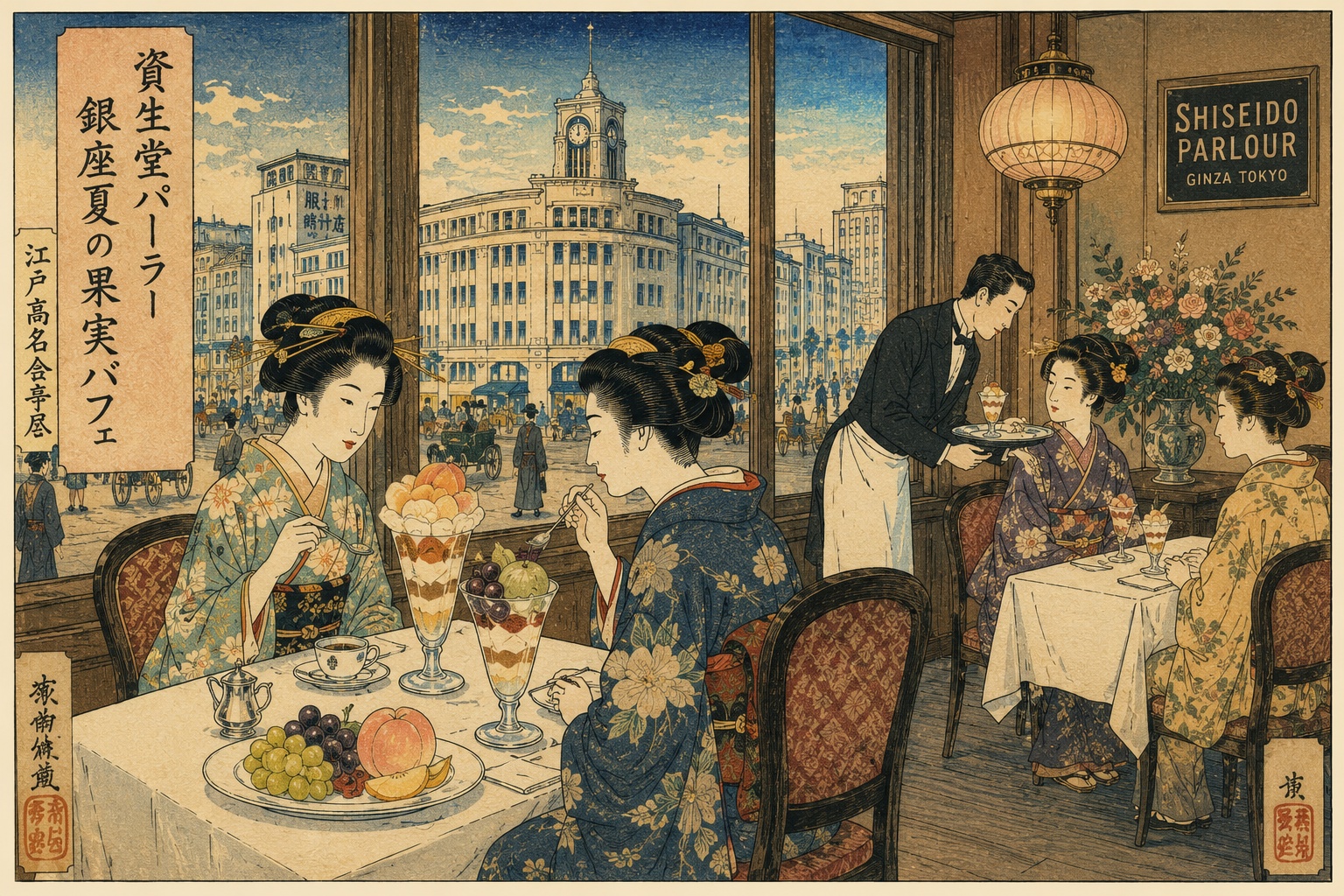
Shiseido Parlour announced that the second phase of its 2026 Midsummer Parfait Fair would run at the Ginza Main Store Salon de Café from August 1 through August 30. The four principal parfaits feature three Japanese grapes, Furano melon from Hokkaido, figs from Wakayama and peaches from Okayama. A ¥3,500 plated white-peach parfait marks the Tokyo Ginza Shiseido Building’s 25th anniversary, and a domestic Shine Muscat ice-cream soda is offered during the same period. The ¥6,000 Ruby Roman Royal Parfait is planned for late August and will be limited in quantity. Supply can change the contents and period. This article uses official announcements and historical sources available by 6:00 a.m. Japan time on August 1, 2026; it does not invent the unnamed grape varieties, the origin of the white peach, sales results or customer reactions.
A map of summer rises on Ginza’s third floor
A long spoon moves toward the bottom of the glass. It may begin with peach, then pass through sorbet, sauce, ice cream and jelly. Seen from above, it is one dessert. Excavated vertically, it reveals Okayama, Wakayama, Hokkaido, Ishikawa and several grape-growing regions that the menu does not name, each arriving at a different temperature and texture.
The August menu at the Salon de Café, on the third floor of the Tokyo Ginza Shiseido Building at Ginza 8-chome, is more than a set of seasonal fruit parfaits. Three domestic grapes, Furano melon, Wakayama figs and Okayama peaches are joined by a white-peach dessert released from the glass onto a plate, a Shine Muscat soda and, later in the month, the planned arrival of Ruby Roman. Japanese orchard agriculture has been reduced to a scale that can be eaten from one Ginza seat.
Behind the color are irregular harvests, narrow windows of ripeness, bruising in transit, grading loss, refrigeration, preparation and human judgment. A parfait does not come into being simply because fruit is piled high. It is architecture that reorganizes a farmer’s season into a few minutes of order.
Reading the August menu precisely
| Menu | Price and period | Composition and verification |
|---|---|---|
| Parfait of Three Japanese Grapes | ¥3,000 Aug. 1–30 | Uses three recommended domestic grapes. The announcement does not name the varieties or origins, so the presence of Shine Muscat or any specific cultivar should not be assumed. |
| Furano Melon Parfait | ¥3,000 Aug. 1–30 | Made with melon from Furano, Hokkaido, described as grown in a basin with large temperature differences and ripened after harvest. |
| Wakayama Fig Parfait | ¥3,000 Aug. 1–30 | Fresh fig is translated into sorbet, sauce and red-wine compote, allowing several temperatures and states of the same fruit to be compared. |
| Okayama Peach Special Parfait | ¥4,000 Aug. 1–30 | Uses Okayama peaches from a cultivation tradition extending into the Meiji era. The individual cultivar is not disclosed. |
| Ruby Roman Royal Parfait | ¥6,000 Planned from late Aug.; limited | Ruby Roman appears as fruit, jelly, sauce and sorbet. The starting date remains dependent on supply. |
| Ricotta and Fig Gâteau | ¥2,800 Aug. 1–30 | Fresh and sautéed fig, ricotta gâteau and banana sorbet scented with truffle; served with a beverage. |
| Plated White-Peach Parfait | ¥3,500 Aug. 1–30 | A 25th-anniversary dessert with peach almond jelly, sauce, house-made peach sorbet, vanilla ice cream and milk ice cream. The peach origin is not announced. |
| Domestic Shine Muscat Ice-Cream Soda | ¥1,300 Aug. 1–30 | Shine Muscat soda topped with the traditional vanilla ice cream, connecting a modern Japanese grape to the shop’s 1902 origins. |
All prices include tax. The salon does not accept reservations and is normally closed on Mondays, opening when a Monday is a national holiday. Because August 3, the date of this edition, is a Monday, it is not a normal operating day. Readers planning a visit should verify the calendar, supply, sellouts and the actual Ruby Roman start date.
Those details are not peripheral to a luxury dessert. A restaurant that promises the same seasonal fruit at all times will eventually privilege logistics over fruit. Stating that availability can change is not weakness. It is a form of honesty that refuses to treat an orchard product like an identical factory component.
A parfait edits fruit vertically
The Japanese parfait is related to the frozen French dessert whose name suggests perfection, but it has grown into its own towering vessel. It does more than place fruit on top. It sequences cold and less-cold, firm and yielding, acid and dairy fat, transparent and opaque, first bite and last bite inside one narrow container.
The fig parfait makes that editing visible. Fresh fig is fragile, softly aromatic and full of fine seed texture. As sorbet, its temperature and aromatic release change. Sauce connects layers. Red-wine compote reorganizes moisture and gives sweetness and acidity more depth. Processing does not merely disguise the fruit; it gives the same fruit several voices.
The plated white-peach parfait reverses the grammar. A glass partly determines the eating order. Opened onto a plate, peach, almond jelly, sorbet and two ice creams can be recombined by the diner. The meaning of a 25th-anniversary dessert is therefore not the preservation of one historical shape. It is the presentation of inherited components in a new syntax.
In 1902, a soda fountain appeared inside a pharmacy
Shiseido Parlour began not as a restaurant but in a corner of a pharmacy. Founder Arinobu Fukuhara visited the Paris Exposition in 1900 and returned through the United States. Inspired by soda fountains inside American drugstores, he began manufacturing and selling soda water and ice cream at the Shiseido pharmacy in Ginza in 1902.
His pursuit of authenticity was unusually complete. Shiseido’s official history says he imported not only the machinery but syrups, glasses, spoons and even straws from the United States. Soda water and ice cream were rare in Japan. The novelty was not only flavor, but a system of equipment, service and behavior—a new way to occupy the city.
Early customers included geisha from nearby Shinbashi. They paused for soda water between shamisen lessons and engagements, and the shop is said to have provided a place to leave their instruments. An imported Western drink entered the everyday rhythm of Tokyo’s traditional entertainment district. Modernity was not a straight line erasing the old. Ginza’s particular hybrid appeared when soda bubbles and shamisen cases shared one room.
In 1928 the beverage operation developed into the Shiseido Ice Cream Parlour and deepened its engagement with Western cooking and confectionery. The 2026 Shine Muscat ice-cream soda reconnects the two original elements—soda and ice cream—to a twenty-first-century grape bred in Japan.
The White Palace, the earthquake and reopening two months later
The food culture cannot be separated from the buildings that held it. In 1921 the Izumo-cho shop was remade with a white exterior intended as a “White Palace.” Shiseido’s history recalls how the white façade stood against the red-brick pavement still remaining in Ginza 7- and 8-chome, especially after rain. Food, cosmetics, architecture and printed matter were already being treated as one urban impression.
The Great Kanto Earthquake destroyed the Ginza premises in September 1923. Two months later, a single-story temporary store opened on the same ground. Its white walls and purple window frames created a European atmosphere despite its emergency construction. Beauty was not discarded because conditions were difficult; beauty was considered necessary precisely then.
The present Tokyo Ginza Shiseido Building was completed in 2001 and marks its 25th anniversary in 2026. Its address, Ginza 8-8-3, is also the site identified by Shiseido Parlour as the birthplace of the 1902 soda fountain. The white-peach anniversary dessert is therefore more than a branded commemorative item. It celebrates the continuing urban right to sit down for something sweet through earthquake, war, reconstruction, mass consumption, economic reversal and pandemic.
Fruit became Ginza’s calendar
The Salon de Café changes its fruit program with the month. Strawberries lead winter and spring; cherries and mangoes carry early summer; peaches, grapes, melon and figs announce high summer. This is menu development, but it is also a calendar through which city residents relearn agricultural time.
Refrigeration and global logistics make seasonality less visible. Supermarkets carry many fruits across long periods, and processed products can erase harvest time altogether. The fruit parlour reverses that tendency by selling “what is at its best now.” Waiting, ending and selling out become part of value.
There is also a risk. A salon can reduce farming to scenery—beautiful place names without farm labor, off-grade fruit, weather damage, bargaining power or waste. If only the statement “Japanese fruit is expensive and beautiful” survives, the regional story has been flattened. A Ginza glass becomes a meaningful entrance to a producing area only when it explains why fruit has the shape, fragility and price it does.
Okayama peach: whiteness is also the color of labor
One August centerpiece is peach from Okayama. The prefecture says its commercial peach story reaches back to 1875. Early growers struggled with disease and insects, then developed and spread bagging techniques that made stable production possible.
Covering each fruit suppresses red coloration from direct sunlight and helps produce the smooth pale appearance associated with Okayama white peach. Bags can also reduce rubbing and pest damage, but the method requires extensive labor: fruit by fruit, at the correct stage, across an orchard. The peach’s whiteness is not only climate. It is the result of people managing light.
That pale surface, melting flesh and fragrance became bound to gift culture. Sending a fragile fruit with a short eating window asks the giver to imagine the recipient’s time, not merely to spend money. In the Ginza parfait, the recipient and eater become the same person. Glassware and table service replace the gift box, padding and wrapping that protect the fruit in transit.
Accuracy still matters. The August announcement says “Okayama peach” without naming a cultivar such as Shimizu Hakuto. The separate ¥3,500 white-peach dessert does not disclose its origin. Treating the two peach dishes as the same cultivar or source would turn seasonal reporting into wishful labeling.
Grapes: when agriculture became intellectual property
The three-grape parfait leaves its varieties unnamed, while the soda explicitly uses Shine Muscat. Registered in 2006, Shine Muscat emerged from Japanese breeding that crossed European and American grape lineages, seeking muscat aroma, firm texture and the ability to perform in Japan’s humid growing conditions.
It now looks like an inevitable symbol of premium fruit, but it represents years of crossing, selection and field trials. “Natural deliciousness” is often the result of human choices repeated across generations. The soda translates that breeding achievement into carbonation and vanilla ice cream, joining Japan’s modern agricultural research to an American-style fountain introduced in 1902.
Late August is expected to bring Ruby Roman, an Ishikawa original developed over 14 years. The prefecture records that breeders planted 400 seeds from Fujiminori grapes in 1995 and narrowed the population through repeated selection. Ruby Roman is known for bright red color, berries described as about twice the size of Kyoho and strict shipment standards.
The ¥6,000 Royal Parfait uses the grape not only as fresh fruit but in jelly, sauce and sorbet. That is technical commitment and conspicuous abundance. It also raises questions: does enough value return to growers, can processing reduce loss, and can off-grade but flavorful fruit be used in sauces rather than discarded? The word “royal” should describe responsibility toward the crop as well as price.
Wakayama fig: turning fragility into cuisine
The Japanese word for fig is written with characters suggesting “fruit without flowers,” yet the flowers are not absent. They are arranged inside the enclosed structure commonly treated as the fruit. What appears as fine seeds when cut is connected to a hidden flowering architecture. In a transparent Ginza glass, an inward-blooming fruit is made visible.
Wakayama describes its warm, sunny northern districts as favorable for fig cultivation. Production spread from the late 1960s as a conversion crop on former rice land, and the prefecture first reached No. 1 in national harvest volume in the 2017 crop year after the relevant survey began. The fruit is soft, vulnerable to rain and impact, and historically difficult to distribute fresh; improvements in cultivation and transport expanded the market.
Using fig fresh, as sorbet, sauce and red-wine compote is not merely decorative technique. It creates several exits for a perishable crop: perfect ripe fruit served intact, pieces that can surrender shape but retain aroma, and cooked fruit that gains stability and depth. Luxury pastry can support agriculture not only by selecting the prettiest specimen, but by increasing the useful life of the whole harvest.
Furano melon: harvest day is not eating day
The Furano melon description contains an important phrase: the fruit is harvested and then allowed to ripen to completion. “Freshly picked” is not automatically the aromatic and yielding peak for every melon. Temperature and time after harvest must be managed until fragrance, flesh and sweetness align.
The basin surrounded by mountains and its pronounced day-night temperature differences form part of Furano’s agricultural narrative. Yet climate in the field cannot complete a parfait by itself. The receiving kitchen must judge when to cut each fruit and coordinate melons of different firmness with the service calendar. Ripeness management at the restaurant matters as much as the story of the farm.
This is knowledge that a cold-chain economy can obscure. Fruit does not mature according to a reservation ledger. Staff must read aroma, stem, rind and resilience. Ginza service is genuinely luxurious not because the fruit is expensive, but because invisible decisions synchronize the fruit’s time with the guest’s arrival.
A ¥3,000 parfait and a ¥6,000 parfait
The prices place these desserts beyond an ordinary snack: ¥3,000 to ¥4,000 for the main four and ¥6,000 for Ruby Roman. At the displayed rate of ¥157.57 to the U.S. dollar, that is roughly $19 to $38, but exchange conversion does not explain the domestic burden. Japanese diners measure the purchase against lunch, books, household goods and wages.
The price includes fruit procurement, sorting, loss, refrigeration, multiple preparations, ice cream, tableware, Ginza occupancy, labor and service. Peach and fig are especially vulnerable, and a forecasting error quickly becomes waste. The diner pays not only for grams of fruit, but for the system that prevents failure.
High price does not automatically make a culture superior. If Japanese fruit becomes overly dependent on gift specifications and flawless appearance, everyday fruit can recede from households while growers remain trapped in a high-cost system. A salon that wants to carry fruit culture forward should think beyond Royal Parfait rarity: off-grade use, clear producer explanation, fair returns and affordable entrances matter too.
The ¥1,300 ice-cream soda may be one such entrance. Rather than merely looking up at the most expensive grape, a first-time guest can meet a modern Japanese cultivar in a form close to Shiseido Parlour’s origin. Culture is not preserved only at the highest price. It continues through steps that allow someone to choose a next glass.
Why does a cosmetics company’s parlour look so composed?
Shiseido has shaped “lifestyle culture” through pharmacy, cosmetics, food, advertising, architecture, photography, print and galleries. The visual authority of a Shiseido Parlour plate does not come from cuisine alone. It belongs to a lineage that placed trademarks, an internal design function, packaging, interiors, uniforms and menu typography near the center of business.
Beauty should not mean forcing fruit into perfect uniformity. Peaches differ subtly, grape clusters are uneven and ripe figs collapse. Agricultural products are not as identical as cosmetic containers. The beauty a 2026 parfait should demonstrate is not a flawless promotional photograph that erases variation, but the skill to read variation and edit it into its best form.
Shiseido Parlour’s language often connects eating with beauty. That connection should not be reduced to a promise that dessert improves appearance. The salon’s beauty lies less in nutritional marketing than in taking time, recognizing a season, seeing the vessel and sharing a table.
Ginza in 2026: elegance upstairs, shaved ice in the street
On August 1, the fair’s opening day, the Yukata de Ginbura 2026 festival filled Chuo-dori. Shiseido Parlour sent a food truck to the Ginza specialty stalls and offered its first shaved ice alongside its popular curry. A ¥4,000 peach parfait upstairs and festival ice on the street are not contradictory; together they reveal Ginza’s durable range.
Ginza is a showroom of luxury and also a public space where pedestrian zones, festivals, geisha, office workers and visitors mix. When a long-established shop steps outside during a street event, the brand returns from the building to the neighborhood.
Shiseido Parlour’s history cannot be explained as closed elite culture alone. The 1902 soda fountain was a practical pause for Shinbashi geisha. For fruit culture to remain alive in 2026, Ginza needs both the ceremonial salon and the accidental street encounter.
What to know before visiting
- Address: 3F, Tokyo Ginza Shiseido Building, 8-8-3 Ginza, Chuo-ku, Tokyo.
- Period: The principal August menu runs August 1–30. Ruby Roman is planned for late August and limited.
- Closed: Mondays, except when Monday is a national holiday. August 3 is a Monday.
- Hours: Tuesday–Saturday 11:00 a.m.–9:00 p.m. (last order 8:30); Sunday and holidays 11:00 a.m.–8:00 p.m. (last order 7:30).
- Reservations: The Salon de Café does not accept reservations, so queues are possible.
- Supply: Fruit availability can change menu contents and periods. Confirm on the day when seeking a specific cultivar.
- Allergies: The compositions include dairy, almond-jelly elements and wine preparations. Confirm detailed ingredients with the store.
Putting 124 years into one glass
In 1902, soda water in a Ginza pharmacy tasted like the future. Bubbles, ice, glass, straws and ice cream were new enough to become literature and conversation. That modernity eventually became ordinary urban life. In 2026, the surprise may point in the opposite direction: not toward a distant future, but toward the realization that Japanese regions still produce such different aromas, colors and textures within one season.
Okayama’s fruit bags, Wakayama’s fragile figs, Furano’s post-harvest ripening, NARO’s Shine Muscat and Ishikawa’s 14-year breeding program are layers of time. The height of a parfait should be measured not by cream, but by the years beneath it.
The Ginza glass will empty. Peach fragrance and sorbet cold will disappear. But when place names and the reasons for seasonality remain in memory, dessert becomes more than consumption. As the soda fountain once announced a new Japanese lifestyle, the 2026 fruit parfait asks how city and countryside can protect each other’s time. The last spoon retrieves that question from the bottom of the glass.
Sources and verification
Japan.co.jp reviewed official material from Shiseido Parlour, Shiseido, prefectural governments, an agricultural research organization and Ginza sources available by 6:00 a.m. Japan time on August 1, 2026. Menu prices, periods and declared origins follow the July 22 announcement. The article does not supply unnamed cultivars, the origin of the white peach, sales totals or post-launch reactions. Fruit condition and business information can change.
- Shiseido Parlour: Ginza Salon de Café 2026 Midsummer Parfait Fair, second phase
- Shiseido Parlour official history: from the 1902 soda fountain
- Shiseido official history: founding, soda water, ice cream and design culture
- Shiseido Parlour: company philosophy and more than 120 years of food culture
- Shiseido Parlour: the ice-cream soda as tradition and innovation
- Shiseido Parlour: Tokyo Ginza Shiseido Building 25th-anniversary program
- Shiseido Parlour: first shaved ice at Yukata de Ginbura 2026
- Okayama Prefecture: Meiji-era peach cultivation and fruit bagging
- NARO: Shine Muscat breeding, registration and genome research
- Ishikawa Prefecture: the 14-year development history of Ruby Roman
- Wakayama Prefecture: fig production, distribution and agricultural context
- GINZA OFFICIAL: pedestrian zones and the history of Yukata de Ginbura
